- Agentic AI in Financial Services
- 2025-11-06
Agentic AI in Financial Services: The Rise of Autonomous Advisors, Risk Engines & Fraud Busters
Audio Track
Table of Contents
Key Takeaways:
- Agentic AI can be defined as artificial intelligence systems acting independently for achieving objectives without the need of continuous human intervention.
- Key application areas of Agentic AI in Banking includes independent financial advising, risk underwriting and assessment, fraud detection & prevention, regulatory & compliance reporting and customer service and experience.
- The benefit of this technology includes streamlining operations, driving innovation and improving customer interaction.
- Financial institutions step up the pace of adoption must address a range of ethical, regulatory, and technical challenges. Starting from transparency to overdependence, handling the risks inherent in agentic AI applications in finance is crucial to responsible and sustainable innovation.
- As the technology evolves, its uses will extend beyond support tools and become independently governing financial entities that are capable of managing wealth, enhance customer engagement, and power end-to-end digital processes.
Overview
In the fast-transforming landscape of financial technology, financial institutions are now facing a revolutionary shift from general automation to genuinely autonomous operations. At the base of this is the Agentic AI- one of the artificial intelligence systems which can act independently for achieving objectives without requiring constant human intervention.
By leveraging the power of Agentic AI in finance, banks and financial organizations will be able to automate end-to-end tasks, get goal-oriented reasoning offer hyper personalized intelligence and unlock value from varied data. This helps in positioning banks and other financial institutions for realizing new-levels of innovation and efficiency, under-pinned by data-focused making of decisions.
What is Agentic AI?
Agentic AI in banking can be defined as an artificial intelligence system that helps in accomplishing a particular goal with minimum supervision. It includes AI agents- ML models that helps in duplicating human decision-making for solving problems in real-life.
The technology is continuously evolving and has amazing adaptability, learning from market fluctuation, feedback for refining predictions and enhancing decision-making overtime. These systems are also capable of collaborating with other AI agents, financial data bases and APIs and more for executing complex workflows. It is goal oriented as it works towards various objectives like improving efficiency and customer experiences.
Key Areas of Application in Financial Services
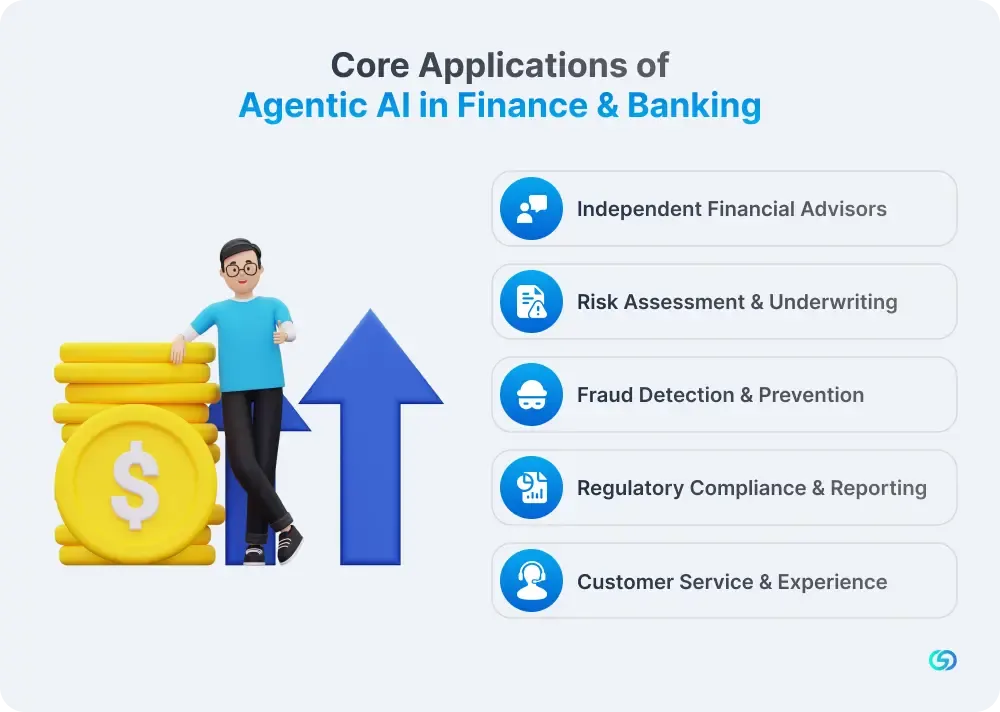
Agentic AI is transforming financial services with intelligent, autonomous AI systems that can execute sophisticated tasks with little or no human intervention. In contrast to legacy AI, which needs pre-defined inputs and actions, agentic AI works through self-directed reasoning, goal-setting, and adaptive behavior—opening compelling use cases across multiple financial areas.
▶ Independent Financial Advisors
Perhaps the most revolutionary use of agentic finance AI is the development of autonomous financial planners. These are sophisticated machines that can take control of investment accounts, automatically rebalancing investments in real time and making decisions based on market conditions and personal risk tolerance.
By knowing what users want to achieve—retirement, property purchase, or education savings—the agentic AI facilitates individualized financial guidance, matching strategies with life stages and long-term goals. These counselors also process live information from various economic ecosystems (stock markets, economic indicators) in order to provide dynamic decision-making, reacting instantly to volatility or outside shocks without needing human intervention.
This degree of independence moves classic robot-advisors to actual financial partners, providing hyper-personalized wealth management in volume.
▶ Risk Assessment & Underwriting
Risk underwriting and assessment are the pillars of banking and insurance but are also bounded by human intuition and fixed models. Agentic AI changes this by allowing real-time dynamic credit scoring and behavior risk modeling based on huge and changing data points ranging from spending habits and transaction histories to macroeconomic factors.
Through ongoing learning from user action and market indicators, agentic systems construct-rich risk profiles for individuals as well as businesses. These are not merely reactive but predictive profiles, enabling institutions to anticipate defaults or high-risk exposures.
Furthermore, agentic AI drives adaptive underwriting policies that automatically respond to changes in context, such as market recession or client behavior, by modifying terms and conditions. Equipped with reasoning capabilities, these AI agents can provide explainable reasons for underwriting choices—closing the gap between automation and trust.
▶ Fraud Detection & Prevention
Agentic AI brings a new realm of vigilance to fraud prevention and detection. Unlike static rule-based systems that depend on prior patterns, agentic models are always-on intelligent agents that continuously monitor transactional activity across millions of accounts.
They're not only detecting anomalies—they're learning from them. These AI agents have the ability to recognize new patterns of fraud, model attack vectors, and actively update their own defense systems. For example, if a new phishing scam is discovered, the system not only raises the flag but also automatically deploys new protections and notifies affected teams.
Secondly, agentic AI enables preventive measures, including temporarily blocking suspicious transactions, initiating multi-factor authentication, or redirecting activities for manual examination—all without even requiring human consent. This real-time insight is pivotal in reducing financial loss and enhancing customer confidence.
▶ Regulatory Compliance & Reporting
Financial institutions are in the midst of a constantly shifting regulatory environment, where compliance can both be resource and error-heavy. Agentic AI revolutionizes regulatory compliance through self-servant auditors that scan regulatory alterations, cross-check against organizational policy, and flag areas of potential gaps in real-time.
They also automate regulatory reporting, facilitating on-time and precise submissions to multiple jurisdictions. Rather than generating reports after the fact, agentic agents link directly into core systems, providing ongoing monitoring and dynamic alerts when deviations from compliance are detected.
Such an anticipatory approach keeps legal exposure low, enhances the transparency of operations, and promotes institutional credibility—particularly in extremely regulated sectors such as banking, insurance, and investment management.
▶ Customer Service & Experience
When it comes to key applications of Agentic AI in banking and finance, it is important to know how does Agentic AI enhance customer engagement in banking. Customer experience in banking is increasingly being shaped by agentic AI-powered service agents. These AI interfaces surpass scripted chatbots to deliver 24/7 personalized assistance, getting the intent of customers and providing goal-based responses.
Whether assisting users through a loan process, resetting a card, or providing investment tips, such agents deal with sophisticated questions independently across channels—web, mobile, or voice.
Further, their multilingual abilities and ongoing learning help them effectively serve different populations. Already, some banks are using self-service banking models, in which customers can control their finances without ever interacting with a human—thanks to agentic systems that can make decisions and get things done on the fly.
By providing rapid, intelligent, and consistent service, agentic AI improves customer satisfaction, fuels loyalty, and drops support expenses significantly.
Benefits of Agentic AI in Finance
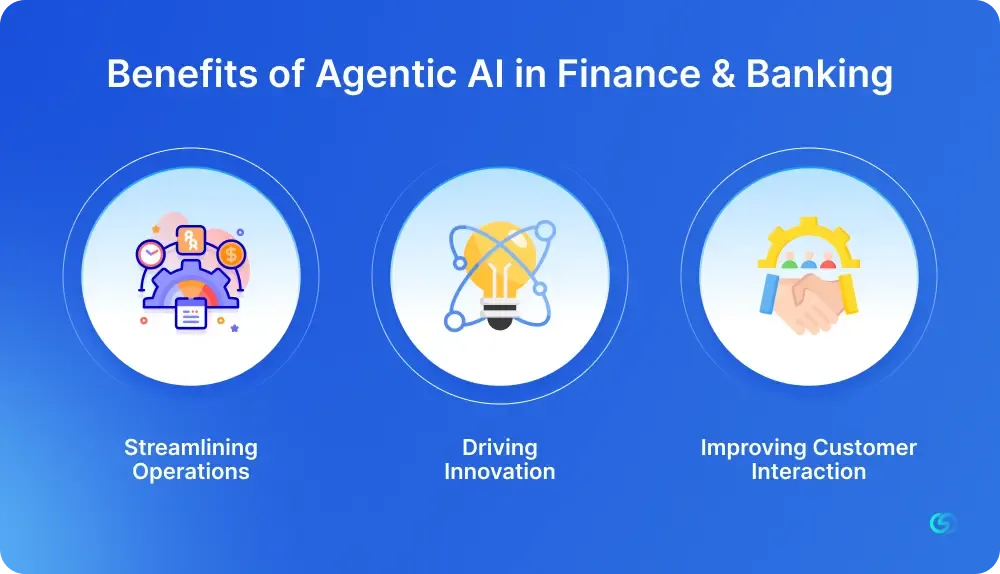
Financial leaders are now discovering that Agentic AI in financial industry provides value beyond the incremental gains in efficiency. Apart from the first-generation AI solutions that only automate the daily tasks, Agentic AI mainly transforms how finance and banking institutions work, making innovative approaches to customer service, regulatory compliance and fraud detection which was traditionally impossible.
Agentic AI in banking and finance transforms how the sector operates in several ways-
⏯ Streamlining operations
It helps in automating repetitive tasks like compliance check, data entry and transaction processing. Agentic AI in finance industry boosts productivity and decrease chances of human errors. This further helps in making the employees free for more strategic word.
⏯ Driving Innovation
It allows the creation of new financial tools, like personalized robot advisors or adaptive asset management systems adjusting strategies in real-time depending on customer preferences and market changes.
⏯ Improving Customer Interaction
Agentic AI in BFSI helps in building trends like embedded finance and open banking for providing customers with extremely personalized AI agents. These agents can handle finances, make streamlined decisions and align strategies with individual goals and risk levels.
What are some real-world applications of agentic ai in finance industry?
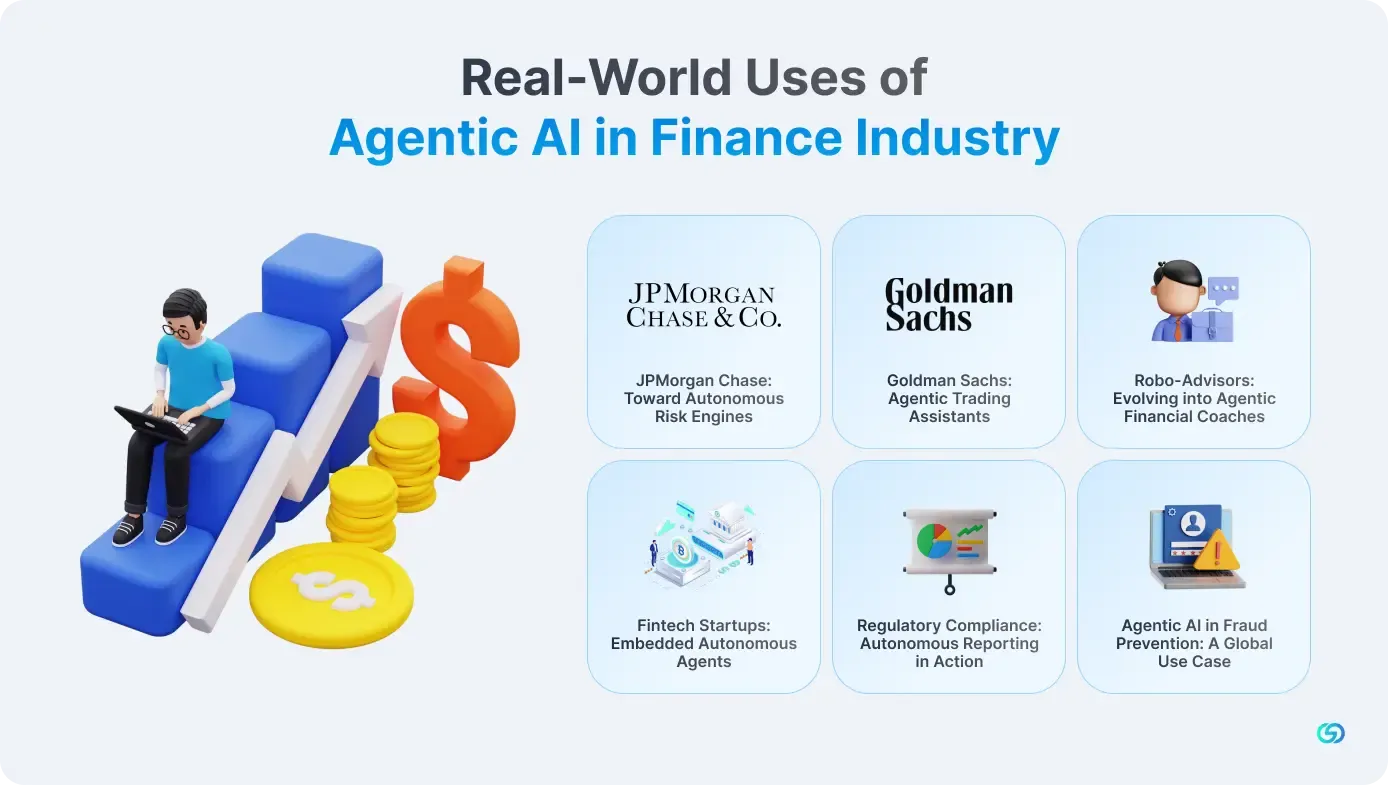
While the concept of Agentic AI may still sound futuristic, leading global banks and fintech innovators are already integrating it into real-world financial workflows. By empowering AI agents with decision-making capabilities, goal-setting autonomy, and adaptive reasoning, these institutions are ushering in a new era of self-directed financial ecosystems. Below are notable Agentic Ai examples in finance and evolving case studies that highlight how agentic AI is being actively deployed in banking and finance.
1️⃣ JPMorgan Chase: Toward Autonomous Risk Engines
JPMorgan has long been a pioneer in the use of AI for fraud detection and trading. In recent years, the firm has taken a bold step toward agentic risk assessment systems. These AI agents autonomously monitor client behaviour, analyse real-time market data, and assess creditworthiness based on evolving transaction trends—not just static credit histories.
By employing behavioural analytics, JPMorgan’s agentic models adjust risk scores and trigger interventions (like flagging risky trades or recommending credit limit changes) without requiring manual escalation. These agents are also capable of re-training themselves based on market volatility or new risk variables, reducing reliance on fixed scoring algorithms and improving response time during financial disruptions.
2️⃣ Goldman Sachs: Agentic Trading Assistants
Goldman Sachs is exploring agentic AI for algorithmic trading and portfolio optimization. The bank is developing self-learning agents that manage multi-asset portfolios, rebalancing investments based on predefined goals such as risk minimization, ESG compliance, or long-term return maximization.
Unlike traditional quant models that rely on historical datasets, these agentic systems ingest live market feeds, geopolitical indicators, and social sentiment signals to reshape their strategies autonomously. For example, during high-volatility periods, the AI adjusts asset allocations in real time, aligning with both market behaviour and client investment objectives—without direct human prompts.
This ability to adapt instantly has proved invaluable in mitigating losses during unexpected events, such as the collapse of a major index or geopolitical shocks.
3️⃣ Robo-Advisors: Evolving into Agentic Financial Coaches
Robo-advisors, once limited to automated investment rebalancing, are now transitioning into fully agentic financial coaches. Platforms like Betterment and Wealthfront are embedding intelligent agents that learn from each user’s financial behaviour, life milestones, and economic context to offer dynamic, personalized advice.
For instance, if a user experiences a sudden income drop, the system doesn't just halt investment contributions—it adjusts financial plans, reallocates funds toward essential expenses, and provides alerts about upcoming risks or opportunities. These systems also autonomously react to macroeconomic shifts like inflation hikes, market crashes, or policy changes by realigning portfolios in real time.
In essence, robo-advisors are becoming proactive partners, not just reactive tools—marking a crucial evolution in wealth management.
4️⃣ Fintech Startups: Embedded Autonomous Agents
Several fintech startups are pushing boundaries with agentic AI embedded into consumer financial platforms. Startups like Tavaga (India), Zeni (USA), and Cleos AI (UK) have rolled out solutions where AI agents independently manage budgeting, savings, or even small business finances.
Zeni, for example, automates accounting and CFO functions for startups. Its AI not only generates financial reports but makes autonomous financial recommendations—like reducing marketing spend based on ROI data or renegotiating vendor contracts. The system continuously optimizes operations by learning from past decisions and real-time inputs, acting much like a virtual finance executive.
Similarly, Cleos AI integrates an agentic financial assistant within a chatbot interface. It actively nudges users toward smarter spending decisions, flags risky transactions, and even negotiates recurring payments—all while learning from user feedback and evolving financial goals.
5️⃣ Regulatory Compliance: Autonomous Reporting in Action
Beyond customer-facing applications, some institutions are deploying agentic AI to streamline back-office operations. A European bank (undisclosed due to NDA agreements) recently piloted autonomous regulatory reporting agents. These AI agents scan updates from multiple regulatory bodies in real time, map them to internal policies, and generate compliance reports automatically.
In the event of a regulatory mismatch—say, exceeding liquidity thresholds—the agent flags the event, communicates with the compliance team, and suggests remedial actions. This autonomy in governance reduces compliance risks and ensures timely adherence to complex, multi-jurisdictional regulations.
6️⃣ Agentic AI in Fraud Prevention: A Global Use Case
A Southeast Asian digital bank implemented a network of agentic fraud prevention bots trained on transaction behavior, regional fraud patterns, and user biometrics. These agents autonomously block suspicious transactions, request verification steps, or even pause account activity—all in real time.
What’s different is their adaptive learning loop: as new fraud tactics emerge (e.g., AI-generated voice scams), the bots learn from each incident and update the detection criteria autonomously. This makes fraud prevention a continuously evolving defence mechanism, capable of outpacing fraudsters in speed and sophistication.
Risk and Challenges of Using Agentic AI in BFSI
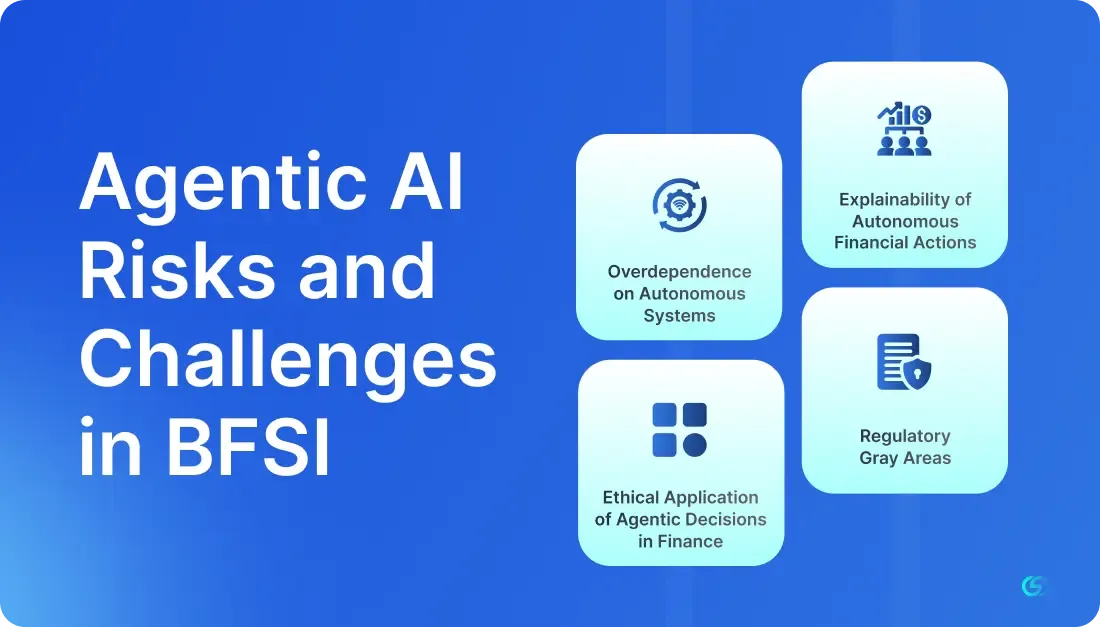
As the growth of agentic AI in finance brings about a new age of smart automation, personalization, and process efficiency, it is not without its pitfalls. As financial institutions step up the pace of adoption, they also must address a variety of ethical, regulatory, and technical challenges. Ranging from transparency to overdependence, managing the risks inherent in agentic AI applications in finance is essential to responsible and sustainable innovation.
➡ Ethical Application of Agentic Decisions in Finance
Perhaps the most contentious issue in the finance sector is the ethical application of agentic AI. Such systems function independently making lending, investment, and customer interaction decisions independently of direct human intervention. Though autonomy improves efficiency, it also increases the threat of bias and not-even-tacit discrimination, particularly if the training material incorporates historical disparities.
As more banking applications of agentic AI come into being—like autonomous approval of credits or risk evaluations—banks and other financial institutions need to ensure fairness, transparency, and inclusivity. A guarantee that agentic AI in banks and the financial sector is aligned with ethics is crucial in establishing trust and preventing reputational or legal harm.
➡ Overdependence on Autonomous Systems
The advantage of agentic AI is its capability to act on its own, but this will prove a weakness if organizations over-depend on autonomous systems. In cases like portfolio management or detection of fraud, complete autonomy will lead to unforeseen actions devoid of human judgment or context.
As more agentic AI applications find their way into finance, the likelihood of systemic failure due to bad decision-making or misinterpretation of data grows. Failure in an agentic system might result in mispriced assets, incorrect loan rejections, or suspended trading activities—having an impact on thousands of clients.
To address this, banks and financial institutions need to have human-in-the-loop management, audit AI activity regularly, and have fallback procedures in place for ensuring continuity and accountability.
➡ Regulatory Gray Areas
Perhaps the most critical challenge facing agentic AI in finance is regulatory ambiguity. Most of the current financial compliance legislation was written with traditional systems in mind and not with autonomous agents that can interpret, learn, and act on tasks without specific rules being defined.
As agentic AI examples in finance grow more complex—such as autonomous compliance monitoring or agent-driven regulatory reporting—the question of accountability becomes critical. Who is responsible if a system violates AML rules or denies credit unfairly: the organization, the AI developer, or the AI itself?
To stay ahead, financial institutions must collaborate with regulators to define new standards and guidelines that govern the development and deployment of agentic systems. Proactively addressing these grey areas will ensure safer adoption and avoid costly litigation or sanctions.
➡ Explainability of Autonomous Financial Actions
One principal obstacle to trust in agentic AI in banking is explainability. Most of these technologies are black boxes—applying sophisticated, dynamic algorithms to make decisions that even their designers might not be entirely familiar with.
This transparency is an issue only when customers or regulators request explanation for actions like declined payments, risk ratings, or investment suggestions. To address that, the industry needs to invest in explainable AI software that provides insight into how agentic systems think, reason, and act.
This not just guarantees improved compliance but also serves the increasing call for accountability in high-risk agentic AI applications in finance.
The Future of Agentic AI in Finance
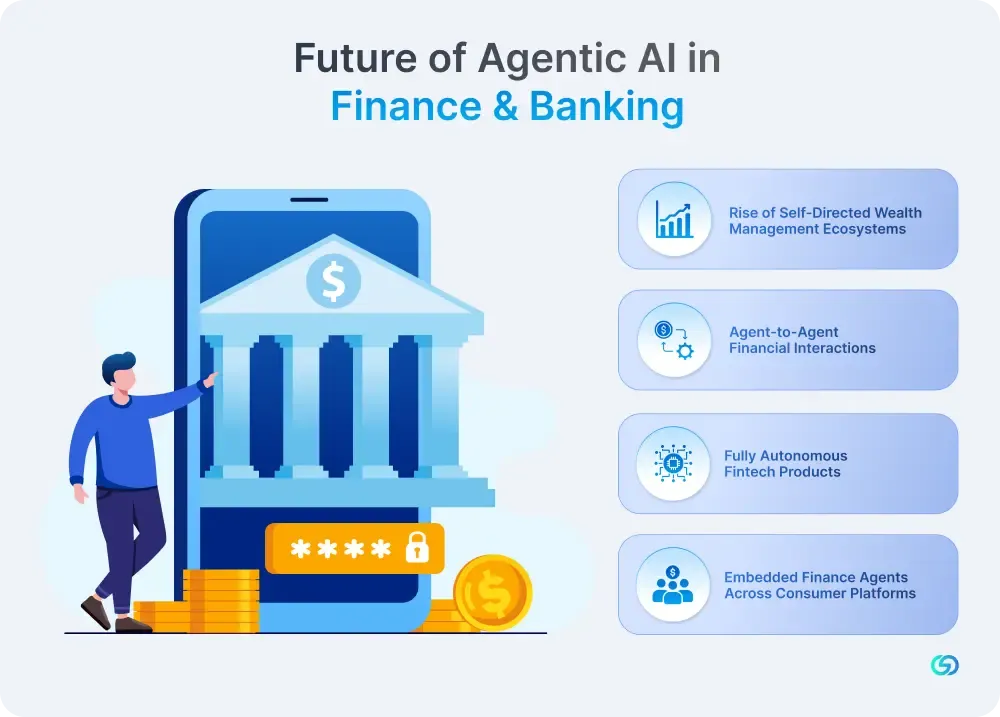
The future of agentic AI in finance will change the face of the financial services industry by allowing systems to act, reason, and improve independently. As the technology ripens, its uses will extend beyond support tools and become independently governing financial entities—able to manage wealth, maximize customer engagement, and power end-to-end digital processes.
Here are some significant trends defining the future of agentic AI in banking and finance:
🔹 Rise of Self-Directed Wealth Management Ecosystems
Agentic AI will make possible fully autonomous financial advisors who control portfolios according to personal objectives, market dynamics, and behaviour data. These platforms will be automatically learning and adjusting, eliminating the necessity for continuous human monitoring in wealth management.
🔹 Embedded Finance Agents Across Consumer Platforms
Financial agents will be natively embedded into e-commerce, healthcare, or travel apps. They will provide real-time services—such as contextualized loan proposals or micro-insurance—based on user actions and context, one of the most pragmatic agentic AI applications in finance.
🔹 Fully Autonomous Fintech Products
From compliance to onboarding, agentic AI will power the creation of fully autonomous fintech platforms. These platforms will perform intricate functions by themselves, and thus, applications of agentic AI in finance will become more scalable and cost-effective.
🔹 Agent-to-Agent Financial Interactions
In the long run, we can anticipate ecosystems in which AI agents negotiate, trade, and decide with each other—lessening human intervention and increasing efficiency. This is the next step in agentic AI in the financial sector.
Conclusion
Agentic AI in finance is no longer a futuristic vision. It is reshaping the landscape of financial services today. Starting from autonomous advisors to changing risk engines to self-updating compliance tools and intelligent fraud detection, the AI agents are now unravelling unprecedented speed, accuracy and personalization across the banking and finance industry.
However, with powerful autonomy also comes responsibility. Thus, to completely leverage the power of Agentic AI, institutions now should address regulatory, ethical and transparency challenges. Through balancing innovation with accountability, banks and other financial institutions can develop customer-centric and resilient systems. This will help set the stage for a brighter future where AI agents will become indispensable partners and not simply tools in the banking and finance sector.
Frequently Asked Questions
What real-world use cases of Agentic AI exist in financial services?
Agentic AI is already in active use across multiple financial operations:
-
Accounts Payable Automation: AI agents can autonomously approve invoices and initiate payments by cross-verifying vendor data, reducing manual bottlenecks.
-
Automated Account Reconciliation & Financial Close: These systems dramatically reduce errors (up to 99%) and accelerate financial close cycles by up to 40% through continuous learning and matching.
-
Treasury Monitoring & Cash Forecasting: Agentic AI monitors real-time cash flows, forecasts liquidity needs, and triggers alerts or suggested actions in case of anomalies.
-
Autonomous Customer Support: AI agents independently provide status updates, flag incomplete applications, prompt for missing documents, and guide users through next steps—without human involvement.
How safe and governed is Agentic AI for finance operations?
Agentic AI can be safe and reliable if deployed with strong governance frameworks. Leading institutions implement:
- Human-in-the-loop mechanisms for critical decisions.
- Continuous auditing and explainability tools to trace how AI reached conclusions.
- Bias detection and ethical AI practices to ensure fair outcomes.
- Regulatory compliance layers that monitor legal boundaries dynamically.
While agentic systems act autonomously, they must be embedded in a broader risk management ecosystem with oversight and fallback protocols.
What is the ROI and business case for adopting Agentic AI in finance?
The ROI of Agentic AI is substantial across both cost reduction and value creation:
- Cost savings via automation of high-volume tasks like reconciliation, compliance, and fraud monitoring.
- Revenue growth through hyper-personalized financial advisory and faster onboarding.
- Operational efficiency by cutting down cycle times and reducing error rates.
- Regulatory readiness with real-time compliance tracking and reporting.
Early adopters report up to 30–50% operational savings and enhanced customer satisfaction metrics.
How does Agentic AI handle errors or unexpected financial data anomalies?
Agentic AI systems use:
- Anomaly detection algorithms to flag deviations in financial behaviour or data inputs.
- Adaptive learning loops that update their logic based on feedback and market shifts.
- Fallback protocols where high-risk decisions are escalated to human review.
- Root cause analysis mechanisms to explain errors and retrain models to avoid recurrence.
This ensures continuous performance improvement and risk containment.
Can agentic workflows be integrated with ERP, FP&A, or treasury systems?
Yes, Agentic AI platforms are designed to be modular and API-driven, enabling:
- Seamless integration with ERP platforms like SAP or Oracle for transaction data and controls.
- Real-time interfacing with FP&A systems for autonomous budgeting, forecasting, and variance analysis.
- Connection with treasury platforms to monitor cash positions, manage liquidity, and automate risk hedging decisions.
These integrations allow AI agents to operate as intelligent co-pilots within existing financial ecosystems.
What is the future outlook for Agentic AI in finance?
The future is agent-led, autonomous, and increasingly embedded:
- Self-directed wealth management ecosystems will make AI the lead decision-maker in portfolios.
- Embedded financial agents will appear inside e-commerce and mobile apps, offering real-time financial services.
- Agent-to-agent interactions will allow AI systems to negotiate trades, resolve discrepancies, or align strategies—without human mediation.
- Fully autonomous fintech platforms will emerge, capable of managing onboarding, compliance, and even lending end-to-end.
Agentic AI is set to move from support roles to strategic leadership in financial systems.
How is Agentic AI used in financial services?
Agentic AI in finance is transforming the sector across key areas:
- Wealth Management: Through autonomous advisors that manage portfolios in real time.
- Risk and Underwriting: By dynamically scoring credit and predicting defaults.
- Fraud Detection: Via AI agents that monitor transactions, detect anomalies, and prevent fraud proactively.
- Customer Service: With always-on intelligent agents offering personalized assistance across platforms.
- Compliance and Reporting: Through autonomous systems that adapt to evolving regulations and generate timely reports.
Its application spans front-office to back-office, redefining how financial institutions operate and innovate.