- Enterprise Software Development
- 2026-07-09
Enterprise Software Development for Ecommerce and Retail: A Complete Guide for Modern Businesses
Audio Track
Table of Contents
Key Takeaways
- Enterprise software builds a connected ecommerce and retail ecosystem by integrating platforms, CRM, ERP, inventory, and supply chain systems, enabling businesses to optimize operations and make faster, data-driven decisions.
- AI-driven capabilities like personalized recommendations, intelligent inventory management, predictive analytics, and automated customer support help retailers enhance efficiency, improve customer experiences, and increase profitability.
- Modern architecture, such as microservices, cloud-native, API-first, and MACH, offers flexibility, scalability, improved customer experiences, and increased profitability.
- Modern architectures such as cloud-native, API-first, and MACH offer the scalability, agility, and flexibility required to support omnichannel commerce and future business growth.
- A structured enterprise software development process, from business analysis and solution design through deployment and ongoing support, ensures scalable, secure, and high-performing retail solutions. - Partnering with an experienced technology partner like ConvexSol allows retail and ecommerce businesses to develop future-ready, customized enterprise software that powers operational excellence, innovation, and sustainable growth.
The Growing Need for Enterprise Software in Modern Retail & Ecommerce
Modern ecommerce and retail businesses operate in a complex environment, shaped by customer expectations, multiple sales channels, and rapidly evolving technologies. Customers today expect simplified experiences across websites, mobile apps, marketplaces, and physical stores, making consistency and operational efficiency more crucial than ever. At the same time, retailers should manage inventory, orders, customer data, supply chains, and marketing activities across several platforms without creating data silos or operational bottlenecks.
This is where enterprise software development, ecommerce, and retail solutions have become crucial. By connecting vital business systems and automating workflows, enterprise software enables businesses to streamline operations, improve customer experiences, and gain real-time visibility into business performance. From omnichannel commerce and intelligent inventory management to AI-powered analytics and personalization, enterprise software provides the foundation for sustainable growth. This guide explores the key components, benefits, development processes, and future trends revolutionizing the enterprise.
What is Enterprise Software Development for Ecommerce and Retail?
Retail and ecommerce businesses today manage far more than online storefronts and point-of-sale systems. They operate across multiple channels, handle vast amounts of customer and inventory data, and coordinate complex supply chain activities. To efficiently manage these interconnected processes, organizations increasingly rely on enterprise software solutions tailored to their unique operational needs.
▶️ Understanding Enterprise Software Development
Enterprise software development for ecommerce and retail involves designing, building, and integrating custom software solutions that support large-scale business operations. Unlike standard retail software that focuses on individual functions, enterprise software creates a connected ecosystem where sales, inventory, customer management, fulfilment, marketing, and analytics work together seamlessly.
The primary purpose of enterprise software is to streamline operations, improve efficiency, and provide businesses with a unified view of their processes. This enables retailers to make informed decisions, respond quickly to market demands, and deliver consistent customer experiences across all touchpoints.
▶️ The Role of Enterprise Software in Retail Operations
Enterprise software serves as the digital backbone of retail and ecommerce organizations by centralizing critical business processes into a single ecosystem. Instead of relying on disconnected applications, businesses can manage inventory, orders, customer interactions, and financial data from integrated platforms.
Additionally, enterprise software enables data-driven decision-making by providing real-time insights into sales performance, customer behavior, inventory levels, and operational efficiency. This visibility helps organizations identify opportunities, mitigate risks, and improve overall business performance.
▶️ Key Components of an Enterprise Retail Ecosystem
A successful enterprise retail ecosystem typically consists of several interconnected components. Commerce systems manage online and in-store sales channels, while operational systems handle inventory, order processing, warehousing, and supply chain activities. Customer management platforms centralize customer data, loyalty programs, and engagement initiatives, enabling personalized interactions. Analytics and business intelligence tools collect and interpret data from across the organization, helping leaders make strategic decisions based on actionable insights.
▶️ Benefits of Enterprise Software Development
Enterprise software development for ecommerce and retail offers numerous advantages for retail and ecommerce businesses. It provides scalability to support growing customer bases, product catalogs, and sales channels without compromising performance. Automation reduces manual workloads and improves operational efficiency by streamlining repetitive tasks. Enhanced operational visibility enables businesses to monitor performance in real time and make faster decisions. Most importantly, enterprise software helps deliver superior customer experiences through personalized interactions, seamless omnichannel journeys, and faster service delivery.
Why Retail & Ecommerce Businesses Need Enterprise Software Development?
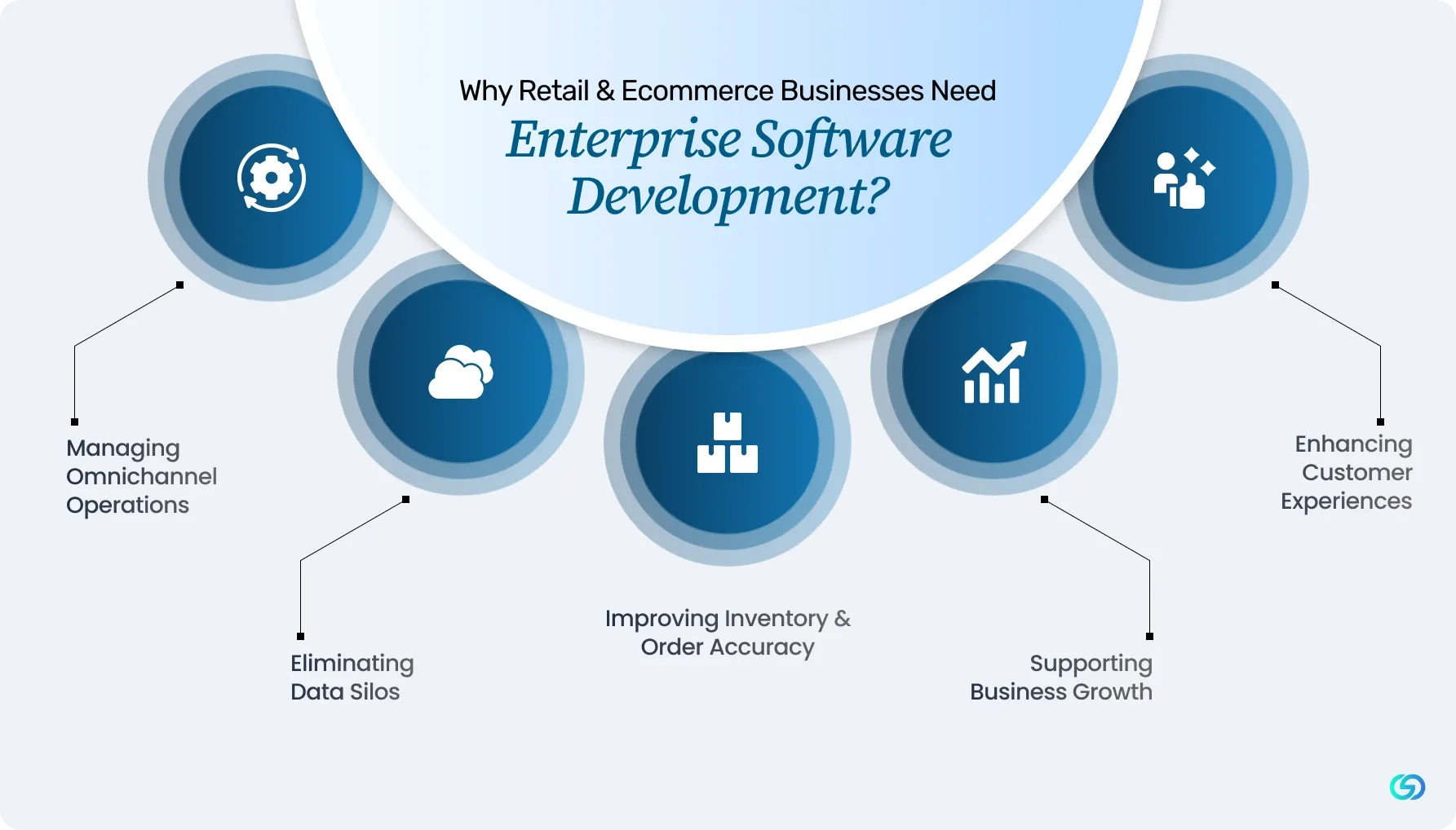
Modern retail and ecommerce businesses work across multiple channels, handle vast amounts of data, and serve largely demanding customers. Enterprise software development for ecommerce and retail helps businesses optimize operations, enhance visibility, digitize processes, and develop scalable systems, supporting sustainable business growth.
🔶 Managing Omnichannel Operations
Retailers are currently selling through mobile apps, websites, marketplaces, social commerce platforms, and physical stores. Enterprise software helps unify these multiple sales channels within a centralized ecosystem, ensuring consistent product pricing, information, inventory updates, and customer experiences across each touchpoint while enhancing operational efficiency.
🔶 Eliminating Data Silos
As businesses grow, information tends to become scattered across disconnected departments and systems. Enterprise software centralizes business data and enables real-time synchronization across platforms, ensuring teams have access to information quickly, enhancing collaboration, reducing errors, and enabling faster decision-making.
🔶 Improving Inventory & Order Accuracy
Efficient inventory and order management are crucial for maintaining profitability and customer satisfaction. Enterprise software provides real-time visibility into inventory across warehouses and sales channels, while digitizing order processing, tracking, and fulfilment workflows to reduce errors and improve delivery performance.
🔶 Supporting Business Growth
Business expansion introduces greater operational complexity, transactional volumes, and market-specific needs. Enterprise software offers the scalability and flexibility required to support growth, enabling organizations to enter new markets and manage multi-region operations.
🔶 Enhancing Customer Experiences
Modern consumers expect tailored and seamless journeys across all channels. Enterprise software enables businesses to leverage customer data for customized interactions, personalized recommendations, and targeted engagement, while accelerating service delivery through automation and integrated business processes.
Core Enterprise Software Solutions for Retail & Ecommerce
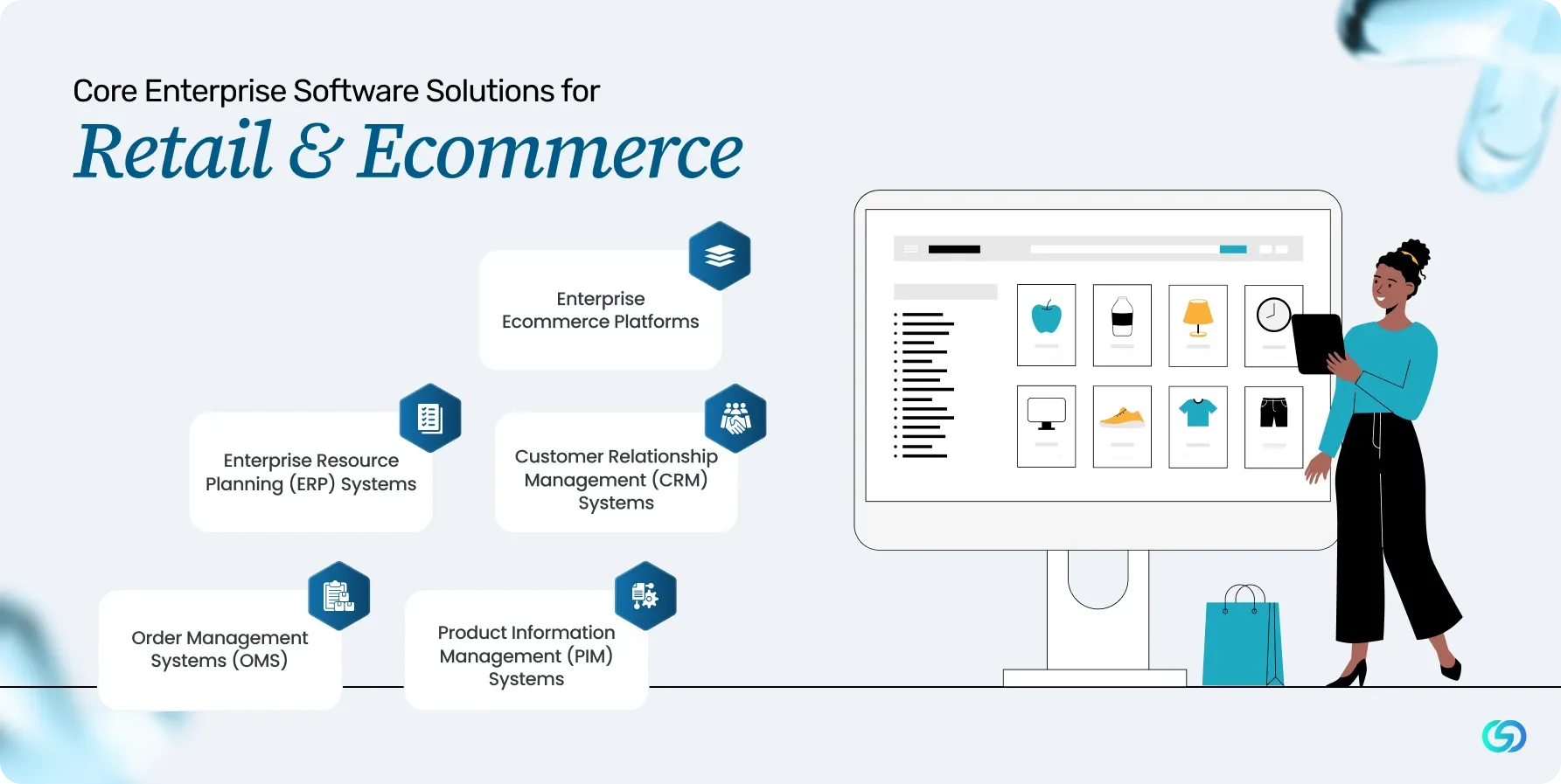
Retail and ecommerce enterprises use multiple software systems to manage operations, customer interactions, inventory, and business performance. These solutions form a connected ecosystem that increases efficiency, improves visibility, and supports scalable growth.
➡️ Enterprise Ecommerce Platforms
Enterprise ecommerce platforms are the foundation of digital commerce, allowing businesses to manage online storefronts, product catalogs, pricing, promotions, and customer transactions. They support omnichannel selling, deliver seamless shopping experiences, and scale to handle increased traffic, inventory, and sales.
➡️ Enterprise Resource Planning (ERP) Systems
ERP systems centralize core business functions, including finance, procurement, inventory management, supply chain operations, and resource planning, within a single platform. With real-time data access and automated workflows, ERP solutions increase efficiency, reduce manual tasks, and support better decision-making.
➡️ Customer Relationship Management (CRM) Systems
CRM systems centralize customer information, interactions, loyalty programs, and marketing activities. By providing a unified customer view, these systems enable personalized engagement, improve retention, strengthen relationships, and support targeted sales and marketing efforts.
➡️ Order Management Systems (OMS)
Order Management Systems streamline the entire order lifecycle, from order placement and inventory allocation to fulfilment and delivery. They provide centralized order visibility across sales channels, improving fulfilment accuracy, reducing delays, and ensuring a consistent customer experience. The inventory storage, stock movement, picking, packing, and shipping operations within distribution centres and warehouses. By improving inventory accuracy and warehouse efficiency, WMS solutions help reduce operational costs, accelerate order fulfilment, and support faster delivery times.
➡️ Product Information Management (PIM) Systems
PIM systems centralize product information, such as descriptions, specifications, images, pricing, and digital assets, across all sales channels. By ensuring consistent, accurate data, these systems improve product management, enhance the customer experience, and speed time-to-market for new products and updates.
Essential Features of Modern Enterprise Retail and Ecommerce Software
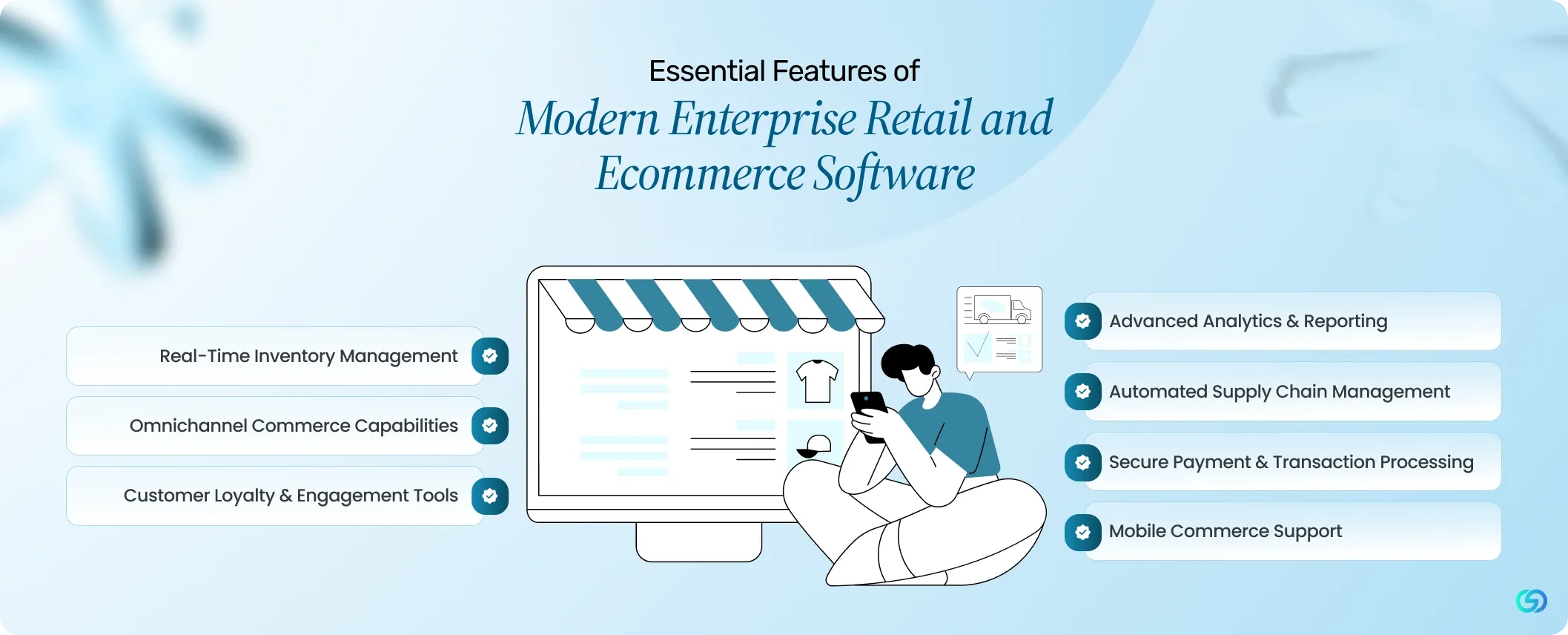
Modern enterprise retail software serves as a centralized operational hub, linking customer touchpoints to supply chains and inventory. The main features, such as real-time tracking, channel synchronization, and AI-driven predictive analytics, help in preventing stockouts and overselling while driving customer loyalty.
The main features of modern enterprise retail software include:
⏺️ Real-Time Inventory Management
Real-time inventory management enables retailers to track stock levels across fulfilment centres, warehouses, and sales channels from a single system. By providing clear inventory visibility and supporting stock streamlining strategies, businesses can reduce stockouts, prevent overstocking, and improve inventory planning.
⏺️ Omnichannel Commerce Capabilities
Omnichannel commerce capabilities help retail and ecommerce businesses synchronize operations across mobile apps, websites, social commerce platforms, and physical stores. This ensures consistency in product information, promotions, pricing, and customer experiences across all the channels while streamlining multi-channel management.
⏺️ Customer Loyalty & Engagement Tools
Customer loyalty and engagement tools enable businesses to build strong relationships through reward programs, personalized offers, and targeted communication. By encouraging repeat purchases and increasing customer retention, these features help maximize customer lifetime value and strengthen the brand's loyalty.
⏺️ Advanced Analytics & Reporting
Advanced analytics and reporting capabilities provide businesses with actionable insights through intelligence dashboards and performance monitoring tools. Retailers can track key metrics, analyze customer behavior, identify trends, and make data-driven decisions that enhance overall business performance.
⏺️ Automated Supply Chain Management
Automated supply chain management optimizes procurement, inventory replenishment, logistics operations, and vendor coordination. By reducing manual intervention and streamlining supply chain workflows, businesses can improve efficiency, lower operational costs, and ensure on-time product availability.
⏺️ Secure Payment & Transaction Processing
Secure payment and transaction processing features safeguard sensitive customer and financial information throughout the purchasing journey. By implementing advanced payment security measures and fraud-prevention mechanisms, retailers can minimize risks, maintain compliance, and build customer trust.
⏺️ Mobile Commerce Support
Mobile commerce support enables businesses to provide easy shopping experiences across tablets and smartphones. By supporting mobile-first customer engagement, responsive interfaces, and mobile transactions, retailers can enhance accessibility, increase conversions, and meet emerging consumer preferences.
Enterprise Software Architecture for Retail & Ecommerce
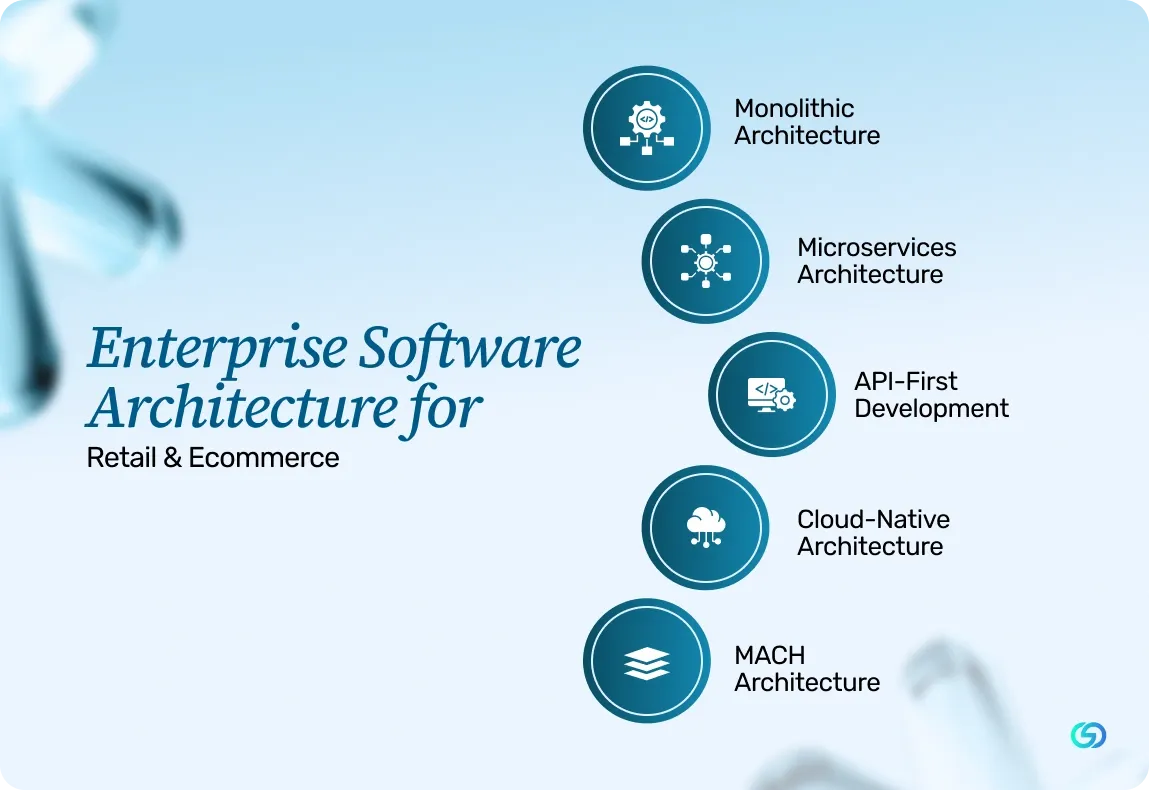
The architecture of enterprise software plays a vital role in understanding a business's flexibility, performance, scalability, and long-term success. Modern retail and ecommerce businesses largely adopt specialized architectural approaches to support growing customer needs, changing technologies, and complex operational needs.
🔷 Monolithic Architecture
Monolithic architecture is a traditional software design approach in which all components of an application work as a single, unified system. While this architecture is initially simpler to develop and deploy, it can become more difficult to update, scale, and maintain as business needs grow. Changes to a single component may affect the entire application, limiting agility and innovation.
🔷 Microservices Architecture
Microservices architecture divides apps into small, independent, platform-specific business functions. This approach enables businesses to scale individual components, speed up development cycles, and deploy updates without affecting the complete system. Although it offers greater flexibility and resilience, handling multiple services can increase architectural complexity.
🔷 API-First Development
API-first development focuses on developing software components that communicate via standard application programming interfaces (APIs). This approach streamlines integrations among ERP systems, e-commerce platforms, CRM solutions, third-party applications, and payment gateways. It also enhances scalability by allowing businesses to add new technologies without disrupting existing systems.
🔷 Cloud-Native Architecture
Cloud-native architecture utilizes cloud infrastructure to develop and operate flexible, scalable, and highly available applications. By using cloud services, businesses can dynamically adjust resources as needed, reduce infrastructure costs, and improve system reliability. This approach allows retailers to respond faster to changing business needs while maintaining cost efficiency.
🔷 MACH Architecture
MACH architecture combines API-first, Cloud-native, and Headless technologies into a modern framework for enterprise software development. This architecture enables retailers to build highly flexible, composable digital ecosystems that adapt more quickly to changing customer expectations. As a result, businesses can innovate faster, integrate new technologies more easily, and provide superior omnichannel experiences across all customer touchpoints.
How AI is Transforming Enterprise Retail Software?
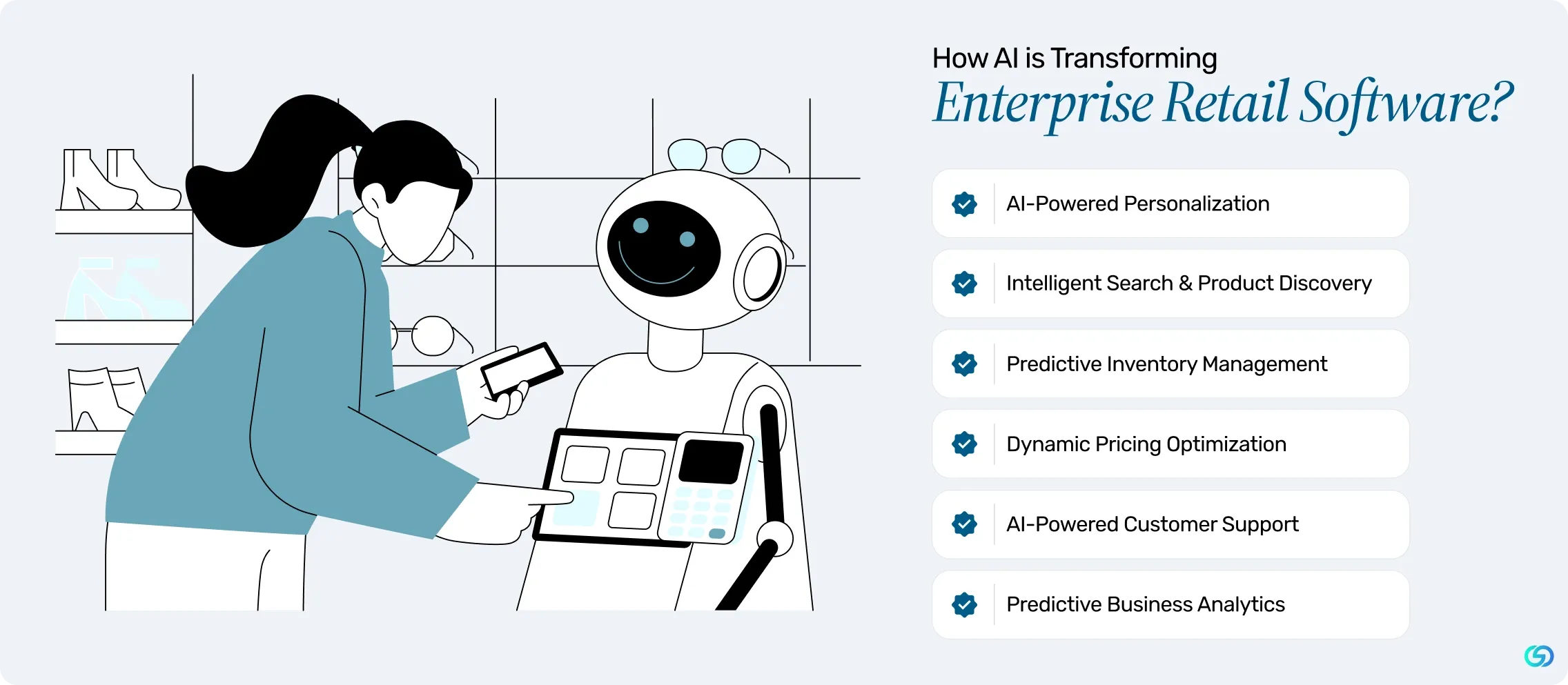
AI is revolutionizing the retail and ecommerce industries by enabling smarter decision-making, automating business processes, and delivering highly personalized customer experiences. From inventory planning and pricing optimization to customer engagement and predictive analytics, AI is enabling retailers to operate more efficiently while gaining a competitive advantage in a largely digital marketplace.
↗️ AI-Powered Personalization
AI-powered personalization enables retailers to analyze customer behavior, purchase history, browsing patterns, and preferences to deliver highly relevant shopping experiences. Via intelligent product recommendations and customer segmentation, businesses can increase engagement, enhance conversion rates, strengthen customer loyalty, and maximize customer lifetime value.
↗️ Intelligent Search & Product Discovery
Modern AI-powered search capabilities help customers find products more quickly and accurately by understanding context, search intent, and user behavior. Specialized AI-powered search and visual search improve product discovery, reduce search friction, and enhance the overall shopping experience across digital channels.
↗️ Predictive Inventory Management
AI helps retailers streamline inventory management by analyzing historical sales data and market demand patterns. Through demand forecasting and stock optimization, businesses can reduce inventory costs, prevent stockouts, minimize excess inventory, and ensure products are available when customers need them.
↗️ Dynamic Pricing Optimization
AI-powered pricing systems largely evaluate market conditions, competitor pricing, and purchasing behavior to determine optimal product prices. By enabling real-time pricing and revenue optimization, businesses can enhance profitability while staying competitive in fast-changing markets.
↗️ AI-Powered Customer Support
AI improves customer service via virtual assistants, intelligent chatbots, and automated service workflows. These solutions offer immediate responses to customer inquiries, optimize support operations, reduce response times, and ensure consistent service experiences across several communication channels.
↗️ Predictive Business Analytics
AI-driven analytics platforms process huge amounts of customer and operational data to uncover actionable insights. Through trend forecasting and strategic planning, retailers can anticipate market changes, identify growth opportunities, enhance decision-making, and develop more effective long-term business strategies.
Enterprise Software Development Process for Retail & Ecommerce
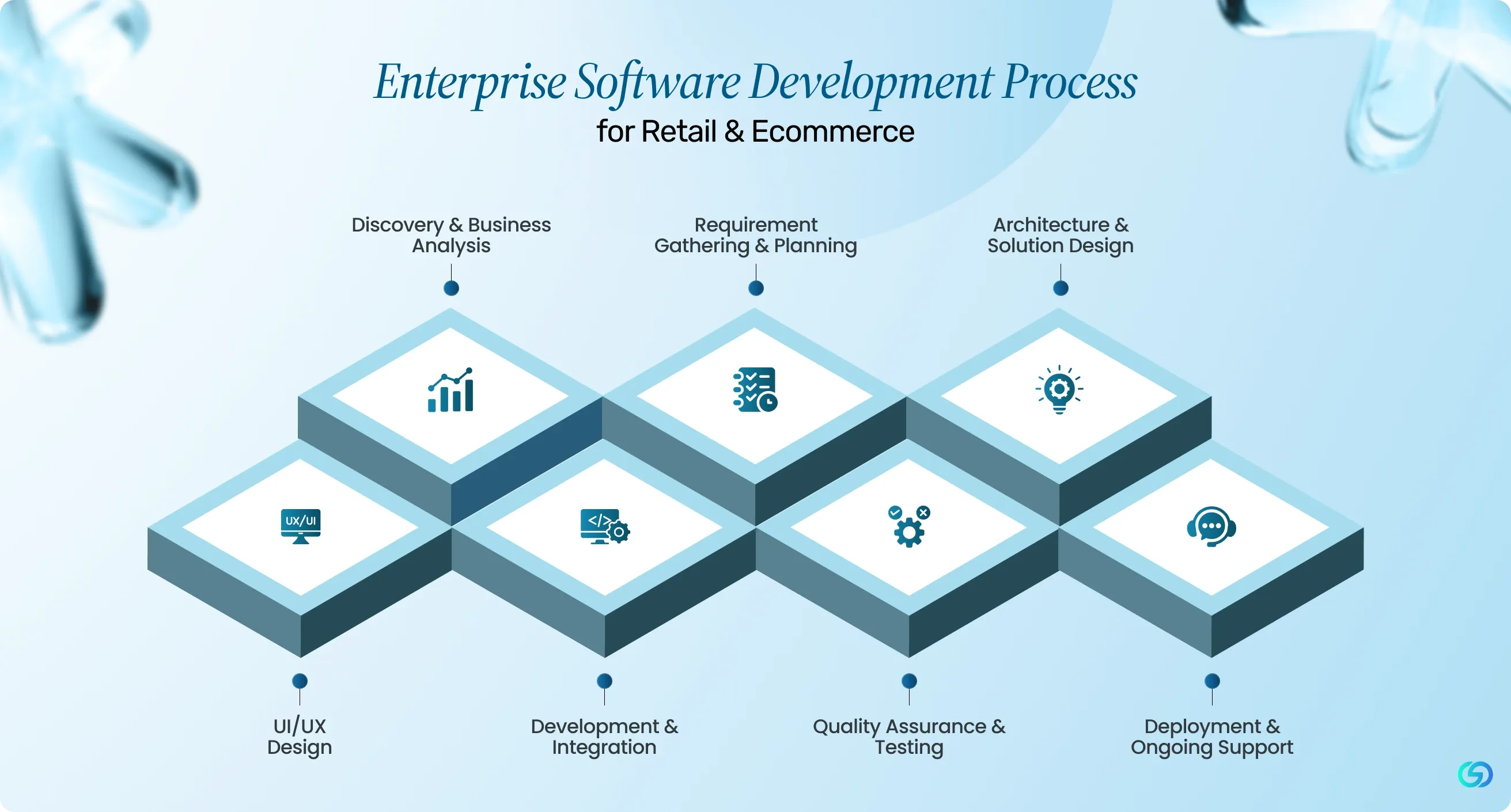
Developing enterprise software for ecommerce and retail requires a well-defined, strategic process that aligns with technology investments and business objectives. A structured development approach helps businesses build scalable, secure, and high-performing solutions that support customer engagement and long-term growth.
1️⃣ Discovery & Business Analysis
The development process began with a detailed understanding of the business's objectives, operational challenges, and growth goals. Through project assessment, stakeholder discussions, and workflow evaluations, businesses can identify pain points, define project scope, and establish clear needs that guide the entire development initiative.
2️⃣ Requirement Gathering & Planning
This phase focuses on documenting both the functional and technical needs to ensure the solution meets the business and user expectations. By defining workflows, system capabilities, integrations, performance requirements, and compliance needs, businesses can develop a detailed roadmap for successful project execution.
3️⃣ Architecture & Solution Design
Architecture and solution design establish the technical base of the software application. This involves defining the system architecture, selecting appropriate technologies, planning integrations, and designing a scalable framework that supports current business requirements while accommodating future growth.
4️⃣ UI/UX Design
An effective user experience is necessary to maximize software adoption and usability. UI/UX design focuses on developing intuitive user journeys, optimized workflows, and visually appealing interfaces that enhance efficiency, decrease friction, and improve interactions for its internal users and customers.
5️⃣ Development & Integration
At this stage, developers implement core app functionality and business-specific features. The process also involves integrating third-party systems such as ERP platforms, CRM solutions, inventory systems, payment gateways, and e-commerce platforms to develop a unified business ecosystem.
6️⃣ Quality Assurance & Testing
Quality assurance helps ensure that the software performs reliably in practical conditions. Through functional testing, performance testing, security validation, and bug resolution, businesses can verify that solutions meet quality standards and provide a seamless user experience.
7️⃣ Deployment & Ongoing Support
As testing is complete, the software is launched by signing off on a carefully planned go-live strategy designed to minimize operational disruptions. Continuous maintenance, monitoring, updates, and optimization efforts help ensure long-term performance, adaptability, and alignment with changing business needs.
Industry Use Cases of Enterprise Software in Retail & Ecommerce
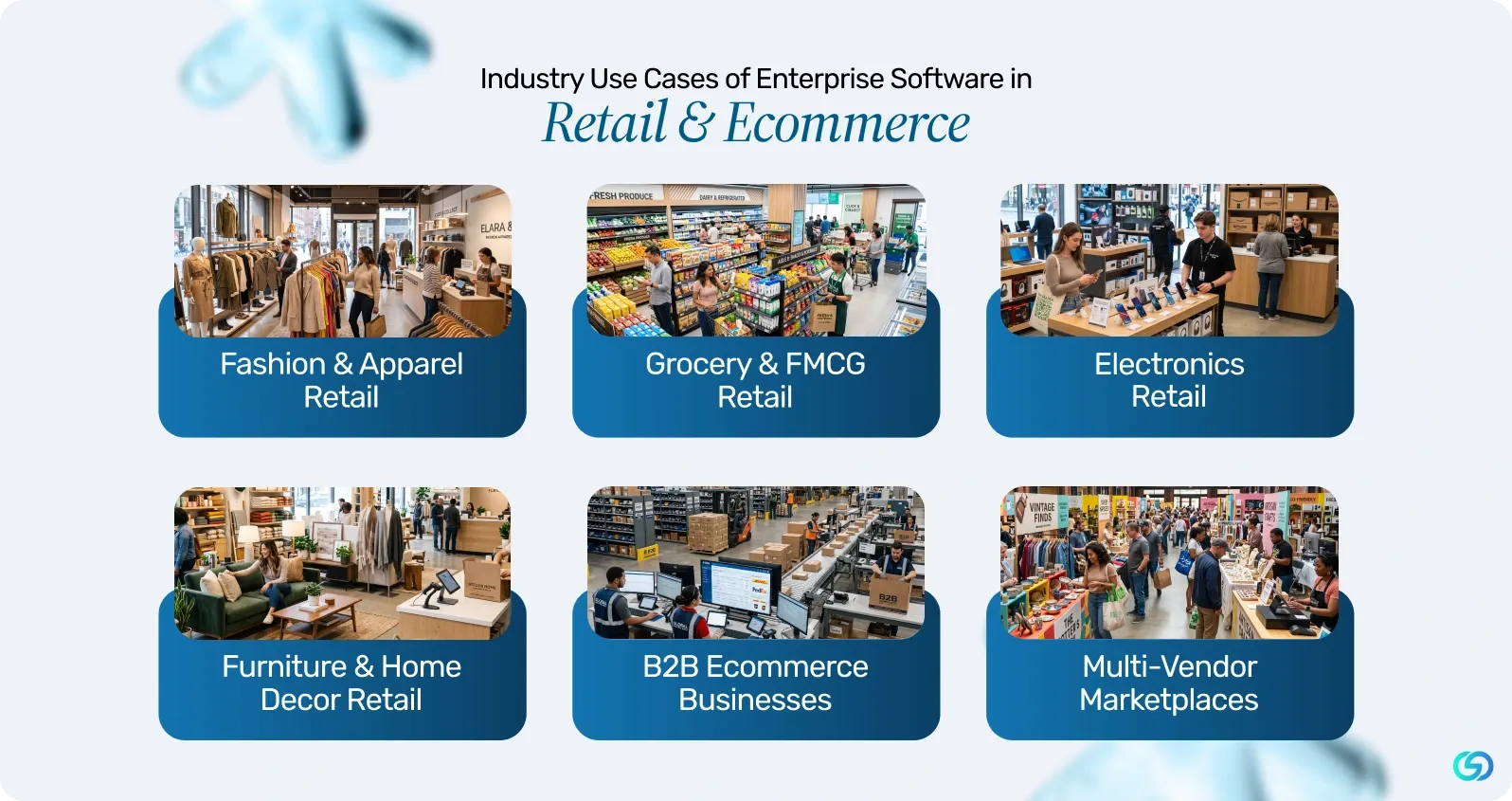
Enterprise software solutions address ubiquitous operational challenges across various retail and ecommerce segments. By incorporating business processes, enhancing visibility, and digitizing workflows, these solutions help businesses streamline performance, improve customer experiences, and achieve sustainable growth.
*️⃣ Fashion & Apparel Retail
-
Common challenges
The highest return rates across all the retail categories, complicated reverse logistics, speedily changing seasonal trends, and sizing inconsistencies. -
Enterprise Software Solutions
PIM system for handling massive visual catalogs, 3D/AI virtual try-on software, and enterprise OMS for optimizing omnichannel returns. -
Business Outcomes
Decreases return costs, enhances inventory turnover, and provides a hyper-personalized customer experience that enhances brand loyalty.
*️⃣ Grocery & FMCG Retail
-
Common Challenges
Razor-thin profit margins, reduction of food waste, tight delivery windows for perishables, and scaling DTC models without disrupting the traditional distribution channels. -
Enterprise Software Solutions
Mobile routing and last-mile delivery software, automated inventory and expiry date tracking, and AI-driven dynamic ordering to streamline margins -
Business Outcomes
Minimized spoilage of perishable items, increased fleet efficiency, and direct access to valuable consumer purchase data.
*️⃣ Electronics Retail
-
Common Challenges
Handling complex global supply chains, rapid product obsolescence, complex global supply chains, price erosion, and warranty tracking. -
Enterprise Software solutions
Enterprise ERP for accurate landed cost and supplier management, centralized IoT-powered supply chain traceability, and omnichannel POS synchronization. -
Business Outcomes
Increased supply chain visibility reduced excess stock of older models, and a secure infrastructure to handle high-value, high-volume transactions.
*️⃣ Furniture & Home Decor Retail
-
Common Challenges
High shipping and delivery costs for large or heavy items, difficult online visual merchandising, and long supply chain lead times. -
Enterprise Software Solutions
Specialized PIM systems for handling complex product variations, 3D visualization, and AR room-planning enterprise solutions. -
Business Outcomes
Decreased cart abandonment, decreased customer friction regarding fit, and more efficient warehousing and freight management.
*️⃣ B2B Ecommerce Businesses
-
Common Challenges
Complex pricing tiers, long-term credit terms, value-based discounts, and the necessity to incorporate directly with buyers’ procurement systems. -
Enterprise Software Solutions
B2B-streamlined enterprise platforms such as Adobe Commerce or Shopify Plus feature account-specific pricing, bulk ordering workflows, and automated credit validation. -
Business Outcomes
Digitized purchasing journeys decreased B2B order errors, and optimized sales processes that scale without needing proportional headcount increases.
*️⃣ Multi-Vendor Marketplaces
-
Common Challenges
Vendor onboarding and compliance, splitting and calculating payments, tax liabilities across jurisdictions, and catalog synchronization. -
Enterprise Software Solutions
Enterprise marketplace platforms, multi-currency/multi-lingual payment solutions, and vendor portal software for automated product feeds as well as payouts. -
Business Outcomes
Scalable global expansion, diversifies revenue streams, and provides a localized shopping experience that accommodates several disparate sellers.
Challenges in Enterprise Retail Software Development for Ecommerce and Retail
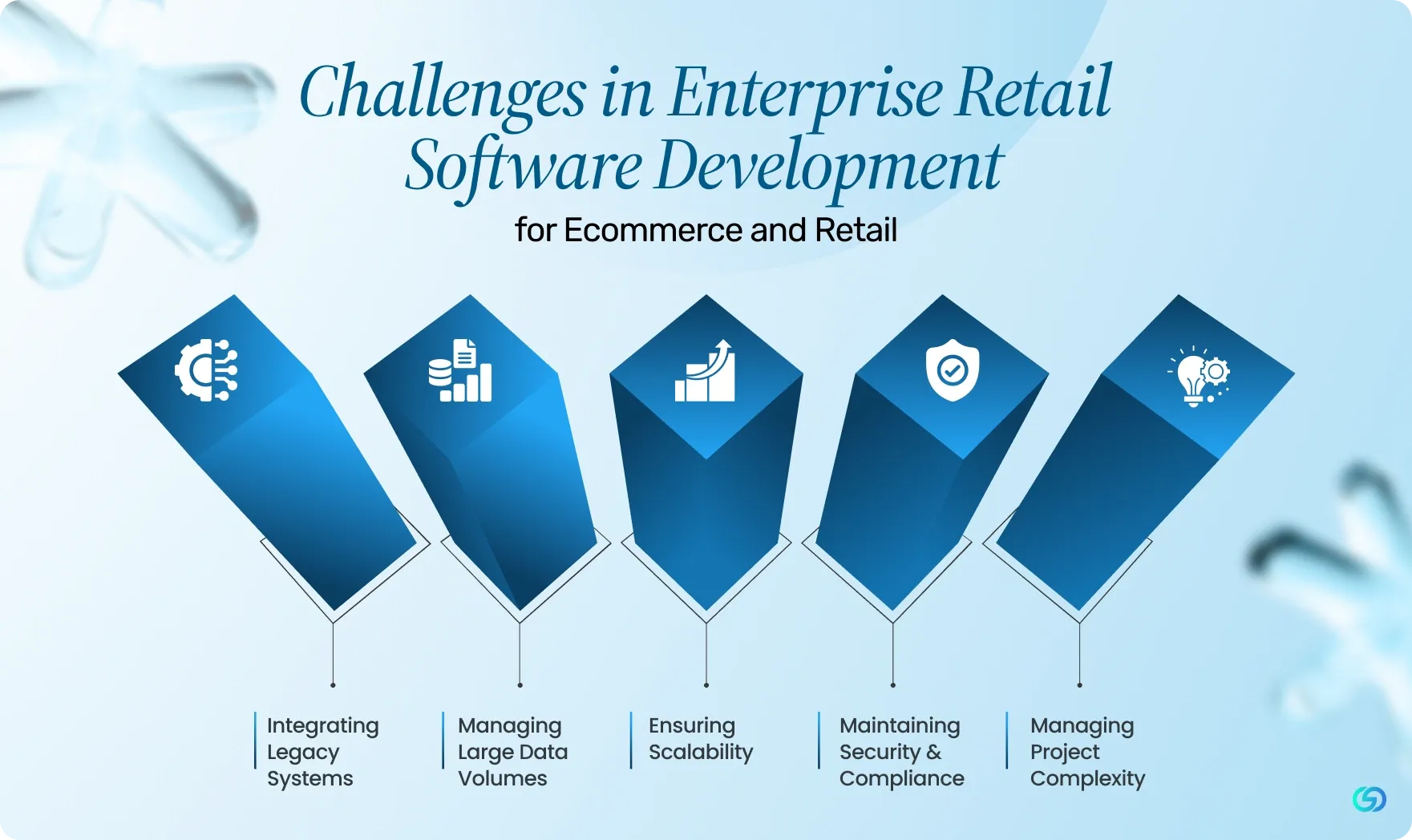
Enterprise software can deliver significant value to businesses, but building and deploying these solutions is not always easy. Companies need to tackle technical, operational, and organizational challenges to make sure the software works well, people use it, and it performs reliably over time.
▶️ Integrating Legacy Systems
Many retail and ecommerce companies still use outdated systems that were not built for today’s digital needs. Connecting these older systems with new software can lead to problems like compatibility issues, data silos, and workflow interruptions. By updating systems in stages, using APIs, and carefully planning migrations, businesses can address these challenges and reduce risks.
▶️ Managing Large Data Volumes
Retail businesses collect huge amounts of data from customers, transactions, inventory, and sales channels. To keep this data accurate and easy to use, companies need to make sure it is consistent and follow good data management practices. This helps everyone in the organization get reliable information when they need it.
▶️ Ensuring Scalability
When businesses grow, their software needs to keep up with more transactions, users, products, and complex operations. If scalability is not managed early, it can hurt system performance and customer experience. Building flexible systems and planning for growth helps companies stay on track and meet their goals.
▶️ Maintaining Security & Compliance
Enterprise retail systems process sensitive customer, financial, and business data, so security is extremely important. Companies need to implement strong data protection measures, control who can access information, use encryption, and comply with regulations to protect both business and customer data. Software solutions can fail if employees are reluctant to embrace new systems and processes. Effective change management initiatives, employee training programs, and ongoing support help users adapt to new technologies, improve productivity, and maximize the return on software investments.
▶️ Managing Project Complexity
Enterprise software projects usually involve many people, teams, technologies, and integration needs. Keeping everyone on the same page and using agile methods can help manage complexity, encourage teamwork, reduce risk, and deliver better results.
Future Trends in Enterprise Software Development for Ecommerce and Retail
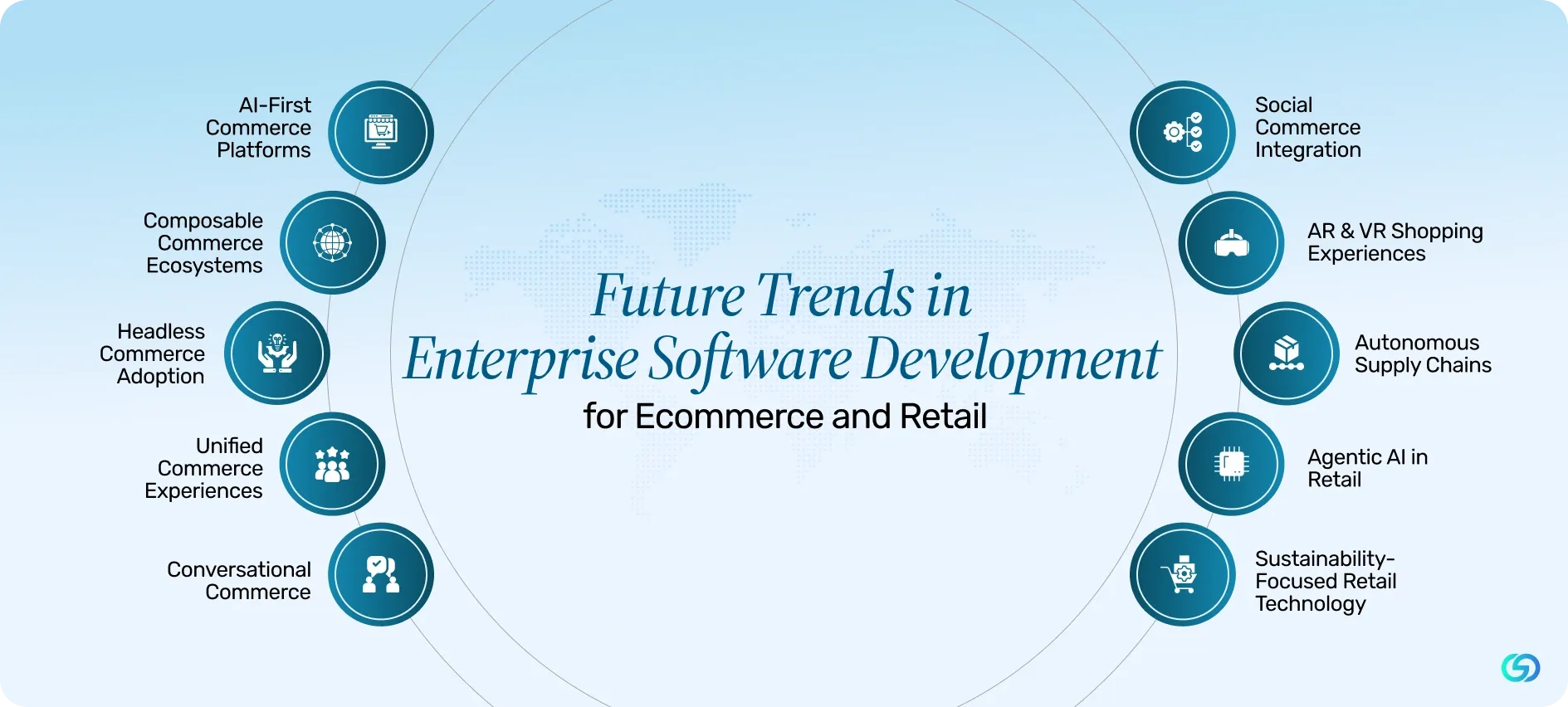
The future of ecommerce and retail is getting shaped by flexible structures, intelligent technologies, and largely immersive customer experiences. As businesses strive to remain competitive in an evolving market, enterprise software is becoming increasingly automated, adaptive, and customer-centric. Below are trends expected to revolutionize how retailers work, engage customers, and drive growth in the coming years.
➡️ AI-First Commerce Platforms
Retailers are now increasingly adopting AI-first commerce platforms that embed AI into all aspects of the customer journey and business operations. From personalized recommendations and intelligent merchandising to automated decision-making, these platforms enable businesses to deliver highly relevant experiences while improving operational efficiency.
➡️ Composable Commerce Ecosystems
Composable commerce enables organizations to develop flexible digital ecosystems utilizing independently deployable, best-of-breed components. Apart from relying on a single platform for each functionality, retailers can integrate specialized solutions for payments, search, personalization, and analytics, enabling greater agility and faster innovation.
➡️ Headless Commerce Adoption
Headless commerce helps separate the front-end customer experience from backend commerce functionality, enabling businesses to develop and manage experiences across multiple touchpoints more efficiently. This approach offers greater flexibility, shorter deployment cycles, and the ability to adapt more quickly to the customer's changing expectations.
➡️ Unified Commerce Experiences
The future of commerce is in developing a single, centralized ecosystem where customer data, sales channels, inventory, and fulfilment operations work together easily. Unified ecommerce helps eliminate data silos, enhance operational visibility, and enable businesses to maintain consistent user experiences across both online and offline touchpoints.
➡️ Conversational Commerce
Conversational commerce is changing how customers discover products and interact with brands. By leveraging AI-powered chat interfaces, messaging platforms, and virtual assistants, businesses can offer personalized recommendations, optimize purchasing decisions, and create more engaging shopping experiences through natural conversations.
➡️ Social Commerce Integration
Social commerce continues to blur the lines between product discovery and purchase. Modern platforms increasingly enable customers to browse products, complete purchases, read reviews, and track orders without leaving social media apps, helping businesses shorten the customer journey and increase conversions.
➡️ AR & VR Shopping Experiences
Augmented reality and virtual reality technologies are developing immersive shopping experiences that fill the gap between digital and physical retail. Interactive product visualization, virtual showrooms, and virtual try-on experiences help customers make informed decisions while reducing return rates.
➡️ Autonomous Supply Chains
Advancements in AI, automation, and predictive analytics are enabling the development of autonomous supply chains. These systems can automatically forecast demand, streamline inventory levels, adjust pricing strategies, and trigger replenishment activities, reducing manual intervention while enhancing operational efficiency.
➡️ Agentic AI in Retail
Agentic AI represents the next evolution of AI in commerce. Unlike traditional AAI systems that respond primarily to user inputs, agentic AI can proactively perform tasks, streamline workflows, manage digital storefronts, and act as intelligent shopping assistants that help customers find products based on preferences and intent.
➡️ Sustainability-Focused Retail Technology
Sustainability is now a strategic priority for retailers and ecommerce businesses worldwide. Enterprise software solutions are widely used to reduce overproduction, streamline delivery routes, support circular economy initiatives, and enhance supply chain transparency. These technologies help businesses meet environmental goals while enhancing operational efficiency and profitability in the long term.
Why Choose ConvexSol for Enterprise Software Development for Ecommerce and Retail?
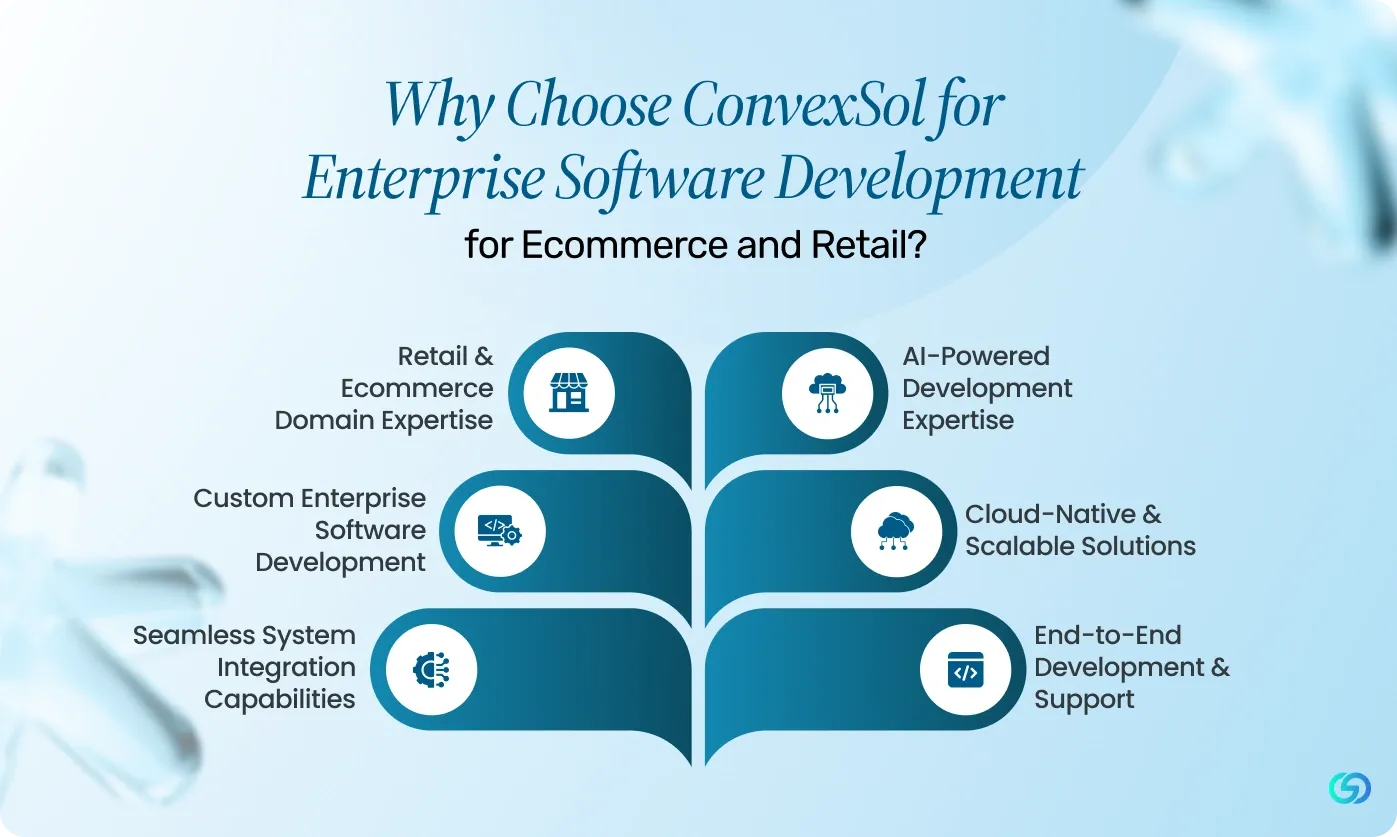
Building successful enterprise software for retail and ecommerce requires more than technical expertise. It demands a deep understanding of industry challenges, emerging technologies, customer expectations, and scalable architectures. ConvexSol combines domain knowledge, engineering excellence, and innovation-driven development to help businesses build future-ready digital ecosystems.
🔶 Retail & Ecommerce Domain Expertise
ConvexSol possesses extensive experience in developing solutions tailored to the unique needs of retail and ecommerce businesses. From omnichannel commerce and inventory management to customer engagement and order fulfilment, our team understands the complexities of modern retail operations and delivers solutions that drive measurable business outcomes.
🔶 Custom Enterprise Software Development
Every business has unique requirements, workflows, and growth objectives. ConvexSol develops custom enterprise software solutions designed around your specific business needs, ensuring greater flexibility, scalability, and long-term value compared to one-size-fits-all platforms.
🔶 Seamless System Integration Capabilities
Modern retail enterprises rely on multiple business systems to operate efficiently. Our integration expertise enables seamless connectivity between ecommerce platforms, ERP systems, CRM solutions, payment gateways, inventory management tools, and third-party applications, creating a unified business ecosystem.
🔶 AI-Powered Development Expertise
We leverage advanced artificial intelligence technologies to help businesses automate processes, improve decision-making, enhance customer experiences, and unlock actionable insights. From AI-driven personalization and predictive analytics to intelligent automation, ConvexSol develops solutions that support digital innovation and competitive advantage.
🔶 Cloud-Native & Scalable Solutions
Our cloud-native development approach enables businesses to build highly scalable, resilient, and performance-driven applications. By utilizing modern architectures and cloud technologies, we ensure your software can adapt to changing business requirements and support future growth without compromising efficiency.
🔶 End-to-End Development & Support
ConvexSol provides comprehensive services throughout the software development lifecycle, from strategy and consulting to design, development, deployment, and ongoing support. Our end-to-end approach ensures seamless project execution, continuous optimization, and long-term success for your retail and ecommerce initiatives.
Conclusion
As retail and ecommerce businesses continue to evolve, investing in enterprise software development for ecommerce and retail has become crucial to achieving operational efficiency, delivering exceptional customer experiences, and supporting long-term growth. From omnichannel commerce and AI-powered personalization to intelligent supply chain management and scalable architectures, enterprise software provides the foundation for digital success in a highly competitive marketplace. Businesses that embrace future–ready systems and modern technologies will be better positioned to adapt to changing customer expectations and market demands. ConvexSol helps ecommerce and retail brands develop scalable, customized, and innovation-driven enterprise software solutions that speed up growth and drive lasting business value.
FAQ
What factors should businesses consider before investing in enterprise software development for ecommerce and retail?
Businesses must evaluate their existing operational challenges, scalability needs, integration requirements, security and compliance needs, long-term objectives, and budget. It is also important to choose a technology partner with proven expertise in ecommerce and retail to ensure solutions align with the business's goals and deliver long-term value.
Can enterprise software be implemented without disrupting day-to-day retail operations?
Yes. A well-planned implementation strategy helps minimize business disruptions by leveraging phased deployment, comprehensive testing, data migration planning, and employee training. An experienced development partner like ConvexSol provides continuous support to ensure a seamless transition while maintaining business continuity.
How important is API integration when developing enterprise ecommerce or retail software?
API integration is crucial as it enables easy communication between ecommerce platforms, CRM software, ERP systems, payment gateways, logistics providers, inventory management tools, and other third-party apps. This develops a connected ecosystem that enhances operational efficiency, customer experiences, and data accuracy.
How can enterprise software help expand ecommerce or retail businesses internationally?
Enterprise software development for ecommerce and retail supports international growth by enabling multi-currency transactions, multilingual storefronts, compliance management, region-specific payment methods, and centralized inventory and order management. This enables businesses to efficiently handle global operations while delivering consistent customer experiences across different markets.
What performance metrics should ecommerce businesses track after implementing enterprise software?
Businesses should monitor key performance indicators such as inventory accuracy, order fulfilment time, customer satisfaction, conversion rates, cart abandonment rate, average order value, system uptime, operational costs, and return on investment. Tracking these metrics helps evaluate software performance and identify opportunities for ongoing improvement.
Is it possible to modernize an existing retail or ecommerce system instead of replacing it completely?
Absolutely. Several businesses choose to modernize their current systems by incorporating new technologies, migrating to cloud-based infrastructure, adopting microservices, or implementing API-driven solutions. This phased approach helps extend the lifespan of legacy systems, reduces implementation risk, and provides access to modern enterprise capabilities without a full system replacement.