- Enterprise Software Development
- 2026-07-15
Enterprise Software Development for Travel and Hospitality: Powering the Future of Guest Experiences
Audio Track
Table of Contents
Takeaways
- Enterprise software helps hospitality and travel organizations in unifying reservations, operations, customer data, and reporting within a connected digital ecosystem, enhancing efficiency and business visibility.
- AI-powered enterprise solutions allow personalized predictive demand forecasting, personalized guest experiences, revenue optimization, workflow automation, and data-powered decision-making at scale.
- Custom software addresses common enterprise challenges like data silos, fragmented systems, inconsistent customer experiences, scalability limitations, and operational inefficiencies.
- Modern hospitality tech stacks incorporate critical systems such as PMS, CRM, CRS, ERP, RMS, analytics platforms, and AI solutions to support simplified business operations.
- Choosing the right enterprise software development partner is crucial for developing scalable, secure, and future-ready solutions, aligning with the long-term growth of businesses and digital transformation goals.
Overview: Understanding Enterprise Software Development for Travel and Hospitality
The travel and hospitality sector is undergoing a rapid digital transformation, driven by changing customer expectations, evolving operational complexity, and rising competition. Travel agencies, airlines, large hotel chains, resorts, and tourism enterprises mostly rely on multiple systems to handle reservations, operations, customer relationships, revenue, and workforce activities. However, juggling between disconnected platforms and legacy infrastructure can create data silos, inefficiencies, and inconsistent customer experiences.
Enterprise software development for travel and hospitality addresses these issues by developing scalable, integrated, and secure digital ecosystems aligned to business requirements. From centralized booking and property management to AI-driven personalization, analytics, and workflow automation, enterprise software development can help travel and hospitality businesses improve guest experiences and make data-driven decisions. As the industry becomes increasingly digital, custom enterprise software has become a critical driver of innovation and long-term growth.
Market Statistics & Insights on the Hospitality and Travel Technology Industry
The hospitality and travel sector is experiencing significant growth as enterprises speed up their digital transformation initiatives. Industry projections indicate that the worldwide travel and hospitality software market is expected to cross $25 billion by 2030, driven by the increasing demand for advanced booking platforms, custom management tools, property management systems (PMS), and AI-powered solutions. Customer behavior is also fueling this shift, with over 70% of travelers preferring to research, book, and manage their journeys via digital channels.
To meet changing expectations, more than 75% of hospitality businesses have adopted booking engines and PMS platforms to optimize reservations, pricing, inventory management, and guest information. Moreover, more than 60% of hotels are investing in custom enterprise software solutions to enhance scalability, strengthen data security, allow easy integrations, and deliver personalized guest experiences across multiple properties and customer touchpoints.
Why Hospitality & Travel Enterprises Need Custom Software More Than Ever?
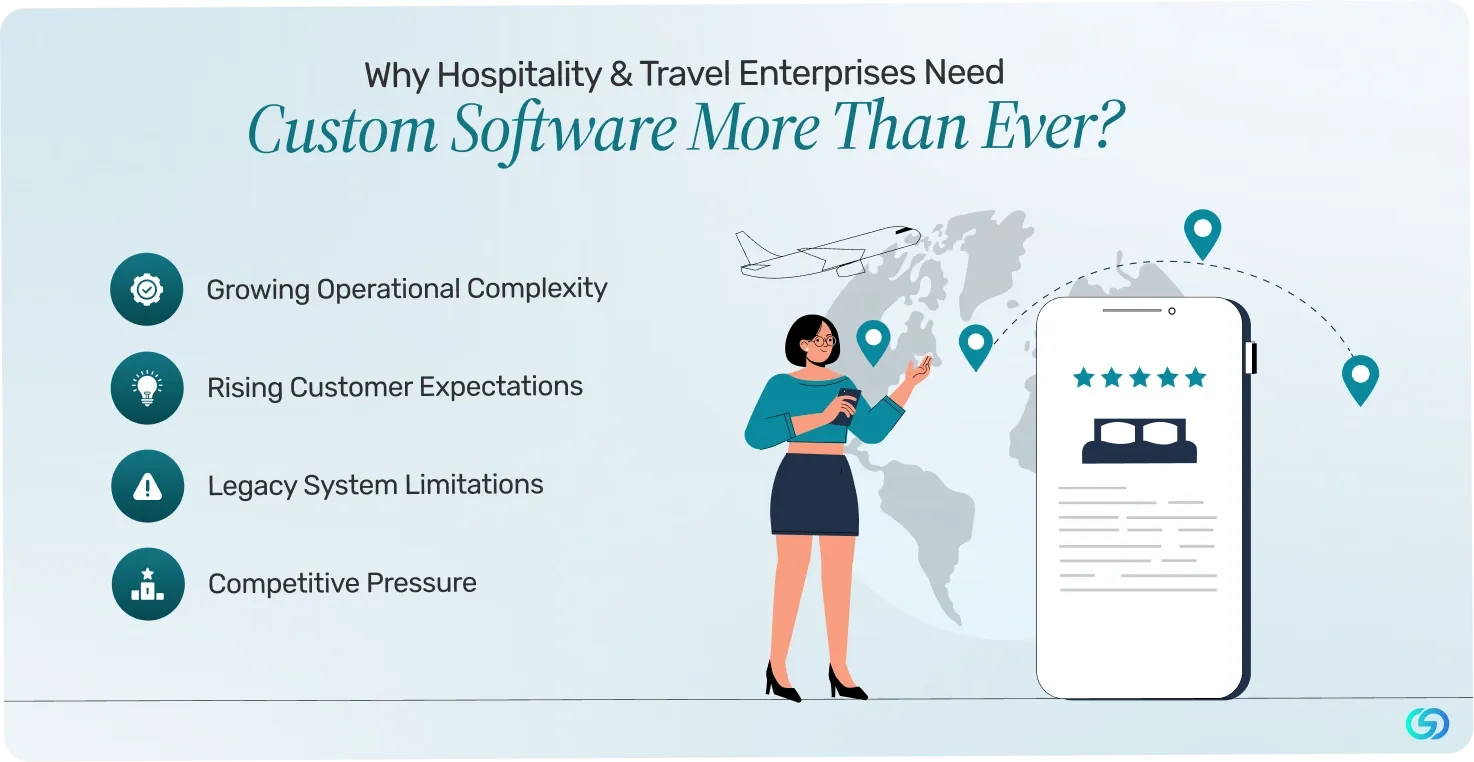
As hospitality and travel enterprises expand across locations, channels, and customer segments, managing operations through disconnected systems becomes increasingly difficult. Custom enterprise software helps businesses unify processes, enhance customer experiences, streamline decision-making, and develop scalable digital ecosystems that support long-term growth.
▶️ Growing Operational Complexity
Handling multi-property operations, worldwide customer bases, and extensive franchise networks can become overwhelming more quickly when relying on disconnected systems. Custom enterprise software helps unify operations, standardize processes, enhance visibility across different locations, and optimize the management of reservations, customer data, workforce activities, and business performance from a centralized location.
▶️ Rising Customer Expectations
Travelers today want personalized experiences, easy interactions across channels, and convenient self-service options throughout their journey. Enterprise software enables hospitality and travel businesses to unify customer data, deliver personalized recommendations, support omnichannel engagement, and offer digital self-service capabilities that improve guest satisfaction and loyalty.
▶️ Legacy System Limitations
Several hospitality businesses still rely on SEOers, CRM, PMS, ERP, and booking systems that develop data silos and operational inefficiencies. Custom software integrates these platforms into a connected ecosystem, enabling real-time data sharing, improved collaboration, enhanced reporting, and scalability to support future business expansion.
▶️ Competitive Pressure
The rise of digital-first hospitality brands and online travel platforms has largely increased competition. Custom enterprise software helps businesses optimize operations, innovate faster, deliver superior customer experiences, and adapt more quickly to changing market demands, enabling them to maintain a competitive advantage in a highly technology-driven landscape.
How AI and Enterprise Software Development Are Transforming Hospitality & Travel?
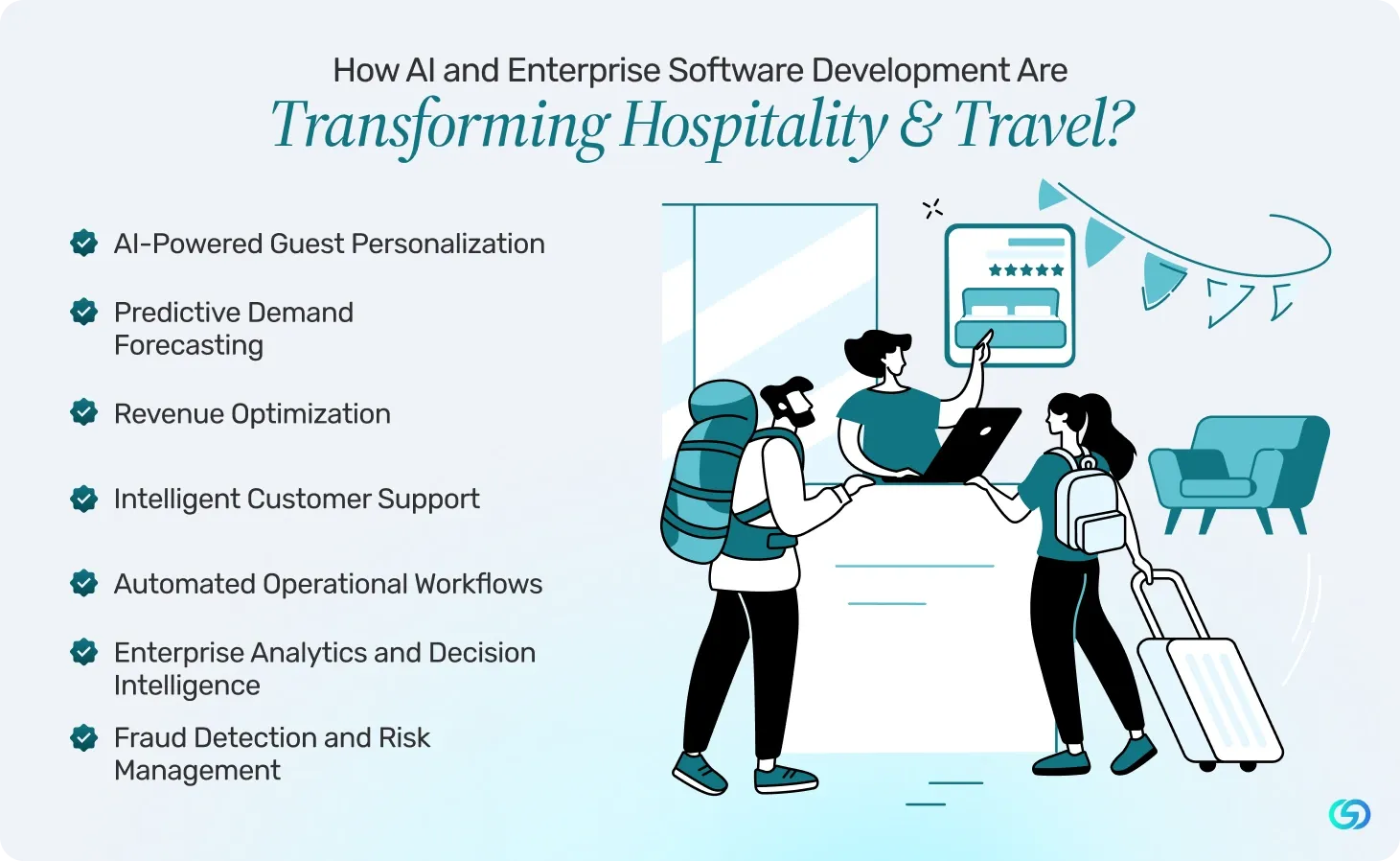
AI is rapidly becoming the core component of enterprise software development for travel and hospitality industry. When integrated with modern enterprise platforms, AI enables businesses to automate operations, enhance decision-making, personalize customer experiences, and improve business efficiency. As travel enterprises handle rising volumes of customer data and operational processes, AI-powered software solutions are helping them remain competitive in a largely digital landscape.
➡️ AI-Powered Guest Personalization
Modern travelers expect brands to realize their preferences and offer relevant recommendations. AI-powered enterprise software helps analyze guest behavior, booking history, spending patterns, and engagement data to deliver personalized upgrades, travel packages, and loyalty rewards. This kind of personalization helps hospitality enterprises enhance customer satisfaction, strengthen loyalty, and increase repeat bookings.
➡️ Predictive Demand Forecasting
Demand in the travel and hospitality sector can fluctuate because of seasonal trends, market conditions, events, and traveler behavior. AI-driven forecasting tools for analyzing historical and real-time information for predicting occupancy rates, volumes of bookings, and travel demand patterns. These insights help businesses make informed decisions about staffing, inventory management, pricing strategies, and resource allocation.
➡️ Revenue Optimization
Enterprise software powered by AI enables dynamic pricing strategies that respond to market demand, competitor rates, customer behavior, and booking trends. By continuously evaluating several variables, businesses can streamline room rates, package pricing, and service offerings. This maximizes revenue opportunities while maintaining competitiveness across multiple properties and booking channels.
➡️ Intelligent Customer Support
AI-powered chatbots, virtual assistants, and automated support systems enable hospitality businesses to offer round-the-clock customer service. These solutions help answer common inquiries, handle bookings, manage itinerary changes, and resolve service requests faster. As a result, enterprises can enhance response times, decrease support costs, and improve the complete guest experience,
➡️ Automated Operational Workflows
Many hospitality businesses still rely on manual processes for reservations, employee scheduling, housekeeping coordination, guest communication, and reporting. Enterprise software integrated with AI can help automate repetitive tasks and optimize workflows across departments. This enhances operational efficiency, minimizes errors, and enables staff to focus on delivering high-value customer experiences.
➡️ Enterprise Analytics and Decision Intelligence
Large hospitality and travel enterprises generate huge volumes of data from reservations, websites, mobile apps, CRM systems, and operational platforms. AI-powered analytics solutions help consolidate this data and transform it into actionable insights. Decision-makers gain real-time visibility into customer trends, business performance, operational bottlenecks, and growth opportunities, enabling faster, more informed strategic decisions.
➡️ Fraud Detection and Risk Management
As digital transactions continue to grow, hospitality and travel businesses face increasing risks from payment fraud, account misuse, and cybersecurity threats. AI-powered enterprise software can find unusual patterns, detect suspicious activities, and trigger real-time alerts before issues arise. This proactive approach helps businesses strengthen security, reduce financial losses, and maintain customer trust.
Enterprise Challenges in Hospitality & Travel That Custom Software Solves
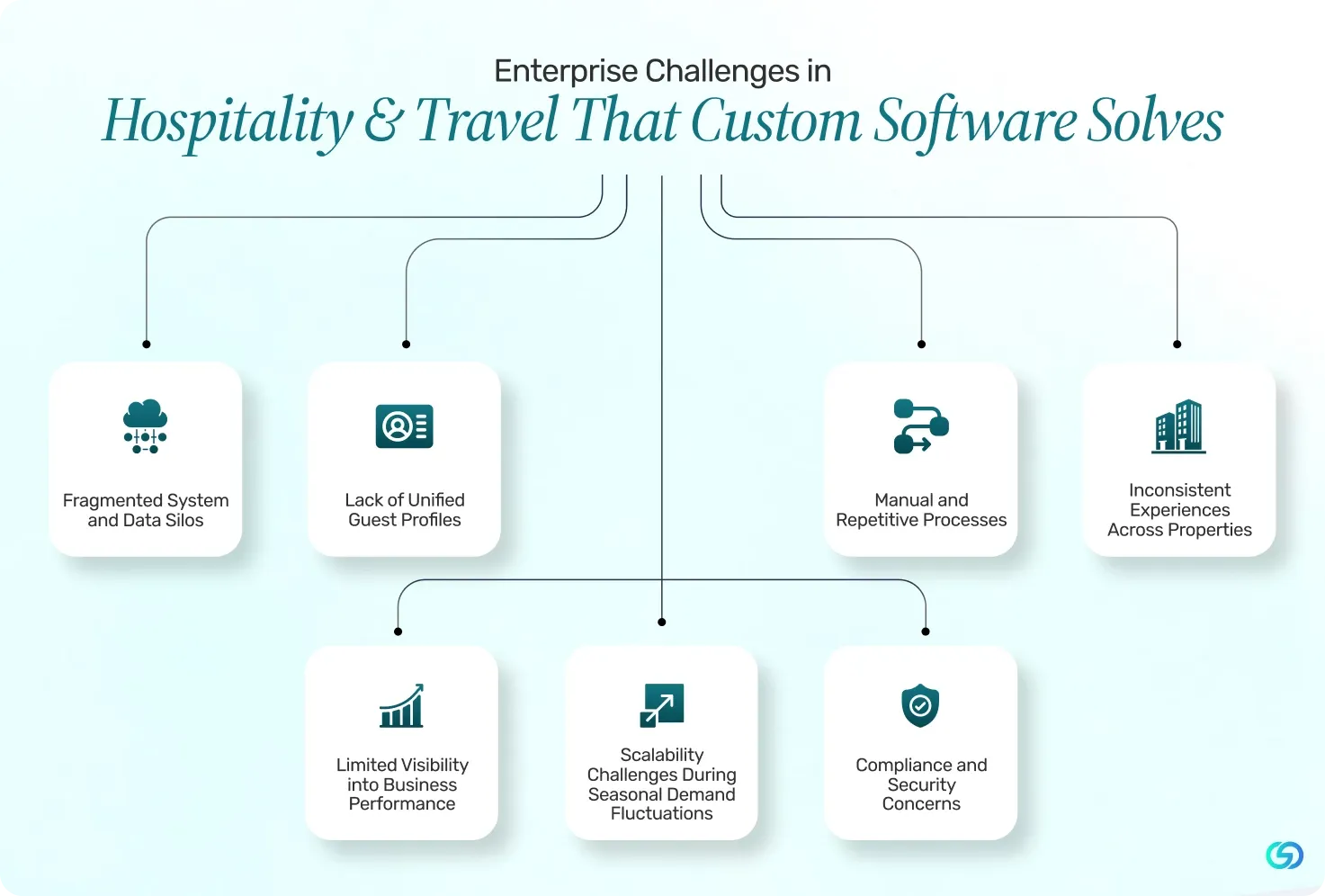
As hospitality and travel enterprises expand their operations, they mostly face challenges related to system integration, customer experience management, operational efficiency, and business scalability. While off-the-shelf solutions may address particular functions, custom enterprise software development for travel and hospitality helps businesses overcome these challenges by developing a scalable, connected, and data-driven technology ecosystem.
🔶 Fragmented System and Data Silos
Several hospitality organizations depend on separate property management systems (PMS), booking platforms, payment gateways, and ERP software. These disconnected systems mostly create data silos and operational inefficiencies. Custom software integrated these platforms into a unified environment, allowing easy data flow, enhanced collaboration, and more informed decision-making across departments and properties.
🔶 Lack of Unified Guest Profiles
Guest information is mostly scattered across several touchpoints, including mobile applications, websites, loyalty programs, booking engines, and customer service channels. Custom enterprise software helps consolidate this data into a centralized profile, enabling businesses to better understand customer preferences, personalize interactions, and provide more consistent experiences throughout the guest journey.
🔶 Manual and Repetitive Processes
From guest communications and reservation management to scheduling employees and reporting, many hospitality processes still rely on manual effort. Custom software helps automate repetitive workflows, reduce administrative burdens, minimize human errors, and allow employees to focus on providing exceptional customer service and operational excellence.
🔶 Inconsistent Experiences Across Properties
For resorts, hotel chains, and franchise-based businesses, ensuring consistent service delivery across properties can be challenging. Custom enterprise platforms help standardize processes, centralize customer information, and provide operational visibility. This ensures guests receive a consistent brand experience regardless of location.
🔶 Limited Visibility into Business Performance
Without centralized reporting and analytics, enterprise leaders mostly struggled to get a full view of operational performance. Custom software aggregates data from several systems and locations into a unified dashboard, offering real-time insights into revenue trends, occupancy rates, customer behavior, and overall business performance.
🔶 Scalability Challenges During Seasonal Demand Fluctuations
The travel and hospitality sectors experience significant fluctuations in demand due to seasons, holidays, and major events. Legacy systems often struggle to manage increased volumes of bookings and operational workloads. Custom enterprise software is developed for scaling efficiently, helping businesses handle peak demand while maintaining service quality and performance.
🔶 Compliance and Security Concerns
Hospitality enterprises handle huge volumes of payment, customer, and operational data, making security a vital concern. Custom software can be developed with enterprise-grade security controls, encryption, role-based access management, audit trails, and compliance frameworks, helping businesses protect sensitive information while meeting regional and industry regulatory needs.
Key Features of Modern Enterprise Hospitality & Travel Software
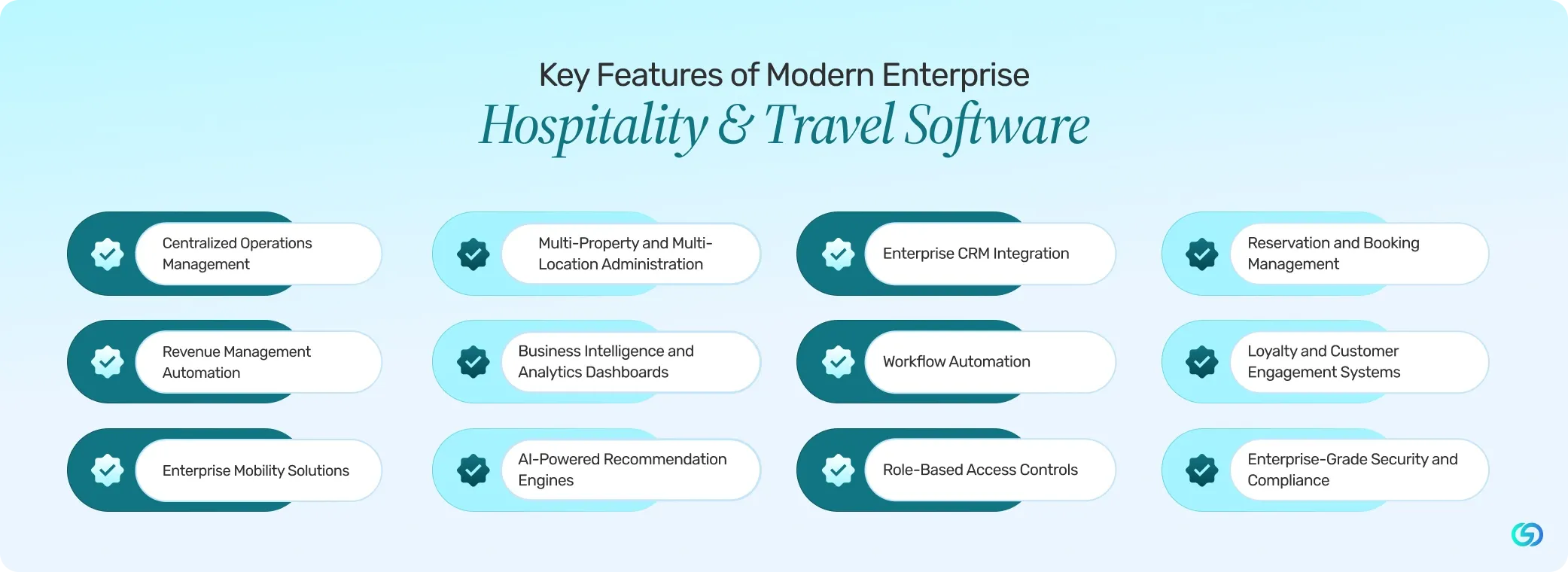
Modern hospitality and travel businesses need more than standalone property management systems and booking tools. They require integrated software ecosystems that connect operations, customer information, analytics, and business processes across multiple locations and touchpoints. Enterprise software development for travel and hospitality is built to improve efficiency, enhance customer experiences, and support scalable growth through advanced features tailored to evolving industry needs.
*️⃣ Centralized Operations Management
Enterprise hospitality software helps centralize operations such as customer management, reservations, workforce coordination, billing, and reporting. By bringing several functions together with a single platform, businesses can enhance operational visibility, decrease inefficiencies, and make faster business decisions.
*️⃣ Multi-Property and Multi-Location Administration
Hospitality groups mostly operate across resorts, hotels, or travel locations. Enterprise software enables centralized oversight of property performance, pricing, occupancy, inventory, and operational processes while maintaining flexibility to address location-specific needs and business goals.
*️⃣ Enterprise CRM Integration
Integrated CRM capabilities help organizations in consolidating customer data from websites, booking engines, loyalty programs, and service interactions. This unified view enables enhanced customer engagement, personalized communication, and more effective relationship management throughout the entire guest lifecycle.
*️⃣ Reservation and Booking Management
Modern reservation systems enable businesses to handle bookings from mobile apps, websites, online travel agencies, and direct channels via a unified platform. This enhances the accuracy of booking, inventory management, and customer convenience while decreasing operational complexity.
*️⃣ Revenue Management Automation
Enterprise software can digitize pricing decisions depending on demand forecasts, market trends, booking patterns, competitor rates, and occupancy levels. This helps hospitality businesses maximize revenue opportunities while maintaining competitiveness across several locations and channels.
*️⃣ Business Intelligence and Analytics Dashboards
Enterprise hospitality platforms offer real-time dashboards that help in consolidating financial, operational, and customer data. These insights help decision-makers identify trends, monitor performance, evaluate profitability, and make data-driven decisions that support long-term growth.
*️⃣ Workflow Automation
Several hospitality operations involve repetitive tasks such as guest communications, reservation confirmations, approvals, housekeeping coordination, and reporting. Workflow automation decreases manual effort, minimizes errors, and enhances overall operational productivity across departments.
*️⃣ Loyalty and Customer Engagement Systems
Customer loyalty programs play a vital role in driving repeat business. Enterprise software helps businesses manage promotions, rewards, memberships, and personalized campaigns while leveraging customer data to develop more meaningful and engaging guest experiences.
*️⃣ Enterprise Mobility Solutions
Mobile-enabled enterprise platforms empower managers, employees, and customers with real-time access to necessary information and services. Starting from mobile check-ins and guest support to workforce management and operational monitoring, mobility enhances convenience and responsiveness.
*️⃣ AI-Powered Recommendation Engines
AI-driven recommendation engines analyze booking history, customer preferences, and behavioral patterns to suggest relevant services, upgrades, travel packages, and promotions. These businesses improve customer satisfaction while generating additional revenue opportunities.
*️⃣ Role-Based Access Controls
Enterprise hospitality environments include multiple users across locations and departments. Role-based access controls ensure employees can access only information relevant to their responsibilities, enhancing data security, accountability, and operational governance.
*️⃣ Enterprise-Grade Security and Compliance
Hospitality enterprises manage large volumes of payment, customer, and operational data. Enterprise software incorporates specialized security measures such as encryption, authentication protocols, audit trails, and compliance controls to protect sensitive data and meet regulatory requirements.
Why Custom Enterprise Software Development for Travel and Hospitality Matters Now: Key Trends Shaping the Industry
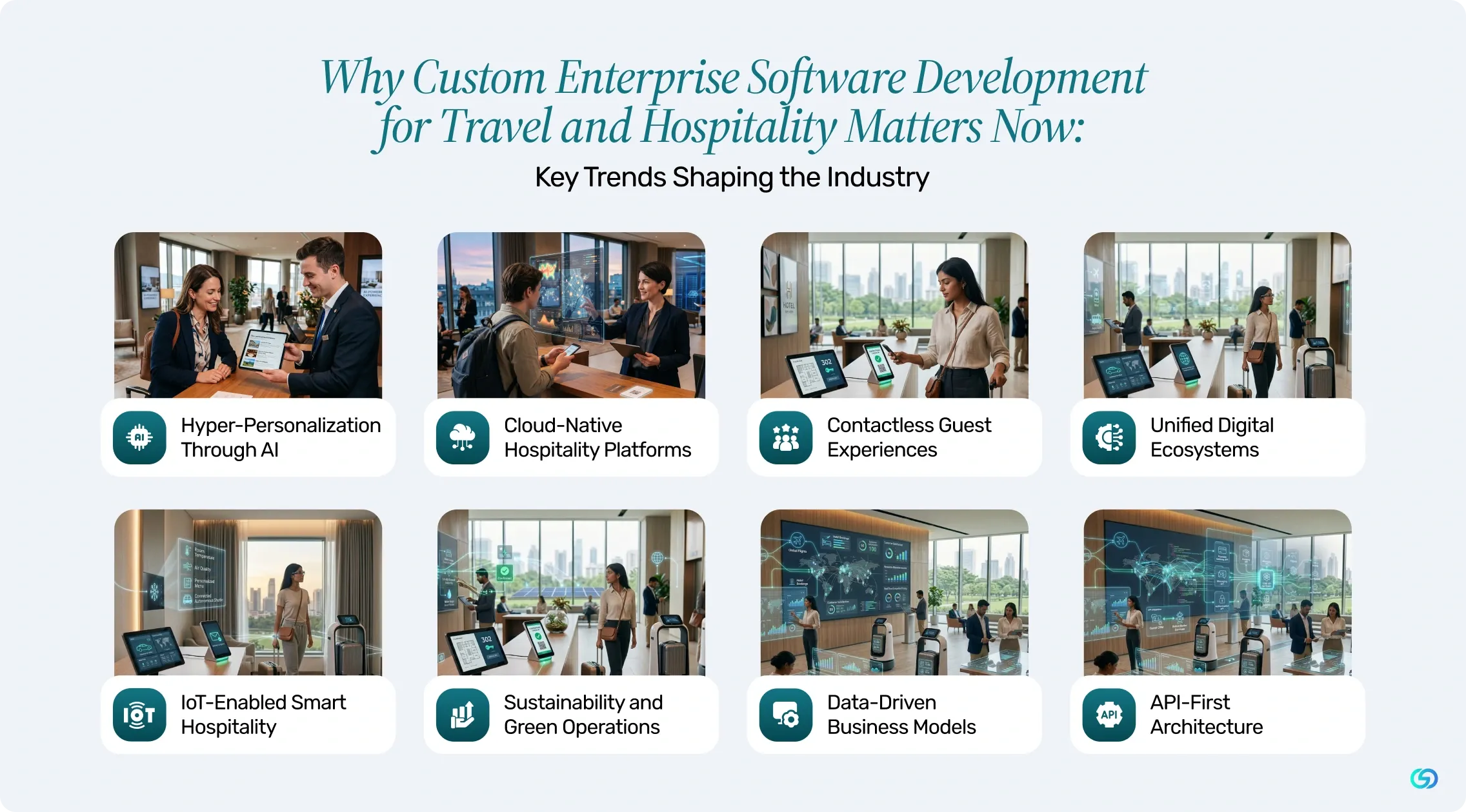
The hospitality and travel industry is rapidly evolving as enterprises embrace new technologies to enhance guest experiences, optimize operations, and drive business growth. From artificial intelligence and cloud computing to sustainability initiatives and connected ecosystems, various trends are reshaping how hospitality businesses invest in and develop enterprise software solutions.
🔷 Hyper-Personalization Through AI
Travelers today expect personalized interactions at all stages of their journey. AI-powered enterprise software analyzes customer preferences, booking history, behavioral patterns, and engagement information to deliver customized recommendations, loyalty rewards, targeted offers, and personalized services that improve satisfaction and retention.
🔷 Cloud-Native Hospitality Platforms
Hospitality enterprises are increasingly adopting cloud-native platforms to modernize legacy infrastructure and enhance operational efficiency. Cloud-based enterprise software offers greater scalability, simplified maintenance, real-time access, and seamless integration, enabling businesses to respond faster to changing market demands.
🔷 Contactless Guest Experiences
The need for frictionless travel experiences has sped up the adoption of contactless technologies. Enterprise software now supports digital room keys, mobile check-ins, self-service kiosks, online payments, and automated guest communications, helping businesses enhance convenience while decreasing operational dependencies.
🔷 Unified Digital Ecosystems
Several hospitality businesses work multiple platforms for reservations, property management, finance, and customer engagement. Custom enterprise software helps build a unified digital ecosystem where data flows easily across systems, enabling improved collaboration, operational efficiency, and customer experience management.
🔷 IoT-Enabled Smart Hospitality
Internet of Things technologies are transforming hospitality operations via connected devices and smart infrastructure. Enterprise software can integrate with smart room controls, energy management systems, occupancy sensors, and connected equipment to improve guest comfort, operational efficiency, and resource utilization.
🔷 Sustainability and Green Operations
Sustainability has become a strategic priority for several hospitality enterprises. Custom software solutions help businesses monitor energy consumption, streamline resource usage, decrease waste, and track sustainability initiatives. These capabilities support environmental goals while helping businesses improve operational efficiency and reduce costs.
🔷 Data-Driven Business Models
Hospitality businesses generate huge volumes of operational and customer data daily. Enterprise software equipped with specialized analytics capabilities enables businesses to transform this data into actionable insights, supporting seamless decision-making, enhanced forecasting, improved customer engagement, and long-term strategic planning.
🔷 API-First Architecture
Modern hospitality enterprises need software that can integrate seamlessly with third-party apps, payment gateways, booking channels, CRM platforms, and emerging technologies. API-first architecture enables easy connectivity between systems, enabling businesses to expand capabilities, accelerate innovation, and adapt to future technology needs more easily.
What Enterprise Hospitality & Travel Software Development Services Include?
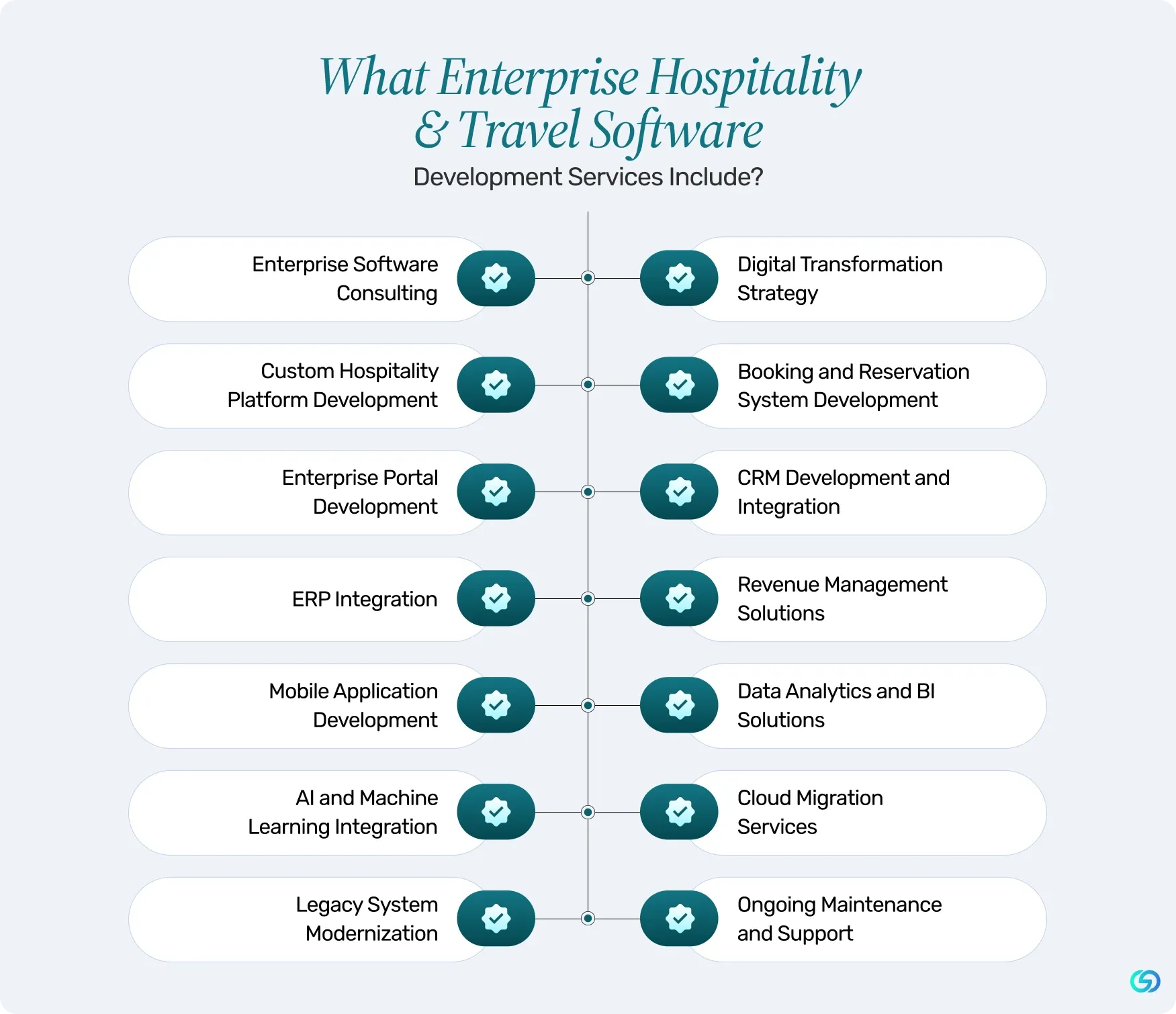
Enterprise hospitality and travel software development extends beyond developing individual apps. It includes designing, developing, integrating, and streamlining technology ecosystems that support operational efficiency, customer experiences, revenue growth, and business scalability. These services help hospitality businesses modernize their digital infrastructure while addressing industry-specific challenges and rising market demands.
↗️ Enterprise Software Consulting
Enterprise software consulting helps hospitality businesses evaluate their current systems, identify operational gaps, define technology roadmaps, and select the right solutions to achieve their business goals. This strategic approach ensures technology investments deliver measurable value and long-term business benefits.
↗️ Digital Transformation Strategy
Digital transformation services help hospitality businesses modernize legacy processes and adopt emerging technologies. By developing a structured transformation strategy, businesses can enhance customer experiences, optimize operations, and build a more agile, data-driven business environment.
↗️ Custom Hospitality Platform Development
Every hospitality business works differently. Custom platform development enables businesses to build software solutions tailored to their workflows, service models, operational needs, and customer engagement strategies, rather than relying solely on generic off-the-shelf apps.
↗️ Booking and Reservation System Development
Custom booking and reservation systems enable businesses to handle inventory, availability, rates, and customer bookings across several channels. The solutions enhance booking efficiency and improve user experience.
↗️ Enterprise Portal Development
Enterprise portals provide employees, vendors, partners, and customers with centralized access to data, workflows, and business applications. These platforms enhance collaboration, optimize communication, and support operational efficiency across the business.
↗️ CRM Development and Integration
Enterprise portals offer partners, employees, vendors, and customers centralized access to information, business applications, and workflows. These platforms improve collaboration, streamline communication, and support the complete guest lifecycle.
↗️ ERP Integration
ERP integration services help in unifying procurement, finance, inventory, human resources, and operational systems into a connected ecosystem. This enhances data consistency, process efficiency, and visibility into enterprise-wide performance while reducing operational silos.
↗️ Revenue Management Solutions
Revenue management solutions utilize real-time data, demand forecasts, occupancy trends, and market insights to support dynamic pricing decisions. These systems help hospitality businesses maximize revenue opportunities while maintaining competitiveness across channels.
↗️ Mobile Application Development
Mobile apps allow customers and employees to access services and information from anywhere. From mobile bookings and digital check-ins to workforce management and customer support, enterprise mobile solutions enhance convenience, engagement, and operational flexibility.
↗️ Data Analytics and BI Solutions
Data analytics and business intelligence solutions help businesses collect, analyze, and visualize information from several systems. These insights support performance monitoring, forecasting, customer analysis, and strategic decision-making across the business.
↗️ AI and Machine Learning Integration
AI and machine learning technologies allow hospitality businesses to automate workflows, personalize guest experiences, predict demand, streamline pricing strategies, and enhance customer support. These capabilities help businesses increase efficiency while delivering smart services.
↗️ Cloud Migration Services
Cloud migration services help businesses move application workloads and data from legacy environments to modern cloud platforms. This enhances accessibility, security, scalability, disaster recovery capabilities, and complete operational flexibility.
↗️ Legacy System Modernization
Many hospitality enterprises still depend on aging systems that limit growth and innovation. Legacy modernization services help businesses upgrade existing apps, enhance integrations, improve performance, and adopt modern technologies without disrupting operations.
↗️ Ongoing Maintenance and Support
Enterprise software needs ongoing monitoring, optimization, updates, and technical support to remain secure and efficient. Ongoing maintenance services help businesses address changing business needs, maintain system performance, and ensure uninterrupted operations over time.
Core Systems in a Modern Enterprise Hospitality Technology Stack
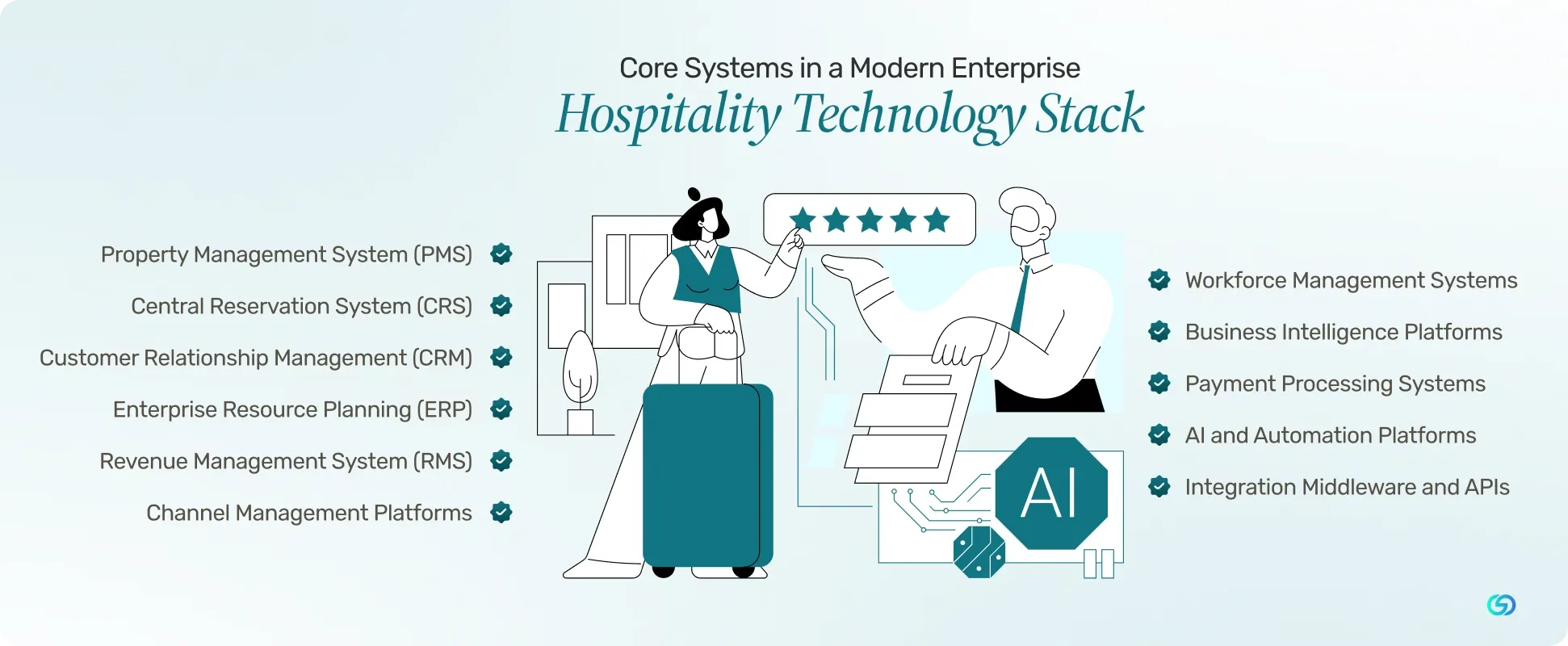
Modern travel and hospitality enterprises depend on connected technology ecosystems rather than a single software solution. From handling reservations and customer relationships to streamlining workforce operations and revenue, multiple systems work together to support the business's performance. A well-integrated enterprise technology stack allows businesses to enhance efficiency, improve guest experiences, and make more informed business decisions.
⏩ Property Management System (PMS)
A property management system serves as the operational backbone of resorts, hotels, and hospitality businesses. It helps manage room inventory, guest check-ins and check-outs, housekeeping, billing, and property operations, while ensuring streamlined coordination between departments and locations.
⏩ Central Reservation System (CRS)
A central reservation system allows hospitality enterprises to manage room availability and rates, as well as reservations across direct booking channels, mobile apps, websites, and third-party platforms. This helps maintain inventory accuracy while enhancing booking efficiency and revenue control.
⏩ Customer Relationship Management (CRM)
CRM systems help centralize customer data, booking history, preferences, and interactions across multiple touchpoints. This enables hospitality businesses to customize communications, enhance customer engagement, handle loyalty programs, and develop more meaningful guest experiences.
⏩ Enterprise Resource Planning (ERP)
ERP systems connect finance, inventory management, procurement, human resources, and other back-office functions within a centralized platform. This allows better operational control, optimized workflows, and greater visibility into enterprise-wide business performance.
⏩ Revenue Management System (RMS)
Revenue Management Systems utilize market data, booking patterns, occupancy trends, and demand forecasts to support dynamic pricing strategies. These insights help hospitality businesses maximize revenue, enhance occupancy rates, and respond effectively to changing market conditions.
⏩ Channel Management Platforms
Hospitality businesses mostly distribute inventory via websites, global distribution systems, online travel agencies (OTAs), and travel partners. Channel management platforms help synchronize rates and availability across channels, reducing overbooking risk and enhancing operational efficiency.
⏩ Workforce Management Systems
Handling staff across several locations can be challenging without the right tools. Workforce management systems help businesses streamline scheduling, track attendance, manage labor costs, and ensure adequate staffing levels to support service quality and operational demands.
⏩ Business Intelligence Platforms
Business intelligence platforms aggregate data from CRM, PMS, ERP, and reservation systems, as well as other sources, to create interactive dashboards and reports. These insights help leaders monitor performance, identify trends, measure profitability, and make data-driven decisions across the enterprise.
⏩ Payment Processing Systems
Modern payment systems support several payment methods and currencies, as well as booking channels, while ensuring a safe transaction process. This helps optimize billing operations, enhance customer convenience, and support compliance with financial security standards.
⏩ AI and Automation Platforms
AI-powered platforms allow hospitality businesses to automate routine tasks, enhance demand forecasting, personalize guest interactions, and improve customer support. These technologies help businesses improve efficiency while delivering more intelligent, responsive services.
⏩ Integration Middleware and APIs
As businesses adopt multiple software solutions, easy integration becomes important. Middleware platforms and APIs facilitate the exchange of data between CRM, PMS, ERP, payment systems, booking engines, and other apps, ensuring consistent data flow across the complete technology stack.
The 5 Questions That Tell You What to Build First in Travel & Hospitality Enterprise Solutions
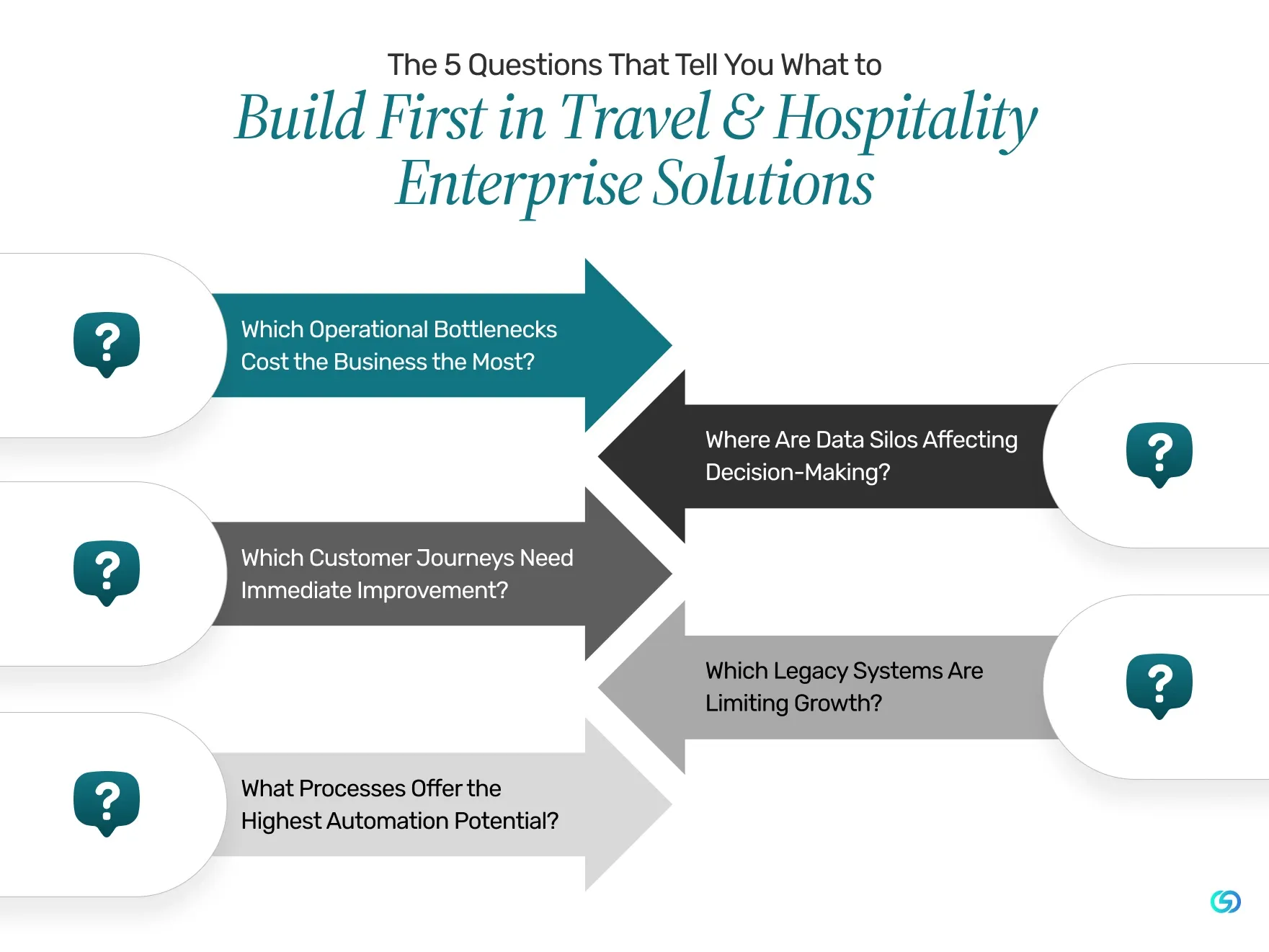
Several hospitality and travel enterprises recognize the requirement for digital transformation but struggle to understand where to start. Developing every system at once is cost-effective and rarely practical. Instead, businesses should evaluate their operational challenges, customer requirements, and technology gaps to identify the software initiatives that will provide the greatest business impact first.
1️⃣ Which Operational Bottlenecks Cost the Business the Most?
The very first step is to understand where operational efficiencies develop delays, increase costs, or decrease productivity. Whether it involves manual reservation management, fragmented reporting, repetitive administrative tasks, or workforce scheduling issues, addressing the most expensive bottlenecks yields the fastest and most measurable returns on investment.
2️⃣ Where Are Data Silos Affecting Decision-Making?
All customer interactions, from booking and check-in to post-stay engagement, impact the brand's perception. Businesses should evaluate where friction occurs in the guest journey and prioritize solutions that enhance convenience, personalization, communication, and the overall customer experience across digital and physical touchpoints.
3️⃣ Which Customer Journeys Need Immediate Improvement?
Every customer interaction, starting from booking and check-in to post-stay engagement, affects brand perception. Businesses should evaluate where friction remains in the guest journey and prioritize solutions that enhance personalization, communication, and the overall customer experience across digital and physical touchpoints.
4️⃣ Which Legacy Systems Are Limiting Growth?
Several hospitality enterprises continue to depend on outdated platforms that are difficult to maintain, scale, or integrate with modern technologies. Finding out systems that restrict innovation, create operational inefficiencies, or hinder business expansion helps determine where modernization efforts should start.
5️⃣ What Processes Offer the Highest Automation Potential?
Processes such as guest communications, reporting, pricing adjustments, inventory updates, and customer support consume significant time and resources. Evaluating automation opportunities helps businesses prioritize software investments that enhance efficiency, reduce manual workload, and allow teams to focus on high-value activities.
Common Misconceptions About Enterprise Software Development for Travel and Hospitality
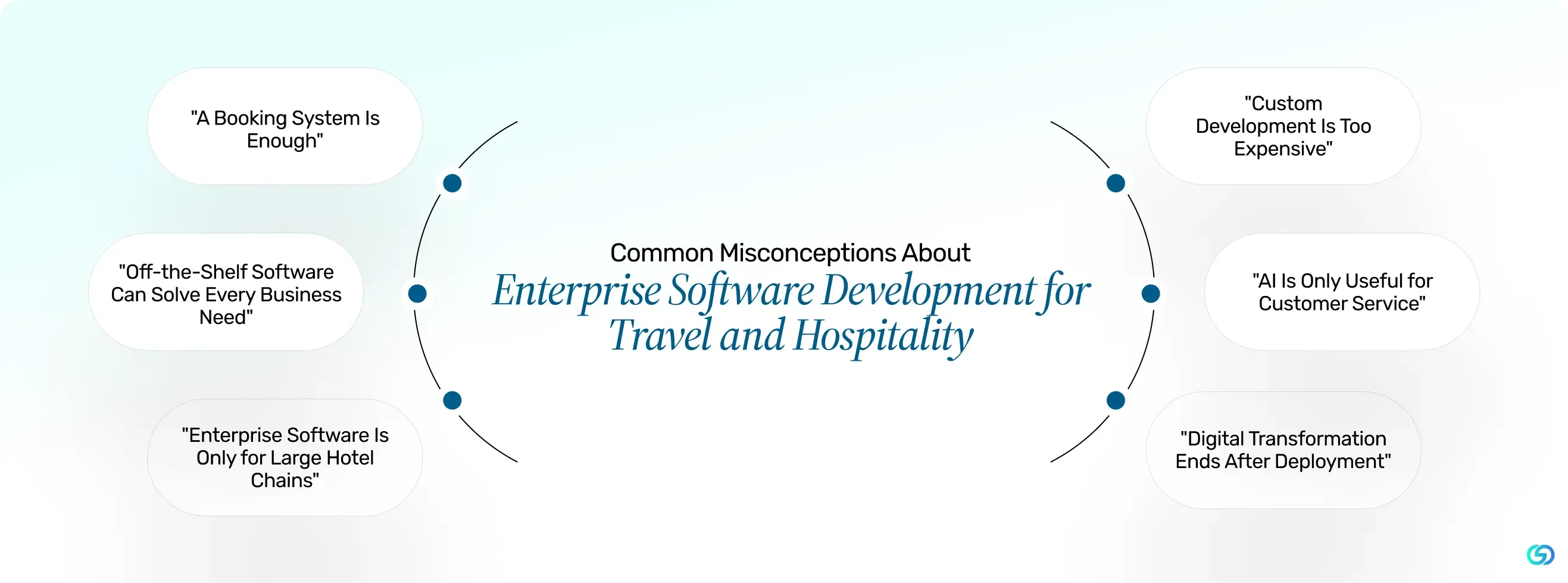
As travel and hospitality businesses accelerate their digital transformation efforts, various misconceptions continue to influence technology decisions. While enterprise software development has become largely crucial for operational efficiency and customer experience management, several businesses still underestimate its value, scope, and long-term effect. Realizing these misconceptions can help enterprises make more informed technology investments.
⏺️ "A Booking System Is Enough"
While booking systems are crucial, they represent only one component of a bigger technology ecosystem. Hospitality enterprises also require integrated PMS, CRM, ERP, analytics, revenue management, customer engagement, and operational management solutions. Without the help of these connected systems , businesses may struggle to offer seamless experiences and achieve operational efficiency.
⏺️ "Off-the-Shelf Software Can Solve Every Business Need"
Off-the-shelf solutions mostly work well for common business functions but can lack the flexibility needed to support unique workflows, custom integrations, multi-property operations, or specialized customer experiences. Custom enterprise software allows businesses to build solutions that align with their specific business goals and operational requirements.
⏺️ "Enterprise Software Is Only for Large Hotel Chains"
Enterprise software is not just limited to multinational hotel groups. The evolving hospitality industry, including resorts, travel agencies, tour operators, and franchise networks, can also leverage the benefits of scalable enterprise software solutions that enhance efficiency, improve customer experiences, and support future expansion as business needs evolve.
⏺️ "Custom Development Is Too Expensive"
Although custom software development may require a higher upfront investment than ready-made solutions, it can significantly reduce long-term operational costs. By eliminating unnecessary features, enhancing efficiency, reducing manual workloads, and reducing dependence on multiple software subscriptions, custom solutions deliver stronger long-term returns.
⏺️ "AI Is Only Useful for Customer Service"
Several businesses associate only AI with chatbots and virtual assistants. Practically, AI can support revenue optimization, demand forecasting, customer personalization, predictive analysis, fraud detection, business intelligence, and workflow automation. These capabilities enable hospitality businesses to enhance both operational and strategic performance.
⏺️ "Digital Transformation Ends After Deployment"
Successful digital transformation extends far beyond software implementation. As customer expectations, technologies, and market conditions continue to evolve, hospitality enterprises should continue to optimize systems, introduce new capabilities, monitor performance, and adapt their technology strategies to maintain long-term competitiveness and business growth.
Choosing the Right Partner Enterprise Software Development for Travel and Hospitality
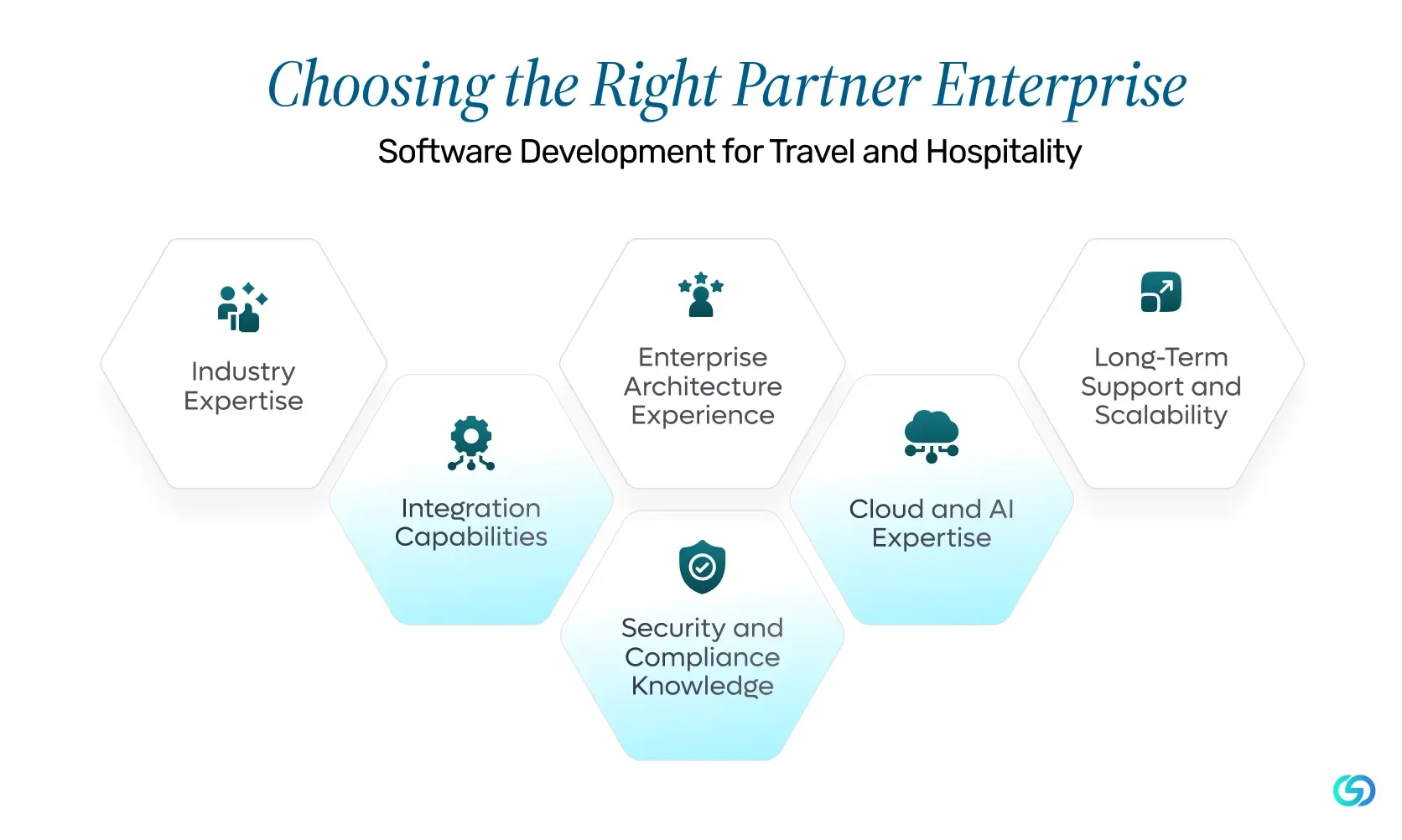
Selecting the right software development partner is a critical decision that can significantly influence the success of a hospitality enterprise's digital transformation journey. Beyond technical expertise, organizations should look for a partner that understands industry-specific challenges, supports long-term growth, and delivers scalable solutions aligned with evolving business objectives.
➡️ Industry Expertise
A development partner with hospitality and travel industry experience can better understand operational workflows, guest expectations, booking processes, revenue management requirements, and industry challenges. This domain knowledge helps ensure that software solutions are aligned with real-world business needs and market demands.
➡️ Integration Capabilities
Modern hospitality enterprises rely on multiple platforms, including PMS, CRM, ERP, booking engines, payment gateways, and analytics tools. A capable development partner should have experience integrating diverse systems to enable seamless information flow across the organization and eliminate operational silos.
➡️ Enterprise Architecture Experience
Enterprise software must support growing customer volumes, expanding operations, and evolving business requirements. Partners with strong enterprise architecture expertise can design scalable, flexible, and future-ready solutions that accommodate business growth without requiring significant system overhauls.
➡️ Security and Compliance Knowledge
Hospitality organizations manage large amounts of customer, financial, and operational data. A reliable development partner should understand security best practices, access management, encryption standards, and compliance requirements to help safeguard sensitive information and reduce business risks.
➡️ Cloud and AI Expertise
Cloud computing and artificial intelligence are becoming essential components of modern hospitality technology. Development partners with expertise in these areas can help organizations improve scalability, automate operations, enhance customer experiences, generate business insights, and accelerate innovation initiatives.
➡️ Long-Term Support and Scalability
Enterprise software development does not end with deployment. Organizations should choose a partner capable of providing ongoing maintenance, performance optimization, feature enhancements, and technical support. Long-term collaboration helps ensure that software solutions continue to evolve alongside changing business needs and industry trends.
Final Thoughts
The travel and hospitality industry is now becoming largely digital, connected, and customer centric. As enterprises handle growing operational complexity, rising guest expectations, and changing market demands, custom enterprise software development from travel and hospitality has emerged as a vital enabler of business growth and innovation. From AI-driven personalization and revenue optimization to real-time analytics and integrated technology ecosystems, modern software solutions help businesses enhance efficiency, improve customer experiences, and make smarter decisions.
However, achieving these results needs more than just implementing individual tools; it requires a strategic approach to digital transformation. By investing in scalable, secure, and future-ready enterprise software, hospitality and travel businesses strengthen their competitive position, adapt to industry changes more effectively, and build resilient operations, supporting long-term success in a largely technology-driven marketplace.
FAQs
How long does it typically take to develop enterprise hospitality software?
The timeline for developing enterprise hospitality software depends on the complexity, required integrations, and deployment scope. While basic solutions can take up to a few months, enterprise-level platforms with multiple integrations and custom workflows typically require a longer development cycle.
Can enterprise hospitality software integrate with existing third-party booking platforms and OTAs?
Yes. Modern enterprise software can integrate with online travel agencies(OTAs), payment gateways, global distribution systems (GDS), CRM platforms, and third-party services via middleware solutions and APIs.
What factors influence the cost of enterprise software development for hospitality businesses?
Scope of the project, customization needs, number of integrations, technology stack, security needs, cloud infrastructure, and continuous support needs are among the main factors that affect development costs.
How can enterprise software support international hospitality operations?
Enterprise platforms can support multiple languages, currencies, tax structures, location-specific workflows, and regional regulations, making them perfect for businesses operating across several countries and markets.
What role does data migration play in hospitality software modernization projects?
Data migration is crucial when replacing legacy systems. It helps ensure that reservation histories, customer records, operational data, and business information are seamlessly transferred to the new platform without disrupting operations.
How do hospitality enterprises measure the ROI of custom software development?
Businesses typically evaluate ROI through metrics such as operational cost savings, increased booking conversions, enhanced customer retention, revenue growth, improved employee productivity, and reduced manual workloads.
How often should enterprise hospitality software be updated?
Regular updates are recommended to maintain security, enhance performance, support new business needs, ensure compatibility with third-party systems, and leverage emerging technologies such as advanced analytics and AI.
Should hospitality enterprises choose cloud-based, on-premises, or hybrid software deployment models?
The ideal deployment model depends on the business's objectives, security needs, regulatory considerations, current infrastructure, and scalability requirements. Several enterprises are largely adopting hybrid or cloud approaches to get greater flexibility and operational agility.