- Benefits of Outsourcing RPA Development
- 2026-02-23
10 Benefits of Outsourcing RPA Development in 2026 for Better ROI

Audio Track
Table of Contents
TL;DR:
- RPA development outsourcing is crucial for organizations that are starting with automation.
- Outsourcing robotic process automation delivers a range of benefits and saves time and money.
- RPA can be paired with AI integration tools, which renders greater benefits and more success overall.
- Just outsourcing is not enough; a business must also focus on picking up the correct outsourcing partner.
How Outsourced RPA Development Cuts Costs and Improves Growth
Robotic Process Automation (RPA) is slowly evolving to be a massive jump for businesses. It is a software technology with the ability to closely resemble human actions, interactions, and interfaces. But is it enough to power complex workflows and automate lengthy tasks? Fortunately, the answer is yes. This is another reason why corporate behemoths have been leaning towards a robotic process automation service provider, and it is also delivering pretty hefty benefits.
RPA development is a massive advantage for companies that are utilizing it, as it enhances business productivity, efficiency, and reduces cost by a significant margin. So how does it do it? To answer this question, one must understand how it works and how it is advancing in the year 2026.
Why RPA Outsourcing is Advancing in 2026
Robotic Process Automation and its demand have grown as a service to organizations at a rapid pace. The RPA market is projected to expand to $24 billion by 2029, which is a massive leap for the market in the coming years. This is purely due to the exponential growth in the AI-driven automation sector and enterprise-wide adoption of the phenomenon.
With no sign of stopping anytime soon, RPA harbors the capability to take over most repetitive business tasks and streamline the workflow. That being said, outsourcing RPA development addresses specific pain points such as implementation complexity, shortage of skilled developers, and the requirement of continuous optimization. So, let’s dive into the benefits of it.
Top Benefits of RPA Outsourcing to Consider
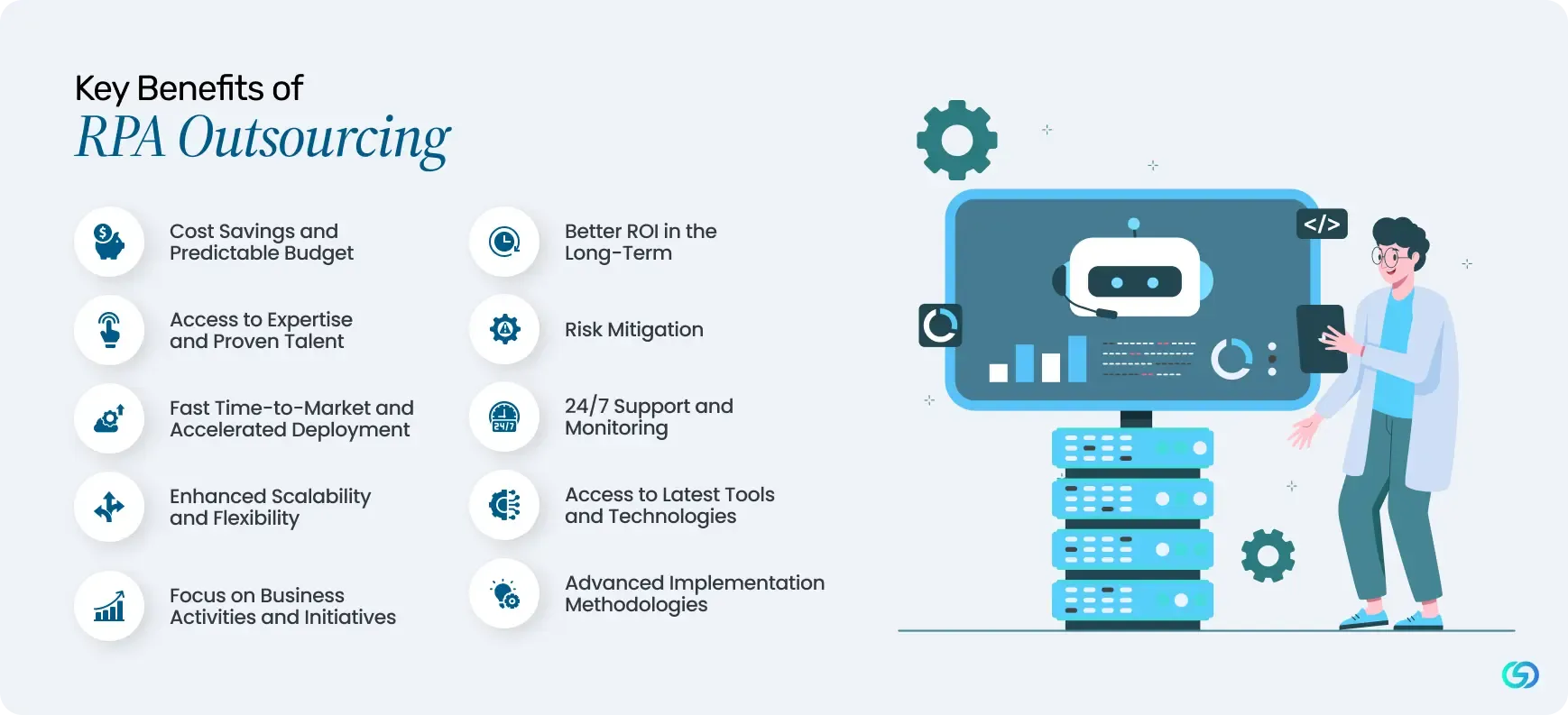
RPA development is not an easy task and implementing it into an existing workflow can get even more difficult. However, after successful integration, a business can look forward to significant benefits. Here they are:
1️⃣ Cost Savings and Predictable Budget
Upfront costs such as developer and project manager salaries, licenses, infrastructure, training programs, and maintenance often make it difficult for businesses to sustain a project. These prices can often spiral, and if projects are delayed or require constant changes, it becomes a lot more difficult for an organization to continue development.
On the other hand, outsourcing RPA development transforms the expenses into more predictable billing, which is also scalable. Many studies suggest that outsourcing the RPA project can cut costs compared to Western countries. RPA bots only cost around one-third of an offshore worker. This can reduce capital expenditure and help a business allocate resources more strategically.
2️⃣ Access to Expertise and Proven Talent
With the demand for automation increasing by the passing day, it has become difficult to find experienced RPA professionals in the competitive market. That being said, outsourcing does mitigate a lot of the challenges by giving organizations a list of top-tier RPA talent.
RPA development professionals bring a massive pool of deep technical knowledge, industry practices, and experiences, which helps build resources that organizations cannot otherwise afford to invest in while maintaining business operations.
3️⃣ Fast Time-to-Market and Accelerated Deployment
When it comes to automation, speed and pace are equally important in how fast it is implemented and how fast it can help an organization compete in the market. Longer development time can make a business remain stuck with inefficient and manual processes, which ultimately drains time.
Outsourcing partners have a streamlined methodology, where they reuse frameworks and utilize pre-built automation templates that aid in reducing development time. RPA teams can also deliver automation solutions that are significantly faster than in-house teams. This is due to a standardized process and an established set of practices.
4️⃣ Enhanced Scalability and Flexibility
Requirements for businesses can change frequently. This means organizations may need to scale Robotic Process Automation deployments during crucial seasons and expand automation to newer departments. An in-house team may struggle with such flexibility due to a fixed headcount or infrastructure constraints.
Meanwhile, outsourcing partners offer flexibility to adjust their team size, scope, and support levels, depending on the current project requirement. Regardless of the number of automating processes, an outsourcing hub will provide access to the right resources with little to no limitations. This includes hiring, training, or even restructuring. This makes outsourcing much better for the scalability of a project, and it is flexible.
5️⃣ Focus on Business Activities and Initiatives
Automation is not the end to all solutions and problems. However, it is a method to solve most problems and a bridge between efficiency and task handling. While outsourcing tackles RPA development, internal teams must focus on other important aspects such as strategy, innovation, customer experience, and revenue-generating activities.
Outsourcing Robotic Process Automation liberates a set amount of workforce to concentrate on other activities that are impactful for the business and drive market advantage. RPA outsourcing hubs are known for their Agile workflows and process optimization specialization, which, as a result, delivers smooth implementation while internal teams are working on other important priorities.
6️⃣ Risk Mitigation
RPA implementations arrive at risk. Data security concerns, regulatory compliance, integration challenges, and downtime upon bots failing are important factors to consider. Businesses that implement RPA must adhere to standards such as GDPR, HIPAA, SOC 2, and regulations that are specific to industries.
Robotic process automation outsourcing partners who are experienced in the field understand the risks and can come up with strategies which can aid a business. Clients who work with established RPA outsourcing hubs often report minimal compliance issues, which demonstrates adherence to industry standards and best practices. RPA offers less compliance risks and works on accuracy and automated audit trails to make regulatory reporting much more reliable.
7️⃣ 24/7 Support and Monitoring
RPA bots require constant monitoring and, if needed, around-the-clock support. This is because these bots cannot just be deployed and forgotten about. They require updates, bug fixes, and optimization to make viable business decisions and automate tasks with minimal flaws. Without it, RPA cannot offer its best evolving processes, and as applications get updated, a business will likely run into more problems.
Most RPA outsourcing companies offer 24/7 support and monitoring. This is to make sure that issues are resolved as soon as they are detected, before they can affect any business workflow. This method helps businesses maintain their best efficiency without any disruptions or downtime.
8️⃣ Access to Latest Tools and Technologies
Most RPA development ecosystems are evolving at a rapid pace. With new platforms, features, and AI implementations emerging, best practices are tuned regularly to keep up with the current requirements of the market. Moreover, AI agents, Generative AI, machine learning, and intelligent automation are slowly turning RPA’s future around this year.
An outsourcing partner can stay on the edge of RPA-related technologies because automation is the core of their business and services. They harbor the knowledge of new automation tools, AI-powered mining abilities, intelligent document processing (IDP), computer vision, and natural language processing (NLP). These are innovative capabilities that can boost a business further into the horizon of a harsh market.
9️⃣ Advanced Implementation Methodologies
If an RPA outsourcing company is experienced, it will follow a standardized methodology, which will boost automation deployment speed in an organization. These methodologies are well refined and validated across various implementations and diverse industries. An important aspect of RPA deployment is to understand that it is more about process, governance, and change management than just the technology itself.
RPA development outsourcing firms are experts in automation. These organizations have worked across a vast range of industries like banking, insurance, healthcare, manufacturing, and retail. They have tested different tools and platforms and applied refined implementation approaches over time. These methodologies encompass enhanced process assessment, automation analysis, ROI modeling, and more continuous improvement frameworks.
🔟 Better ROI in the Long-Term
The ultimate long-term benefit of outsourcing RPA development is measurable returns on investment for organizations. Companies that are implementing RPA through outsourcing hubs often report better results with more ROI within the first year. Additionally, they also report significant cost reductions compared to manual processes, and the majority of businesses confirm fewer manual workloads, which also reduces error rates in the workflow.
According to research, about 70% of organizations achieve paybacks of less than 12 months from RPA initiatives, through automation implemented in about 2 to 3 weeks. The best RPA adopters also report massive returns on investments, which further reinforces their trust on RPA development outsourcing, and they also depend more on their workflows on automation.
How ConvexSol Can Be Your RPA Outsourcing Company?
ConvexSol has proven itself to be an industry leader in software development and automation. The Dubai-based company has over 250 experts who are proficient in modern technologies and can deliver comprehensive RPA outsourcing solutions to clients across the globe. We also specialize in Robotic Process Automation, offering end-to-end automation capabilities to access renowned platforms such as UiPath, Blue Prism, and Automaton Anywhere.
Our services include a complete automation ecosystem, which encompasses strategic consulting to identify automation opportunities, custom bot development tailored to business processes, seamless integration with IT infrastructure, and 24/7 support for optimal performance. ConvexSol has also successfully empowered hundreds of clients across the globe, from healthcare to government sectors.
What sets us apart is the holistic approach of combining RPA development with AI/ML, data analytics, and system modernization. This creates intelligent automation ecosystems to offer measurable returns for an organization. Additionally, the agile development methodology helps with swift deployment and less disruption, while a proactive maintenance approach ensures reliability and scalability of projects.
ConvexSol has proven expertise in delivering accurate results, cross-platform compatibility, and regulatory compliance. We transform repetitive workflows into streamlined and automated processes that aid you and your team in focusing on important aspects such as strategic growth and innovation.
Final Thoughts
RPA development in 2026 is going to become the norm for most companies. It is no longer a limited technology to the big shots, but even smaller organizations and startups have begun to utilize its benefits to ease workflows and automate processes. Robotic process automation is more than just a tool. Moreover, it is one of the best processes to cut costs and accelerate digital transformation for an organization.
Outsourcing RPA development allows a business to access world-class expertise and mitigate implementation risks, while also driving measurable business outcomes. If you partner with specialized RPA outsourcing providers like ConvexSol, your organization can overcome challenges of in-house development, talent shortages, budget overruns, and maintenance complexities. Connect with us today to embark on your RPA journey.
Frequently Asked Questions
Is RPA the same as AI?
While RPA and AI may share a few similar features, practically, they have a completely different ecosystem. RPA automates rule-based, repetitive tasks by mimicking human actions. AI, on the other hand, makes decisions using machine learning and cognitive abilities. Modern RPA integrates AI technologies such as NLP and computer vision to make intelligent automation solutions, which can handle more complex processes.
What are the three main RPA tools?
UiPath, Automation Anywhere, and Blue Prism are considered the three leading RPA platforms. UiPath offers user-friendly visual design and welcoming community support. Automation Anywhere is known for offering cloud-native architecture with AI, and Blue Prism works on enterprise-grade security and scalability for large businesses.
Is RPA used for development or testing?
Robotic process automation is used for both development and testing. During a development process, RPA automates business processes like data entry, invoice processing, and customer onboarding. When testing, RPA bots perform repetitive test execution, regression testing, and test data generation. This reduces manual efforts for quality assurance and accelerates software release workflows.
How soon can we expect results from RPA implementation?
Most businesses that implement RPA into their workflows see results within two to three weeks for simple bots. To achieve full ROI, it can take a few months. However, implementing robotic process automation does give some quick wins, including time savings, fewer errors, and improved efficiency. Timelines regarding this may vary depending on process complexity, integration demands, and readiness.
Can robotic process automation work with legacy systems?
Yes, RPA cannot just work with legacy systems but excel at it without needing expensive upgrades or API integrations. Bots interact with legacy applications with the help of a user interface layer, which mimics human actions like clicking, typing, and data extraction. This makes RPA an ideal choice for outdated systems as they are modernized in a cost-effective way.
Will outsourcing RPA affect my existing IT infrastructure?
RPA operates at the presentation layer without affecting any existing infrastructure. Hence, it will not affect your existing IT infrastructure. Outsourced RPA implementations are designed to be integrated with your current systems seamlessly. It minimizes disruption and enhances efficiency. ConvexSol will ensure compatibility, security, and smooth deployment, which is also aligned with IT governance.
What should I look for when hiring an RPA development outsourcing partner?
When looking for proven experts in major RPA platforms such as UiPath, Automation Anywhere, and Blue Prism, prefer alignment with important factors like industry experience, strong security and compliance practices, 24/7 support capabilities, transparent pricing, successful case studies, and measurable returns. Additionally, ensure they are up to date with modern technologies.