- Fintech Development Outsourcing
- 2026-06-30
The Complete Guide to Fintech Development Outsourcing in 2026

Audio Track
Table of Contents
Key Takeaways:
- Fintech outsourcing helps teams move faster while ensuring security, control, and compliance.
- Outsourcing works best when in-house teams focus on strategy while external experts handle execution and regulations.
- Choosing the right engagement and delivery model reduces burnout and keeps fintech products reliable.
Why is Fintech Outsourcing a Strategic Decision in 2026?
FinTech companies aren’t lacking futuristic strategies or competitive ideas, but it is speed that doesn’t stop for any. Products launch at breakneck speed; regulations tighten without prior warnings, and customer trust is won or lost on reliability. As said, it’s not that fintech teams are aimless, rather it’s the gap.
A growing gap between internal teams and what needs to be built while remaining under the tremendous pressure of blowing timelines and burning out team members.
The system grows more complex, compliance obligations increase, and the integration burden only multiplies, in turn, slowing down execution. In such a scenario, the internal team is seen struggling to maintain stability rather than pushing for innovation. Eventually what happens in most organizations is that progress slowly erodes as the business blueprint stretches, and delivery becomes rare.
The reality is quite visible across financial businesses that are compliance-driven, operating under strict regulatory guidelines, new platforms that are scaling, CTOs and product leaders tackling delivery accountability, and enterprises wanting to modernize legacy infrastructure.
This is where fintech development outsourcing shows up. Fintech outsourcing is not a shortcut but the only and the best way to restore momentum in the business. On correct execution, outsourcing becomes a go-to, allowing the internal teams to focus on core work while specialized work moves forward in parallel.
Building a permanent team for short-term needs might lead to long-term complexity, which is why fintech development outsourcing is a safe and reliable option, offering complete flexibility.
This 2026 and beyond guide for fintech development outsourcing is written for those who want to know how to maintain compliance while balancing both speed and control.
What is Fintech Development Outsourcing?
In simple terms, Fintech development outsourcing means partnering with an external development team to design, build, test, and launch financial technology platforms. With an outsourcing company, you no longer need to hire an in-house development team; you can outsource everything to skilled professionals with profound domain expertise and knowledge.
Fintech entered 2026 and is comparatively very different than what it was a couple of years ago. The market now prefers businesses that adapt to the changes quickly and meet customer demands, all the while maintaining their core systems. Isn’t the change quite visible in how technology is advancing in the fintech industry?
Fintech development outsourcing is not just a short-term tactic to gain a competitive edge, but a part of how fast-growing startups and established enterprises keep pace with evolving needs and become a part of digital transformation.
Fintech Development Outsourcing Models Explained
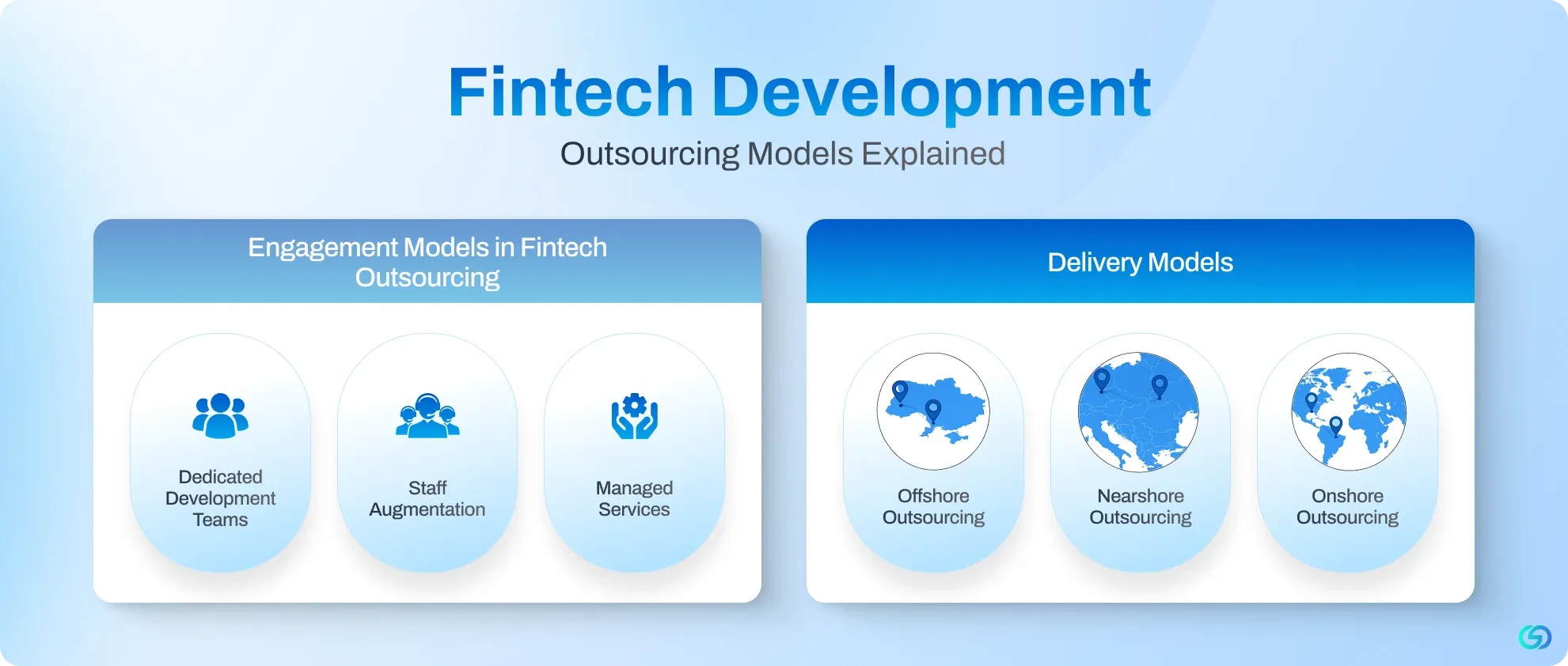
A one-size-fits-all strategy is no longer effective in the fintech industry. Organizations have unique needs and reasons to hire experts. By understanding what fits your needs the best, you can choose the right outsourcing model.
1️⃣ Engagement Models in Fintech Outsourcing
🔹 Dedicated Development Teams
This model involves long-term teams staffed externally but led by internal stakeholders. A dedicated development team works for your product—development, strategizing, scaling, and executing the entire roadmap.
🔹 Staff Augmentation
Businesses hire developers temporarily to fill in specific gaps in skill or scale during high-demand periods. They add specific expertise to your current internal team.
🔹 Managed Services
Under this model, the external party takes ownership of a specific business function. Managed services are focused on results rather than just hours of work.
2️⃣ Delivery Models
🔹 Offshore Outsourcing
This delivery model offers access to a broader pool of talent, often working at a lower cost. The software developers work either as an extension of the in-house team or exclusively on the product. The model requires strong coordination and communication due to gaps in time zones and cultural differences.
🔹 Nearshore Outsourcing
Under this model, businesses hire talent from nearby countries, sharing similar business hours and time zones. Fintech companies can leverage this model to balance real-time collaboration and cost efficiency.
🔹 Onshore Outsourcing
Onshore outsourcing means partnering with a service provider in the same geographic region as yours. This model offers cultural and proximity alignment and increased collaboration and control, but typically comes at a higher cost.
Current & Future Trends in Fintech Development Outsourcing
The fintech industry experiences exponential growth. Fintech outsourcing is a part of a multibillion-dollar outsourcing ecosystem that supports financial tech transformation globally.
- According to statistics, the global fintech BPO market is estimated to reach $12.21 billion in 2026.
- The IT outsourcing market is estimated to hit $777.7 billion by 2028.
- The global financial service outsourcing market is said to be valued at approximately $193.91 billion by 2026.
- More than 60% of finance firms outsourced operations to reduce the cost of operation.
- There’s been a 57% increase in AI automation across outsourced financial operations and customer support.
The numbers stated above clearly show that many fintech firms are opting for outsourcing services and for good reason.
As the fintech platform expands, outsourcing will be defined less by cost and more by depth of specialization.
Compliance-first outsourcing is the most visible trend, where external teams embed regulatory requirements directly into workflows, architecture, and development cycles and treat compliance seriously.
Another shift is the growing demand for AI and data-led outsourcing capabilities. Fintech firms are outsourcing fraud detection models, advanced analytics, automation pipelines, and risk scoring systems, these are the areas that require niche expertise.
Platform modernization and legacy transformation will control outsourcing demand. With organizations moving away from monolithic systems, outsourcing will play a crucial role in API-powered ecosystems, cloud migration, and microservices adoption.
Looking ahead, fintech development outsourcing will be about building adaptable systems without slowing down the business.
What Fintech Development Services Should You Outsource?
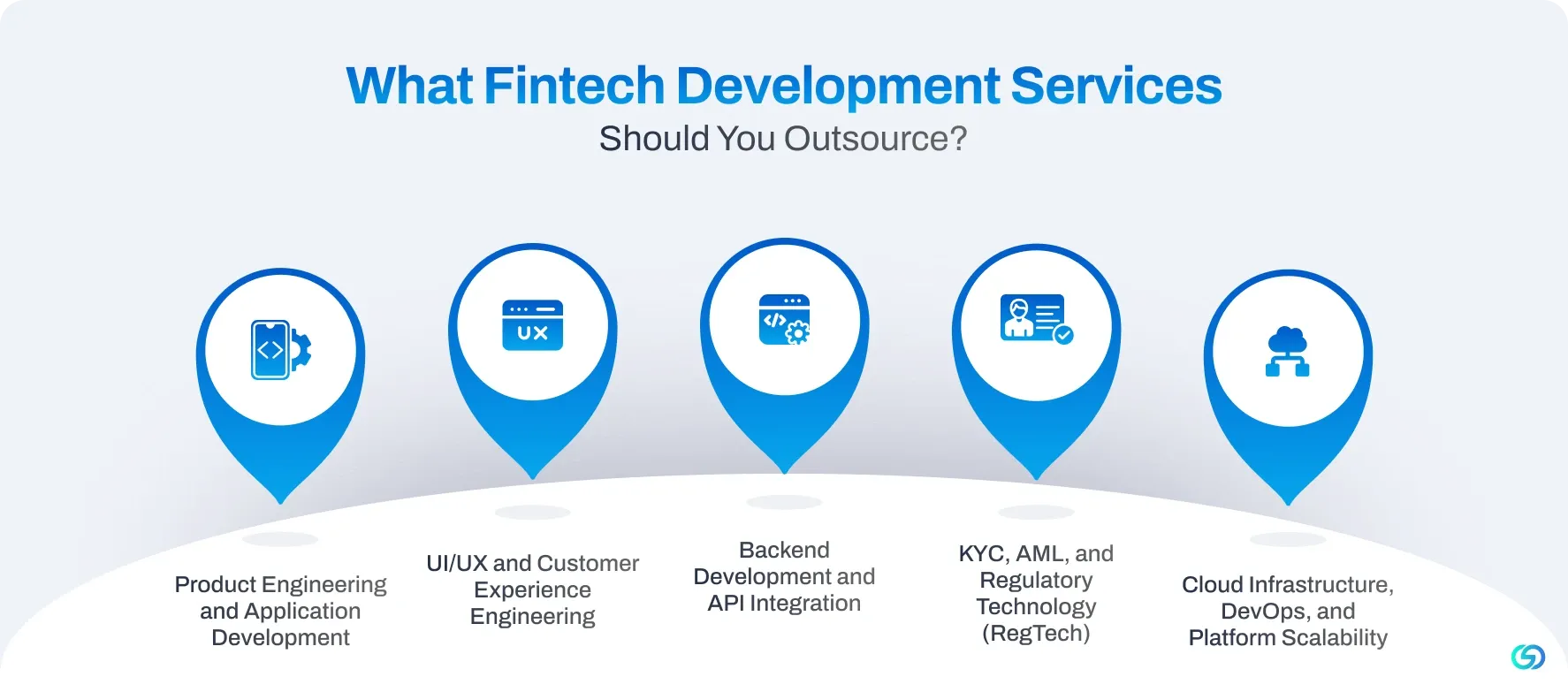
Fintech development outsourcing allows fintech companies to delegate special tasks to experts while focusing on the core operations. By partnering with external teams, companies can intensify development timelines, access advanced technology, and reduce overhead costs.
These are the fintech development services you can consider outsourcing:
▶️ Product Engineering and Application Development
Fintech outsourcing works the best when applied to projects that demand special skill, scalability, and constant regulatory alignment. While the core team focuses on the vision and strategy, the external team handles operational and technical execution. The aim is to strengthen execution where complexity can slow down the internal process.
▶️ UI/UX and Customer Experience Engineering
The outsourcing team helps in simplifying complex financial workflow through intuitive interface design, accessibility improvements, and ongoing experience optimization.
▶️ Backend Development and API Integration
Outsourcing helps in securing backend architecture and third-party integrations for fintech platforms. It also supports transaction processing, payment API integration, and financial data synchronization across ecosystems.
▶️ KYC, AML, and Regulatory Technology (RegTech)
Regulatory compliance keeps growing in complexity across the fintech industry, and outsourcing helps in implementing fraud detection platforms, verification systems, automated compliance reporting, and AML monitoring tools without straining internal teams.
▶️ Cloud Infrastructure, DevOps, and Platform Scalability
Fintech platforms need to handle large volumes of transactions. Outsourced cloud and DevOps teams handle CI/CD pipeline management, cloud migration, infrastructure monitoring, and disaster recovery planning.
Benefits of Fintech Outsourcing to Stay Competitive
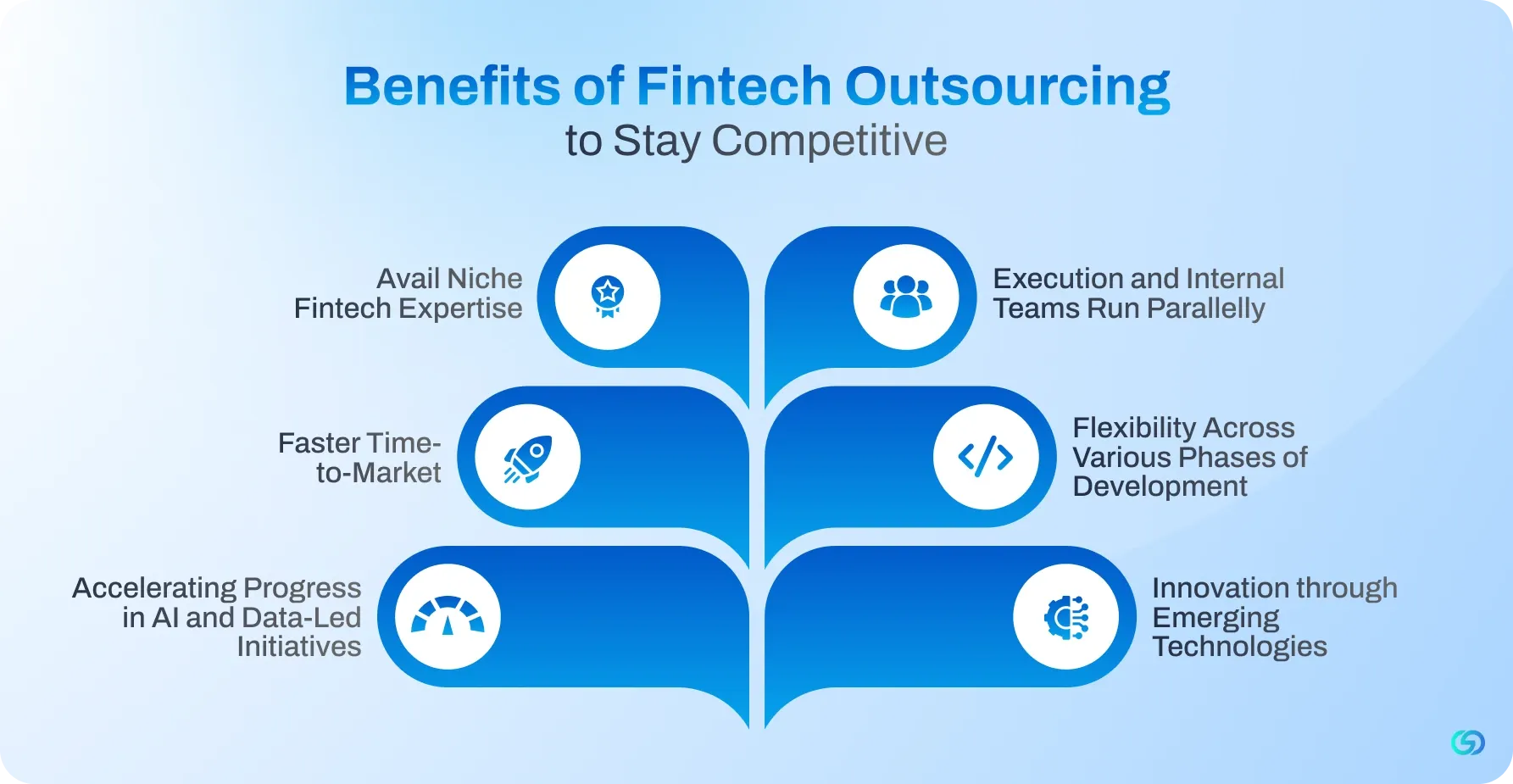
Fintech outsourcing benefits you the most when it removes friction and lessens complexities and not when it adds layers. Businesses do not go for outsourcing just to build a solution but because the speed of the market and innovation no longer awaits. Fintech outsourcing helps stay responsive and eventually removes bottlenecks.
➡️ Avail Niche Fintech Expertise
Why compromise with fintech development when outsourcing allows you to access a pool of talent. Fintech outsourcing partners bring in deep knowledge regarding several areas like fraud detection, AI, digital wallets, and so on. Along with it, they have experience in leveraging the best and most modern technology for software development. This niche fintech expertise is of utmost importance if you want a successful product.
➡️ Execution and Internal Teams Run Parallelly
Internal fintech teams are already busy keeping the platform compliant and stable. Therefore, progress stales and there’s literally no room for innovation. In such a scenario, hiring an outsourcing team can help the internal team stay more focused on the core responsibilities while the outsourcing team can move alongside them.
➡️ Faster Time-to-Market
The race towards innovation is fierce, and time-to-market is non-negotiable. Fintech itself is moving at a blistering speed, supposedly, by the time you think of going live with your idea, the idea itself might become old. When you hire an outsourcing team, you’ve definitely gone through their years of experience, processes optimized, and established workflows. The expert team will assist you in developing, testing, and launching the system much quicker compared to your in-house team.
➡️ Flexibility Across Various Phases of Development
Outsourcing isn’t limited to just one stage. Fintech outsourcing helps companies scale resources based on project needs. In any stage of development, this model allows the team to adjust expertise and capacity. The flexibility provided by outsourcing helps minimize workload, maintain development speed, and support continuous innovation without the need for permanent hiring.
➡️ Accelerating Progress in AI and Data-Led Initiatives
AI has drastically changed the fintech industry. Whether your team is ready or not, AI fintech has revolutionized businesses, allowing them to handle large volumes of financial data and improve fraud detection accuracy. Implementing AI systems requires specialized knowledge and expertise and advanced data infrastructure that an outsourcing team can deploy.
➡️ Innovation through Emerging Technologies
A fintech development outsourcing company gives businesses access to trending technologies such as predictive analytics, AI, and ML due to their ecosystem of constant training whenever new technology arrives in the market. But the best part is that the reliable outsourcing team has the latest tech pieces readily available with them to embed on your platform.
Top Use Cases of Fintech Outsourcing
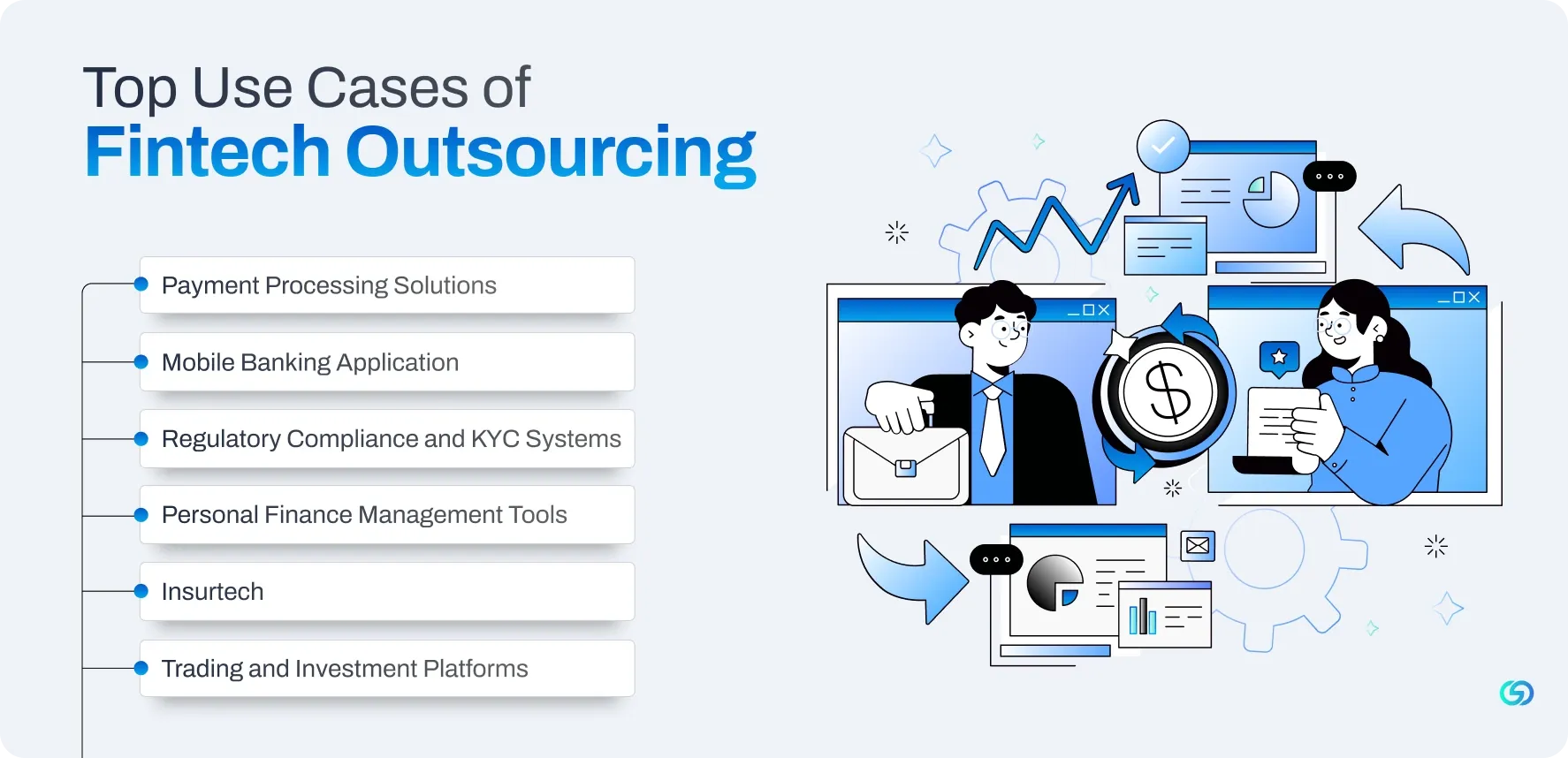
Fintech outsourcing makes sense when internal teams are stretched between delivering innovative solutions and maintaining stability. Here are the most common and practical use cases seen across fintech businesses today:
-
Payment Processing Solutions: Outsourcing helps in the development of payment gateways, cross-border payment platforms, and peer-to-peer transfer systems. This allows for quick launch without having to build special payment infrastructure in-house.
-
Mobile Banking Application: Traditional banking and neobanks outsource Android and iOS app development for responsive and user-friendly mobile banking experiences with advanced features such as biometric authentication, account management, and bill payments, to name a few.
-
Regulatory Compliance and KYC Systems: The complexity of financial regulations is quite known, and companies outsource development of KYC verification, AML monitoring, and regulatory reporting tools.
-
Personal Finance Management Tools: Firms outsource budgeting apps, investment advisors, expense trackers, and financial planning platforms that aid in managing money to users.
-
Insurtech: Insurance firms can outsource the development of claims processing systems, AI-powered risk assessment systems, and policy management platforms to modernize the operations.
-
Trading and Investment Platforms: Brokerage companies outsource stock trading apps, portfolio management platforms, and robo-advisors.
How to Outsource Fintech Software Development
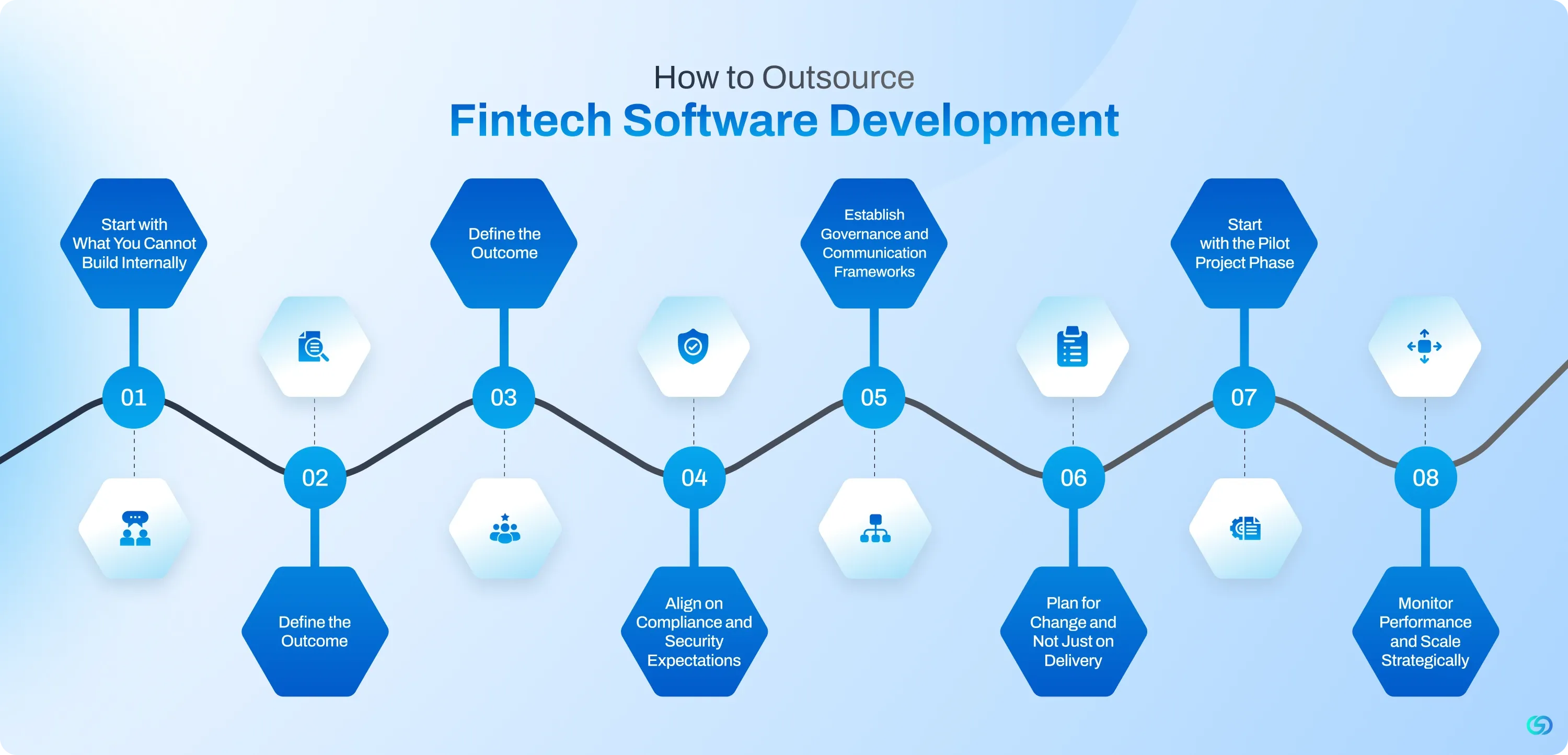
Fintech development success requires a structured approach. Outsourcing companies align your long-term goals with your current requirements. Before partnering with one, organizations should establish a complete development process that clearly defines compliance requirements, core IP, and technical specifications.
🔷 Step 1: Start with What You Cannot Build Internally
Decide what you can develop in-house, like proprietary algorithms, core IP, strategic decisions, and risk logic. Other remaining activities, beyond core strategy and decision-making, can be handled by supporting teams.
🔷 Step 2: Define the Outcome
Instead of compiling tasks, fintech development outsourcing subdivides the requirements into clearly defined outcomes, such as what should be production-ready or what needs to undergo audits. Such an approach works well when quality and compliance matter more than speed of delivery.
🔷 Step 3: Shortlist Fintech Experts
Here comes the main part: evaluate the vendors on the fintech domain based on their years of experience, expertise, portfolio, and technology capabilities. It’s best to hire someone with industry-specific experience to reduce compliance and accelerate onboarding.
🔷 Step 4: Align on Compliance and Security Expectations
In fintech software development, both security and compliance cannot be an afterthought. Access control, audit trails, data handling, and regulatory alignment—all need to be agreed upon before even writing a single line of code. Exceptional fintech outsourcing integrates this right into its delivery workflow.
🔷 Step 5: Establish Governance and Communication Frameworks
Define project milestones, reporting structures, performance KPIs, and collaboration tools. Transparent communication helps maintain delivery consistency.
🔷 Step 6: Plan for Change and Not Just on Delivery
In fintech, roadmaps are constantly evolving, regulations shift with time, the pattern of app usage alters, and products are never simply “launched and done.” This step is highly crucial to building flexibility into engagement models and contracts, allowing teams to adapt easily as requirements change.
🔷 Step 7: Start with the Pilot Project Phase
It’s best to start with feature development or smaller modules to analyze the outsourcing team’s technical capabilities and collaboration efforts.
🔷 Step 8: Monitor Performance and Scale Strategically
The outsourcing partner continuously tracks performance and ensures security compliance. With time, as trust and efficiency improve, businesses can expand outsourcing involvement based on their requirements.
Compliance and Security Considerations for Outsourced Services in the Fintech Industry
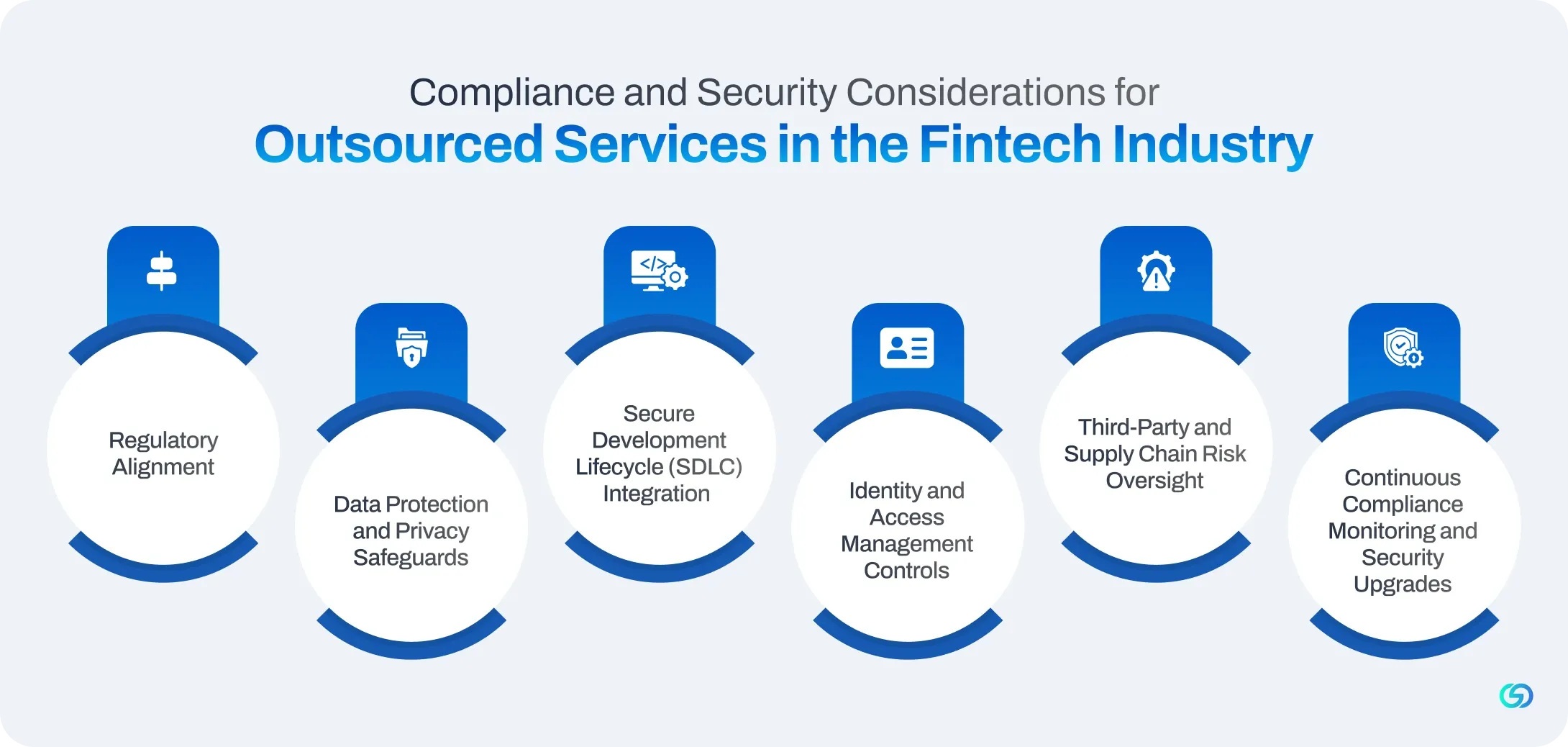
Outsourcing decisions are judged based on how well risk is controlled rather than delivery speed. Both security and compliance are embedded into the platform’s architecture and access models right from the initial phase.
*️⃣ Regulatory Alignment
Fintech solutions operate across several regulatory environments. Outsourcing partners must have experience in global and regional financial regulations, such as:
- GDPR
- PCI DSS
- PSD2
- AML
- KYC
Your outsourcing partner should be able to transition regulatory frameworks into practical development that supports audit readiness.
*️⃣ Data Protection and Privacy Safeguards
Fintech services involve highly sensitive personal and financial data. It’s crucial for vendors to follow strict encryption standards, implement secure management practices, and ensure data storage environments. Robust privacy frameworks reduce exposure to breaches and strengthen customer trust.
*️⃣ Secure Development Lifecycle (SDLC) Integration
Security needs to be implemented throughout the development process rather than applying only in the final testing phase. Vendors must follow:
- Secure coding standards
- Conduct vulnerability assessments
- Ensure continuous testing
All these practices ensure that the platform remains reliable.
*️⃣ Identity and Access Management Controls
Robust access ensures that only authorized personnel interact with delicate financial systems. Outsourcing companies can maintain role-based access control, continuous activity monitoring, and multi-factor authentication.
*️⃣ Third-Party and Supply Chain Risk Oversight
Outsourcing partners depend frequently on APIs, financial data services, or cloud providers. Each external dependency introduces security exposure that must be monitored and evaluated constantly.
*️⃣ Continuous Compliance Monitoring and Security Upgrades
With the continuous evolution of financial regulations and cyber threats, outsourcing companies need to update compliance records, examine regulatory changes, and reinforce security policies to maintain long-term operational success.
Major Risks & Challenges Associated with Fintech Outsourcing
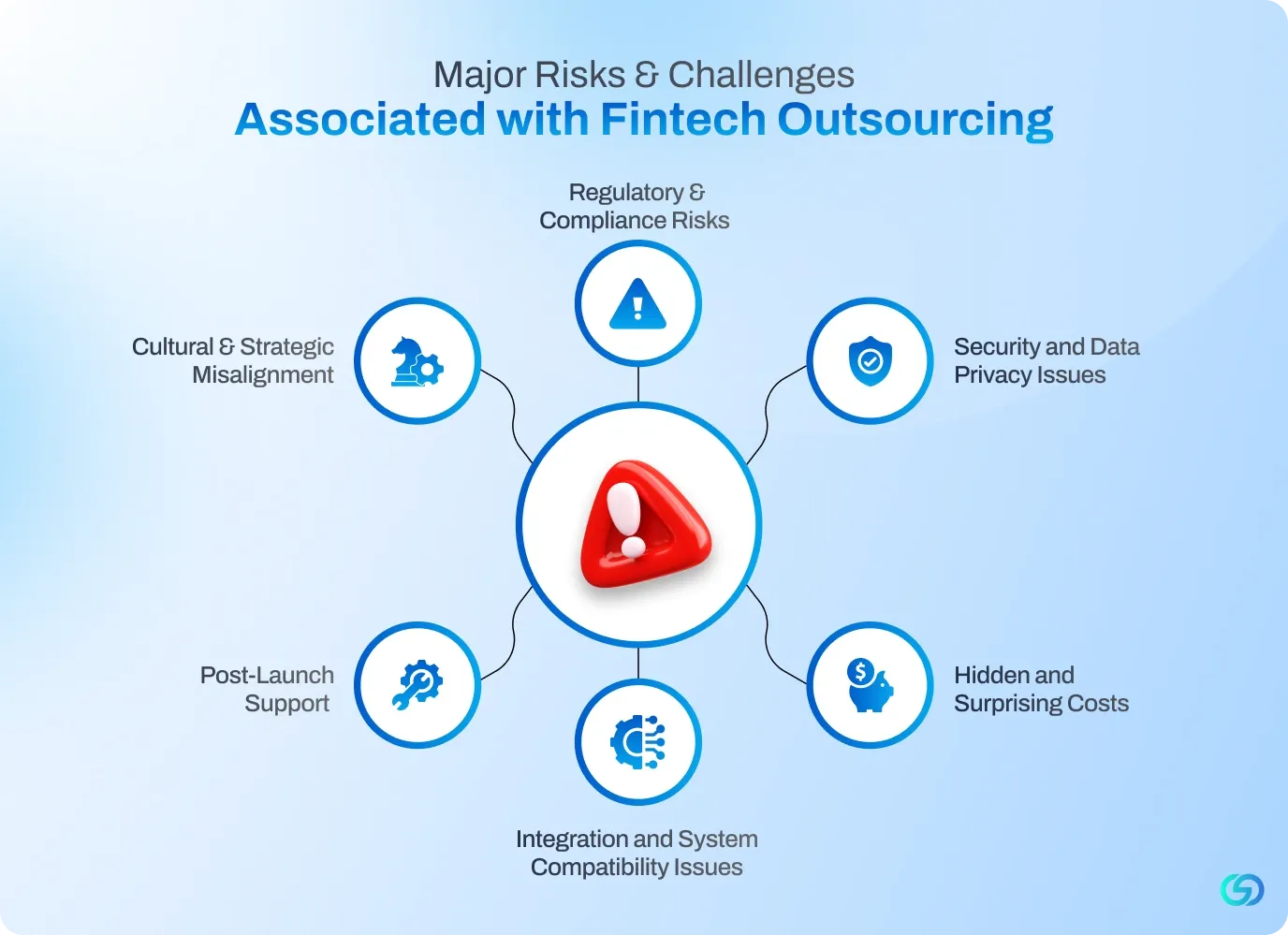
Though fintech outsourcing is versatile and allows you to hire top talent, it does come with certain major challenges. If you are operating in the fintech industry, it’s best to be aware of the risks and challenges beforehand. Let’s see what to watch out for:
↗️ Regulatory & Compliance Risks
Fintech development needs to abide by restrictive laws, which can cause legal issues or delays when working with a partner who lacks an understanding of the regulations where you operate.
↗️ Security and Data Privacy Issues
The stakes are high during the processing of sensitive user data. The fintech development outsourcing partner needs to be aware of good security measures, otherwise, it can lead to security breaches.
↗️ Hidden and Surprising Costs
Make sure the scope is well-defined; otherwise, what looks affordable can turn quite expensive. Ensure pricing models and policy changes are thoroughly reviewed to avoid bottlenecks.
↗️ Integration and System Compatibility Issues
The fintech systems depend heavily on complex integrations with APIs, payment gateways, banks, and third-party services. Outsourcing partners with poor coordination can lead to integration failures and performance bottlenecks.
↗️ Post-Launch Support
Some companies provide core outsourcing services and vanish right after the product launch. This makes updates, bug fixes, and other necessary fixes tougher if support isn’t defined properly in advance.
↗️ Cultural & Strategic Misalignment
If you think your long-term goals and business vision don’t align with the outsourcing vendor’s priorities, then it’s best to choose a team that completely gets you.
Our Internal Checklist for Evaluating Fintech Outsourcing Partners
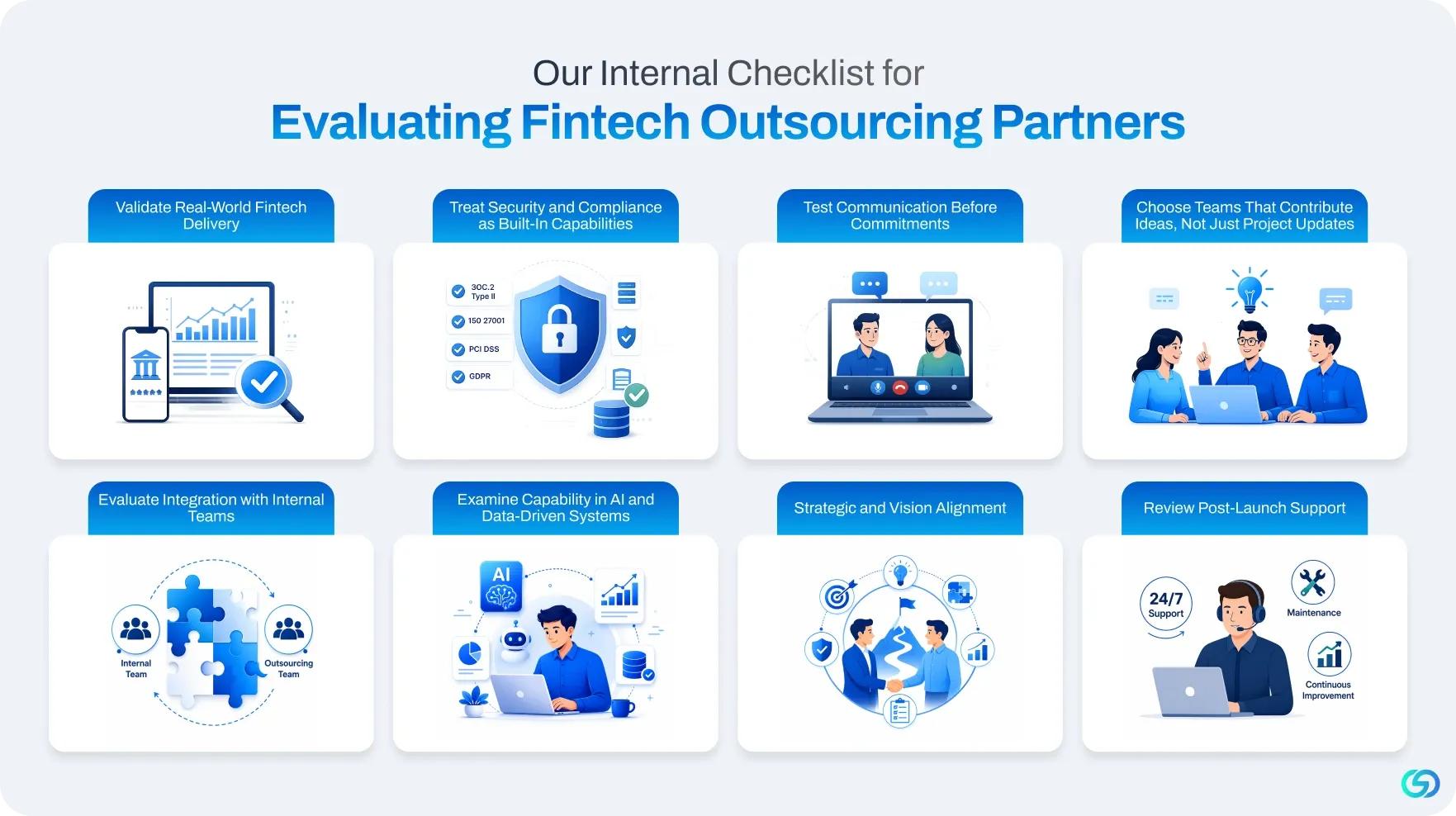
In fintech, it’s not just about coding skill, it’s about collaborating with a team that has in-depth knowledge about the industry, innovation cycles, and AI-driven initiatives. This allows the margin for error to shrink. The right outsourcing development partner very well understands compliance and regulations and accelerates execution.
⏺️ Validate Real-World Fintech Delivery
Not just a generic platform, but a fintech partner should bring direct experience of building fintech products. It’s essential that your vendor is familiar with financial data flows, regulatory-driven development, and availability systems that reduce onboarding time and risks of execution.
⏺️ Treat Security and Compliance as Built-In Capabilities
Data security is completely non-negotiable in the fintech industry. The offshore company you select should be familiar with various laws such as GDPR, SOC 2, or KYC/AML. To fast-forward the process, ask how they manage sensitive data, control user access, and the tools they use for encryption.
⏺️ Test Communication Before Commitments
Efficient coding is nothing if communication is weak. Early communication patterns reveal how delivery will unfold. Do they help you gain clarity? Ask questions about business objectives? What tools do they use to keep you in the loop?
⏺️ Choose Teams That Contribute Ideas, Not Just Project Updates
Reliable fintech development outsourcing companies won’t just act as you want them to, but they’ll recommend ideas, latest tools, and more innovative approaches.
⏺️ Evaluate Integration with Internal Teams
A good fintech outsourcing partner will not work in silos, they will fit into the existing team, work with your tools and models, while keeping responsibilities clearly defined on both sides.
⏺️ Examine Capability in AI and Data-Driven Systems
Experienced fintech partners will not just talk about AI, rather, they will have expertise in how to work with AI models, analytics, build smarter systems, and leverage automation that reduces risk and improves decision-making.
⏺️ Strategic and Vision Alignment
It’s easier to work with someone who understands your work culture and is active when you need them. A few overlapping work hours make collaboration smoother.
⏺️ Review Post-Launch Support
Fintech partners don’t just require constant updates and regulatory adjustments after launch. They provide a structured approach, incident response readiness, and more, helping you meet business needs.
Why ConvexSol is Your Ideal Fintech Development Outsourcing Partner
Fintech outsourcing isn’t about replacing the internal teams, but about executing at the right moment. When bottlenecks and complexities grow faster compared to delivery capacity, outsourcing restores momentum.
Leaders see outsourcing as a controlled way of operating their business. Organizations gain speed without losing control over their functionality by retaining ownership of risk, strategy, and core IP.
We hope this guide helps you gain clarity around fintech development outsourcing. With ConvexSol, fintech leaders move faster, and internal teams focus on other crucial areas of the business.
Product engineering, cloud, AI, compliance-driven development, and integration-heavy platforms, we work as an extension of your team, focusing on modernization and scalability accompanied by confidence, clarity, and long-term stability.
Frequently Asked Questions
Who should consider fintech development outsourcing?
Pretty much anyone in the financial space. This includes startups, traditional banks, payment companies, insurance firms, lending platforms, and even crypto businesses. If you don’t have an in-house team, outsourcing does make sense.
Can outsourcing partners handle compliance requirements as per my region?
Yes, but for that you need to choose carefully. Good fintech development companies have ample experience with regulations like GDPR, PCI DSS, or certain banking rules in your country. Just ensure they have worked in your region and understand the compliance landscape.
Can fintech outsourcing work for products that are already live and scaling?
Yes, you don’t need to start from scratch. Many firms outsource to improve performance, add advanced features, and manage increased user loads. It’s actually common to bring in an outsourcing team when you need an extra hand.
How long does it typically take to see ROI from fintech outsourcing?
Usually 6 months or so, though it varies. You will witness cost savings quickly because outsourcing is comparatively cheaper than building an in-house team.
Can businesses of all sizes benefit from fintech development outsourcing?
Yes, startups can build MVPs, and mid-sized firms can move it past competitors. Even large enterprises outsource specific projects to access niche expertise that they don’t have internally.