- enterprise digital transformation
- 2026-07-01
Enterprise Digital Transformation: Strategy, Benefits & Future Trends
Audio Track
Table of Contents
Key Takeaways
- Enterprise digital transformation is a strategic business initiative that modernizes customer experiences, operations, and decision-making via digital technologies.
- Legacy systems mostly limit scalability, agility, innovation, and data accessibility, making modernization important for the long-term growth of the business.
- Technologies such as cloud computing, automation, AI, data analytics, cybersecurity, and IoT are the foundation of successful digital transformation initiatives.
- A successful digital transformation strategy needs clear business objectives, employee adoption, strong leadership, effective change management, and ongoing optimization.
- The future of enterprise digital transformation is largely intelligent and agentic, with AI-driven systems driving autonomous workflows, predictive insights, and enterprise-wide innovation.
Overview: Understanding Enterprise Digital Transformation?
Enterprise digital transformation means strategically integrating advanced digital technologies across all business functions to enhance operations, deliver greater value, and strengthen client relationships. For enterprises, digital transformation drives innovation, streamlines processes, and elevates customer experiences. It is more than automating tasks or eliminating paper; it requires reimagining your business to align with today’s digital-first environment.
Think about a big financial services firm that has been there for decades. For several years, they have relied on manual processes, including in-person meetings, paper records, and manual data entry. While it worked well for a while, as tech-savvy competitors began to dominate the market, they started to lose ground. Understanding the requirement for change, the business embraced digital transformation. They introduced specialized analytics to make sense of their data, automated repetitive or routine tasks to free up employees' time, adopted cloud technology for accessible, secure storage, and considered implementing AI to improve customer interactions. The result was a more efficient, agile, and customer-focused business that is not merely surviving but thriving. This illustration extends beyond finance. Whether in healthcare, manufacturing, or education, digital transformation applies universally. It is about evolving to meet the demands of a rapidly shifting world.
The Problems with Legacy Architecture for Enterprise
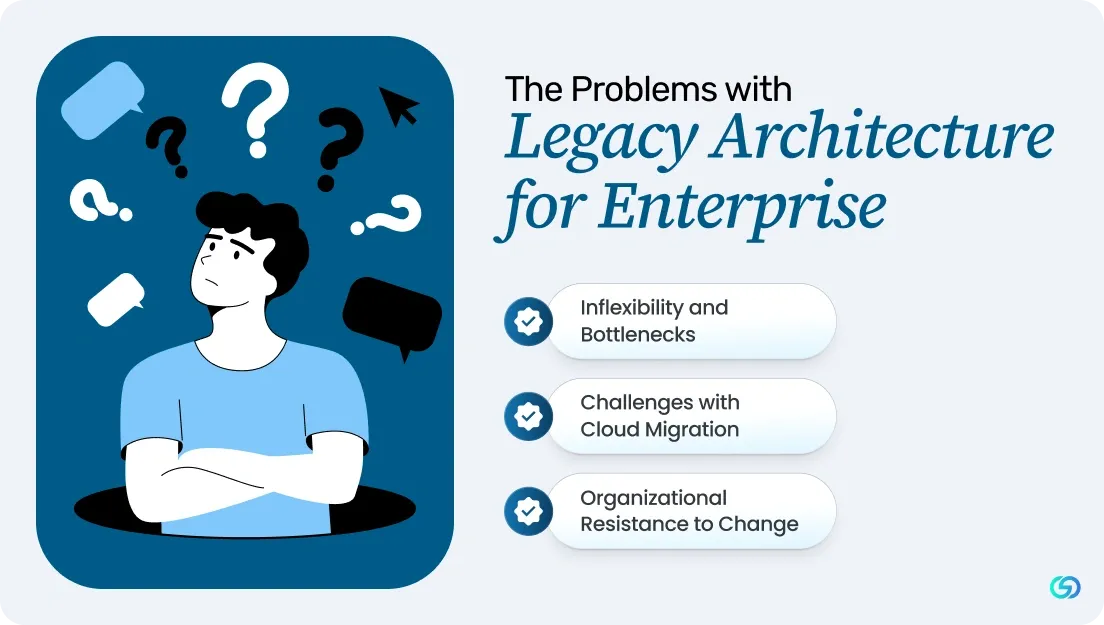
Many enterprises still rely on legacy digital platforms. While once effective, these systems now fail to meet evolving digital needs, creating obstacles to modernization and agility.
Legacy platforms, although successful in the past, are often at odds with today’s digital goals. The following explains why these systems can significantly block enterprise transformation.
↗️ Inflexibility and Bottlenecks
Legacy systems are rigid, making adaptation, scaling, or innovation difficult.
Updating a single component can require changes across the system, slowing development and increasing risk.
Content teams often encounter inefficient workflows, as publishing across multiple channels requires duplicating effort rather than optimizing. These platforms restrict organizations to specific formats, making it challenging to modernize the user experience without significant development.
Enterprises often need new multisite features that most existing CMS platforms cannot support efficiently.
Updating, maintaining, and enhancing legacy systems with new technologies is often challenging. Frequently, these platforms cannot keep pace with digital advancements, which may ultimately hinder enterprise growth.
↗️ Challenges with Cloud Migration
Many legacy platforms were built for on-premises environments rather than the cloud. Adapting them for cloud deployment often results in performance issues, added complexity, and missed opportunities.
This can result in higher latency, security limitations, and increased costs. Many solutions are all-in-one, combining features, leading to inconsistent integration.
This makes it harder for IT teams to maintain compatibility and for marketing and content teams to deliver cohesive experiences using poorly integrated tools.
↗️ Organizational Resistance to Change
Relying on legacy platforms can slow teams and reduce efficiency. Over time, this fosters a mindset that resists upgrades, allowing outdated systems to hinder progress rather than support it.
Departments may resist new solutions due to concerns about retraining, loss of ownership, or perceived risk. As a result, stopgap measures often arise to patch outdated processes.
This slows transformation and can cause businesses to fall behind more agile competitors that quickly adopt modular and modern technologies.
What are the Key Elements of Digital Transformation for Enterprises?
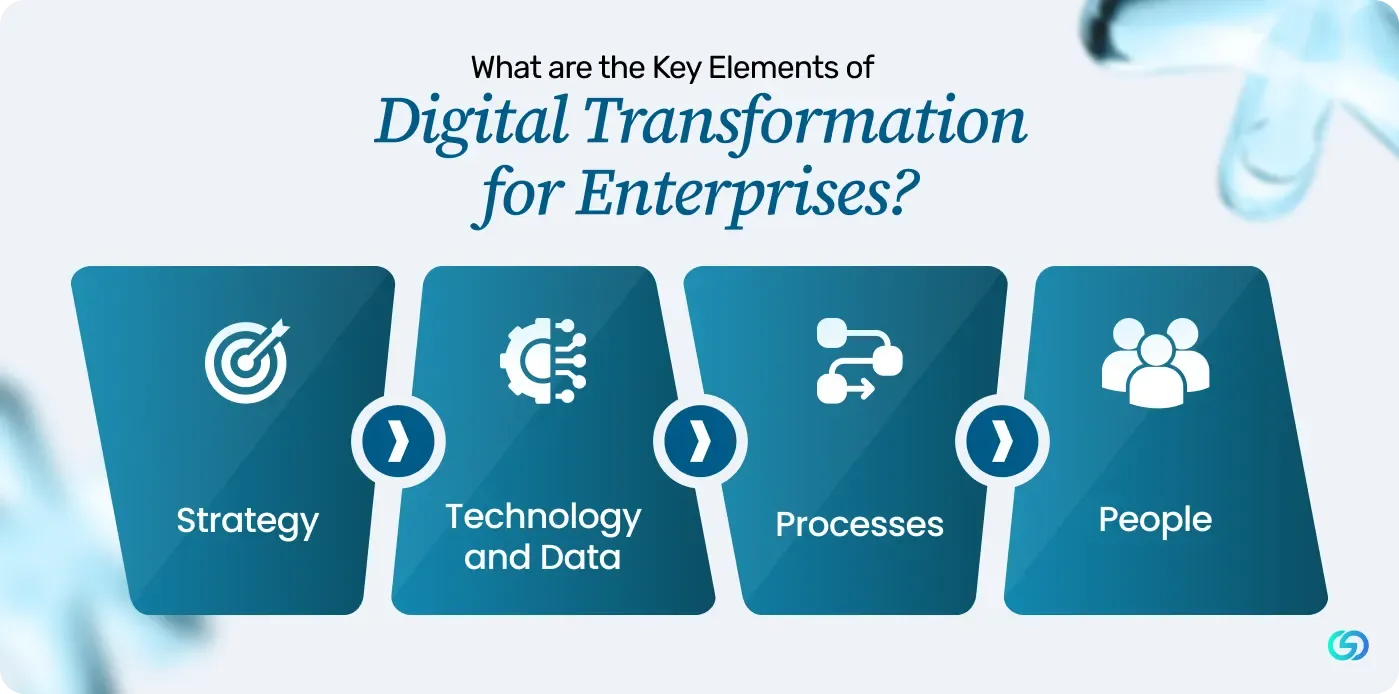
Successful digital transformation depends on integrating several key elements. While technology is essential, true transformation aligns strategy, technology and data, processes, and people to create sustainable business value. When these components are coordinated, enterprises can improve efficiency, foster innovation, enhance customer experiences, and achieve long-term growth.
🔷 Strategy
A well-defined strategy forms the foundation of digital transformation by establishing the organization’s vision, objectives, and roadmap. Digital transformation goals should align with broader business objectives, such as improving customer experiences, increasing efficiency, expanding into new markets, or driving revenue growth.
A clear strategy allows organizations to prioritize initiatives, allocate resources, gain stakeholder support, and define key performance indicators to track progress.
🔷 Technology and Data
Technology and data are central to digital transformation. Enterprises require scalable, secure, and flexible technology ecosystems to support innovation and growth. Solutions like cloud computing, artificial intelligence, machine learning, automation, and advanced analytics streamline operations, improve decision-making, and enable personalized customer experiences.
However, technology alone is insufficient. The effectiveness of digital tools depends on the quality, accessibility, and governance of supporting data. By treating technology and data as strategic assets, enterprises gain actionable insights, increase agility, and achieve scalable results.
🔷 Processes
Even with a strong strategy and modern technology, transformation may fail if business processes are inefficient or disconnected. Processes determine how work flows across departments, teams, and systems, making them essential to digital transformation.
Rather than simply digitizing existing workflows, enterprises should reimagine and optimize processes to eliminate bottlenecks, enhance collaboration, and deliver greater customer value. Automation, workflow standardization, and continuous improvement help organizations become more agile, efficient, and responsive to changing needs.
🔷 People
People are critical to successful digital transformation. New technologies and processes deliver value only when employees understand, adopt, and use them effectively. Change management, employee engagement, and skills development are essential.
Organizations should foster a culture of innovation, collaboration, and continuous learning, while providing employees with the training and support needed to adapt. Strong leadership and cross-functional alignment ensure transformation is embraced throughout the enterprise, supporting long-term success and growth.
What Are the Drivers and Benefits of Enterprise Digital Transformation?
In the present fast-changing business environment, digital transformation has become crucial rather than a choice for enterprise businesses that want to stay agile and relevant. By utilising digital technologies, businesses can streamline their processes, improve customer experiences, and optimise. However, what actually drives this change and what advantages can businesses expect to get from it? Let us explore the key drivers and benefits of enterprise digital transformation solutions.
The main drivers of enterprise digital transformation:
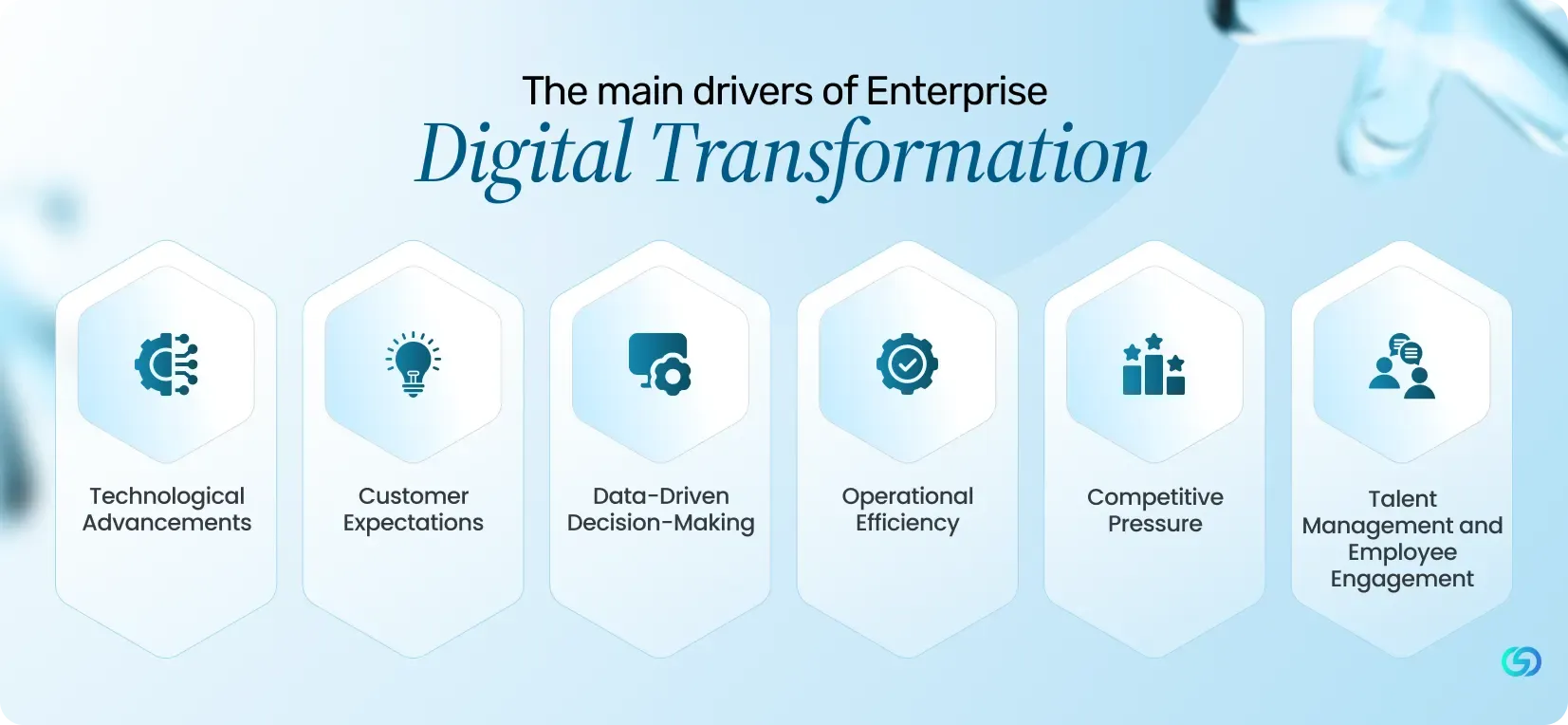
▶️ Technological Advancements
The rapid pace of technological innovations is among the strongest drivers of digital transformation. Emerging technologies such as artificial intelligence (AI), machine learning (ML), cloud computing, and the Internet of Things (IoT) offer businesses tools to automate processes, analyse large volumes of data, and gain deeper insights into customer behaviour and business performance. These technologies help businesses stay competitive in a rapidly digitalising world.
▶️ Customer Expectations
Customers currently expect easy, highly responsive service. Whether you are communicating with a company online or in person, customers demand real-time engagement and convenience. Meeting these expectations requires businesses to adopt digital tools that deliver a consistent, superior experience across all touchpoints. This change in customer behaviour is pushing businesses to evolve digitally to remain relevant.
▶️ Data-Driven Decision-Making
The increasing availability of data has transformed business operations. Businesses now have access to more data than ever before, and digital transformation enables them to effectively analyse and harness this data to make informed decisions. Data-driven decision-making enhances operational efficiency, improves customer insights, and allows businesses to predict trends and respond proactively to market changes.
▶️ Operational Efficiency
The desire to decrease costs, enhance productivity, and optimise operations is a significant driver of digital transformation. Integration of systems, the operation of repetitive tasks, and the ability to access real-time data help eliminate inefficiencies and empower employees to focus on specific tasks. Businesses implementing digital transformation initiatives can significantly improve internal operations, reduce human error, and streamline resource allocation.
▶️ Competitive Pressure
As more businesses adopt digital technologies, there is growing pressure for others to follow suit. If businesses fail to embrace digital transformation, they risk being left behind by competitors who utilise innovative technologies to improve performance and customer offerings. In several industries, those who adapt to digital trends first get a distinct competitive edge.
▶️ Talent Management and Employee Engagement
In today’s workforce, employees expect tools and technologies that improve their productivity and allow a more flexible work environment. Digital transformations enable businesses to provide remote work solutions, collaborative platforms, and better employee engagement tools. These improvements make the business more attractive to top talent, increase employee satisfaction, and enhance retention.
The benefits of enterprise digital transformation are as follows:
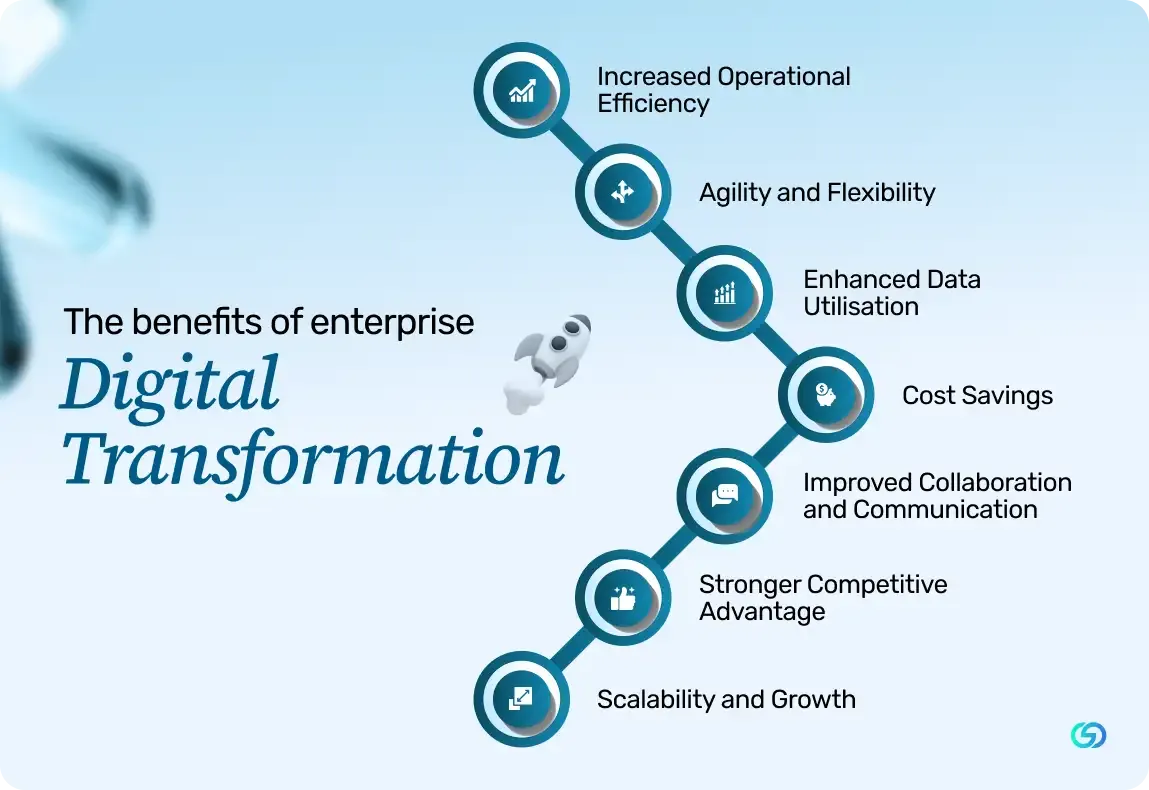
Improved Customer Experience: Digital transformation enables businesses to deliver efficient, personalised, and consistent experiences across multiple channels. By utilising AI, data analytics, and automation, businesses can better understand customer requirements, anticipate preferences, and respond more quickly to queries and concerns. The result is increased loyalty, customer satisfaction, and lifetime value.
▶️ Increased Operational Efficiency
By automating manual processes, implementing systems, and streamlining workflows, digital transformation significantly improves operational efficiency. Employees can focus on high-value tasks, while processes become faster, more accurate, and less prone to error. This results in cost reductions, enhanced productivity, and streamlined resource utilisation.
▶️ Agility and Flexibility
Digital transformation equips businesses with the tools to adapt faster to changing market conditions. Scalable technologies and cloud-based solutions enable enterprises to pivot their strategies, expand into new markets, or adjust offerings in response to customer demands or industry disruptions. This kind of agility is crucial in the present unpredictable business landscape.
▶️ Enhanced Data Utilisation
With digital transformation, companies can gather, store, and analyse large amounts of data from multiple sources. This enables data-driven decision-making, improved forecasting, and better performance measurement. By utilising data effectively, businesses can find out trends, streamline their strategies, and develop new services or products that better meet customer requirements.
▶️ Cost Savings
Digital transformation delivers significant cost savings through automation and improved resource allocation. Cloud solutions eliminate the need for expensive on-premises infrastructure, and digital tools enable businesses to run learner operations with minimal resources. These savings can further be reinvested into innovation, growth initiatives, or other strategic priorities.
▶️ Improved Collaboration and Communication
Digital tools like collaboration platforms, cloud-based project management software, and instant messaging systems are driving better communication and teamwork across departments. This improved collaboration not only enhances internal workflows but also ensures that the team can work together easily, even when working remotely or across multiple locations.
▶️ Stronger Competitive Advantage
By embracing digital transformation, businesses can innovate and stay ahead of the competition. Whether through cutting-edge technology, enhanced customer engagement, or streamlined internal processes, digital transformation enables companies to differentiate themselves in a crowded marketplace. Businesses that utilise digital transformation to differentiate are more likely to achieve long-term success and sustainable growth.
▶️ Scalability and Growth
As businesses grow, their operations and infrastructure have to scale accordingly. Digital transformation enables enterprises to scale more seamlessly and efficiently by offering flexible, cloud-based solutions that evolve with the business. This scalability enables organisations to expand their reach, enter new markets, and grow their customer base without experiencing operational bottlenecks.
Key Areas of Enterprise Digital Transformation
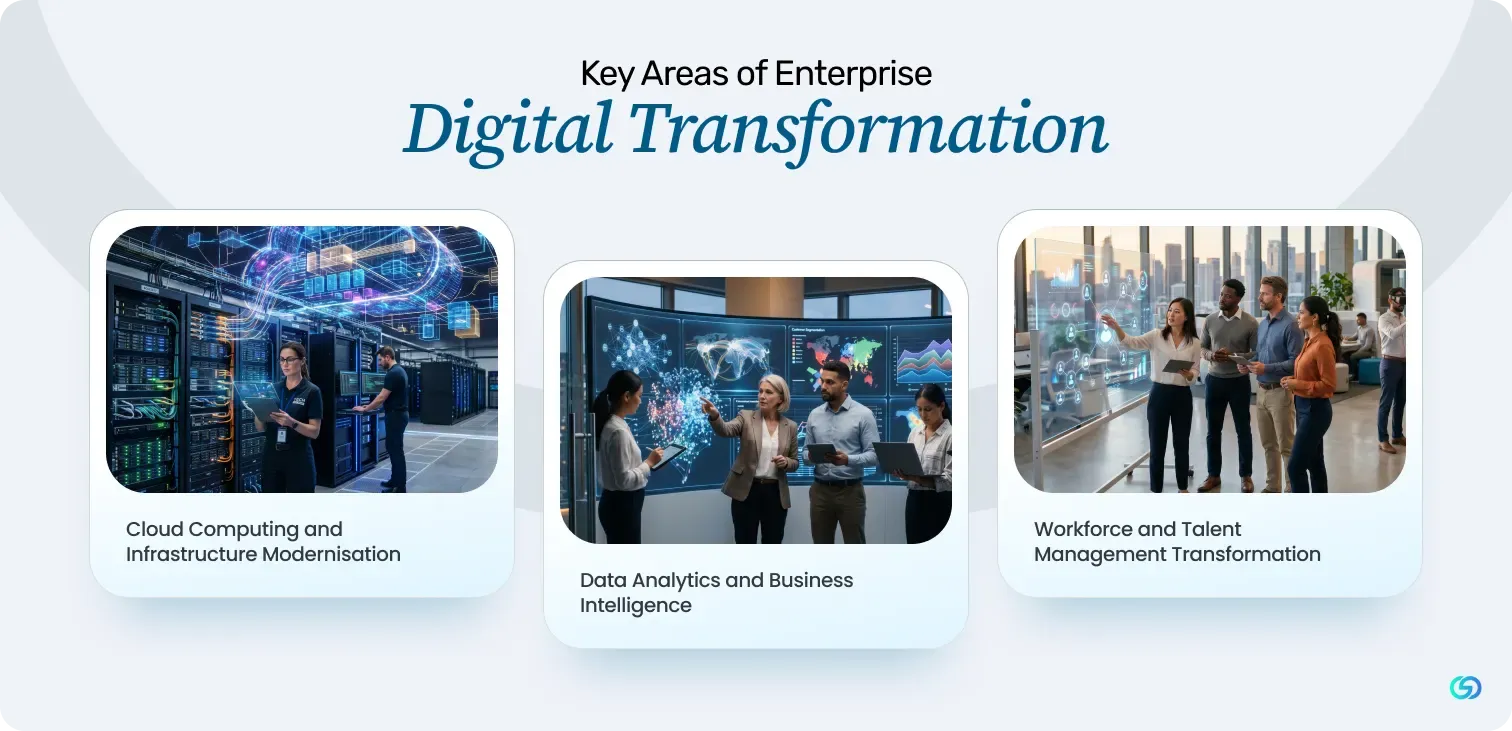
In the present rapidly evolving business environment, enterprises should embrace digital transformation to stay competitive and efficient. Digital transformation involves integrating digital technologies across an organisation's operations to enhance performance, improve customer experiences, and drive innovation. While the processes can encompass a wide range of strategies, there are 3 main areas that are vital for successfully navigating enterprise digital transformation. Let’s explore the main areas and how they can significantly impact a business's success.
⏺️ Cloud Computing and Infrastructure Modernisation
Cloud computing revolutionises how businesses manage their infrastructure. By relocating to the cloud, enterprises can scale operations effortlessly, streamline resources, and improve flexibility. Cloud services allow easy integration of data and applications, providing a unified platform that enhances security. Cloud computing not only supports growth but also ensures business continuity in an ever-changing digital landscape.
⏺️ Data Analytics and Business Intelligence
Data is the heartbeat of modern enterprises, and harnessing its power through data analytics and business intelligence is crucial. By tapping into real-time data insights, businesses can make more informed decisions, enhance operational efficiency, and predict future trends. With advanced tools such as predictive analytics and machine learning, businesses can uncover hidden patterns, streamline strategies, and customise their offerings to meet customer needs. Data-driven insights result in smarter actions, driving innovation and strategic growth.
⏺️ Workforce and Talent Management Transformation
Digital transformation in workforce and talent management allows businesses to optimise HR processes and improve employee engagement. By adopting cloud-based HR solutions, businesses can automate tasks, from recruitment to evaluation of performance, freeing up resources for more strategic initiatives. AI-driven tools for personalised employee development and talent acquisition ensure companies attract, retain, and nurture top talent. This kind of digital evolution empowers businesses to develop a more engaged, agile and productive workforce.
How to Choose the Best Digital Technologies for Your Enterprise?
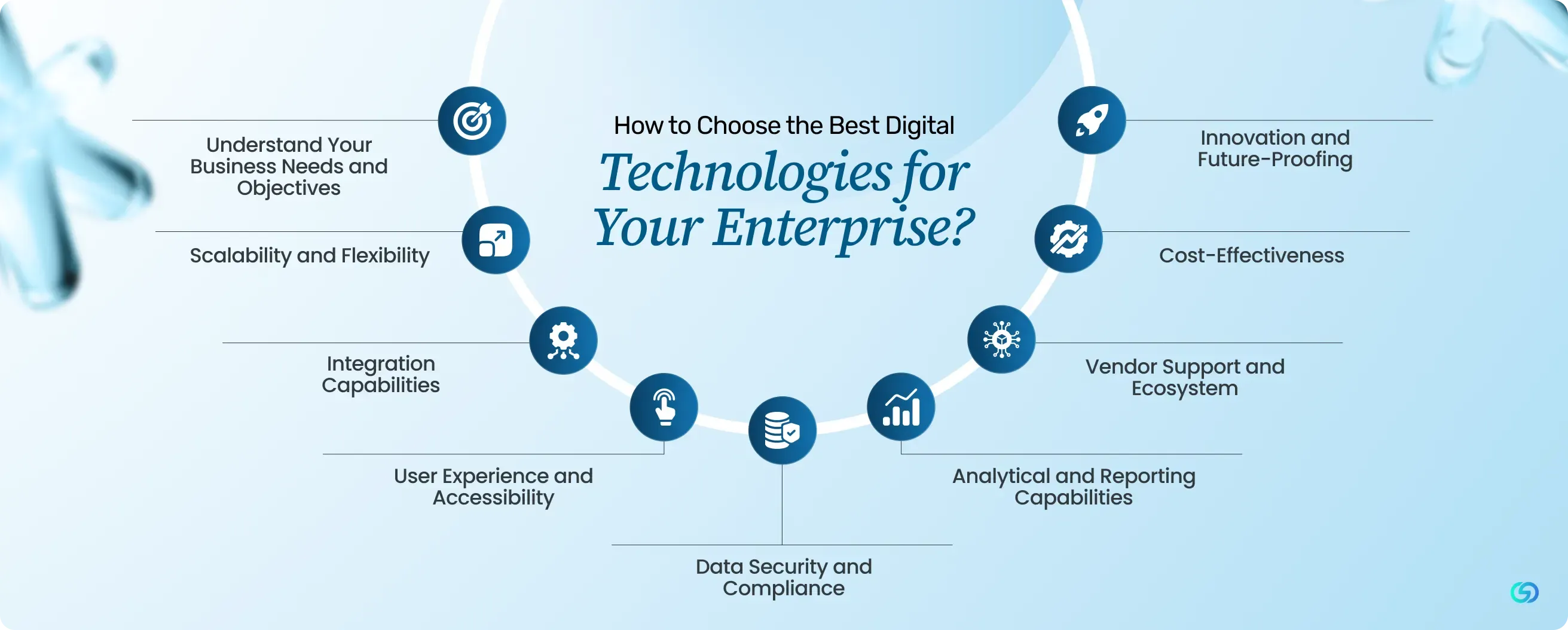
In the fast-paced, ever-changing business landscape, selecting the right digital technologies is crucial for remaining competitive and achieving operational excellence. The digital tools and systems an enterprise adopts can make or break its ability to provide high-quality services, enhance productivity, and scale effectively. Choosing the best digital technologies needs a detailed understanding of your business’s processes, goals, and challenges.
Given below are the crucial factors to consider when choosing the right technologies for digital transformation, with a proper focus on human capital management solutions and enterprise resource planning that optimise HR and foster organisational growth.
*️⃣ Understand Your Business Needs and Objectives
Before diving into the sea of available technologies, assess your business requirements and long-term objectives. Whether you want to improve employee experience, optimise operations, or improve customer engagement, every technology situation should align with these goals.
For example, if your primary objective is to enhance workforce productivity, reduce manual HR processes, and improve talent management, you will want a solution that supports a comprehensive employee lifecycle management cycle. The ideal technology would automate key HR tasks, integrate seamlessly with other systems, and provide deep insights into the workforce. The goal is to pick technologies that align with your vision and help you move closer to your organisational objectives.
*️⃣ Scalability and Flexibility
As your business evolves, so do your technology requirements. When selecting digital solutions, look for platforms that are scalable and flexible enough to accommodate future growth. You do not want to pick a technology that may require or become expensive upgrades as your enterprise grows.
For instance, cloud-based platforms enable easy scaling as business demands increase, allowing you to add new users, modules, or functionalities without disruption. A flexible system allows you to adapt more quickly to changing market conditions, whether by offering new services, entering new regions, or shifting focus areas. Therefore, when choosing digital technologies, ensure that solutions can scale with your enterprise and evolve alongside your business requirements.
*️⃣ Integration Capabilities
One of the most crucial aspects of choosing the right digital technology is its ability to integrate with your business's existing systems. Several enterprises utilise a variety of tools across different departments for HR, finance, customer relations, and more. A system that does not seamlessly integrate with other technologies can create silos and inefficiencies, leading to data discrepancies and decreased productivity.
To avoid this, look for a solution that integrates easily with your existing infrastructure, whether via pre-built connectors or other integration tools. For example, systems that can seamlessly connect with payroll, accounting, or recruitment software ensure seamless operations and eliminate the need for duplicate data entry or manual interventions. The right technology should create a unified ecosystem that enables data to flow freely between departments, ensuring timeliness, accuracy, and consistency.
*️⃣ User Experience and Accessibility
User experience plays a vital role in how successfully a technology is utilised and adopted within a business organisation. A user-friendly, intuitive interface will shorten the learning curve and drive high engagement across teams. If employees struggle to use a system, they are likely to avoid it, leading to frustration and inefficiencies.
When selecting digital technologies, prioritise platforms with a user-friendly interface and easy navigation for employees at all levels. Look for systems that offer self-service capabilities, allowing employees to update personal information, access pay details, or request time off, enabling them to manage their own data. Moreover, ensure that the solution provides mobile accessibility, enabling employees to access important information and tools anytime, anywhere.
*️⃣ Data Security and Compliance
Data security and compliance are crucial considerations when choosing digital technologies, mainly as data breaches and cyber threats become more frequent. Given that customer and sensitive information is processed, it is essential that they implement robust security measures and adhere to industry-specific rules.
When evaluating potential solutions, ensure the platform meets required compliance standards, such as GDPR for businesses operating in the European Union or other region-specific laws. Moreover, look for platforms that provide data encryption, safe access controls, and regular security audits to safeguard sensitive data from unauthorised access.
*️⃣ Analytical and Reporting Capabilities
A robust digital solution should offer robust reporting and analytical capabilities, enabling your business to derive actionable insights from data. By utilising data analytics, businesses can monitor performance, find out areas for improvement, and make more informed decisions.
For instance, in human capital management, analytics can help businesses track key performance metrics such as employee retention rates, recruitment effectiveness, and workforce productivity. By utilising data-driven insights, businesses can streamline HR strategies, enhance decision-making, and drive more effective talent management. Select a solution that includes specialised reporting tools and dashboards for monitoring your business’s performance and making strategic decisions.
*️⃣ Vendor Support and Ecosystem
The vendor you select for your digital solutions should offer excellent customer support and a well-established ecosystem. A robust support network ensures you get timely assistance when problems arise, reducing system disruptions and downtime. Moreover, considering the long-term partnership with the vendor. Will they keep on innovating and updating their solution to meet the changing requirements of your business?
Select a technology provider that has a proven track record to support enterprises in your industry, providing training resources, regular updates, and customer service channels. A trustworthy vendor will help you get the most out of your investment and keep your systems working seamlessly over time.
*️⃣ Cost-Effectiveness
Cost is always a primary factor when selecting digital technologies for your business. While the first investment may seem substantial, the right technology solution can yield major savings in the long run. Look for platforms that provide clear, transparent structures for processing, including implementation costs, subscription fees, and ongoing support charges.
It is crucial to assess the total cost of ownership of a solution, which includes not only the upfront investment but also the cost savings from automation, increased productivity, and optimised operations. The best technology should strike a balance between affordability and functionality, delivering long-term value to your enterprise.
*️⃣ Innovation and Future-Proofing
In a world where technology is constantly evolving, choosing forward-thinking, adaptable solutions is crucial for future-proofing your business. The technology you pick supports emerging trends such as automation, AI, and ML, which will drive further innovation and efficiencies in the coming years.
Picking a platform that is continuously innovating and investing in new features, ensuring that it stays competitive and aligned with the latest industry standards. Future-proofing your enterprise with cutting-edge technologies will enable you to remain ahead of competitors and better serve your customers as new digital trends emerge.
Types of Digital Technologies and Examples
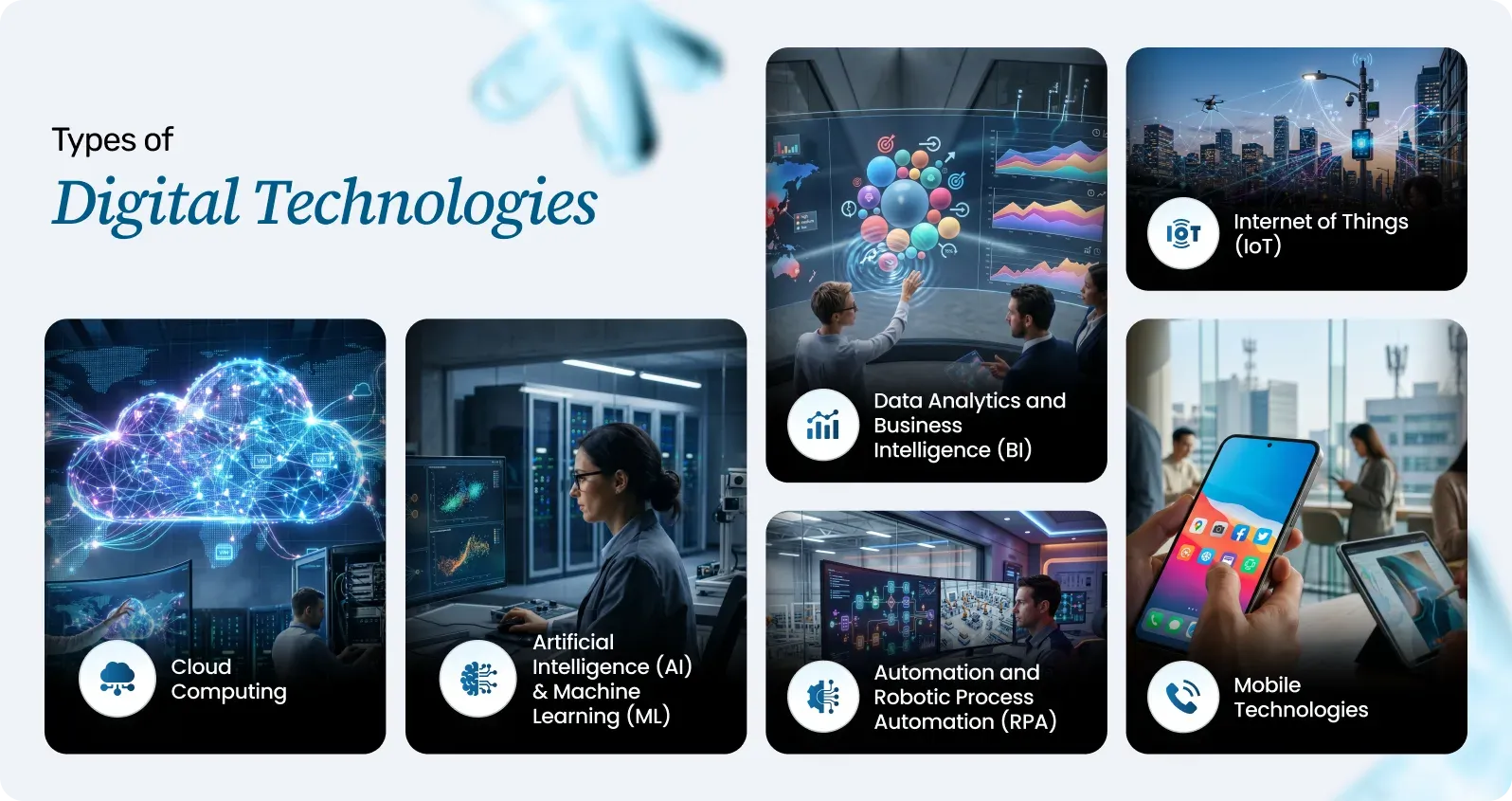
Digital technologies are changing the way businesses work, providing solutions that enhance efficiency, improve decision-making, and empower employees. Given below are the main digital technologies with examples:
🔶 Cloud Computing
Cloud computing allows businesses to store and access data and applications over the internet, offering scalability, flexibility, and cost-efficiency while supporting remote collaboration and business continuity.
Examples: Cloud-based CRM platforms, cloud ERP systems, cloud data warehouses, SaaS applications, cloud data warehouses, and hybrid cloud environments.
🔶 Artificial Intelligence (AI) & Machine Learning (ML)
AI and ML help enterprises automate processes, analyse large volumes of data, generate insights, and enhance decision-making. These technologies allow predictive capabilities and intelligent automation across business functions.
Examples: Predictive maintenance systems, AI-powered chatbots, fraud detection solutions, demand forecasting tools, recommendation engines, and intelligent document processing.
🔶 Data Analytics and Business Intelligence (BI)
Data analytics and BI technologies transform raw information into actionable insights. They assist organisations in monitoring performance, identifying trends, streamlining operations, and making data-driven strategic decisions.
Examples: Interactive dashboards, predictive analytics platform, customer behaviour analytics, sales performance monitoring, and operational intelligence solutions.
🔶 Automation and Robotic Process Automation (RPA)
Automation technologies optimise repetitive and rule-based tasks, decreasing manual effort, enhancing accuracy, and increasing productivity. RPA automates processes across departments without significant changes to existing systems.
Examples: Customer onboarding, invoice processing, order management, workflow automation, compliance reporting, and automated data entry.
🔶 Internet of Things (IoT)
IoT connects machines, physical devices, and sensors to collect and exchange real-time data. This technology allows great visibility into asset performance, operations, and customer interactions.
Examples: Smart manufacturing equipment, fleet tracking solutions, connected supply chain systems, smart energy management systems, and predictive maintenance applications.
🔶 Mobile Technologies
Mobile technologies enable customers, employees, and stakeholders to access business apps and information anytime, anywhere. They support workforce mobility and improve customer engagement.
Examples: Enterprise mobile apps, field service applications, mobile banking platforms, mobile commerce solutions and tools for workforce collaboration.
How to Implement a Successful Enterprise Digital Transformation Strategy?
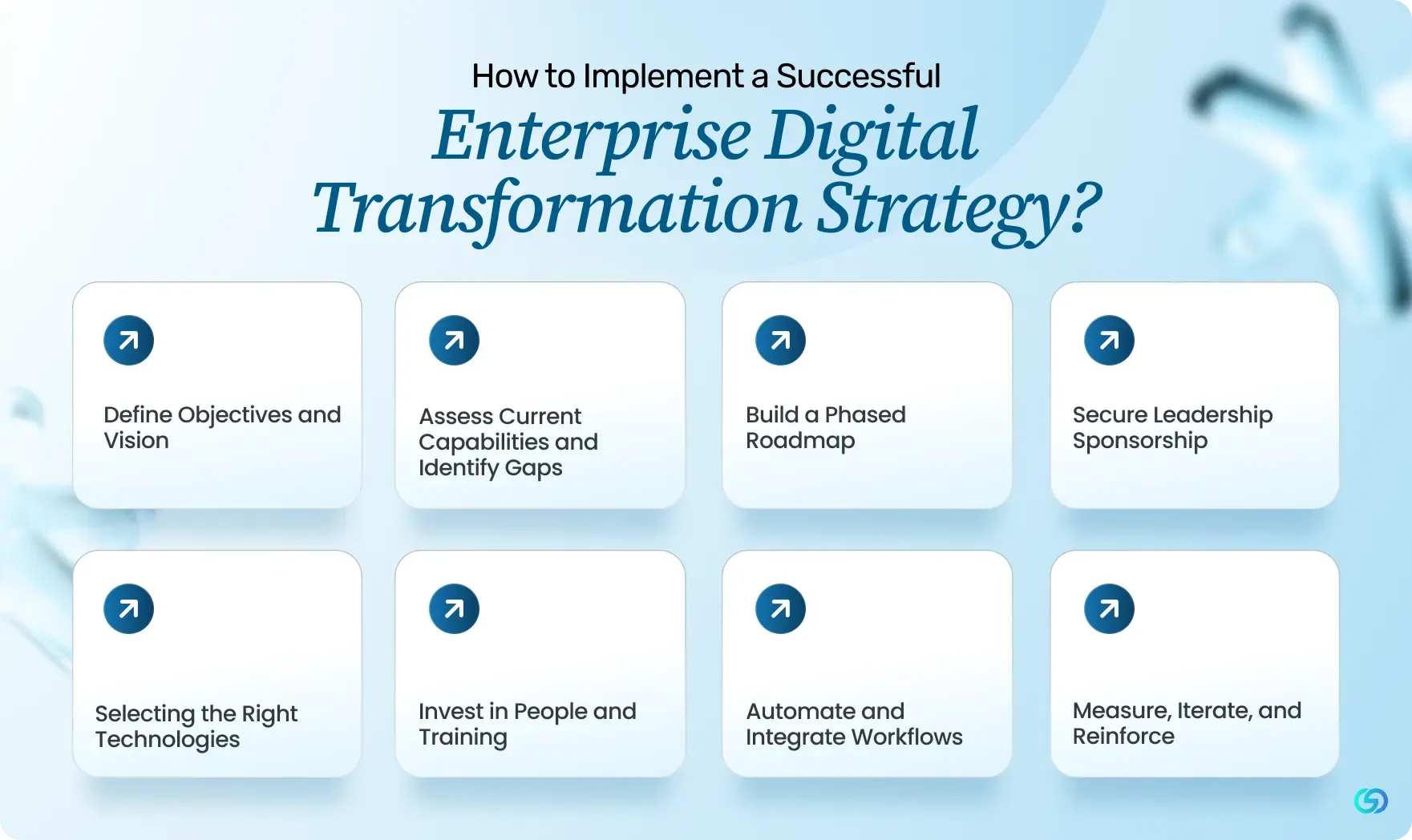
A phased, well-structured approach largely increases the chances of successful transformation. Given below are some of the important steps you can apply:
➡️ Define Objectives and Vision
Define specific, measurable objectives that are directly tied to business results. For instance, decreasing payroll processing time by 80% or enhancing customer issue resolution speed by 35%. Make sure this vision is consistently communicated throughout the entire organisation, not just once.
➡️ Assess Current Capabilities and Identify Gaps
Conduct an audit of data infrastructure, technology systems, business processes and organisational readiness. Find out which legacy systems are still required, which can be replaced, and where bottlenecks exist because of data silos. These analytics serve as the basis for the transformation roadmap.
➡️ Build a Phased Roadmap
Transformation cannot be done all at once. Give priority to high-impact, low-complexity initiatives for developing early momentum. Utilize an iterative approach where every phase becomes a learning input for the next stage.
➡️ Secure Leadership Sponsorship
Active leadership support is a primary success factor. Leaders should not only approve the initiative but also actively communicate the reasons behind the change, remove business barriers, and serve as role models in adopting new ways of working.
➡️ Selecting the Right Technologies
Choose technology based on integration capability, scalability, vendor support, ease of use, and total cost of ownership. It is crucial to ensure compliance with local rules, including payroll, tax, and digital signature requirements.
➡️ Invest in People and Training
Transformation needs workforce readiness to succeed. Offer clear change communication, upskilling programs, and involve employees in solution design. Establish change champions across teams to accelerate adoption.
➡️ Automate and Integrate Workflows
Incorporate cross-departmental systems to eliminate data silos. The focus should not just be on digitisation but also on redesigning processes to be more efficient through automation and connected workflows.
➡️ Measure, Iterate, and Reinforce
Continuously monitor transformation KPIs in a transparent and structured manner. Celebrate fast wins to maintain momentum, and reinforce change through coaching, feedback, and recognition. Digital transformation is a long-term capability that evolves continuously.
Common Challenges Enterprises Face with Digital Transformation
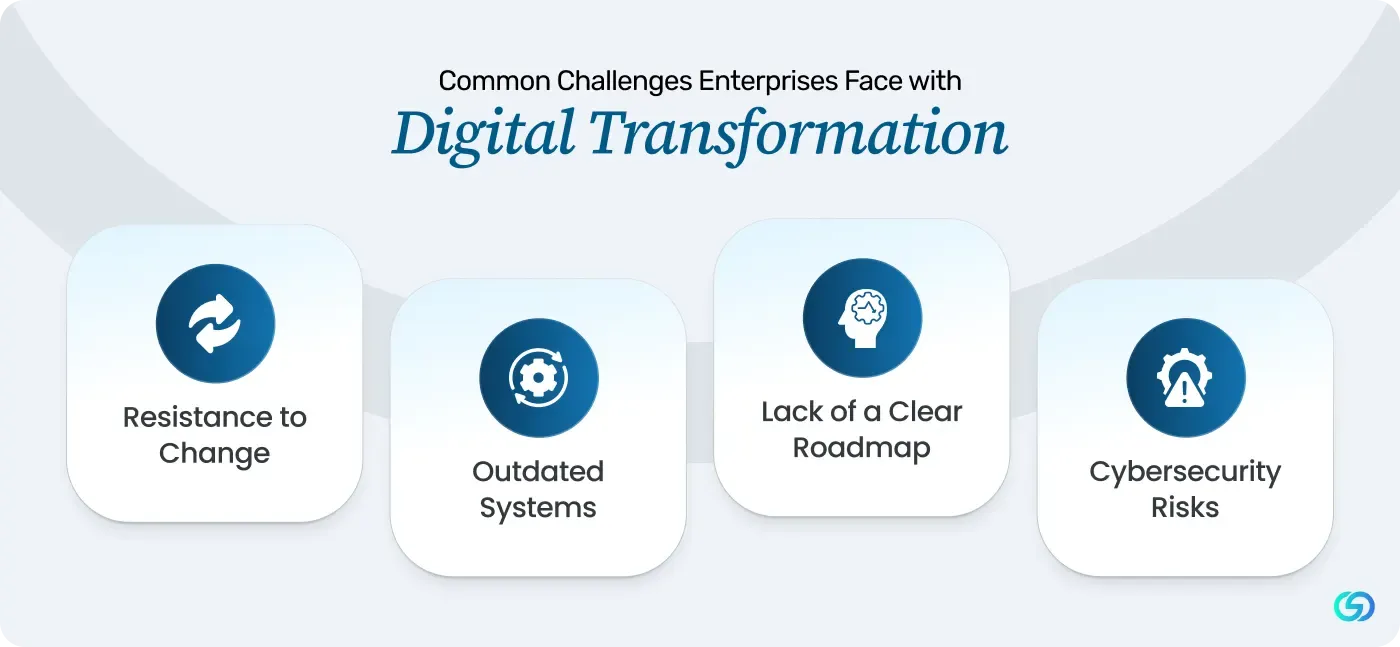
Despite its many benefits, digital transformation can be complex, and several challenges must be overcome. Most issues arise not from the technologies you choose but from a lack of strategy, planning, and structure.
💠 Resistance to Change
To truly implement change, you need all your teams, especially leadership, on board. After all, transformation happens through everyone’s consistent, everyday actions, not one-off, isolated initiatives. However, employees are accustomed to doing things a particular way and may be reluctant to adopt new technology and processes, which can create friction and delay results.
💠 Outdated Systems
As implementing new technology is the primary element of digital transformation, your existing, inflexible, and incompatible system can hinder these processes. Using outdated systems for critical business functions can create data silos and hinder the integration of new tools, such as AI.
💠 Lack of a Clear Roadmap
As discussed, several businesses fall into the trap of adopting technology for its own sake, without connecting the decision to wider objectives. As a result, these consequent efforts do not deliver significant results and waste resources without achieving a good ROI.
To address this, businesses need a clear strategy that prioritises initiatives based on business value rather than technology alone.
💠 Cybersecurity Risks
A more technology-based, connected infrastructure will inevitably expand your attack surface and introduce new potential vulnerabilities to cyber threats.
To mitigate this, cybersecurity should be built into your transformation process as a primary component, not an afterthought. For instance, embed security practices into systems and processes from the outset, ensuring data is safeguarded, access is controlled, and risks are continuously monitored. By taking a proactive, enterprise-wide approach to cybersecurity, you can confidently scale new digital capabilities while protecting customer trust and remaining resilient.
The Role of AI Automation in Enterprise-Wide Transformation
Most enterprises use some form of automation to streamline processes. These traditional solutions, such as legacy platforms, rule-based automation, and basic software tools, struggle to handle complex data analysis or adapt to dynamic changes, limiting their effectiveness. Additionally, these systems lack scalability, are challenging to integrate, and cannot provide real-time insights, hindering complete digital transformation efforts.
- AI automation enables enterprises to manage complex, data-driven tasks beyond the limits of traditional automation.
- AI delivers real-time insights and enhances decision-making by adapting to changing environments.
- AI learns and optimises over time, enabling end-to-end automation and reducing manual intervention.
- AI drives scalability and innovation, helping businesses meet growing demands and focus on strategic initiatives.
1️⃣ How AI helps in Supercharging Transformation?
AI technologies like machine learning, NLP, and agentic AI enable intelligent automation, advancing transformation.
Machine learning detects patterns in large datasets, automating data-driven decisions and enabling enterprises to forecast trends and outcomes, thereby streamlining operations.
Natural language processing (NLP) enables AI to understand spoken or written language, interpret requests, provide accurate information, automate service interactions, and streamline communication between humans and systems.
Agentic AI automates end-to-end workflows by deploying autonomous agents that understand context, make decisions, and adapt independently to evolving tasks, reducing manual intervention in complex business operations.
2️⃣ How AI allows key Digital Transformation shifts?
Building on AI's capabilities, we can examine how these technologies enable key shifts throughout digital transformation initiatives.
Specialised AI-powered automation is no longer simply “nice to have”. It has become a must-have for enterprises aiming to unlock the full potential of digital transformation, resulting in breakthroughs across several areas, from productivity to process automation.
-
Breaks Through Productivity Plateaus Several organisations have already automated basic tasks; however, productivity gains have stalled. Specialised Advanced AI automation enables enterprises to automate complex, multi-step processes across multiple systems, unlocking new levels of productivity and efficiency.
-
Decreases Complexity and Employee Frustration As businesses add more apps and portals, employees struggle to handle tasks scattered across different systems. AI automation can orchestrate actions across these systems, offering a unified experience and decreasing the burden on employees.
-
Allows end-to-end Process Automation Specialised automation goes beyond simple tasks, enabling businesses to automate complete workflows, such as onboarding, provisioning, and incident management. This results in faster, more trustworthy operations and better business outcomes.
-
Supports Scalability and Innovation Through advanced automation, enterprises can scale their operations without a proportional increase in manual effort or headcount. This frees up teams to focus on higher-value, innovative work.
-
Enhances User Experience By digitising complex support and business processes, businesses can deliver faster, more consistent service, thereby enhancing user satisfaction.
Use Cases of Enterprise Digital Transformation Across Industries
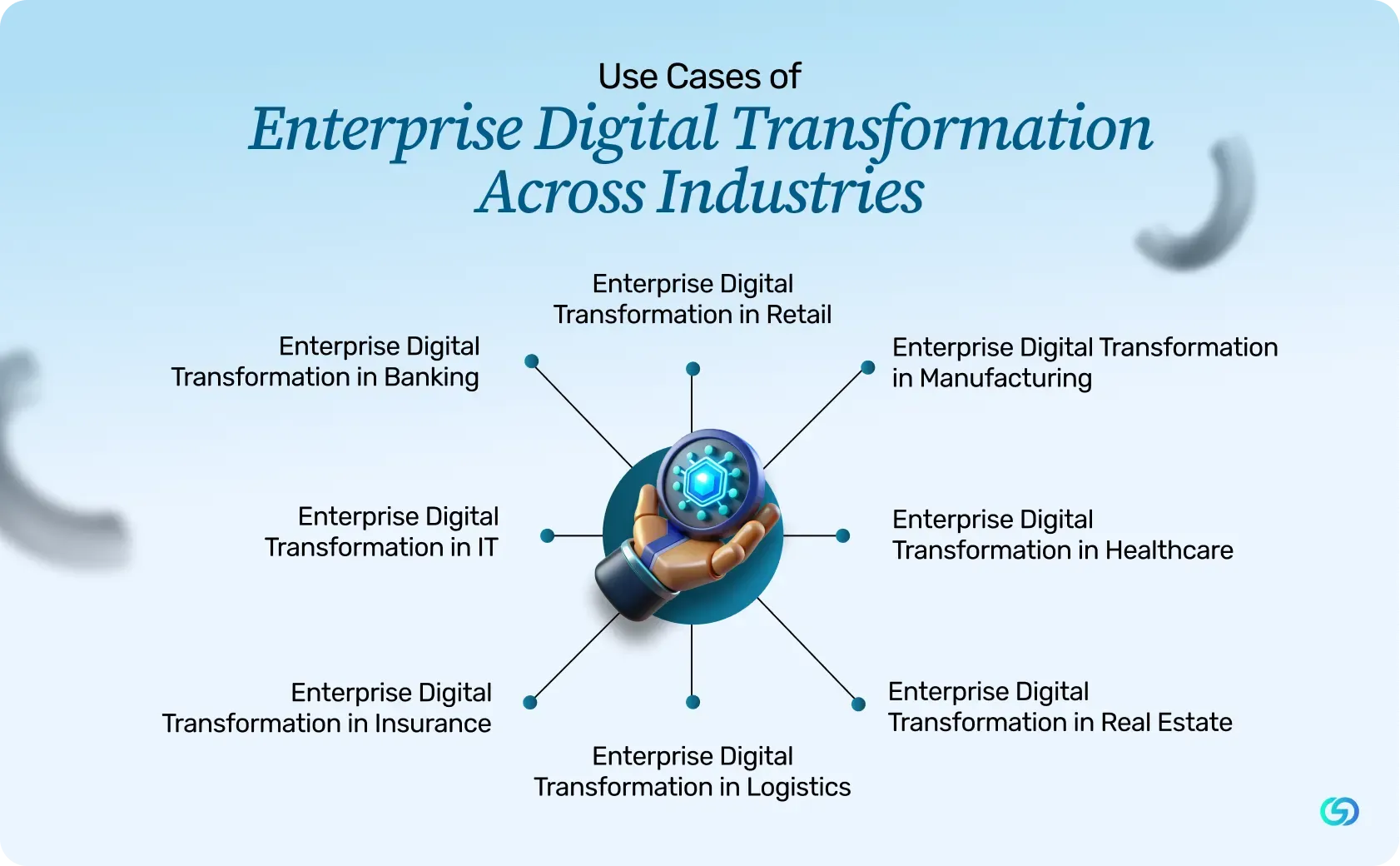
Digital transformation touches every part of your business. These departments are instrumental in employee experience and everyday productivity, which is exactly where intelligent automation can help.
✅ Enterprise Digital Transformation in Banking
Banks are now adopting digital technologies to deliver seamless customer experiences, strengthen security, and enhance operational efficiency. AI-powered chatbots, automated loan processing, digital banking platforms, and fraud detection systems enable financial institutions to offer faster, more personalised services while maintaining regulatory compliance.
✅ Enterprise Digital Transformation in Retail
Retail businesses use digital transformation to develop personalised shopping experiences, streamline inventory management, and enhance omnichannel operations. Specialised analytics and AI help retailers understand customer preferences and drive more targeted marketing campaigns.
✅ Enterprise Digital Transformation in Manufacturing
Manufacturers are embracing Industry 4.0 technologies to increase productivity, reduce downtime, and improve quality control. Connected devices and real-time data insights enable businesses to streamline production processes and improve supply chain visibility.
✅ Enterprise Digital Transformation in Healthcare
Healthcare providers utilise digital transformation to enhance patient care, optimise administrative processes, and improve data accessibility. Digital technologies allow speedy diagnoses, remote care delivery, and more efficient healthcare management.
✅ Enterprise Digital Transformation in Real Estate
Real estate businesses use digital technologies to enhance property management, improve customer engagement, and streamline transactions. Data-driven insights help enterprises make informed operational and investment decisions.
✅ Enterprise Digital Transformation in Logistics
Logistics businesses depend on digital transformation to enhance supply chain visibility, streamline delivery routes, and improve operational efficiency. Real-time tracking and predictive analytics help businesses reduce costs and enhance customer satisfaction.
✅ Enterprise Digital Transformation in Insurance
Insurance companies are modernising their operations through automation, data analytics, and AI. Digital transformation helps optimise policy management, enhance claims processing, and provide more personalised customer experiences.
✅ Enterprise Digital Transformation in IT
IT departments are mostly at the centre of enterprise digital transformation initiatives. Modern IT ecosystems enable businesses to accelerate innovation, improve system reliability, and support scalability through cloud-native architectures and intelligent automation.
The Future of Digital Transformation is Intelligent and Agentic
Enterprise digital transformation is moving beyond basic digitization and automation. Although cloud computing, data analytics, and workflow automation have improved operations, the next phase is driven by intelligent and agentic systems.
Many enterprises continue to use fragmented applications, disconnected data sources, and manual processes, which limit agility and slow decision-making. As business environments grow more dynamic, organizations need technologies that automate tasks, understand context, learn from data, and take proactive actions.
Agentic AI marks a significant shift in how businesses use technology. Unlike traditional automation tools that follow set rules, AI agents analyze information, make recommendations, execute workflows, and continuously improve outcomes with minimal human input.
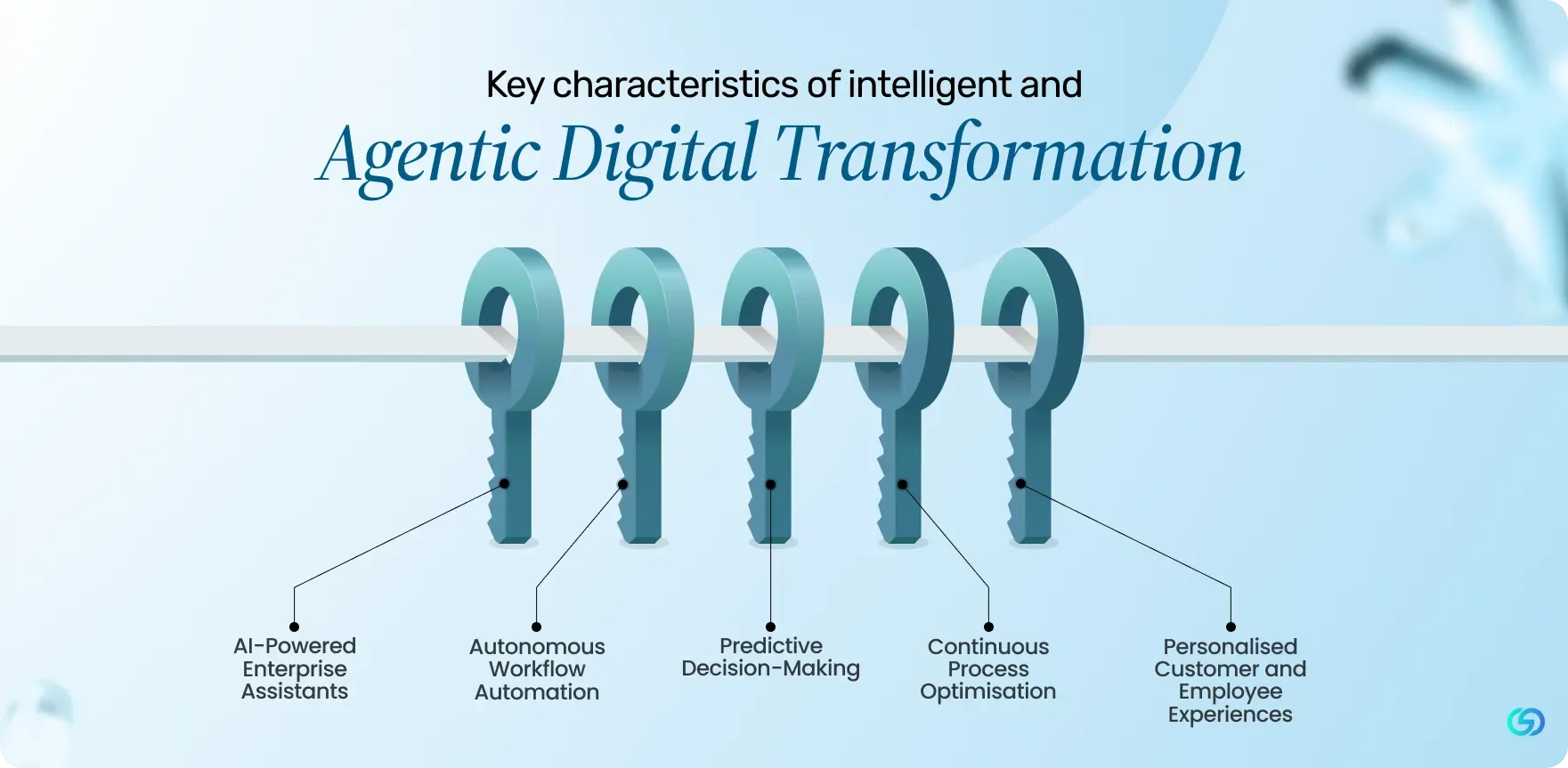
Key characteristics of intelligent and agentic digital transformation include:
-
AI-Powered Enterprise Assistants: Intelligent assistants help employees access information, complete tasks, generate insights, and improve productivity across business functions.
-
Autonomous Workflow Automation: AI-driven systems can manage repetitive processes, coordinate workflows across departments, and optimise operations without constant manual oversight.
-
Predictive Decision-Making: Advanced analytics and machine learning models enable organisations to anticipate customer needs, identify risks, forecast trends, and make more informed business decisions.
-
Continuous Process Optimisation: Intelligent systems analyse operational data in real time to identify inefficiencies, recommend improvements, and drive ongoing performance enhancements.
-
Personalised Customer and Employee Experiences: AI enables enterprises to deliver highly personalised interactions, recommendations, and support experiences at scale.
As organizations advance their digital transformation, intelligent and agentic technologies will become essential for improving agility, accelerating innovation, and building sustainable competitive advantages. Enterprises that adopt these capabilities now will be better prepared to meet future market demands and achieve long-term growth.
Wrap Up
Enterprise digital transformation is no longer an initiative for the future; it is a business imperative for organisations seeking to stay competitive, agile and customer-centric. By modernising legacy systems, leveraging AI-driven automation, embracing cloud technologies, and fostering a culture of innovation, enterprises can unlock new levels of efficiency, growth, and resilience. The key lies in adopting the right technologies and implementing them via a well-defined strategy tailored to business objectives. In case you are looking for reliable enterprise digital transformation services, ConvexSol can help. Our experts design and implement tailored digital transformation strategies that accelerate innovation and deliver measurable business outcomes.
FAQ
How can enterprises measure the success of digital transformation initiatives?
Enterprises can measure success using KPIs such as operational efficiency, customer satisfaction, process automation rates, employee productivity, cost savings, revenue growth, and return on investment (ROI). The right metrics should align with the business’s transformation goals.
Do small and mid-sized enterprises need digital transformation?
Yes. Digital transformation is necessary for businesses of all sizes. Small and mid-sized businesses can utilise digital technologies to optimise operations, enhance customer experiences, decrease costs, and operate more effectively in rapidly emerging markets.
How can enterprises minimise disruption during digital transformation?
Organisations can decrease disruption by implementing changes in stages, conducting pilot projects, training employees, maintaining transparent communication, and working with experienced technology partners to ensure seamless adoption.
Is digital transformation a one-time project or an ongoing process?
Digital transformation is an ongoing journey rather than a one-time initiative. As technologies, customer expectations, and business needs evolve, enterprises should continuously streamline and innovate to stay competitive.
Why is data governance important in enterprise digital transformation?
Data governance ensures that business information remains accurate, accessible, secure, and compliant with regulations. Robust governance enables better decision-making while reducing the risks associated with data breaches and poor data quality.
Can enterprise digital transformation improve sustainability efforts?
Yes, digital technologies can help enterprises streamline resource utilisation, reduce energy consumption, eliminate paper-based processes, enhance supply chain efficiency, and support broader sustainability goals through data-driven insights
Can enterprises achieve digital transformation without replacing all legacy systems?
Absolutely. Several businesses adopt a staged modernisation approach by integrating modern technologies with existing systems. This enables businesses to transform operations gradually while minimising costs and operational risks.
What are the signs that an enterprise is ready for digital transformation?
Common indicators include fragmented systems, increasing operational inefficiencies, rising customer expectations, growing maintenance costs for legacy systems, limited data visibility and a requirement for greater innovation and agility.