- RPA Use Cases in Retail
- 2026-07-10
16 Top RPA Use Cases in Retail: Transforming Operations and Customer Experience
Audio Track
Table of Contents
Key Takeaways:
- Robotic Process Automation offers the retail sector with the opportunity to streamline operations foster growth and remain at the forefront in the competitive market.
- Robots automatically collect data related to shipment from logistics partners and carriers, providing alerts and updates in real-time to managers.
- In order processing, RPA enables orders to be updated in real-time with CRM and ERP systems, ensuring speed and accuracy.
- In market planning, customer segmentation can be automated via RPA through analyzing purchase history, behaviour, and demographics.
- RPA robots pull real-time and historical data from several systems for generating demand forecasts.
- Robotic Process Automation keeps on monitoring transactions for detecting anomalies in real time.
Understanding RPA Use Cases in Retail- An Overview
In the present retail world, businesses are searching for better ways to work smartly, enhance customer service, and keep pace with the fast-paced market. RPA use cases in retail include providing businesses with a tool that helps them handle these challenges.
Robotic Process Automation provides the retail sector with the opportunity to optimize its operations, foster growth, and remain at the forefront of the competitive market by improving the experiences of the customer, automating repetitive tasks, allowing data-driven decision making, and ensuring compliance.
It enables businesses to achieve unparalleled levels of agility, efficiency, and competitiveness. Let’s unlock the various use cases of RPA in retail sector.
What is the Value of RPA in Retail Sector?
Before we start with the RPA use cases in retail The main advantage of RPA in retail enables human workers to transfer the repetitive tasks to the robot coworkers, allowing employee to devote their focus to more value-added and strategic tasks. For instance, RPA can help in decreasing errors in tasks such as customer support. Businesses can schedule unattended bots for handling task that needs repeating, such as regular database updates, leading to fast completion times. The technology can also be utilized in combination with AI-powered chatbots for assisting both customer service agents and the customer with basic tasks such as the return process or product inquiry. As a customer or an employee makes a request, the chatbot can send the request to an RPA bot for conducting the task.
RPA automates rule-based, straightforward, and time-consuming tasks on its own. However, it can be an important gateway to wide-ranging automation efforts due to its low cost, ease of setting up, and the potential to incorporate multiple disparate systems. Top RPA solutions often utilize low-code/no-code platforms that enable users with little technical knowledge to create effective scripts for bots, making Robotic Process Automation an accessible offset for hyperautomation and comprehensive, broader process optimization.
With RPA, retailers can automate complex tasks, but augment the basic capabilities of the technology with advanced AI and ML tools. For instance, a business rules management system can allow RPA bots to not just mimic the activities of humans but also make smart decisions about what kind of task to carry out and when. Workflow automation software can make completely autonomous Robotic Process Automation processes overseen by AI. The process-mining algorithms of ROA allow retailers to dig into the information related to the technology of performance and find out more ways for streamlining its deployment.
How RPA works in Retail?
RPA in the retail sector can be deployed to perform both back-office and customer-facing tasks. It is capable of conducting any task that needs defined, repeating steps, or manipulation of structured data. The most common applications of RPA in the retail sector include-
- Collecting employee data for back-office uses such as payroll, onboarding, and scheduling.
- Generate as well as all processing standard invoices.
- Solving common queries via chatbots
- Sending automatic messages to both customers and suppliers.
Use Cases of RPA in Retail Sector
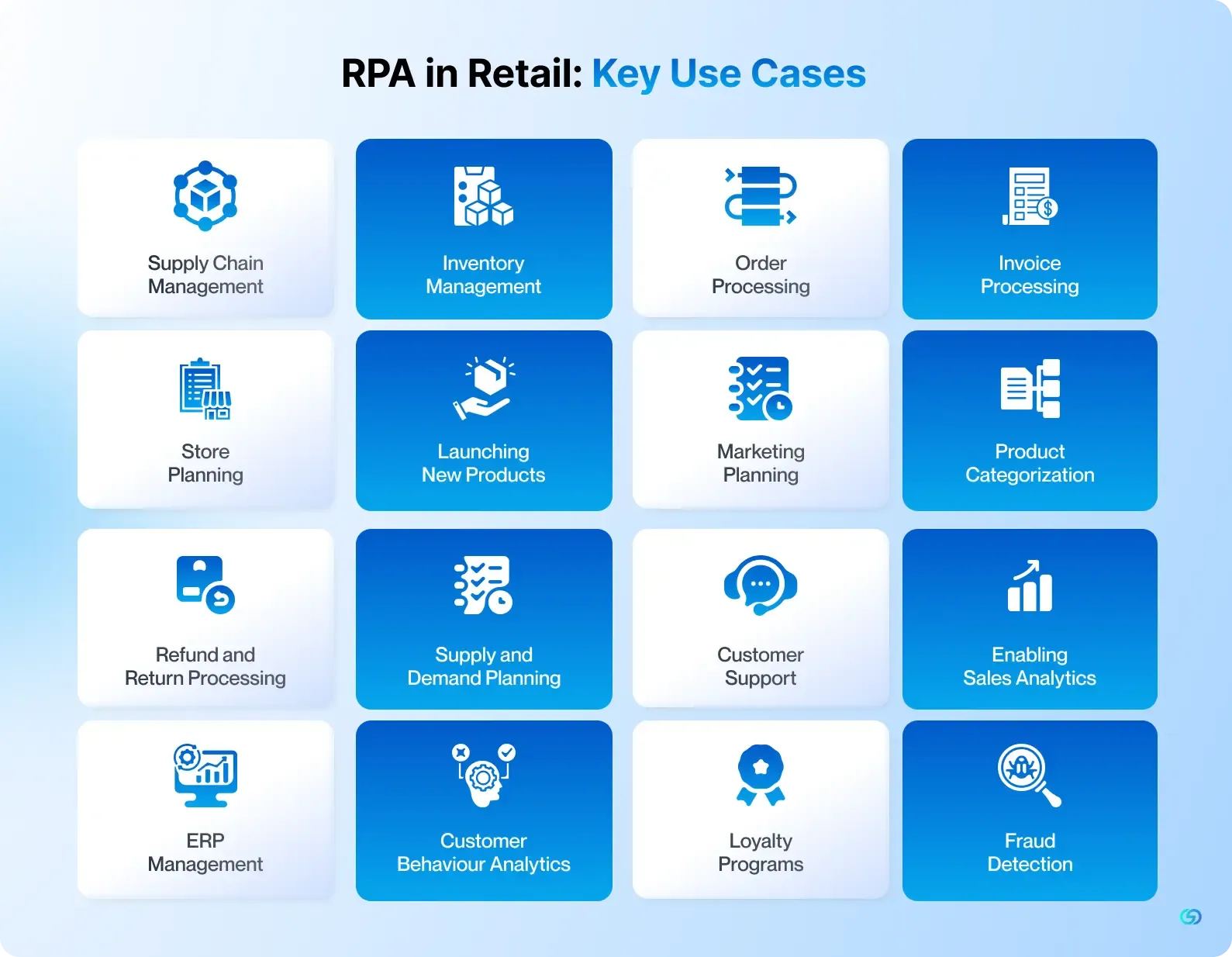
Robotic Process Automation is an excellent technology for automating manual, error-prone, and repetitive tasks or tasks that rely on huge volumes of data, providing few opportunities for human intervention.
Here are some of the most popular RPA use cases in retail -
1. Supply Chain Management
Problems without RPA:
- Manual shipment tracking increases errors and delays.
- Lacks real-time visibility into supply chain information.
- Difficulties in coordinating with several logistics partners and vendors.
- Slow responding to disruptions like delays or shortages.
Solutions with RPA:
- Robots automatically gather information related to shipments from logistics partners and carriers, offering alerts and updates in real-time to managers.
- Automated workflows enhance coordination with distributors and suppliers by sharing updates immediately across systems.
- Dashboards that are driven by RPA provide retailers with complete visibility of transit status, inventory, and delivery timelines.
- Predictive handling of exceptions allows businesses to resolve disruptions in a speedy way, decreasing supply chain risks.
2. Inventory Management
Problems with RPA:
- Overstocking and stocking because of inaccurate data.
- Manual inventory reconciliation across varied systems.
- Delays in restocking decisions result in revenue loss.
- Errors in tracking seasonal or fast-moving products.
Solutions with RPA:
- RPA use cases for inventory management in retail include real-time synchronization of inventory across all sales channels, involving both online and physical stores.
- Automated notifications and alerts let the managers know about excess or low stocks, decreasing the risk of missing out on sales opportunities.
- Bots utilize historical sales data for predicting replenishment needs and preventing stock imbalances.
- Faster and more accurate tracking, trending, or seasonal products, ensuring that the retailers meet demand effectively.
3. Order Processing
Problems without RPA:
- The manual process of order entry is slow and prone to errors.
- High cost of processing due to repetitive tasks.
- Delays in updating customers on order status.
- Difficulty in scaling in high-demand seasons.
Problems with RPA:
- RPA bots capture and validate across varied platforms automatically, decreasing human error.
- Orders are updated in real-time with CRM and ERP systems, ensuring speed and accuracy.
- Customers get automated confirmations and notifications on shipment, enhancing customer experience.
- When the demand is at peak, bots manage thousands of interactions without delays. This ensures continuity and scalability.
4. Invoice Processing
Problems without RPA:
- Manual matching of invoice results to frequent errors.
- Time-consuming approval workflows cause delays in payments.
- Difficulty in detecting fraudulent or duplicate invoices,
- High cost of operation for back-office teams.
Solutions with RPA:
- RPA bots can cross-check invoices with delivery receipts and purchase orders immediately to reduce mismatches.
- Automated routing helps in sending invoices seamlessly to the correct approvers, eliminating bottlenecks in workflows.
- Duplicate or fraudulent invoices are flagged instantly by bots analyzing inconsistencies and patterns.
- Payments are automatically scheduled after approvals, speeding up cash flows and decreasing overhead costs.
5. Store Planning
Problems without RPA:
- Store layouts often rely heavily on intuition or trial-and-error rather than real customer behaviour data.
- Manual data collection about customer movement, popular sections, and dwell time is time-consuming and inaccurate.
- Inefficient layouts lead to poor shelf utilization, customer frustration, and lost sales opportunities.
- Retail managers lack continuous insights to adapt store layouts to changing customer preferences.
Solutions with RPA:
- RPA bots continuously collect data on customer behavior, including visit duration, frequently visited sections, and common navigation paths.
- Automation software analyzes this behavioral data in real time, helping retailers design store layouts that match customer habits.
- Store layouts can be optimized to maximize convenience and create smoother shopping experiences, encouraging customers to spend more time in-store.
- By using automated insights instead of intuition, retailers improve shelf space utilization, increase customer satisfaction, and drive higher sales.
6. Launching New Products
Challenges without RPA:
- Product details entry manually into multiple systems leads to delays.
- Inaccurate updating of product information on multiple e-commerce sites.
- Slow go-to-market process for new launches.
- Challenge in keeping product availability in sync across channels.
Solutions with RPA:
- RPA use cases in retail can also be seen when new product details, price, and images are uploaded by bots all at once on all retail channels.
- Automated validation for identical information across catalogs and systems.
- The lead time in launching new products is minimized, which enables quicker market entry.
- Synchronization between warehouses, stores, and e-commerce channels enhances launch success.
7. Marketing Planning
Challenges without RPA:
- Campaign planning takes a lot of time manually.
- No accurate customer segmentation.
- Measuring campaign performance in real time is difficult.
- Delays in running promotional campaigns.
Solutions with RPA:
- Customer segmentation is automated through RPA via analyzing purchase history, demographics, and behavior.
- Bots automate campaign scheduling so that promotions go live across channels at the same time.
- Real-time monitoring offers instant feedback on campaign performance.
- Shoppers can instantly modify campaigns halfway through to enhance ROI and shopper engagement.
8. Product Categorization
Challenges without RPA:
- Manual categorization introduces errors and inconsistencies.
- Update of product categories across channels takes time.
- Incorrect product tags confuse customers and damage sales.
- Maintaining consistency in catalogs is challenging.
Solutions with RPA:
- RPA robots classify products automatically based on pre-defined rules and characteristics.
- Product details are updated immediately online and offline to maintain alignment.
- Automated labeling increases product visibility in search results.
- Stores have standardized catalogs with less manual effort and better customer shopping experiences.
9. Supply and Demand Planning
Challenges without RPA:
- Error in forecasting because of the use of stale data.
- Inability to respond rapidly to changing demand.
- Stockouts or excess inventory affect sales and expenses.
- Manual processing of data is time-consuming.
Solutions with RPA:
- RPA robots extract real-time and historical data from various systems to create demand forecasts.
- Automated adjustments allow the stock levels to be optimized to reflect trends and changing demand.
- Use cases of RPA in retail also includes predictive analytics enabling retailers to plan for seasonal fluctuations or unexpected demand shifts.
- More accurate planning means less waste and fewer missed sales.
10. Refund and Return Processing
Challenges without RPA:
- Manual validation of returns slows down the refund process.
- Excessive volume of returns overloads employees.
- Inadequate communication with customers at time of refund.
- Chances of error in validating return eligibility.
Solutions with RPA:
- Bots automatically verify return requests against purchase history and company policy.
- Automatically approved refunds are initiated, and customer accounts are updated in real-time.
- Customers are notified promptly on refund status, enhancing satisfaction.
- Retailers minimize manual burdens while avoiding return policy non-compliance.
11. Enabling Sales Analytics
Challenges without RPA:
- Manual data extraction slows down reporting.
- Consolidation errors of sales data across multiple systems.
- Lack of real-time visibility into sales performance.
- Slow decision-making due to poor insights.
Solutions with RPA:
- Bots aggregate sales data from POS, e-commerce sites, and ERP in real time.
- Automated reporting eliminates delays and human errors.
- Interactive dashboards by RPA provide leaders real-time visibility into sales trends.
- Faster, smarter insights drive better business strategies.
12. Customer Support
Problems without RPA:
- High call volumes overwhelm support teams.
- Repetitive queries reduce efficiency.
- Long resolution times frustrate customers.
- Difficulty in managing 24/7 support.
Solutions with RPA:
- RPA chatbots handle repetitive queries instantly, freeing agents for complex issues.
- Bots automate ticket assignment and escalation, reducing response times.
- Customers receive faster resolutions and proactive updates.
- Retailers can deliver round-the-clock support without significantly increasing costs.
13. Customer Behaviour Analytics
Problems without RPA:
- Manual data tracking from multiple touchpoints is complex.
- Limited ability to analyze real-time customer behavior.
- Lack of insights into shopping patterns and preferences.
- Missed opportunities for personalization.
Solutions with RPA:
- Bots collect and consolidate data from social media, POS, and e-commerce platforms.
- Automated analysis highlights shopping habits, frequency, and buying patterns.
- Insights enable retailers to create personalized offers and targeted campaigns.
- Customer retention improves through data-driven personalization strategies.
14. ERP Management
Problems without RPA:
- Manual updates across ERP systems cause inefficiency.
- Data silos due to lack of integration between systems.
- Errors in routine ERP tasks.
- High costs of maintaining ERP data accuracy.
Solutions with RPA:
- RPA bots automatically update records across ERP modules like finance, HR, and inventory.
- Data is synchronized across departments in real time, eliminating silos.
- Repetitive ERP tasks such as reporting, reconciliation, and entry are fully automated.
- Businesses save costs while improving ERP efficiency and data accuracy.
15. Fraud Detection
Problems without RPA:
- Slow identification of fraudulent transactions.
- High reliance on manual monitoring.
- Delayed response to suspicious activities.
- Revenue loss due to late detection.
Solutions with RPA:
- RPA continuously monitors transactions to detect anomalies in real time.
- Bots trigger automated alerts when suspicious activities occur.
- Fraudulent transactions can be flagged, paused, or blocked instantly.
- Retailers minimize financial risks and enhance customer trust.
16. Loyalty Programs
Problems without RPA:
- Manual tracking of rewards leads to inconsistencies.
- Errors in updating customer accounts.
- Delays in communication about loyalty benefits.
- Difficulty in scaling loyalty initiatives.
Solutions with RPA:
- Bots automatically track and allocate loyalty points for each purchase.
- Customer accounts are updated instantly across systems, ensuring transparency.
- Automated communication keeps customers informed about rewards and offers.
- Loyalty programs scale seamlessly, improving customer engagement and retention.
Final Thoughts
Robotic Process Automation is helping in transforming the retail industry by optimizing operations, enhancing customer experiences, and fostering business growth. Starting from supply chain management and tracking of inventory to fraud detection and customer support, the advantages of automation are undeniable. By addressing the basic challenges like errors, inefficiencies, and high operational costs, retailers are capable of unlocking new opportunities for innovation and agility. The varied RPA use cases in retail reflect how automation goes beyond basic handling of tasks. It enables smart decision-making, better scalability, and seamless processes.
As the demands of customers are continuously evolving, retailers that are leveraging the power of RPA will get a competitive edge, assuring they remain customer-focused, efficient, and prepared for the digital retail.
Frequently Asked Questions
How secure is RPA for handling customer data?
How secure RPA is for managing and handling customer information completely depends on its implementation. If governed by robust security protocols, Robotic Process Automation can improve data protection by eliminating human error, creating comprehensive audit trails, and offering consistent compliance.
Is RPA suitable for small and medium-sized retail businesses (SMEs)?
Yes, Robotic Process Automation is absolutely suitable for small and medium-sized retail businesses as it offers significant advantages such as cost reduction, enhanced accuracy, and improved efficiency by automating repeating tasks such as invoice processing, inventory management, and customer service, allowing the SMEs to compete more effectively in the market. RPA provides an affordable and scalable solution, enabling small businesses to grow without the need to increase labour costs and giving employees free time to focus on more strategic and value-added tasks.
What is the difference between RPA and AI in retail?
In the retail sector, Robotic Process Automation mimics human activities for automating rule-based, repetitive tasks by utilizing structured data. When it comes to artificial intelligence, it stimulates human intelligence for performing cognitive and complex tasks utilizing both structured and unstructured data. RPA is a ‘doer’; it executes predefined processes with accuracy and speed. While AI is a ‘thinker’, it uses reasoning and learning to make autonomous decisions.
What does the future of RPA in retail look like?
The future of Robotic Process Automation in retail can be defined by its growth into “intelligent automation.” This combines traditional RPA with state-of-the-art technologies, such as AI, machine learning(ML), and the Internet of Things. This kind of shift will allow the software bots to move beyond simple, rule-based tasks for handling complicated, end-to-end processes that need cognitive decision-making.
What is your approach to identifying automation opportunities within our retail operations?
At ConvexSol, we start with understanding the processes of your business and the pain points via data analysis and interviews. We give priority to automation opportunities by focusing on efficiency, customer satisfaction, and cost savings. Our experts collaborate closely with your team to refine the roadmap for maximum value.
How do you ensure seamless integration of RPA solutions with our existing systems and processes?
ConvexSol conducts a thorough assessment of the current infrastructure to find out integration points. Thereafter, we develop a custom integration plan customized to the requirements of your business, ensuring minimal disruption. Efficient testing helps in guaranteeing easy operation and flow of data across all the systems.