- RPA Use Cases in Customer Service
- 2025-11-10
Top 18 Real-world RPA Use Cases in Customer Service

Audio Track
Table of Contents
Key Takeaways:
- RPA is automating repetitive tasks and time-consuming tasks, enabling enterprises for offering accelerated, more accurate and consistent service. This finally leads to improved customer satisfaction and decreased operational costs.
- Reduced costs leads to an increase in efficiency, and RPA in customer service technologies are among the best cost-cutting options.
- RPA bots help in automating the end-to-end process for order management, from capturing order details to inventory validation, invoicing, and tracking updates.
- Using RPA along with Natural Language Processing (NLP), enterprises can automatically collect, categorize, and analyse customer feedback from emails, surveys, as well as social media platforms.
- RPA optimizes helpdesk efficiency by automating the process of ticket triaging and categorization. Bots are capable of scanning incoming service requests, figure out keywords, prioritize issues, and assign tickets to the appropriate department or agent.
Overview
In the present fast-paced digital world, businesses are always seeking innovative ways to improve customer service. RPA or Robotic Process Automation is one of the most revolutionary technologies in this space. RPA in customer service is transforming how businesses interact with and support their customers. RPA is automating repeating and time-consuming tasks, allowing enterprises to offer speedy, more accurate, and consistent service. This ultimately leads to enhanced customer satisfaction and decreased operational costs.
The blog explores the premier RPA use cases in customer service, reflecting how it can change multiple aspects of customer interactions and operations.
Why is RPA in Customer Service Necessary?
RPA enhances customer service by decreasing administrative and back-office workload. Customer service is accelerated by software robots collecting information and documents from multiple systems, handling service requests, and updating customer records.
RPA in customer service manages routine tasks such as data entry, updating records, and order processing more quickly than humans, decreasing wait times for customers. It also eliminated human error in the routine tasks. RPA ensures improved consistency and reliability in managing day-to-day processing requests.
It also allows companies to seamlessly scale operations up or down, meeting demand with a significant increase in staffing, ensuring consistency in service levels even in peak times.
Some of the main traditional customer service challenges are as follows-
- Lack of a customer-centric approach.
- Dealing with the dissatisfaction of clients.
- Unrelated support tools across teams.
- No planning and mapping of the journey of the customer to contact support processes.
- Getting feedback.
- No being able to realize customer expectations or identify a 360° customer view.
- Handling the problem of service outrage.
- Overload of service tickets.
- Excessive recruitment and transfer of knowledge.
What are the Benefits of RPA in Customer Service?
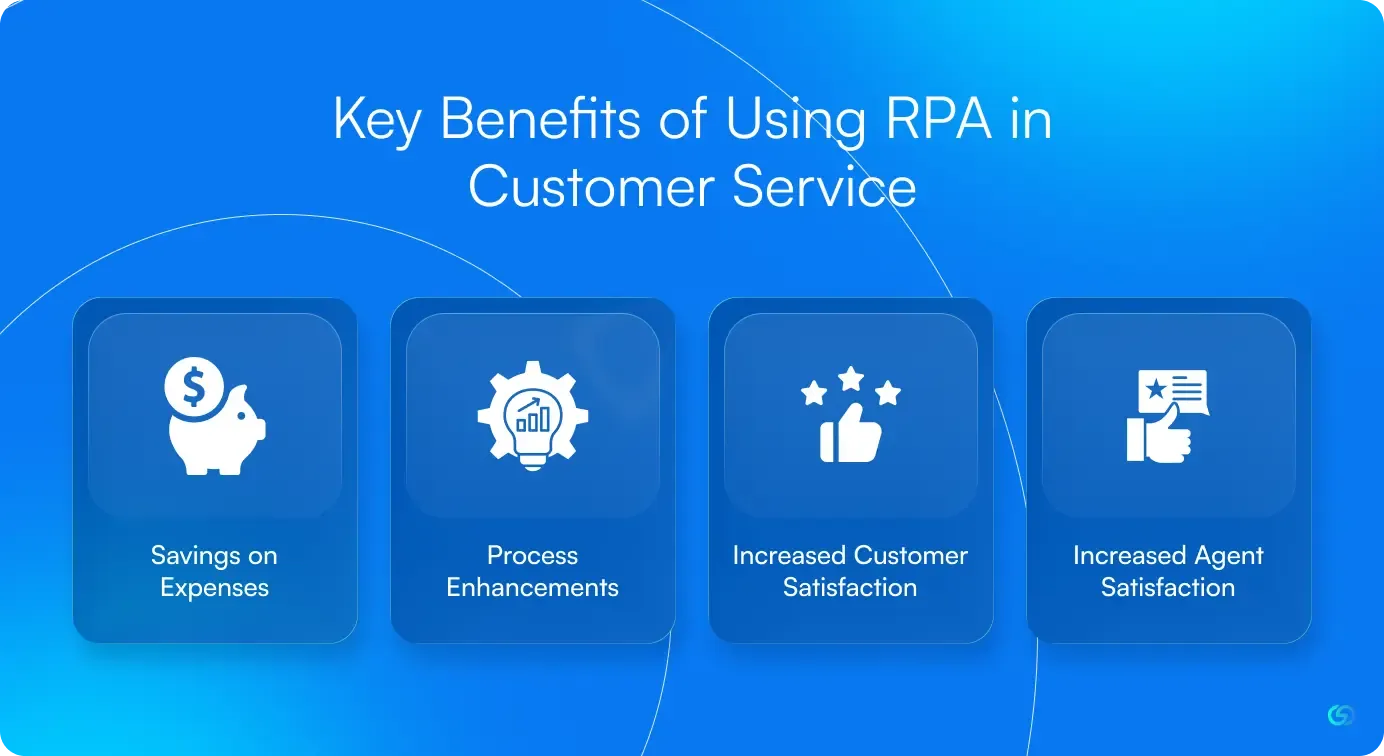
Before we move on to the RPA use cases in customer service, let’s understand the numerous advantages of customer service. The most notable services are as follows-
- Savings on expenses: Reduced costs lead to an increase in efficiency, and RPA in customer service technologies are among the best cost-cutting options. For instance, the average handle time (AHT) is significantly decreased when a customer service representative utilizes an RPA-powered system. As a result, the cost of processing is cut in half.
- **Process enhancements: ** RPA improves business processes, maintains compliance, reduces errors, and enhances efficiency by utilizing customer service. Basically, it may ensure that all the changes to your system are seamlessly recorded. Apart from that, Robotic Process Automation customer service robots run inspections and update your workflows in the background.
- Increased customer satisfaction: RPA allows you to efficiently cater to the customers while enhancing the complete experience of the customers, with 81% of customers stating that they would like more self-service options. Implementing effective chatbots enables customers to connect with the company 24 hours a day and 7 days a week. This allows your customers to solve all their common problems at any time, whether it is day or night, throughout the week. With RPA, the frustration of customers from waiting for a response from the customer service agent will be a thing of the past.
- Increased Agent Satisfaction: RPA in customer service has more benefits than just for customers. For instance, agents give significant time to locating and tracking the information of customers across several systems. RPA in customer service systems is capable of handling this task by researching the process faster, enabling agents to decrease lead times and offer better support.
Real-world Use Cases of RPA in Customer Service
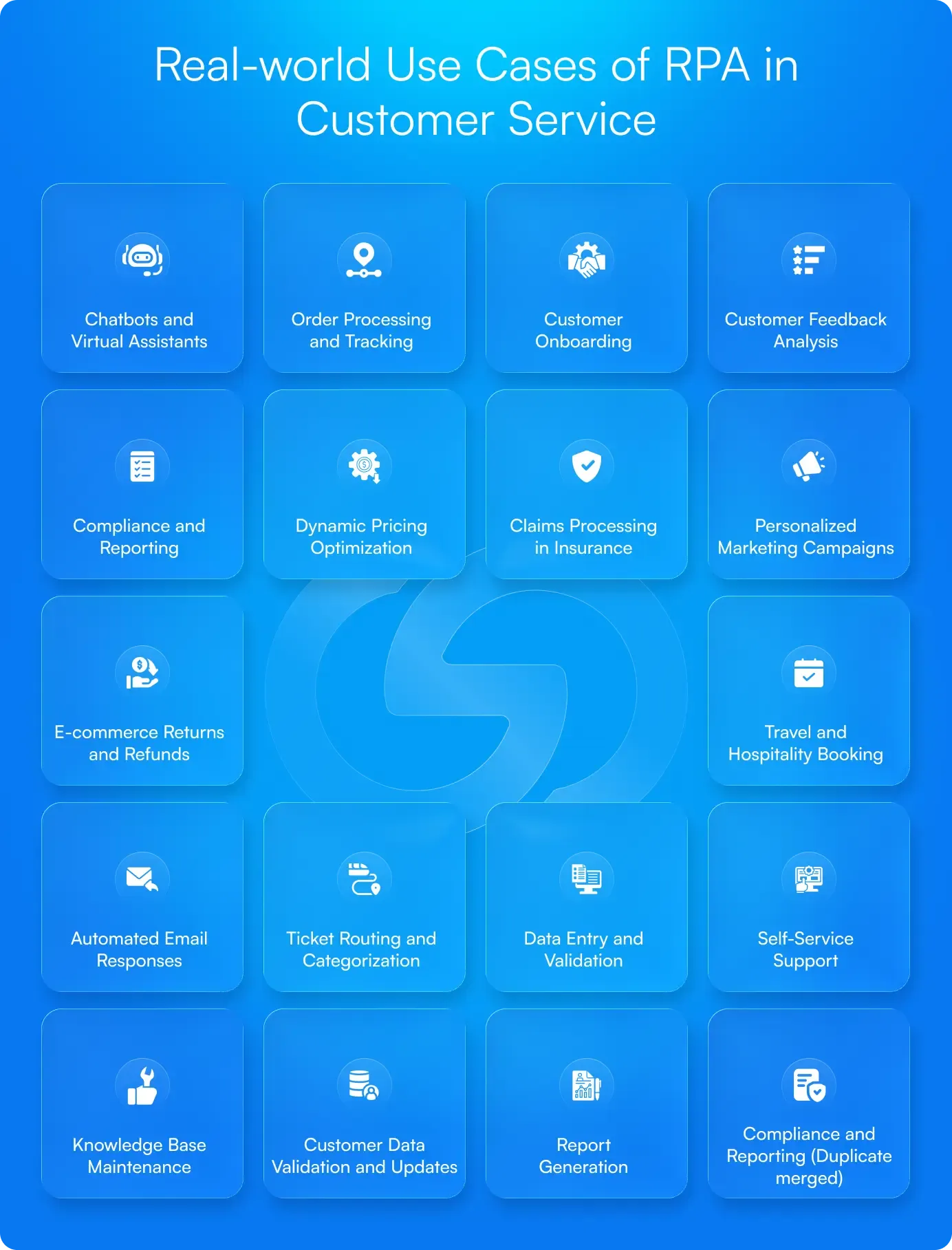
Now let us delve into the real-world RPA use cases in customer service, enhancing customer experiences-
1. Chatbots and Virtual Assistants
RPA-powered chatbots and virtual assistants optimize customer interactions via automating responses to common questions, tracking requests as well as via executing simple transactions. Integrated with CRM systems, they offer customized recommendations as well as real-time assistance around the clock. These intelligent bots enhance customer satisfaction by decreasing wait times and ensuring consistency in service quality. Moreover, they free the customer support agents for focusing on complicated issues, enhancing complete productivity and decreasing operational costs while maintaining high engagement levels of engagement and accuracy in customer communication.
2. Order Processing and Tracking
RPA bots automate the end-to-end order management process — from capturing order details to inventory validation, invoicing, and tracking updates. By automatically syncing data between sales, warehouse, and logistics systems, they minimize manual errors and processing delays. Customers benefit from real-time visibility into order status, while businesses experience improved accuracy and faster fulfilment cycles. This automation enhances customer experience, boosts transparency, and reduces back-office workloads, making order tracking a seamless and efficient process.
3. Customer Onboarding
RPA accelerates customer onboarding by automating repetitive steps such as data entry, document verification, and account setup. Bots validate information across multiple databases, ensuring compliance and accuracy before activating new accounts. This streamlined process shortens onboarding time from days to minutes while enhancing accuracy and customer satisfaction. By eliminating manual errors and improving communication between systems, RPA ensures a frictionless, transparent onboarding experience that sets a positive tone for the customer’s long-term relationship with the brand.
4. Customer Feedback Analysis
Using RPA combined with Natural Language Processing (NLP), businesses can automatically collect, categorize, and analyze customer feedback from emails, surveys, and social media platforms. The bots identify sentiment trends, highlight recurring issues, and compile actionable insights for improvement. This enables customer service teams to respond proactively to complaints, tailor services based on user sentiment, and boost overall satisfaction levels. Automating feedback analysis helps organizations continuously refine their offerings, enhance decision-making, and maintain a customer-centric business strategy.
5. Compliance and Reporting
RPA simplifies compliance management by automatically gathering, validating, and organizing regulatory data from multiple systems. Bots generate accurate audit reports, monitor compliance thresholds, and flag anomalies for review. This reduces the manual burden on compliance teams while ensuring transparency and adherence to industry standards. Automation minimizes human error, accelerates reporting timelines, and provides a reliable audit trail — helping organizations maintain accountability, avoid penalties, and confidently meet evolving regulatory requirements with minimal resource investment.
6. Dynamic Pricing Optimization
RPA supports dynamic pricing strategies by continuously tracking competitor prices, customer demand, and market trends. Bots analyze data across channels, adjust pricing rules, and update listings in real time. This ensures that pricing remains competitive, profitable, and consistent across platforms. By automating repetitive monitoring tasks, RPA helps businesses respond swiftly to market shifts while reducing manual effort. Customers benefit from fair, transparent pricing, while companies maximize revenue potential through data-driven, responsive pricing automation.
7. Claims Processing in Insurance
In the insurance sector, RPA streamlines claims processing by automating form validation, policy verification, and payout calculations. Bots extract data from claim submissions, check eligibility criteria, and update internal systems with approval or rejection details. This automation significantly reduces processing times, improves accuracy, and minimizes fraud risks. Customers experience faster resolutions and greater transparency, while insurers benefit from reduced administrative costs and enhanced compliance — ensuring a more efficient and customer-focused claims management process.
8. Personalized Marketing Campaigns
RPA enables personalized marketing by automating audience segmentation, campaign scheduling, and content distribution. Bots analyze customer data — including past purchases, preferences, and online behavior — to trigger customized messages through email or social media channels. This ensures each customer receives relevant offers, improving engagement and conversion rates. By eliminating manual campaign management, RPA enhances marketing precision and consistency, helping brands deliver tailored experiences that strengthen loyalty and drive measurable business growth.
9. E-commerce Returns and Refunds
Handling returns and refunds can be complex and time-consuming. RPA simplifies the process by automatically validating return requests, verifying transaction details, generating return labels, and updating inventory and payment systems. Bots notify customers about return status and process refunds swiftly, reducing delays and improving transparency. Automation minimizes manual intervention, ensures policy compliance, and enhances the overall post-purchase experience — turning what’s often a pain point into an opportunity for customer satisfaction and retention.
10. Travel and Hospitality Booking
In the travel and hospitality sector, RPA bots manage booking requests, availability checks, and confirmations across multiple platforms. They automatically update reservations, send itineraries, and handle cancellations or modifications. This ensures real-time synchronization and minimizes double bookings or data mismatches. By automating repetitive booking tasks, businesses can provide 24/7 customer service, reduce administrative overhead, and offer seamless, accurate experiences — resulting in increased guest satisfaction and operational efficiency for hotels, airlines, and travel agencies.
11. Automated Email Responses
RPA bots intelligently handle incoming customer emails by classifying queries, extracting relevant details, and generating appropriate responses. Whether it’s acknowledging receipt, providing updates, or sharing resource links, bots ensure timely and consistent communication. Integrated with CRM systems, they maintain conversation records for follow-ups and escalate complex issues to human agents. This automation enhances responsiveness, reduces email backlog, and maintains a professional communication tone — improving customer satisfaction through faster and more reliable interactions.
12. Ticket Routing and Categorization
RPA optimizes helpdesk efficiency by automating ticket triaging and categorization. Bots scan incoming service requests, identify keywords, prioritize issues, and assign tickets to the appropriate department or agent. They also merge duplicate entries and escalate urgent ones. This ensures faster resolution times, balanced workloads, and improved SLA adherence. Automating ticket routing minimizes delays, enhances productivity, and ensures customers are connected with the right experts promptly, leading to smoother and more efficient service delivery.
13. Data Entry and Validation
Data accuracy is vital in customer service operations. RPA bots eliminate manual entry errors by automatically capturing, validating, and updating information across systems. They extract structured and unstructured data from forms, emails, or spreadsheets and ensure it meets defined validation rules before submission. This not only accelerates workflows but also improves data reliability and consistency. Businesses gain more accurate reporting and faster service delivery while agents are freed from repetitive administrative tasks.
14. Self-Service Support
RPA empowers self-service capabilities by automating backend processes for common customer actions like password resets, account updates, order tracking, and policy checks. Bots handle these repetitive requests instantly, giving customers the freedom to resolve issues independently without agent intervention. This reduces ticket volume and support costs while improving customer satisfaction through 24/7 accessibility. Businesses benefit from higher efficiency, faster resolutions, and improved customer retention by offering seamless automated self-service options.
15. Knowledge Base Maintenance
Maintaining an updated knowledge base is crucial for effective customer support. RPA automates this process by monitoring recurring inquiries, identifying outdated content, and updating FAQs or troubleshooting guides automatically. Bots extract insights from ticket histories and agent interactions to ensure articles stay relevant and accurate. This keeps both customers and agents informed, reduces dependency on support teams for repetitive questions, and improves first-contact resolution rates through readily available, high-quality information.
16. Customer Data Validation and Updates
Customer information often changes — addresses, contact details, or preferences. RPA bots routinely validate data against internal and external sources, correct inconsistencies, and update CRM records automatically. This ensures accuracy across all customer touchpoints, leading to improved personalization and reduced communication errors. By keeping databases clean and synchronized, businesses enhance service quality, reduce bounce rates, and maintain compliance with data protection regulations. Reliable data becomes the foundation for smarter, customer-focused decision-making.
17. Report Generation
RPA automates report generation by collecting and consolidating data from multiple sources such as CRM, ERP, or helpdesk systems. Bots create detailed reports on performance metrics, customer satisfaction, and compliance, ensuring accuracy and consistency. They can schedule these reports for automatic distribution to stakeholders, saving hours of manual effort. This automation accelerates decision-making, enhances visibility into operations, and ensures data-driven strategies that improve customer service performance and organizational efficiency.
18. Compliance and Reporting (Duplicate merged)
RPA ensures ongoing compliance by tracking regulatory changes, verifying data accuracy, and maintaining audit trails. Bots automatically collect required documentation, validate compliance metrics, and generate timely reports for stakeholders. This reduces the risk of penalties, enhances transparency, and ensures that processes align with evolving standards. Automation not only saves significant manual effort but also guarantees consistency and reliability across compliance functions — strengthening customer trust and organizational accountability.
Conclusion
Hence, Robotic Process Automation has become a game-changer in the realm of customer service. RPA in customer service provides several benefits, starting from automating routine tasks to improving customer satisfaction as well as operational efficiency. The premier RPA use cases in customer service demonstrate the transformative potential of RPA across multiple aspects of customer service.