- Enterprise Software Development
- 2026-06-05
The Ultimate Guide to Enterprise Software Development in 2026: Benefits, Types, and Best Practices
Audio Track
Table of Contents
Key Takeaways:
- Enterprise software development is important for developing secure, scalable, and integrated systems that support complicated business operations and long-term growth.
- Custom enterprise solutions help in automating processes, enhancing efficiency, and allowing data-driven decision-making across departments.
- Selecting between custom and off-the-shelf software depends on business requirements, scalability, budget, and the needed level of flexibility.
- Technologies such as AI, cloud computing, and automation are fostering the evolution of modern enterprise software and speeding digital transformation.
- Successful enterprise software implementation needs the correct strategy, agile development, and ongoing optimization to maximize both performance and ROI.
Overview
In a largely complex digital landscape, enterprise software development allows business organizations to develop secure, scalable, and integrated systems customized to their unique operational requirements. Unlike the generic apps, enterprise solutions are developed to handle huge volumes of data, support cross-functional workflows, and ensure easy communication across departments. Starting from automating business processes to allowing real-time analytics, these systems play a crucial role in enhancing efficiency as well as decision-making. As enterprises speed up their digital transformation journeys, partnering with a trustworthy enterprise software development company becomes important for driving innovation and maintaining a competitive advantage in a fast-evolving market.
What is Enterprise Software Development?
Enterprise software development is the process of designing, developing, and deploying software apps that specifically cater to the requirements of large-scale businesses. It includes developing powerful and scalable solutions addressing complicated business challenges, facilitating easy operations, and supporting strategic decision-making. Generally, an enterprise software system enables businesses to be more efficient and productive.
The Need for Enterprise Software Development
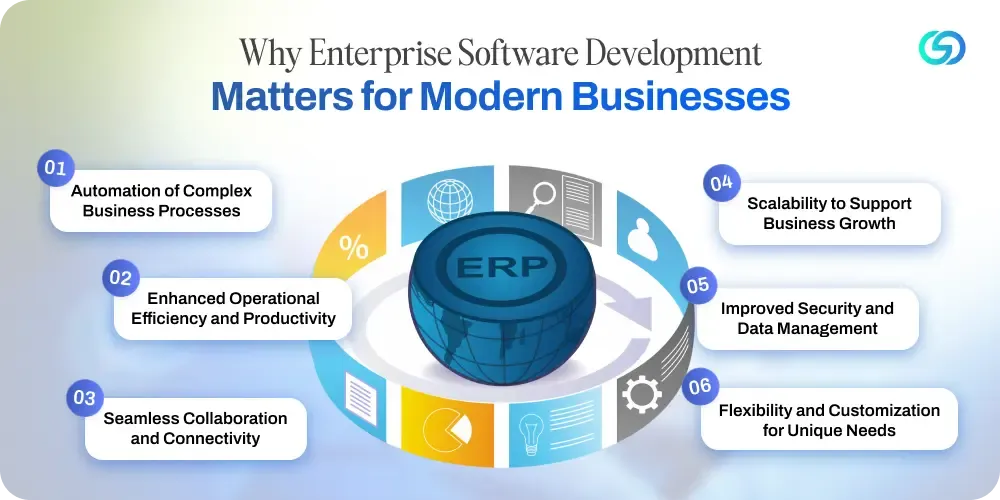
Modern business work in an environment defined by speedy digital transformation, increasing volumes of data, and complicated workflows. This is where the need for custom enterprise software development rises. It is not a simple technology upgrade but a strategic necessity.
🔷 Automation of Complex Business Processes
Businesses that still depend on fragmented and manual systems face delays and inefficiencies. Enterprise software allows automation of repetitive tasks, enabling teams to focus on high-value activities and enhancing overall productivity.
🔷 Enhanced Operational Efficiency and Productivity
A unified or centralized system acts as a single source of truth, decreasing redundancies and optimizing workflows across departments. This results in faster making of decisions, and more efficient operations at scale.
🔷 Seamless Collaboration and Connectivity
With distributed teams as well as hybrid working models, businesses require integrated systems, ensuring collaboration in real-time. Enterprise solutions offer unified success to tools and data, facilitating better coordination across departments and locations.
🔷 Scalability to Support Business Growth
As businesses expand, their operational requirements change. Custom enterprise software development ensures that the system can scale without needed constant replacements, making growth cost-effective as well as sustainable.
🔷 Improved Security and Data Management
Enterprise software development focuses on developing secure, trustworthy systems that can handle huge volumes of sensitive information. With advanced security protocols, compliance measures, and access controls, businesses can protect crucial information and ensure regulatory adherence.
🔷 Flexibility and Customization for Unique Needs
Custom software development for enterprise allows businesses to quickly adapt to technological shifts, changing demands of the market, and operational changes. With integration capabilities and modular architecture, businesses can upgrade and expand their systems without disrupting core operations.
Enterprise Software Market Size
The world-wide enterprise software market is experiencing robust and sustainable growth, showing an increase in the reliance of businesses on advanced digital solutions. Valued at the proximity of USD 291.75 billion in the year 2025, the market is protected to reach up to USD 750 billion and USD 833 billion by 2033 to 34, expanding at a yearly growth rate of 10 to 15%. The speedy growth highlights the crucial role enterprise software plays in the modern business ecosystem.
One of the main contributors to this growth is the varied adoption of cloud computing, which allows flexibility, cost efficiency, and scalability. Moreover, the incorporation of AI and automation is changing enterprise operations, driving demand for more adaptive and smarter software solutions.
In terms of segments, customer relationship management continues to dominate the market because of the direct impact on revenue growth and customer engagement.
On the other hand, Enterprise Resource Planning systems are also expanding largely, with projections that estimate a valuation of more than USD225 billion by 2035.
Regionally, the US leads the market, driven by powerful investments in digital infrastructure and innovation. Altogether, the growth of the market is fuelled by digital change initiatives, increasing volumes of data, and the increasing need for integrated, secure enterprise systems.
Standard Software vs Enterprise Software Development - Key Differences
When it is about software development, there is a distinct difference between enterprise, standard, and regular software development. The differences come from the particular needs, scope, and complexity linked with the development of software solutions for large-scale business organizations. Given below are some of the main disparities between the approaches.
| Parameters | Enterprise Software | Standard Software |
|---|---|---|
| Scale & Complexity | Developed for handling the complexity and scale of large businesses, supporting multiple departments, users, departments, and complex workflows. | Typically cater so particular or small-scale use, with less importance on complexity and scalability. |
| Customization and Flexibility | Highly customizable as well as adaptable or meeting particular business processes, industry needs, and workflows. | Mostly follows a generalized approach with less options for customization. |
| Integration & Interoperability | Involves incorporating new apps with existing systems, allowing seamless data integration as well as interoperability. | Mostly standalone products, low emphasis on interoperability and integration. |
| Security & Compliance | Prioritizes strong security measures as well as compliance with industry regulations because of handling confidential and sensitive information. | Security measures depend on the nature of the app and sensitive data. |
Benefits of enterprise software development
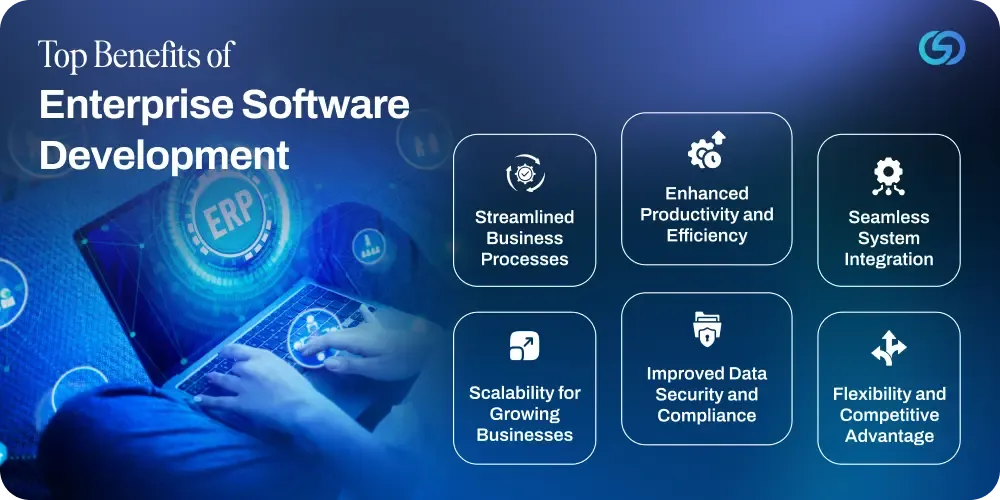
Enterprise software development empowers organizations to streamline operations, improve efficiency, and scale sustainably. By leveraging custom enterprise software development, businesses can address unique challenges, integrate systems seamlessly, and build future-ready solutions that drive long-term growth and competitive advantage.
➡️ Streamlined Business Processes
Enterprise software eliminates inefficiencies by automating workflows and optimizing operations. It helps businesses reduce manual intervention, minimize errors, and ensure consistent performance across departments, ultimately improving productivity and operational efficiency at scale.
➡️ Enhanced Productivity and Efficiency
By centralizing data and automating repetitive tasks, enterprise solutions allow teams to focus on strategic activities. This leads to faster decision-making, improved output, and better utilization of resources across the organization.
➡️ Seamless System Integration
With custom enterprise software development, businesses can integrate multiple systems such as CRM, ERP, and third-party tools into a unified platform. This ensures smooth data flow, eliminates silos, and improves cross-functional collaboration.
➡️ Scalability for Growing Businesses
Enterprise software is designed to handle increasing workloads, users, and data volumes without compromising performance. This scalability ensures that systems evolve alongside business growth, supporting long-term expansion and stability.
➡️ Improved Data Security and Compliance
Enterprise solutions incorporate advanced security protocols, access controls, and compliance measures to protect sensitive business data. This is crucial for organizations handling large volumes of information and operating in regulated industries.
➡️ Flexibility and Competitive Advantage
With custom enterprise software development, businesses can build solutions tailored to their unique needs, enabling faster innovation and adaptability. This flexibility helps organizations respond to market changes quickly and maintain a strong competitive edge.
4 Most Popular Types of Enterprise Software
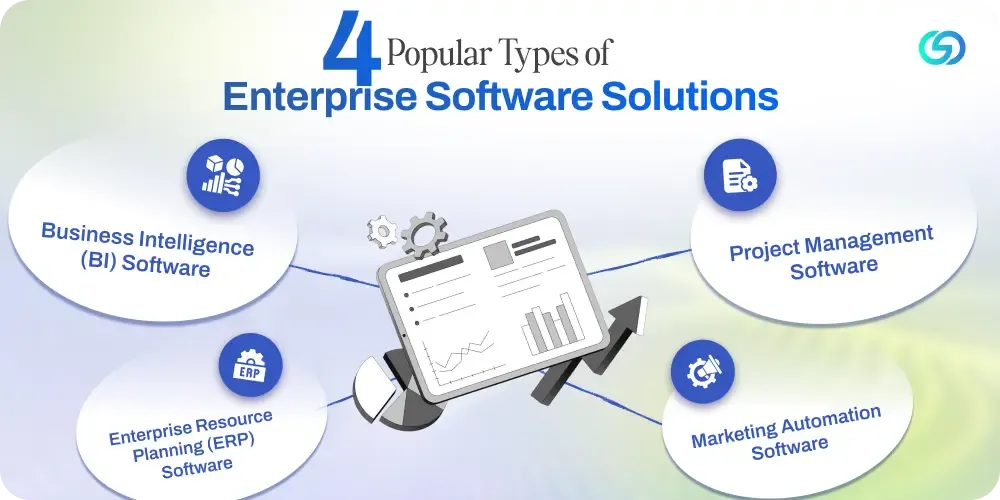
Enterprise applications encompass several types of software developed for meeting particular business needs. Given below are some of the types:
▶️ Business Intelligence (BI) Software
BI enterprise apps allow businesses to come together, analyze, and visualize business information from several sectors, offering in-depth insights, data-driven decision-making, and performance monitoring across several aspects of the business.
▶️ Enterprise Resource Planning (ERP) Software
ERP software solution incorporates and handles primary processes of the business, including inventory, finance, procurement, manufacturing, and human resources, offering a unified system for efficient management, resource planning, and reporting.
▶️ Project Management Software
An enterprise system for project management facilitates organizing, planning, and managing project tasks, resources, timelines, and team collaboration. This ensures the successful execution of the project, enhanced productivity, and effective communication.
▶️ Marketing Automation Software
This type of software helps in automating marketing tasks like email campaigns, lead nurturing, analytics, and social media management, allowing businesses to streamline the efforts of marketing, personalize customer relationships, and generate high-quality leads.
Custom Enterprise Software vs Off-the-Shelf Enterprise Software - Which Is Better?
Organizations investing in enterprise solutions often face a critical decision: should they build a tailored system or adopt a ready-made solution? The answer isn’t universal; it depends on business goals, budget, timelines, and operational complexity. Understanding the strengths and limitations of both approaches helps in making a more informed choice.
💠 Custom Enterprise Software
Custom enterprise software is developed specifically to meet an organization’s unique requirements. It is designed from the ground up, ensuring alignment with existing workflows, processes, and long-term business objectives.
⏭️ Advantages:
One of the biggest benefits is complete customization; the solution fits your business, not the other way around. It also offers greater flexibility and scalability, allowing systems to evolve as the business grows. Custom solutions can provide a competitive advantage by enabling unique features tailored to specific challenges. Additionally, they ensure seamless integration with existing tools, improving data flow and collaboration across departments.
⏭️ Disadvantages:
However, custom development requires a higher upfront investment in both time and cost. It also demands access to skilled development teams and ongoing resources. Maintenance, updates, and support are the organization’s responsibility, which can add to long-term operational costs.
💠 Off-the-Shelf Enterprise Software
Off-the-shelf software refers to pre-built solutions designed to address common business needs. These are readily available and can be deployed quickly, making them a popular choice for many organizations.
⏭️ Advantages:
These solutions are generally more cost-effective initially and offer faster deployment, reducing time to value. They are built using industry best practices, ensuring reliability and standardization. Additionally, vendors typically provide ongoing support, updates, and maintenance, reducing the internal burden on teams.
⏭️ Disadvantages:
The biggest limitation is the lack of customization; businesses may need to adjust their processes to fit the software. Integration with existing systems can also be challenging, sometimes requiring additional effort or third-party tools. Moreover, as highlighted in industry reports, many organizations still require moderate customization even after implementation, which can reduce the perceived simplicity of these solutions.
Which One Should You Choose?
If your organization has unique workflows, long-term scalability goals, and requires deep integration, custom enterprise software is often the better choice. On the other hand, if you need a quick, cost-effective solution for standard processes, off-the-shelf software can be a practical option. Ultimately, the right decision depends on balancing flexibility, cost, and business complexity. If your organization has unique workflows, long-term scalability goals, and requires deep integration, custom enterprise software is often the better choice. On the other hand, if you need a quick, cost-effective solution for standard processes, off-the-shelf software can be a practical option. Ultimately, the right decision depends on balancing flexibility, cost, and business complexity. If your organization has unique workflows, long-term scalability goals, and requires deep integration, custom enterprise software is often the better choice. On the other hand, if you need a quick, cost-effective solution for standard processes, off-the-shelf software can be a practical option. Ultimately, the right decision depends on balancing flexibility, cost, and business complexity.
Industry-Specific Use Cases of Enterprise Software Development
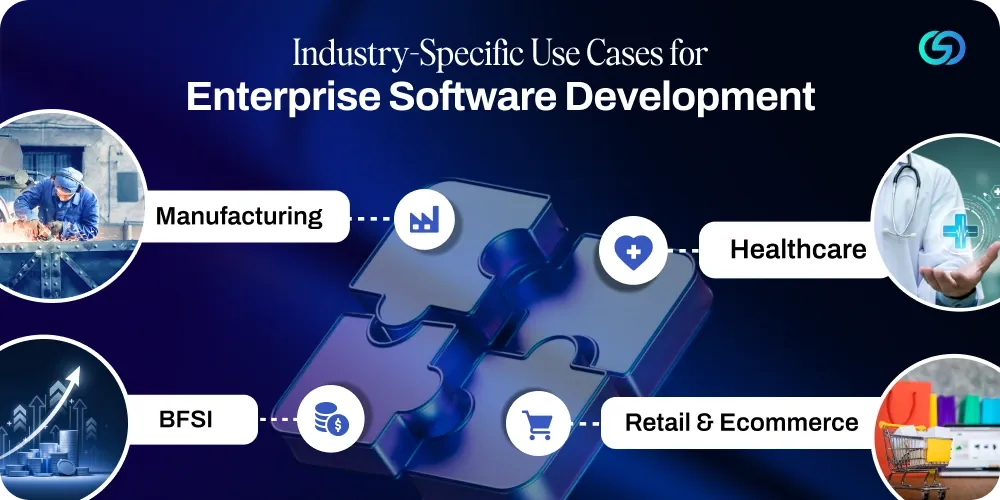
Enterprise software development plays a transformative role across industries by addressing unique operational challenges, improving efficiency, and enabling data-driven decision-making. From production optimization to customer engagement, these solutions are tailored to meet sector-specific demands and drive scalable business growth.
🔶 Manufacturing
Enterprise software development for manufacturing industry focuses on optimizing production, supply chains, and inventory management. Systems like ERP and MES enable real-time production tracking, material planning, and quality control. Advanced solutions also support predictive maintenance and automation, reducing downtime and operational costs. By integrating procurement, production, and logistics, manufacturers gain better visibility and control over end-to-end processes, improving efficiency and product quality.
🔶 BFSI
Enterprise software development for BFSI industry is essential for managing transactions, ensuring compliance, and mitigating risks. These systems enable real-time financial reporting, automated accounting, and fraud detection. Financial institutions also use enterprise solutions for investment tracking, regulatory compliance, and secure data management. By centralizing financial operations, organizations can improve accuracy, transparency, and decision-making while maintaining high levels of security and trust.
🔶 Healthcare
Enterprise software helps in managing patient records, streamlines workflows, and ensures regulatory compliance in healthcare. Solutions such as Electronic Health Records (EHR) systems enable efficient patient data management, appointment scheduling, and billing. Additionally, enterprise software development for healthcare industry supports telemedicine, resource planning, and inventory management for medical supplies, ultimately improving patient care, operational efficiency, and compliance with healthcare standards.
🔶 Retail and Ecommerce
In retail and ecommerce, enterprise software enables efficient inventory management, customer relationship management, and omnichannel operations. Enterprise software development for retail and ecommerce industry is necessary for tracking customer behavior, personalize shopping experiences, and optimize supply chains. Integration of online and offline channels ensures seamless transactions and real-time inventory visibility. This helps retailers enhance customer satisfaction, reduce stockouts, and respond quickly to changing consumer demands.
Agile Development Methodology in Enterprise Software Development Process
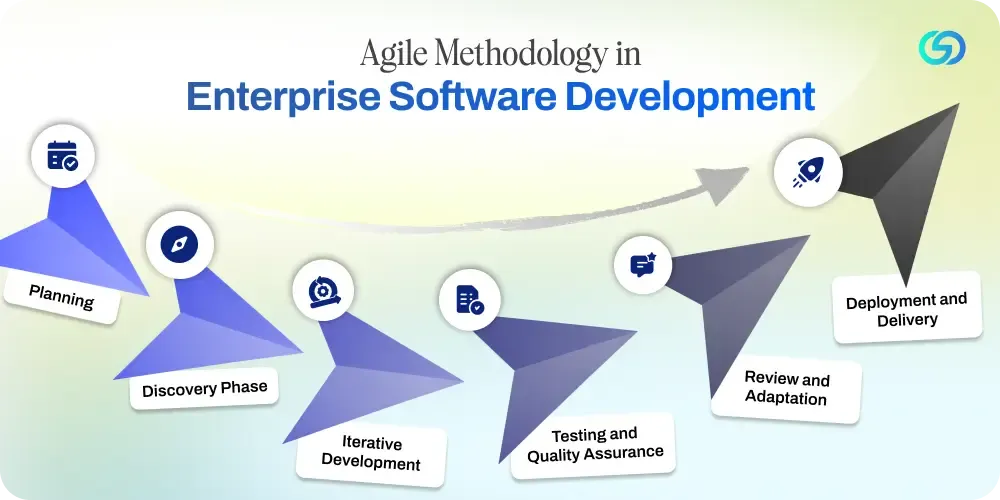
Opting for an agile development approach has gained tremendous popularity because of the numerous advantages and its capability to address complications of large-scale projects. Depending on the vendor you choose and the kind of enterprise software development system, here are the crucial stages of custom enterprise software development.
1️⃣ Planning
In the first stage, the planning stage, the project begins, the requirements are gathered, and a product backlog is developed.
2️⃣ Discovery Phase
In this particular phase, the team conducts more research, uses interviews and analysis for refining needs, and gains a comprehensive understanding of the scope of the project.
3️⃣ Iterative Development
The development team works in short iterations for delivering incremental functionality, integrating feedback, and making continuous enhancements.
4️⃣ Testing and Quality Assurance
The continuous testing throughout the development process ensures the quality of software and meets functional needs.
5️⃣ Review and Adaptation
Regular reviews and sessions for feedback enable the stakeholders to check progress and guide the development direction.
6️⃣ Deployment and Delivery
The working software is delivered and deployed with every iteration, ensuring customer satisfaction and value realization.
Top 3 Best Practices in Enterprise Software Development
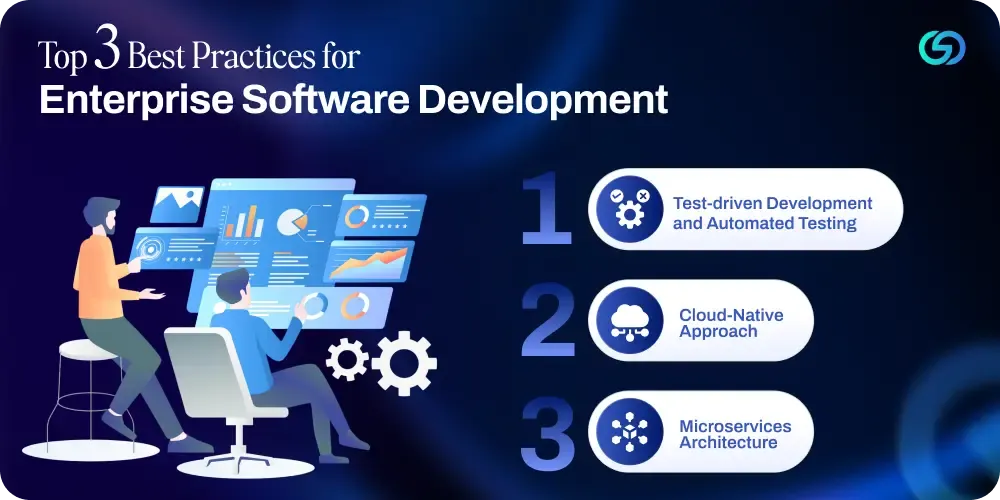
Developing enterprise software is complex and given below are some of the best practices in order to ensure successful project delivery, offering high-quality enterprise solutions.
1. Test-driven Development and Automated Testing
Adopt a test-powered development approach, where the tests are written before the code is written. This ensures that the software meets the needs and works as expected.
Utilize automated testing frameworks and tools to allow continuous testing all over the development lifecycle, enhancing the quality and decreasing the risk of regression.
2. Cloud-Native Approach
Embrace a cloud –native approach to the process of software development, utilizing cloud infrastructure and services to develop, deploy, and handle applications.
Utilize containers as well as container orchestration platforms such as Kubernetes to allow scalability, portability, and resilience in a cloud environment.
3. Microservices Architecture
Break down complicated systems into loosely coupled, smaller services known as microservices to enhance scalability, flexibility, and maintainability.
Microservices allow independent deployment and development of several components, enabling faster time-to-market and agility. By using several tools, you can speed up microservices development.
Most Common Challenges in Enterprise Software Development
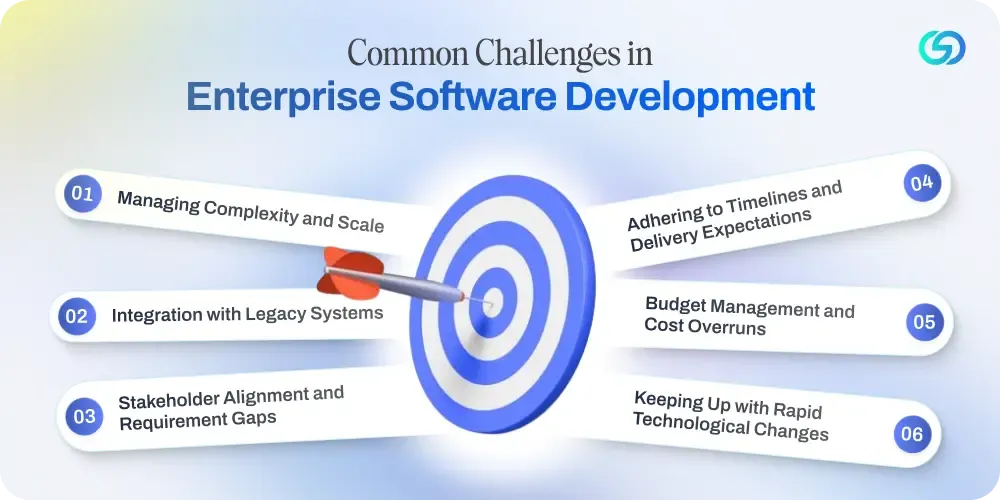
Enterprise software development involves navigating complex systems, diverse stakeholder expectations, and evolving technologies. From integration hurdles to budget constraints, organizations must address multiple challenges to ensure the successful delivery, scalability, and long-term performance of enterprise-grade software solutions.
⏯️ Managing Complexity and Scale
Enterprise systems are inherently complex, involving multiple modules, integrations, and large user bases. Ensuring consistent performance, reliability, and usability across such large-scale environments is challenging, especially when systems must support diverse business functions, geographies, and continuously evolving operational requirements.
⏯️ Integration with Legacy Systems
Many enterprises still depend on legacy systems that are outdated but critical to operations. Integrating modern solutions with these systems often leads to compatibility issues, data silos, and migration challenges, increasing development effort and slowing down digital transformation initiatives.
⏯️ Stakeholder Alignment and Requirement Gaps
Enterprise projects involve multiple stakeholders across departments, each with different priorities and expectations. Miscommunication, unclear requirements, or frequent changes can result in scope creep, project delays, and solutions that fail to fully align with business objectives and user needs.
⏯️ Adhering to Timelines and Delivery Expectations
Meeting deadlines in enterprise software projects is difficult due to technical complexities, changing requirements, and dependencies across teams. Delays in one phase can impact the entire project lifecycle, affect time-to-market and reduce the overall effectiveness of the solution.
⏯️ Budget Management and Cost Overruns
Enterprise software development requires significant investment in skilled resources, infrastructure, and tools. Managing budgets becomes challenging when requirements evolve or unexpected issues arise, making it essential to balance cost control with delivering high-quality, scalable solutions.
⏯️ Keeping Up with Rapid Technological Changes
The fast pace of technological advancements, including cloud computing, AI, and automation, requires organizations to continuously adapt. Keeping systems updated while maintaining stability, training teams, and avoiding technical debt can be a persistent challenge for enterprises.
Wrap up
In an era that is defined by speedy digital transformation, enterprise software has become the backbone of modern business operations. Starting from enhancing efficiency to allowing data-driven decisions, the right solution can significantly affect long-term success. Choosing a custom-built enterprise software ensures the platform will align with the business's goals, scalability needs, and operational complexity.
Partnering with a trustworthy enterprise development company ensures access to the right technology, innovation, and expertise needed to develop future-ready systems. As industries continue to evolve, investing in powerful enterprise solutions is necessary for remaining competitive, agile, and prepared for the future.
Frequently Asked Questions
What factors should businesses consider before starting enterprise software development?
Businesses must evaluate their primary objectives, such as budget, scalability requirements, and their current IT infrastructure. It is also crucial to define clear needs, find out integration points, and plan for long-term maintenance. A well-defined strategy ensures seamless development and improved alignment with business goals.
How do you ensure user adoption of enterprise software within an organization?
User adoption can be enhanced via intuitive design, proper onboarding, and ongoing training. Involving employees early in the process of development, as well as addressing their feedback, helps develop familiarity. The continuous support and clear communication also help in playing an important role in encouraging acceptance.
Can enterprise software be upgraded without disrupting existing operations?
Yes, modern enterprise system are mostly developed using modular architecture that enable updates in phases. This ensures minimal downtime as well as avoids disruption. Proper testing, planning, and deployment strategies further help maintain business continuity during upgrades.
What role does cloud technology play in enterprise software development?
Cloud technology allows flexibility, scalability, and remote accessibility. It decreases infrastructure costs and enables businesses to scale resources depending on demand. Cloud-based solutions also support speedy deployment and easy collaboration across distributed teams.
How do businesses measure the ROI of enterprise software?
ROI is measured by enhancements in efficiency, decreased operational costs, speedy decision-making, and improved productivity. Metrics like time revenue growth, and customer satisfaction also help in evaluating the complete impact of the software.
Is it possible to integrate legacy systems with modern enterprise software?
Yes, a legacy system can be incorporated using APIs, custom connections, or middleware. This enables businesses to retain existing investments while improving functionality with modern capabilities, ensuring seamless transition without complete system replacement.