- RPA Use Cases in Manufacturing
- 2025-11-10
9 Transformative RPA Use Cases in Manufacturing Driving Efficiency in 2025
Audio Track
Table of Contents
Key Takeaways:
- The market for RPA is expected to reach nearly $30 billion by 2030, with 90% of manufacturers reporting improved compliance.
- The combination of RPA and AI helps unlock new levels of automation and benefits such as improved speed, enhanced quality, better customer experience, increased compliance, stronger decision-making, and more.
- RPA use cases in manufacturing, include order creation and processing, inventory management, supply chain management, quality control, customer service, and more.
- Global manufacturing giants like Siemens, Coca-Cola, Volkswagen, and others have already applied RPA to their work processes to boost efficiency.
The Power of RPA
When the market is evolving at an unprecedented speed, businesses need to adapt quickly and remain forward-thinking.
In the past couple of years, a massive transition in the way business functions have led to the adoption of cutting-edge technologies. Among them, Robotic Process Automation (RPA) gained significant attention.
The RPA market is projected to reach $30.85 billion by 2030, highlighting its growing popularity across industries. Automation has transformed several industries, particularly the manufacturing sector.
RPA in manufacturing industry is making remarkable impacts by optimizing operations and improving work productivity. RPA allows businesses to automate complex work processes. The biggest advantage of advanced technologies is that they free up employees from monotonous and repetitive tasks.
To understand better, RPA leverages robots to automate rule-based repetitive tasks, like data entry, so that employees can focus on high-value tasks.
Why Manufacturing Needs Smarter Automation
Looking at the manufacturing landscape in 2025, the traditional approach of daily operations (slower production times or limited scalability) is no longer acceptable in order to sustain a competitive edge.
The latest trend in manufacturing is to implement real-time systems that empower sound decisions and faster development cycles.
Smart automation in the manufacturing industry leverages advanced software like AI, IoT, and RPA to enhance flexibility, scalability, and sustainability. Additionally, automation reduces reliance on manual labor, ensuring consistency.
According to McKinsey, automation improves quality and also addresses workforce health and safety issues. The transition from traditional to automation allows employees to focus on more strategic and complex activities.
To put this into perspective, we will explore RPA examples in manufacturing in this blog and understand how they are changing the sector.
Top Benefits of RPA and AI in Manufacturing
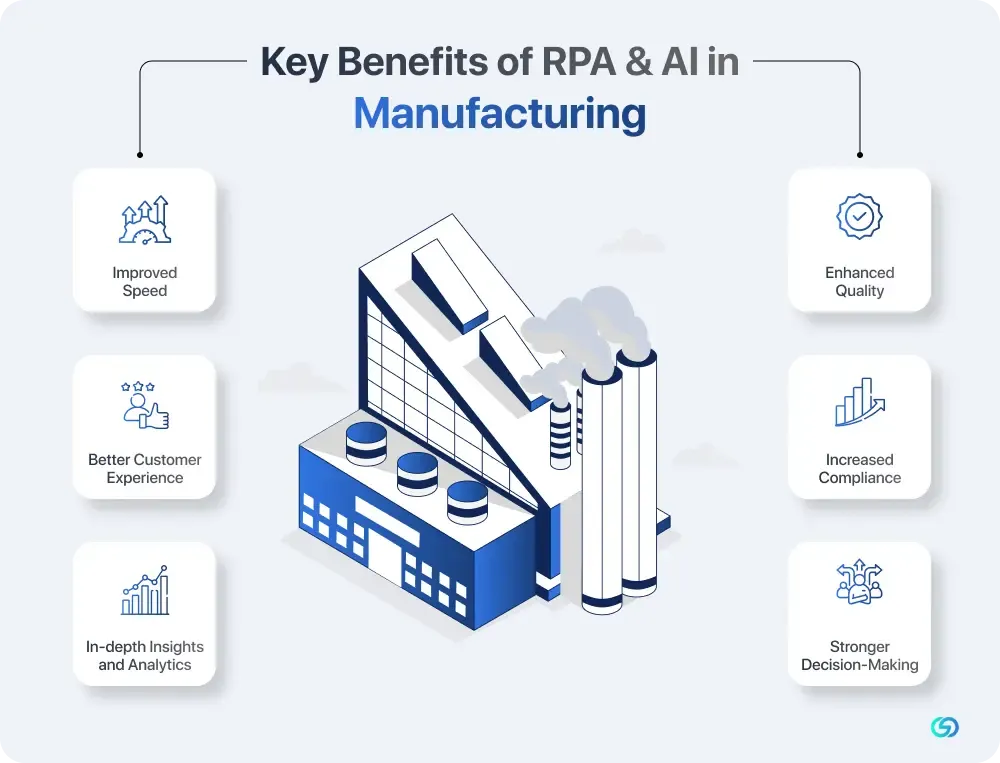
RPA in manufacturing is already streamlining operations, and when combined with AI, the impact only multiples.
Blending RPA in manufacturing industry with AI helps discover new levels of automation, delivering substantial benefits throughout the company. The benefits go beyond cost savings. Let’s find out what happens when RPA and AI are integrated.
- Improved Speed: Automating repetitive and cognitive tasks speeds up the process completion times. Employees are free from monotonous and tedious work, allowing them to focus on higher-value ventures.
- Enhanced Quality: In data interpretation, AI minimizes human errors. On the other hand, RPA perfectly executes steps, removing manual mistakes. These lead to virtually impeccable operations.
- Better Customer Experience: Quick service delivery and correct responses lead to a great customer experience. Employees engage in more strategic and creative work. Both RPA and AI contribute to making businesses sharper and more responsive.
- Increased Compliance: Smart automation leads to a clear audit trail, meaning it maintains strict regulatory compliance.
- In-depth Insights and Analytics: AI processes huge amounts of data, which is generated by RPA. This leads to continuous process improvements. RPA provides structured data while AI analyzes it to identify patterns, refine workflows, and support smarter decision-making.
- Stronger Decision-Making: AI drives business decisions, and when combined with RPA, it means businesses can remove the guesswork and have the confidence that they are making data-driven choices.
The strengths of both RPA and AI combined in businesses can build a stand out automation ecosystem that creates innovation and offers a competitive edge.
RPA Use Cases in Manufacturing Industry
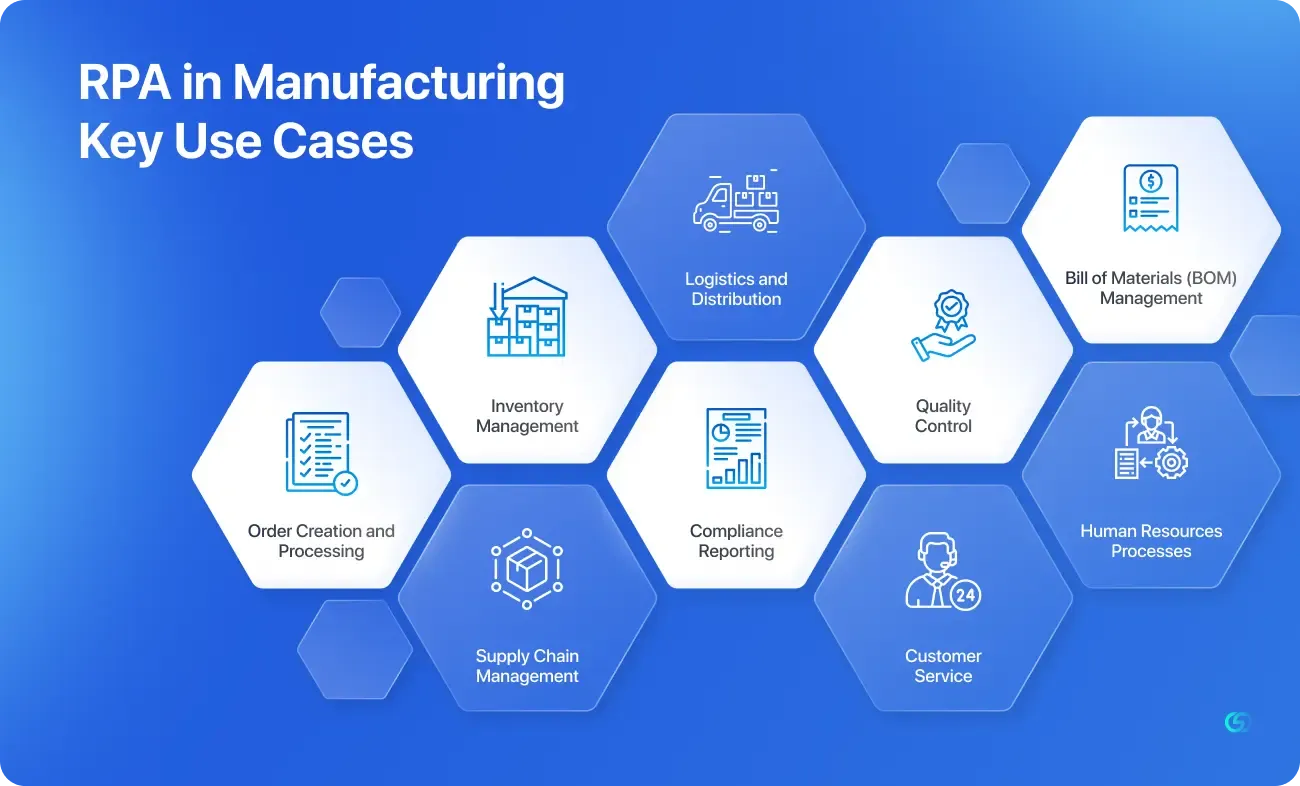
The manufacturing sector globally is facing major business challenges in the upcoming years. In order to get through these challenges, manufacturers need to implement automated systems to simplify business processes.
Let’s check out some RPA use cases in manufacturing industry:
1️⃣ Order Creation and Processing
Without RPA:
- Details regarding the order are collected in emails or documents.
- Employees put data into the Enterprise Resource Planning (ERP) systems, which is time-consuming and prone to mistakes.
- Customers face delays in order confirmations and tracking updates.
With RPA:
- Order Entry Automation: RPA can manage the entire process comprehensively. Right from gathering order details from emails or other sources to putting them into the Enterprise Resource Planning (ERP) systems. This step reduces manual data entry and errors to speed up order fulfillment.
- Streamlined Order Confirmation and Tracking: RPA bots send order confirmations automatically to customers and update tracking details, ensuring customers get timely updates. This is one of the most practical RPA use cases in manufacturing, for it improves customer satisfaction.
2️⃣ Inventory Management
Without RPA:
- Inventory levels are manually tracked, leading to inaccuracies.
- Lack of real-time visibility leads to overstocking and understocking issues.
- Reconciling inventory across systems is tedious and prone to errors.
With RPA:
- Real-time Inventory Tracking: RPA helps in constantly keeping track of inventory, offering instant updates. The bots automatically trigger a reorder when stocks fall below a certain level. This is the perfect RPA example in manufacturing.
- Smart Inventory Reconciliation: It’s easy for bots to compare inventory records across various systems, make adjustments, and spot discrepancies, which ensures inventory data is accurate.
Note: The overall inventory cost can go down by up to 12% by reducing stockouts and overstocks.
3️⃣ Supply Chain Management
Without RPA:
- Supplier communication relies on calls or manual emails, which delays follow-ups and responses.
- Invoice data is entered manually, making it error-prone and slow to process.
- Bottlenecks appear due to a lack of real-time visibility, making it tough to make decisions.
After RPA:
- Supplier Communication: RPA in manufacturing enables routine automated communications, such as sending orders or following up. This reduces the burden on employees while streamlining the entire process.
- Timely Invoice Processing: RPA pulls out data from invoices and automatically matches them to the purchase orders. This automation minimizes the chances of manual errors and ensures vendor payments are on-time.
4️⃣ Logistics and Distribution
Without RPA:
- Shipment tracking needs manual checks, causing delays in updates.
- Freight management is managed through manual entries, slowing down decision-making.
- Customers might face uncertainty due to delays in the communication of shipment statuses.
After RPA:
-
Efficient Shipment Tracking: RPA collects real-time data automatically from different carrier websites and systems to monitor shipment statuses. They are capable of sending timely updates and revised arrival times to customers, if required.
-
Optimized Freight Management: The freight management process can be streamlined, which includes route optimization and freight accounting. RPA use cases in manufacturing work by gathering data from different systems.
5️⃣ Compliance Reporting
Without RPA:
- Compliance reports are manually compiled, increasing the risk of mistakes.
- Audit trails are tough to maintain.
- Most of the time, employees are engaged in tracking and verifying regulatory requirements.
After RPA:
- Automated Report Generation: RPA automates data collection and compliance report generation, ensuring all regulatory standards are met.
- Audit Trail Maintenance: RPA bots are capable of maintaining accurate audit trails, which makes it easier to trace and report compliance during audits.
Note: Nearly 90% of manufacturers experienced improved compliance due to RPA.
6️⃣ Quality Control
Without RPA:
- Manual collection of data leads to mistakes and errors in decision-making.
- Data from inspection tools is time-consuming and scattered.
- Delay in reporting, slowing down correct actions.
After RPA:
- Data Gathering and Evaluation: RPA collects quality control data from different sources. Bots analyze this data to find trends and anomalies that may indicate quality issues.
- Automated Reporting: Quality control data is generated by bots and then shared with the stakeholders, helping address issues quickly. This is a big advantage of RPA in manufacturing industry.
7️⃣ Customer Service
Without RPA:
- Customer queries are handled manually; this leads to longer response times.
- Order tracking, return requests, and refund processing are all done manually.
- Longer wait times and slower processes can lead to poor customer experience.
After RPA:
- Inquiry Resolution: RPA can solve customer queries instantly via chatbots or automated emails. The bot can easily categorize and send the complaint to the appropriate department for faster resolution. These are some of the common RPA examples in manufacturing for customer service, where automation boosts customer experience.
- Automated Order and Return Processing: RPA, for product returns and online orders, takes the requests from emails and cross-checks customer and order data, processes the refund and return, and updates internal systems.
8️⃣ Bill of Materials (BOM) Management
Without RPA:
- Tedious task of manually entering data from design documents into BOM templates
- Inconsistencies when updating BOMs after product design changes.
- Delays in production planning due to incomplete or outdated BOM information.
With RPA:
- BOM Creation Automation: RPA data from design documents can be extracted and entered into BOM templates automatically, keeping them accurate and updated while minimizing risks.
- BOM Updates: RPA has the potential to update the BOMs when product designs are altered. This ensures the team always has access to the latest information.
9️⃣ Human Resources Processes
Without RPA:
- Manually handling documents in the employee onboarding process leads to errors and delays.
- HR spends excessive time on repetitive tasks like leave tracking and payroll calculations.
- Employee satisfaction is affected due to delays or slowness in queries related to salary, leave, or benefits.
After RPA:
- Employee Onboarding: Bots simplify the employee onboarding process by automating workflow such as data entry, document collection, and scheduling sessions.
- Payroll Processing: RPA can automate payroll processing by handling data entry from timesheets, calculating deductions, and processing payments to generate reports.
Note: Studies show that nearly 78% of companies plan on automating their online process.
Real-World Application of RPA in Manufacturing Industry
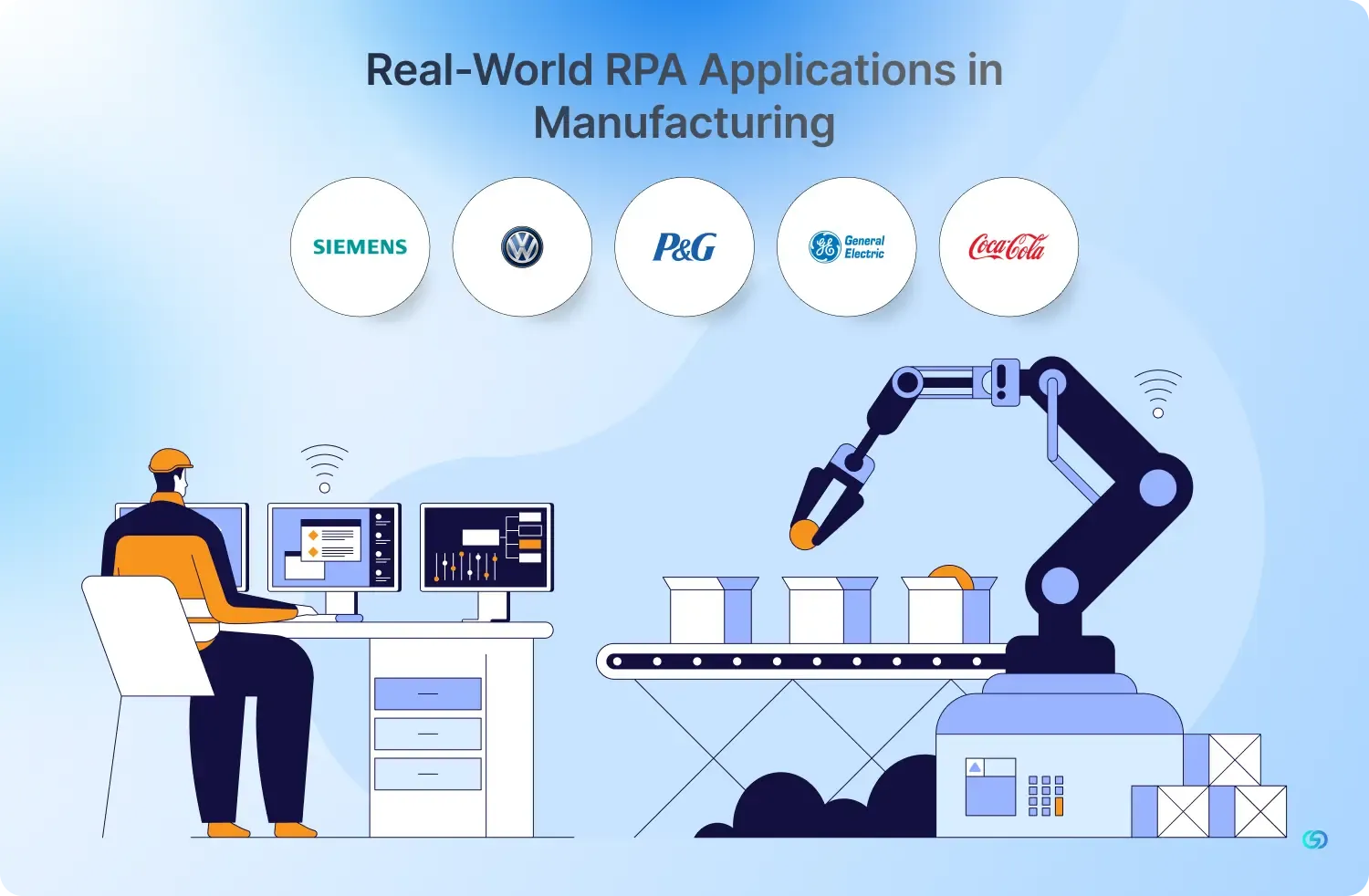
The following are real-world examples, highlighting how manufacturers applied RPA to overcome administrative and production challenges.
🔹 Siemens
Siemens applied RPA in its gas turbine manufacturing. RPA bots automated creating technical documents, which is a process that earlier took experts hours per turbine. RPA was capable of finishing the tasks in minutes, which reduced the production time. This helped engineers focus on intricate tasks.
🔹 Volkswagen
The globally renowned automobile manufacturer, Volkswagen, adopted RPA in its financial operations. By deploying bots, the company automated repetitive tasks such as invoice processing and data entry, which reduced manual workload. This implementation reduced processing time by nearly 60% and enhanced accuracy.
🔹 Procter & Gamble
One of the world’s largest consumer goods companies, P&G, leverages RPA to enhance back-office and manufacturing efficiency. The organization leveraged RPA bots to automate the entire process of receiving and processing orders and connecting these details with the production planning system. The adoption of RPA in manufacturing for P&G resulted in a reduction in order processing and improved accuracy in forecasting production.
🔹 General Electric
General Electric is a global leader in industrial manufacturing and energy solutions. The company integrated RPA to streamline maintenance operations. The bots monitored and analyzed equipment sensor data and produced maintenance work orders when issues were highlighted. This approach minimized unplanned downtime.
🔹 Coca-Cola
RPA was implemented by the very famous Coca-Cola in its inventory management system. They smartly implemented RPA bots to automate and monitor the stock levels across several warehouses. These bots automatically notify in case the inventory falls below the threshold. This smart automation led to enhanced inventory accuracy and reduced overstock and stockouts.
In Conclusion
By now you know that RPA in manufacturing industry works as a powerful tool for transforming businesses across multiple industries. And this is done by automating the repetitive and mundane tasks, which were once handled by humans.
RPA basically copies human interactions with a digital system and has the capability to log into apps, fetch data, and execute tasks. RPA works around the clock and ensures accuracy.
The surge of adopting RPA is undeniable. For manufacturers, the power of RPA lies in its ability to free human workers from tedious tasks and help them focus on more strategic ones to add value to the business.
As you have gone through RPA use cases in manufacturing, you already know how RPA creates a measurable impact, and this is only the beginning. The future advancements are AI-powered, which takes automation even further.
At ConvexSol, we design RPA and excel in providing advanced solutions as per your needs in manufacturing operations. Connect with us to leverage our deep expertise that can remarkably reduce your operational costs and enhance processes.
Frequently Asked Questions
What type of tasks is RPA best suited to handle in manufacturing?
Robotic Process Automation (RPA) is best suited to handle rule-based, repetitive tasks in the manufacturing industry. Tasks such as inventory management, data entry, quality control, customer service, and supply chain management take up a lot of time, and manual processes can even result in compliance issues or huge penalties. By implementing RPA, the workflow becomes more streamlined and structured, increasing speed and efficiency, while freeing up employees.
What are the three types of RPA?
The three main types of RPA are Attended Automation, Unattended Automation, and Hybrid RPA.
- Attended Automation: The bot works with humans to perform activities like data entry. Think of it as a virtual assistant that handles routine tasks.
- Unattended Automation: Works without human intervention to execute tasks like automatic data processing.
- Hybrid Automation: Blends both automations. Provides flexibility in managing both back and front-office activities.
What are the top benefits of combining RPA and AI in manufacturing?
A Goldman Sachs report highlights that AI could increase global labor productivity by over 1% each year, attracting investments of more than $200 billion by 2025. Meanwhile, the RPA market is projected to reach $30.85 billion by 2030. Together, RPA and AI in manufacturing can automate tasks by
- Providing intelligent decision-making,
- Eliminating human intervention,
- Maintaining workflow with high consistency and accuracy,
- Forecasting product demand, automating order processing & fulfillment,
- Cost savings from reduced errors and optimized operations,
- Higher workforce productivity,
- Improved customer satisfaction through faster deliveries.
Can RPA be integrated with my existing manufacturing systems?
Yes, at ConvexSol we can seamlessly integrate RPA with your existing systems such as Enterprise Resource Planning (ERP), Manufacturing Execution Systems (MES), and other technologies. RPA doesn’t disrupt your existing infrastructure. It connects your systems, automates processes, and enhances work without major changes.
What is the difference between RPA and physical industrial robots?
- Nature: RPA is software-based, while industrial robots are mechanical robots with physical bodies.
- Environment: RPA operates in a virtual environment, while industrial robots operate in the physical world.
- Tasks: RPA automates routine tasks, while robots perform physical actions like painting, welding, assembling, and packaging.
- Purpose: RPA increases accuracy in business processes, whereas physical robots handle physically demanding or hazardous tasks that require endurance.
- Examples: RPA examples in manufacturing include processing invoices and updating spreadsheets. Examples of physical industrial robots include robotic arms for car assembly.
Is RPA suitable for small and medium-sized manufacturers?
Yes, RPA is quite suitable for small and medium-sized manufacturers, providing a cost-efficient way to automate repetitive tasks. From inventory management, order and invoice processing, shipment tracking, report generation to and data integration, small and mid-sized companies can compete more effectively by freeing up their employees.
How can a manufacturer get started with RPA?
To get started with RPA, manufacturers need to:
- Find repetitive processes: Map out tasks that are high-volume and time-consuming.
- Prioritize use cases: Select processes, like order processing or quality reporting, to clearly see value early.
- Choose the right RPA partner: Our experts understand RPA tools and manufacturing systems comprehensively.
- Train and align: Ensure employees are trained to understand how RPA works, so they can focus on other business aspects.