- Agentic AI in Manufacturing
- 2025-11-06
Agentic AI in Manufacturing – What You Need to Know Now
Audio Track
Table of Contents
Key Takeaways:
- Agentic AI drives autonomous decision-making, enabling manufacturing systems to adapt, optimize, and respond in real time without constant human intervention.
- It boosts efficiency and productivity by minimizing downtime, streamlining workflows, and improving resource allocation.
- Enhances quality control through predictive analytics, automated inspections, and anomaly detection to maintain high production standards.
- Applicable across manufacturing scales, starting from SMEs to large enterprises, with scalable solutions tailored to specific operational needs.
- Improves supply chain resilience by anticipating disruptions, optimizing inventory, and ensuring timely deliveries.
- Data security and privacy remain a priority, with robust encryption and compliance protocols safeguarding sensitive operational data.
Introduction: The Shift to Autonomous Manufacturing
The manufacturing industry is now undergoing an important transformation driven by advancements in technology. Agentic AI is at the forefront of this transformation. It is a unique form of Artificial Intelligence that allows systems to autonomously perceive, make decisions, and act within complicated environments. While traditional AI operates on predefined algorithms and needs human intervention for making decisions, Agentic AI understands the context, learns from the available information, and makes decisions in real-time without human interference. This kind of autonomy enables manufacturing systems to change and adapt to conditions, streamline processes, and improve overall efficiency.
What Makes Agentic AI Ideal for Manufacturing?
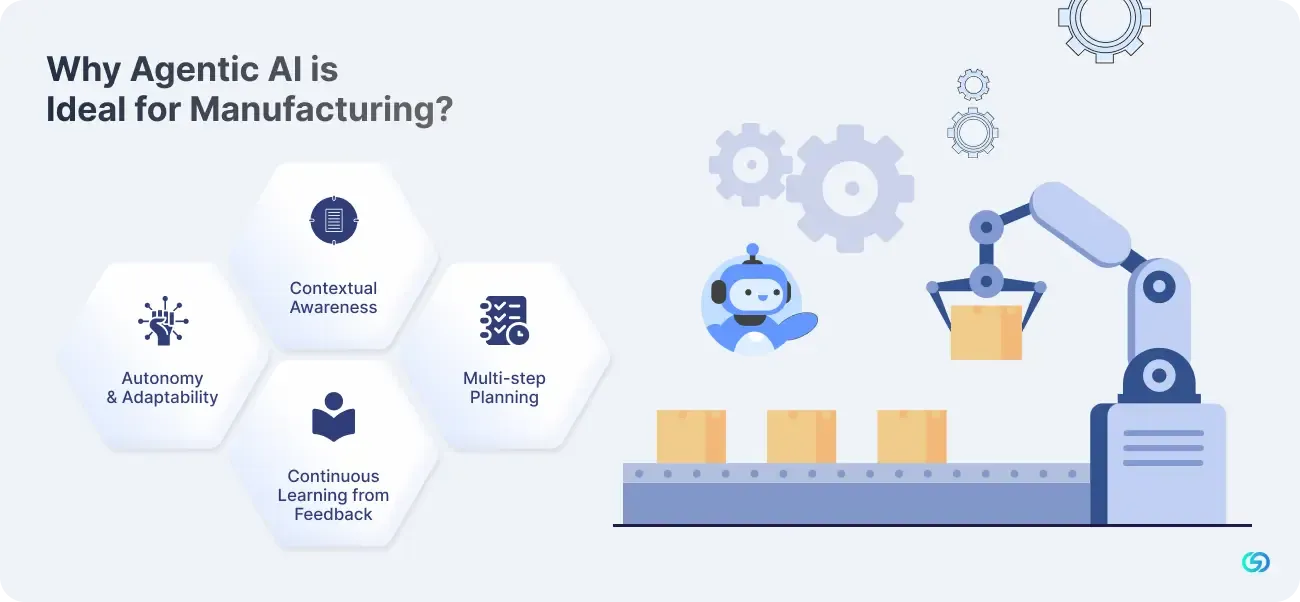
Agentic AI, different from traditional forms of automation, reflects a dramatic change because of the unique capabilities of the technology that allow the system to work beyond the set of given instructions and rather actively reason and act independently to streamline operations.
Given below is a closer look at what makes Agentic AI ideal for the manufacturing industry. Let’s focus on its main capabilities-
- Contextual Awareness: Agentic AI systems are capable of understanding the complete manufacturing environment in real-time by perceiving data from several sources, such as equipment metrics, production data streams, and sensors. This enables the system to grasp the bigger picture, rather than working based on isolated data points.
- Multi-step Planning: Agentic AI in manufacturing is capable of taking high-level goals and breaking them into multiple actionable steps, thereafter, autonomously plans on achieving the steps while also considering several factors and dependencies. This further means they do not require continuous human guidance for progressing via a complex workflow.
- Autonomy and Adaptabilit: The capability of Agentic AI to work independently and make decisions without involving humans is the main differentiator. Agentic AI systems self-optimize by adapting strategies depending on production environment feedback. For instance, it is refining algorithms of predictive maintenance depending on new failure patterns.
- Continuous Learning from Feedback: Utilizing ML techniques, Agentic AI is continuously learning from past interactions to improve decision-making. Apart from traditional AI, memory components enable agents to store historical information as well as adapt to emerging challenges that may come up.
How these Capabilities Align Well with the Manufacturing Environment?
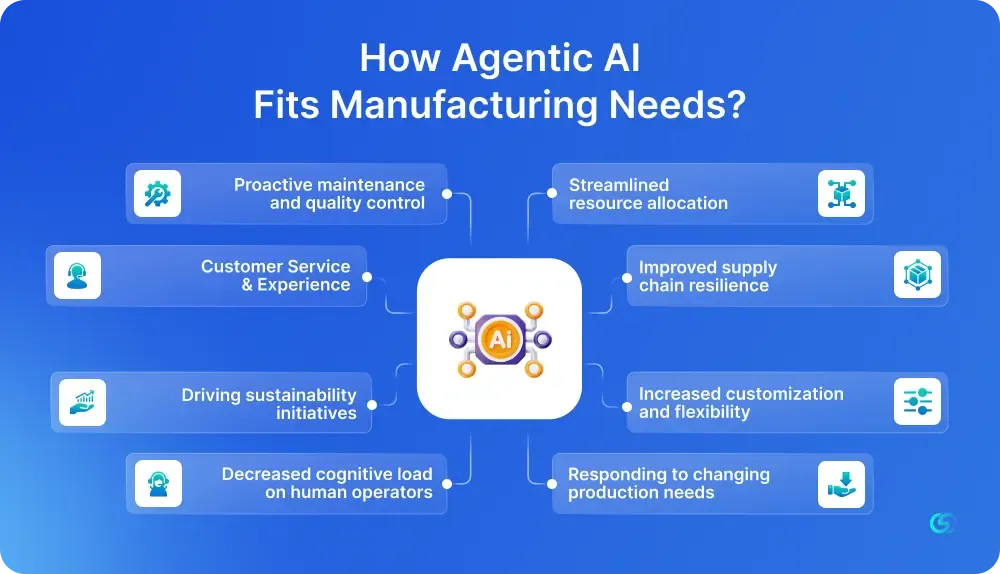
The reasons these capabilities align well with the manufacturing environments are-
-
Responding to changing production needs: Real-time data processing and analysis enables Agentic AI to adapt fast to the changes in machine performance, demand, and other unexpected events like issues related to component availability or malfunctions in the machine.
-
Streamlined resource allocation: Agentic AI in manufacturing applications can analyze data related to raw materials, labor capacity, and availability of machines for creating or adjusting production schedules, ensuring optimized resource utilization and decreasing waste.
-
Proactive maintenance and quality control: Agentic AI-powered systems can monitor the performance of machinery and the quality of product in real-time, detecting potential issues before they become concerning, resulting in reduced downtime, fewer defects, and improved quality of product.
-
Improved supply chain resilience: Agentic AI helps analyze market trends, inventory levels, and supplier performance for predicting and mitigating supply chain disruptions, ensuring on-time production and delivery.
-
Increased customization and flexibility: Agentic AI allows dynamic adjustment of materials, production lines, and processes for facilitating mass customization, catering to the preferences of individual customers efficiently
-
Driving sustainability initiatives: Agentic AI in manufacturing contributes to sustainable manufacturing by streamlining energy consumption, decreasing waste material, and ensuring compliance with environmental regulations.
-
Decreased cognitive load on human operators: By automating repetitive and complicated tasks, Agentic AI allows the human operators to focus on higher-value activities like innovation, problem-solving, and strategic thinking.
These capabilities align perfectly with complex, dynamic manufacturing environments.
Real-World Applications of Agentic AI in Manufacturing
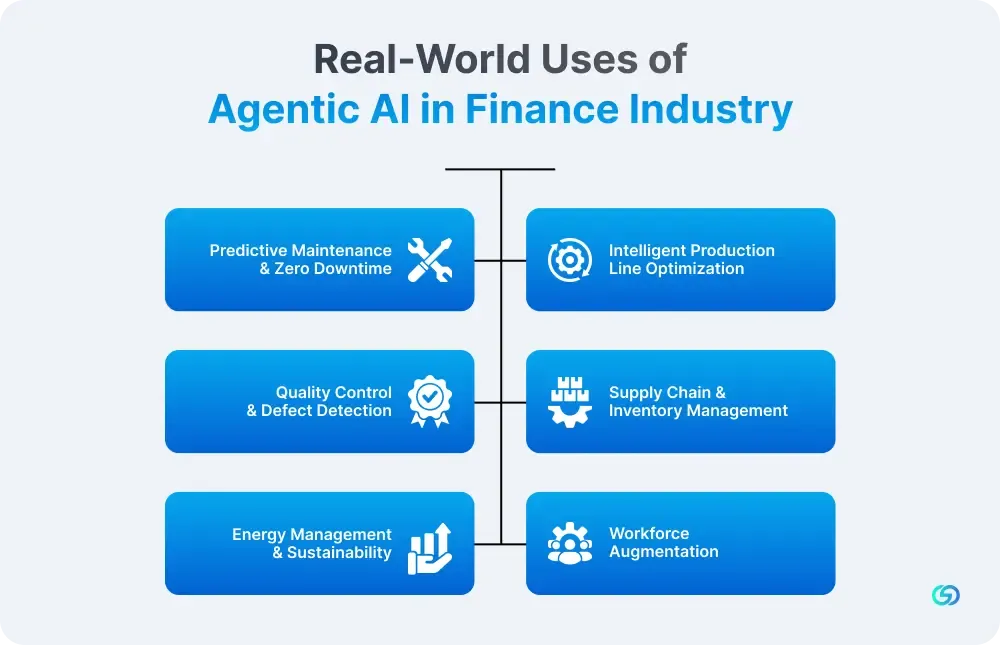
As the manufacturing industry accelerates toward full-scale digital transformation, Agentic AI in manufacturing is emerging as the next big leap. Unlike traditional automation systems that require explicit instructions, Agentic AI operates through autonomous decision-making in smart factories, enabling machines to proactively sense, plan, and act based on dynamic situations.
Let’s explore the most powerful and transformative agentic AI applications in manufacturing—each driving toward zero downtime, hyper-efficiency, and a smarter, more resilient industrial future.
🔹 Predictive Maintenance & Zero Downtime
One of the most critical agentic AI use cases in manufacturing is predictive maintenance. Traditional maintenance strategies often follow a reactive or scheduled approach, resulting in either unexpected downtime or unnecessary servicing. Agentic AI changes the game.
Autonomous AI agents monitor equipment data in real time—vibrations, temperature, motor performance, pressure, and more—to detect early signs of wear or malfunction. These agents predict failures before they occur, giving operations teams a heads-up before a breakdown happens.
More impressively, they automatically schedule maintenance tasks, rerouting workflows or adjusting production timetables to avoid disruption. This reduces downtime in factories, lowers maintenance costs, and extends the lifespan of industrial assets.
What is the use case of agentic AI in manufacturing? This is it—intelligent, proactive machine health monitoring that prevents disruptions without the need for human intervention.
🔹 Intelligent Production Line Optimization
Agentic AI in manufacturing isn't limited to just maintaining machines—it actively orchestrates entire production lines for optimal efficiency. Intelligent agents monitor the movement of goods, the availability of labor, and the performance of individual machines, all in real time.
Using this data, these agents dynamically adjust production flows, eliminating bottlenecks, minimizing idle time, and responding instantly to fluctuations in product demand. For example, if a delay occurs at one assembly station, AI agents can redirect workflows or shift task priorities across machines to ensure consistent throughput.
This kind of autonomous decision-making in smart factories empowers manufacturers to run lean, agile operations, where machines, materials, and human workers operate in harmony under the guidance of AI.
🔹 Quality Control & Defect Detection
Manual quality inspection is time-consuming and error-prone, while traditional automated inspection systems can struggle with variability. Agentic AI offers a revolutionary alternative through vision-powered agents that perform real-time inspections during production.
These AI agents can detect even microscopic defects using advanced computer vision and deep learning algorithms. More importantly, they don't just flag issues—they take corrective action by rerouting defective units, notifying relevant systems, and adjusting process parameters to prevent recurrence.
This results in consistent product quality, reduced waste, and faster time-to-market. It’s one of the most tangible benefits of agentic AI in manufacturing—delivering factory-floor intelligence that ensures precision and reliability at scale.
🔹 Supply Chain & Inventory Management
Modern supply chains are complex, and disruptions are costly. One of the growing agentic AI applications in manufacturing is its role in streamlining inventory and logistics through intelligent automation.
Agentic AI agents monitor inventory levels, supplier performance, and material consumption trends to prevent stockouts or overstock situations. When a certain raw material dips below a threshold, AI agents can auto-replenish stock, find alternate suppliers, or reroute shipments in case of delays.
The result? A self-correcting, demand-driven supply chain that responds to uncertainties in real time, improving operational agility and cutting procurement costs. This is exactly what role agentic AI plays in smart manufacturing—continuous optimization from the factory floor to the supplier's door.
🔹 Energy Management & Sustainability
Energy efficiency has become a top priority for manufacturers worldwide. Here, agentic AI use cases in manufacturing are delivering substantial impact by optimizing energy usage across facilities.
Smart agents analyze machine-specific energy data and production schedules to minimize power wastage. They can autonomously switch off idle equipment, shift energy-intensive processes to off-peak hours, and dynamically balance power loads across the plant.
Moreover, these agents factor in renewable energy availability, cost fluctuations, and carbon emission goals to ensure sustainable production. This not only cuts energy costs but also helps manufacturers meet environmental compliance and ESG targets.
In short, agentic AI in manufacturing is laying the foundation for greener, smarter industrial ecosystems.
🔹 Workforce Augmentation
Despite the rise of automation, human workers remain essential. Agentic AI bridges the gap between machines and humans through real-time decision support, task assistance, and intelligent supervision.
For example, AI agents can guide technicians through complex maintenance procedures, assign high-priority tasks based on urgency, and send alerts when human error is detected in critical processes. In training environments, AR + Agentic AI can simulate real-world scenarios to onboard new employees faster and more effectively.
By augmenting human capabilities rather than replacing them, agentic AI unlocks new productivity frontiers, ensuring that workforce potential scales alongside technological advancement.
Key Benefits of Agentic AI for Manufacturers
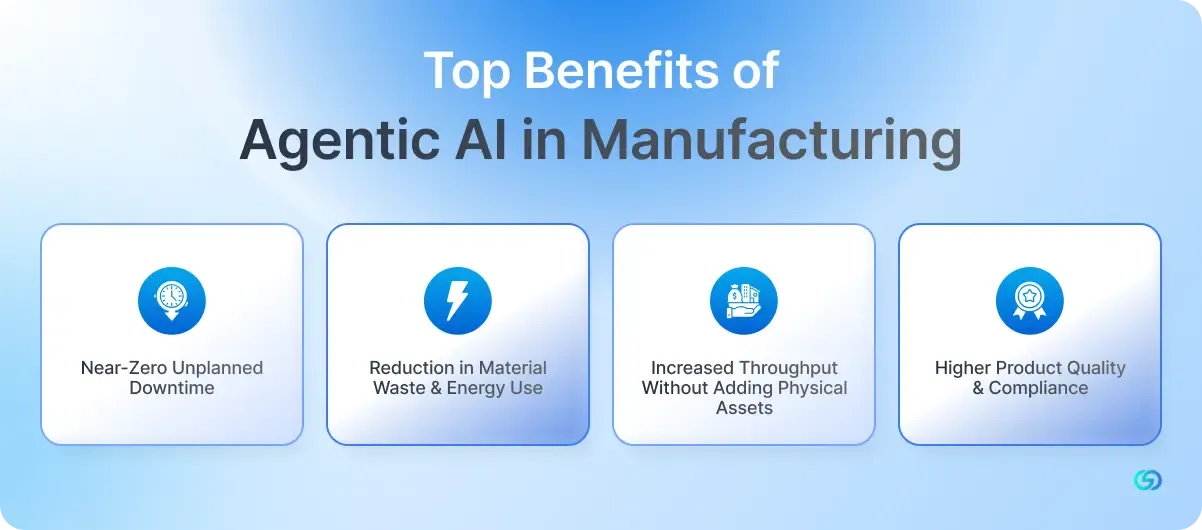
From reactive operations to intelligent autonomy, the manufacturing industry is undergoing a radical transformation. At the heart of this shift is Agentic AI in manufacturing, which empowers machines, systems, and supply chains to act independently—an evolution from traditional automation to full-scale intelligence.
The benefits of Agentic AI in manufacturing are far-reaching, enabling real-time optimization, greater operational efficiency, and data-driven decision-making at scale. Here’s a breakdown of the most impactful advantages manufacturers gain by integrating agentic AI applications in manufacturing.
🔵 Near-Zero Unplanned Downtime
Unplanned downtime has consistently been one of the most costly challenges in factory operations. With agentic AI use cases in manufacturing, real-time monitoring and autonomous diagnostics become the norm.
Agentic AI agents analyze data from sensors embedded in machinery to predict failures before they happen. Instead of waiting for breakdowns or relying on time-based servicing, these agents trigger preventive actions, reroute workflows, and schedule maintenance during off-peak hours, without disrupting production lines.
This shift from reactive to predictive operations significantly reduces downtime in factories, ensuring maximum uptime, reduced repair costs, and longer equipment lifespans.
How agentic AI reduces downtime in factories is a leading proof point of its value, keeping systems running 24/7 with minimal human intervention.
🔵 Increased Throughput Without Adding Physical Assets
Scaling production traditionally meant investing in additional machinery, floor space, or labor. Not anymore. With agentic AI in manufacturing, factories can scale productivity without physical expansion.
AI-powered agents optimize existing machine usage, coordinate work orders dynamically, and streamline processes by identifying inefficiencies and eliminating idle time. Whether it’s balancing workloads between machines or minimizing transition gaps, Agentic AI ensures maximum output from existing resources.
This form of digital scalability supports business growth without inflating capital expenditures, making it one of the most compelling agentic AI applications in manufacturing for mid-sized and large manufacturers alike.
🔵 Reduction in Material Waste and Energy Use
What role does Agentic AI play in smart manufacturing? A crucial one—driving sustainable, efficient, and waste-free operations.
Agentic AI agents continuously analyze raw material consumption, production anomalies, and energy metrics. They detect overuse, defects, or anomalies in processes that lead to scrap or excessive energy draw. Based on this data, the agents make autonomous decisions to reconfigure operations, minimizing waste, energy usage, and emissions.
Moreover, they shift high-energy tasks to low-cost energy periods, turn off idle equipment, and optimize resource usage across multiple production lines.
This not only improves margins but also aligns with the industry’s push for green, sustainable manufacturing practices, making it a critical agentic AI use case in manufacturing in today’s ESG-driven landscape.
🔵 Higher Product Quality and Compliance
In today’s global markets, manufacturers must meet increasingly stringent quality and regulatory standards. Agentic AI acts as a digital quality assurance manager, ensuring that every step of the production process meets predefined benchmarks.
Computer vision agents inspect products in real time, while sensor-driven AI detects deviations in temperature, pressure, or other variables that affect product consistency. If a defect or anomaly is found, the system autonomously adjusts parameters or halts operations, preventing large-scale quality failures.
What’s more, compliance documentation—like traceability logs, test results, and audit trails—can be generated and managed automatically, removing the administrative burden from human teams.
This is one of the most underrated benefits of agentic AI in manufacturing—delivering consistent quality while freeing up human resources to focus on innovation and strategy.
Case Studies & Industry Examples
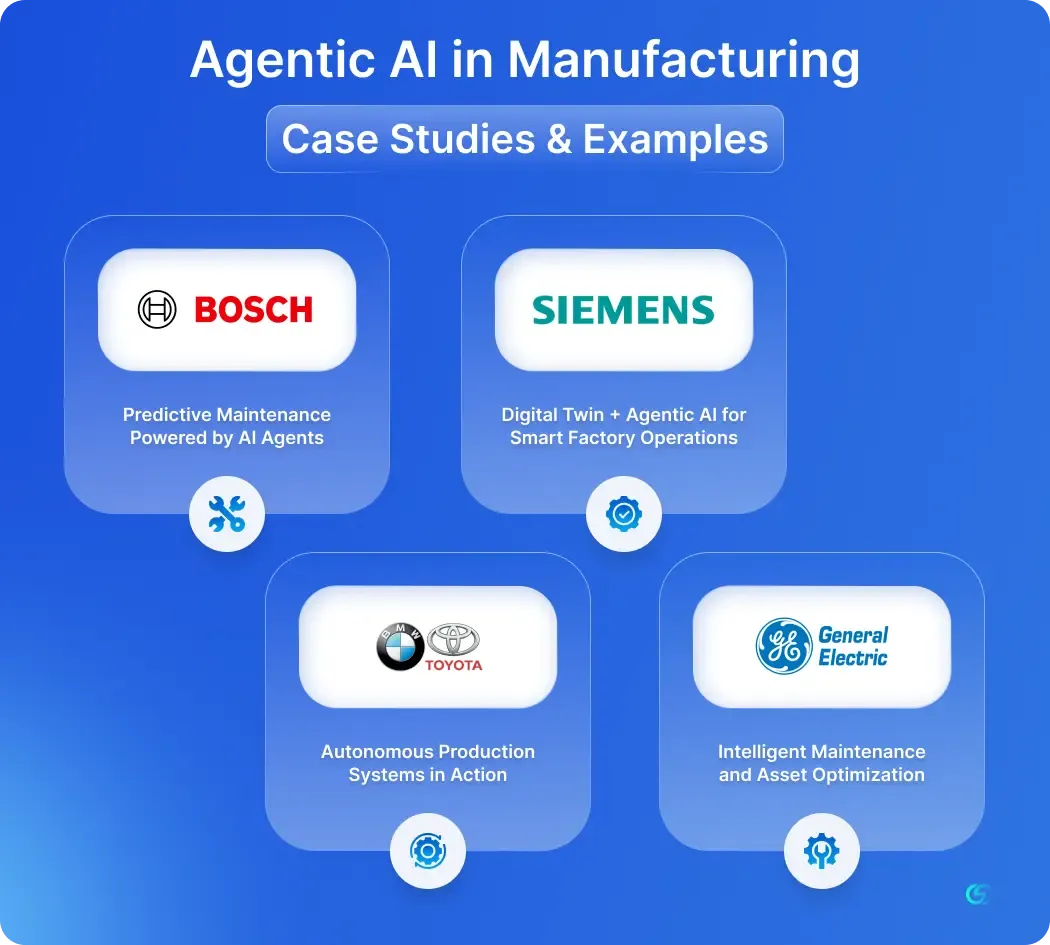
The real impact of Agentic AI in manufacturing is best seen through real-world implementations by global industrial leaders. Companies like Bosch, Siemens, General Electric, BMW, and Toyota are already integrating agentic AI applications in manufacturing to boost efficiency, reduce downtime, and pave the way for autonomous decision-making in smart factories.
Here are a few key examples showcasing how these industry pioneers are using agentic AI use cases in manufacturing to shape the future of intelligent production.
1️⃣ Bosch: Predictive Maintenance Powered by AI Agents
Bosch has been at the forefront of Industry 4.0 innovation. One of their key advancements is the deployment of AI-driven systems in their manufacturing facilities for predictive maintenance—a prime example of how agentic AI reduces downtime in factories.
In its German plants, Bosch uses autonomous monitoring systems that collect and analyze machine data—vibrations, temperature, load cycles, and pressure—in real time. These AI agents continuously evaluate equipment health and predict potential failures days or even weeks before they occur. Once a potential issue is detected, the system schedules maintenance automatically, reallocates workloads, and even adjusts machine parameters—all without human intervention.
This showcases a perfect agentic AI use case in manufacturing, where intelligent agents not only predict issues but also act on them autonomously, resulting in near-zero unplanned downtime and reduced maintenance costs.
2️⃣ Siemens: Digital Twin + Agentic AI for Smart Factory Operations
Siemens' “Factory of the Future” models demonstrate how agentic AI in manufacturing can be scaled across complex industrial systems. By combining digital twin technology with AI agents, Siemens enables a live, real-time replica of its entire production environment.
AI agents within this ecosystem simulate scenarios, detect inefficiencies, and implement solutions across the production floor. For example, if a bottleneck occurs at one station, the agentic system dynamically adjusts workflows, redistributes labor or materials, and maintains throughput without requiring manual input.
This is a prime demonstration of autonomous decision-making in smart factories, where agents act not just on physical cues but also on virtual simulations to make fast, accurate decisions. Siemens has reported improved productivity, fewer quality defects, and a substantial reduction in operating costs through this AI-led framework.
3️⃣ GE: Intelligent Maintenance and Asset Optimization
General Electric (GE) has applied agentic AI applications in manufacturing through its industrial IoT platform, Predix. In GE’s aviation and energy manufacturing arms, agent-like systems help monitor equipment such as turbines and heavy engines.
These agents learn from operational data, detect early warning signs of wear, and suggest optimized operating parameters to extend asset life. The system also sends automated alerts, schedules predictive maintenance, and continuously improves its models using AI feedback loops.
This system has led to significant gains in uptime and asset performance, highlighting the benefits of agentic AI in manufacturing, not just for productivity, but also for long-term cost efficiency and asset health.
4️⃣ BMW & Toyota: Autonomous Production Systems in Action
Automotive giants like BMW and Toyota are adopting agentic AI in manufacturing to power intelligent assembly lines and autonomous production systems.
BMW’s production facilities in Germany use AI-based agents to guide robotic systems in assembling vehicle components. These agents coordinate with machines and human workers, adjusting schedules based on component availability, labor constraints, or order changes. This enables real-time decision-making without human dependency, increasing responsiveness and production accuracy.
Similarly, Toyota leverages AI agents in its smart factories to manage workflows, detect anomalies, and ensure consistent quality. Their use of AI-enabled visual inspection systems further ensures that defective parts are identified and removed autonomously, contributing to higher product quality and compliance.
These examples reflect what role agentic AI plays in smart manufacturing—coordinating humans, machines, and materials to build more intelligent and flexible production environments.
Challenges and Considerations
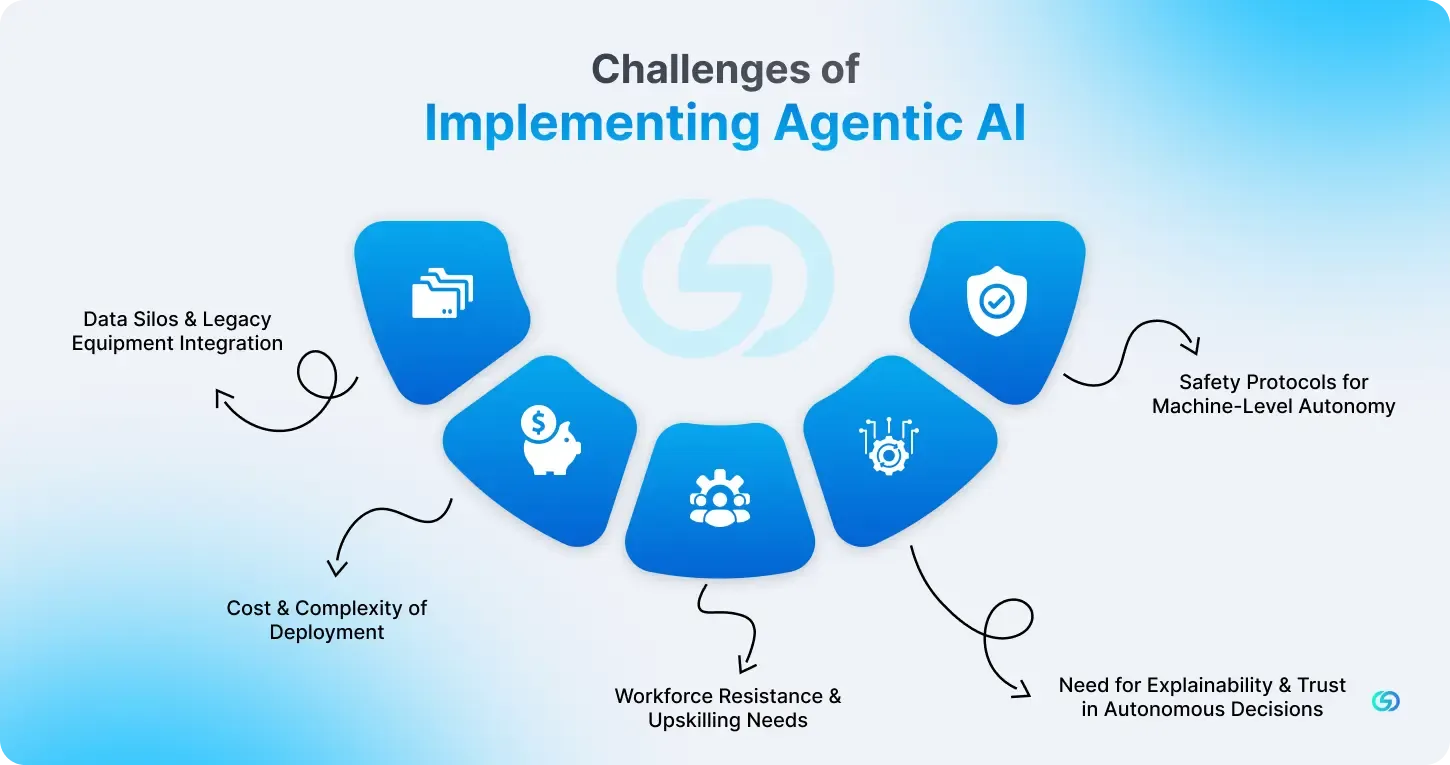
While the benefits of Agentic AI in manufacturing are clear—ranging from autonomous decision-making to zero downtime—the journey to full-scale adoption is not without hurdles. Manufacturers must navigate a range of technical, operational, and human-centric challenges before realizing the full potential of agentic AI use cases in manufacturing.
Here are the key challenges and considerations companies should be aware of when implementing agentic AI applications in manufacturing.
⏭ Data Silos and Legacy Equipment Integration
One of the foundational requirements for successful agentic AI in manufacturing is access to real-time, high-quality data from across machines, sensors, and production systems. However, many factories—especially those with decades-old infrastructure—still rely on legacy equipment that lacks connectivity.
These outdated systems create data silos, where critical machine or operational data is either inaccessible or incompatible with modern AI models. For agentic AI applications in manufacturing to function effectively, they need an integrated environment where all data flows into a centralized decision layer.
Bridging this gap often involves retrofitting old machinery with IoT sensors, integrating disparate systems, and standardizing communication protocols—investments that require time, resources, and technical alignment.
⏭ Cost and Complexity of Deployment
Despite the long-term ROI, the cost and complexity of deploying agentic AI solutions can be a major barrier, especially for small- to mid-sized manufacturers. The implementation process may involve:
- Infrastructure upgrades (sensors, edge devices, cloud platforms)
- Data engineering pipelines to handle real-time information
- Custom AI model development and training
- Integration with ERP, MES, and other core systems
In addition to capital investment, there’s the complexity of ensuring that autonomous AI agents can interact reliably with factory hardware and workflows. For many organizations, the initial setup of agentic AI use cases in manufacturing can feel daunting, particularly when internal expertise is limited.
⏭ Workforce Resistance and Upskilling Needs
A successful AI transformation isn’t just about machines and algorithms—it’s also about people. One of the most under-discussed challenges of agentic AI in manufacturing is workforce resistance.
When AI begins making real-time decisions or recommending actions traditionally handled by humans, workers may feel threatened or marginalized. This is especially true in environments where automation is perceived as a substitute for human labor rather than a supplement.
To overcome this, manufacturers must focus on upskilling their workforce—training employees to work with AI agents, interpret their outputs, and intervene when necessary. Empowering workers with digital literacy and new technical skills ensures smoother adoption and encourages a culture of innovation.
⏭ Need for Explainability and Trust in Autonomous Decisions
A major challenge in deploying autonomous decision-making in smart factories is explainability—understanding why an AI agent made a certain decision. In highly regulated industries like automotive or aerospace, manufacturers must not only comply with safety standards but also justify every production-related action.
Black-box AI models can pose a risk here, especially when autonomous systems make decisions that affect quality control, safety, or compliance. Without transparent logic and audit trails, it becomes difficult to build trust in the system, both from operators and regulatory bodies.
As a result, businesses implementing agentic AI use cases in manufacturing must prioritize explainable AI systems that can provide clear reasoning, traceable actions, and human-overridable decisions.
⏭ Safety Protocols for Machine-Level Autonomy
With agentic AI in manufacturing enabling machines to make independent decisions—like rerouting workflows or adjusting production parameters—the risk of unintended consequences rises. For instance, an incorrect sensor reading or misinterpreted anomaly could trigger an unnecessary stop, a production shift, or even machinery damage.
This makes it essential to establish safety protocols and fail-safes that act as boundaries for AI agents. These include:
- Setting operational limits that AI agents cannot override
- Real-time monitoring of agent decisions with manual override options
- Testing agent behavior in virtual environments before deploying live
- Including cybersecurity measures to protect decision-making systems
Ensuring that agentic AI applications in manufacturing operate within strict safety boundaries is not just a best practice—it’s a necessity for compliance, worker safety, and equipment protection.
The Future of Agentic AI in Manufacturing
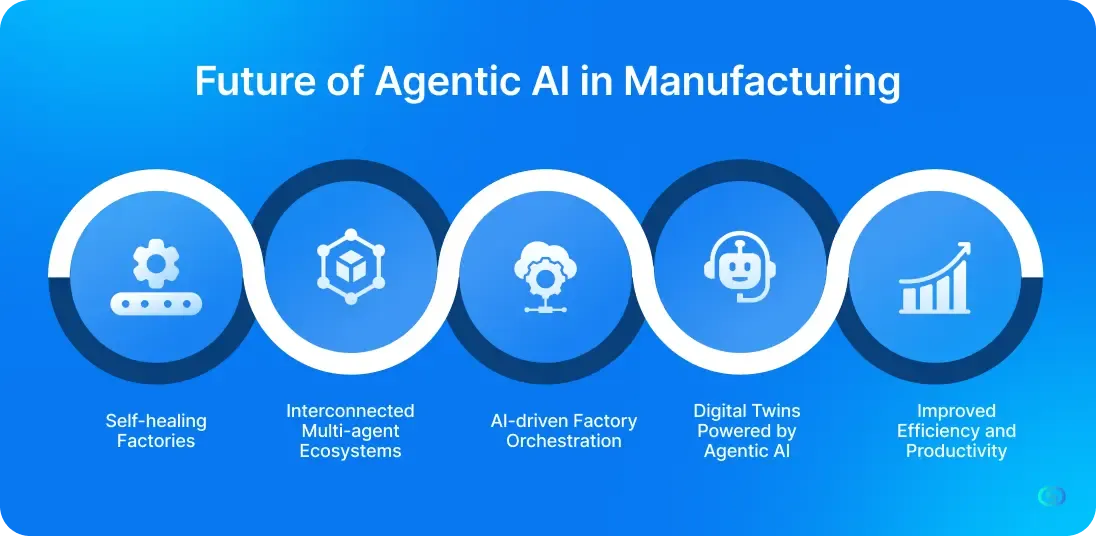
In the future, Agentic AI is going to transform the manufacturing sector with the help of interconnected multi-agent ecosystems, self-healing factories, and AI-driven orchestration. This would further result in autonomous decision-making, improved efficiency, real-time adaptability, improved product quality, and decreased cognitive load on operators.
Here is a more detailed look at the advancements-
-
Self-healing factories: Agentic AI systems will be capable of detecting and correcting faults in real-time, decreasing downtime and enhancing efficiency. This involves autonomous root cause analysis and corrective actions resulting in “right-first-time" production.
-
Interconnected multi-agent ecosystems: Autonomous agents will collaborate across varied areas of the process of manufacturing for optimizing resource allocation and workflows.
-
Digital Twins powered by Agentic AI: Digital representation of processes and physical assets will be utilized for stimulating and streamlining manufacturing operations, allowing for identifying and resolving potential issues before they come up. This will also enable improved accuracy in decision-making and accelerated implementation of solutions.
-
AI-driven factory orchestration: Agentic AI in manufacturing will help in automating complicated tasks, streamlining workflows, and moving towards zero-touch manufacturing. This will also enable more accurate decision-making and fast implementation of solutions.
-
Improved efficiency and productivity: Agentic AI will help streamline complex tasks, coordinate operations, and allow proactive identification and resolution of potential issues before they arise.
Conclusion
Agentic AI in manufacturing is reshaping the sector, ushering in a new era of adaptive, intelligent, and autonomous operations. With capabilities such as predictive maintenance, real-time decision-making, resource optimization, and energy efficiency, it allows manufacturers to achieve higher productivity levels, improved product quality, and decreased downtime.
Across industries, the concept of the “Factory of the Future” is transitioning from vision to execution. Whether it's Bosch’s zero-downtime model, Siemens' digital twin orchestration, or BMW’s autonomous assembly systems, these examples underline one clear message: Agentic AI in manufacturing is no longer experimental—it’s a proven driver of efficiency, scalability, and smart automation.
As the industry is moving towards self-healing factories as well as AI-driven orchestration, companies that proactively adopt the technology will build smarter and more resilient operations. While there are some challenges, the rewards are transformative. Manufacturers embracing Agentic AI are not only streamlining operations but are shaping the future of industrial innovation and global competitiveness.
FAQ
How can manufacturers begin implementing Agentic AI?
Manufacturers can start by implementing Agentic AI by adopting a strategic and phased methodology.
- Find out the specific areas that provide measurable benefits, such as predictive maintenance, supply chain optimization, or quality control.
- Access the readiness of the data, ensuring it is structured, clean, and accessible.
- Choose the right platform and service provider with specialization or experience in manufacturing AI solutions.
- Build internal capabilities by training your workforce in AI literacy and tools.
- Begin small and scale accordingly. Launch the project in a confined environment, get the solution refined as per the requirement, and scale with the growing needs.
What are the key benefits of Agentic AI in manufacturing?
Agentic AI in the manufacturing industry empowers the sector in various ways-
- Minimum unplanned downtime via predictive maintenance and autonomous scheduling.
- More throughput without the addition of new assets by streamlining existing resources.
- Decreased waste and consumption of energy through the intelligent allocation of resources.
- Enhanced quality of product with real-time detection of defects and project adjustments.
- Improved supply chain resilience with predictive logistics and inventory management.
What are the Applications of Agentic AI in Manufacturing Operations?
Agentic AI can be applied across several areas in manufacturing-
- Predictive maintenance helps find out potential failures in equipment before they happen.
- Optimizing the production line to adjust workflows in real-time to eliminate bottlenecks.
- Quality control for detecting defects via machine learning and computer vision.
- Supply chain & inventory management by mitigating disruptions and digitizing replenishment.
- Management of energy by decreasing power wastage and supporting sustainability goals.
- Workforce augmentation offering training assistance and real-time decision support.
Is Agentic AI only useful for large-scale manufacturing plants, or can SMEs benefit too?
Agentic AI in manufacturing is best for both large businesses and SMEs. While large enterprises use agentic AI for complicated, multiline coordination, SMEs can utilize it for enhancing efficiency, decreasing downtime, and scaling production without any significant capital investment. Cloud-based modular solutions and airport solutions make it affordable and accessible, enabling smaller manufacturers to begin with targeted use cases and expand as they get returns.
How does Agentic AI handle sensitive production and operational data?
Agentic AI systems are designed with strict data security and compliance measures. Sensitive production and operational data is encrypted during storage and transmission, and access is restricted based on role-based permissions. Many solutions follow industry standards like ISO 27001 or NIST, and can be deployed on secure on-premise servers or private cloud environments. Additionally, explainable AI frameworks provide traceable decision-making, ensuring transparency, regulatory compliance, and operator trust.