- Industry 4.0
- 2026-06-23
How Industrial IoT is Powering the Future of Industry 4.0?
Audio Track
Table of Contents
Key Takeaways
- Industrial IoT, or IIoT, is the foundation of Industry 4.0, enabling intelligent, connected, and data-driven industrial ecosystems through real-time communication between devices, machines, and systems.
- IIoT helps businesses enhance operational efficiency, decrease equipment downtime, improve workplace safety, and streamline resource utilization via intelligent automation and predictive maintenance.
- Industries such as healthcare, manufacturing, logistics, automotive, retail, agriculture, energy, and oil & gas are utilizing IIoT to optimize operations, enhance visibility, and accelerate digital transformation.
- Emerging technologies like edge computing, AI, digital twins, 5G, and smart automation will go on to strengthen the capabilities of IIoT as well as shape the future of Industry 4.0 and intelligent industrial operations.
Overview: The Rise of Industrial IoT in the Industry 4.0 Era
The evolution of Industry 4.0 is changing traditional industries into connected, intelligent, and data-driven ecosystems. At the core of this transformation is the IIoT or Industrial IoT, connecting sensors, machines, devices, and industrial systems that enable communication in real-time and smarter decision-making. The combination of these technologies, like automation, cloud computing, AI, and data analytics, helps businesses enhance operational efficiency, decrease downtime, and streamline industrial processes.
Unlike the traditional systems used for manufacturing, IIoT-powered environments develop easy connectivity across operations, allowing predictive maintenance, remote manufacturing, and intelligent automation. Starting from manufacturing and logistics to energy and healthcare. Industrial IoT is now becoming the backbone of Industry 4.0, helping businesses develop an agile, scalable, and future-ready industrial ecosystem.
What is Industrial IoT (IIoT)?
IIoT can be defined as a subset of the Internet of Things (IoT), which was originally a futuristic concept in a futuristic time, when everything around us would be connected and would be able to communicate with one another. At present, this concept is becoming a reality, so the term has now risen to represent how we are enabling this connected world to happen.
Industrial IoT is using smart actuators, sensors, and other devices like radio frequency identification tags to improve manufacturing and industrial processes. These devices are networked together to allow the collection, exchange, and analysis of data.
IIoT focuses on connected industrial devices like sensors and robots in factories as opposed to the connected consumer devices you may use at home, like smart appliances or wearables. Smart manufacturing is basically a large segment for IIoT; these capabilities also include a broad range of industry apps, including in mines, ports, and even utilities like energy and water.
Why is IIoT called the Backbone of Industry 4.0?
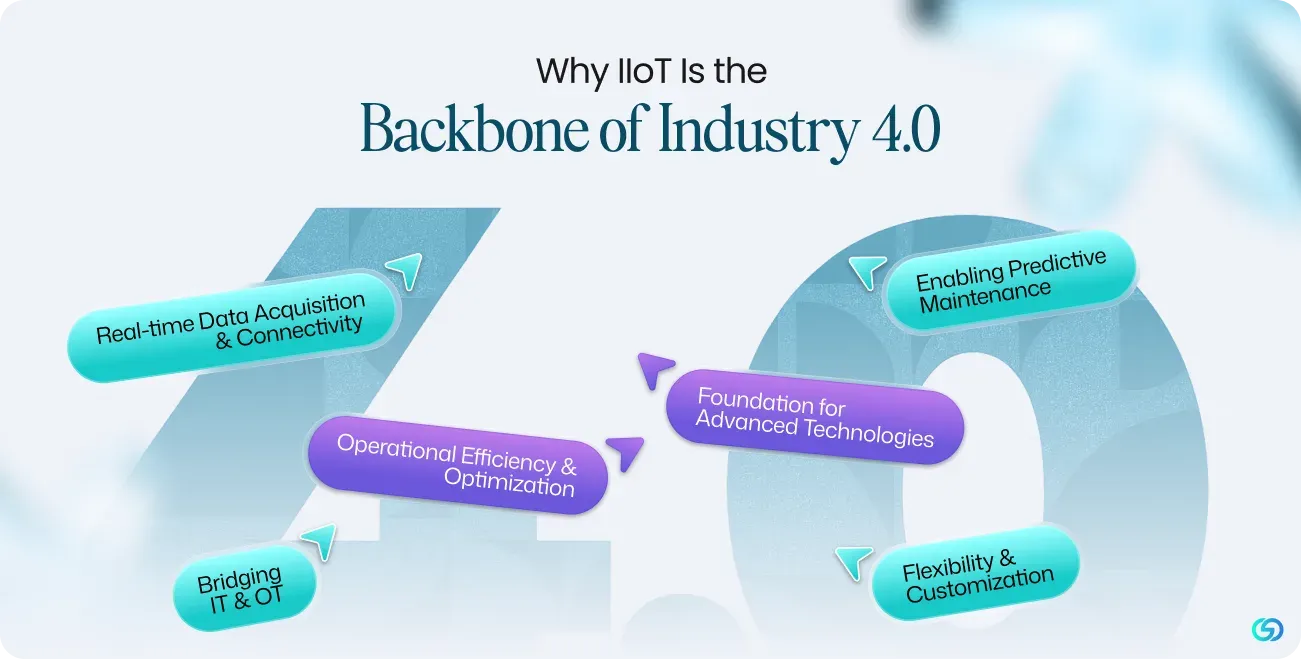
The Industrial Internet of Things (IIoT) is known as the “backbone of Industry 4.0” as it offers the crucial, real-time connectivity and data flow that allows smart machines to communicate, analyze, and streamline industrial processes. It helps in transforming dumb legacy machines into interconnected, intelligent assets, serving as the base of data analytics, automation, and operational efficiency. Here is the reason why IIoT is extremely important for Industry 4.0:
💠 Real-time Data Acquisition & Connectivity: IIoT utilizes sensors and devices for gathering huge amounts of data from the shop floor. This develops a connected ecosystem where machines talk to each other and to human operators, allowing immediate, data-driven decisions.
💠 Enabling Predictive Maintenance: IIoT allows proactive instead of reactive maintenance by detecting temperature changes, machine vibrations, and anomalies before failures happen.
💠 Operational Efficiency and Optimization: By analyzing data in real-time, companies can find out bottlenecks, decrease downtime, and streamline supply chains.
💠 Foundation for Advanced Technologies: IIoT is the needed source of data for other Industry 4.0 technologies, including machine learning, AI, and digital twins. Without the data stream offered by IIoT, these technologies cannot work effectively.
💠 Flexibility and Customization: IIoT enables agile production systems that can adapt to the customer demands in real-time, going beyond rigid, mass models of production.
💠 Bridging IT and OT: IIoT bridges the gap between Information Technology, like ERP/MES, and Operational Technology, like machines, enabling company-wide, comprehensive visibility.
Key Benefits of IIoT in Industry 4.0
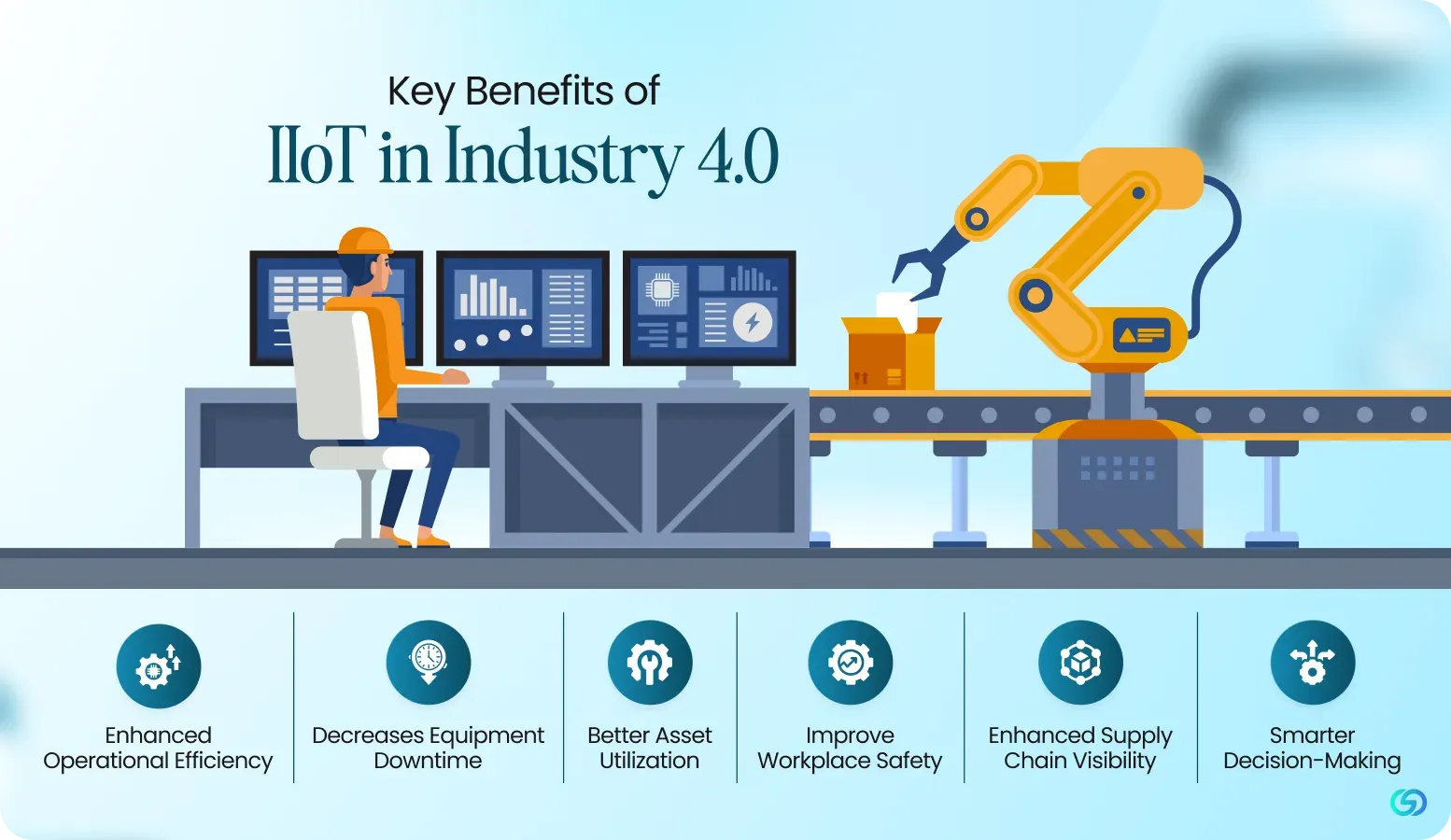
Industrial IoT is helping different industries unlock new levels of automation, efficiency, and operational intelligence in the era of Industry 4.0. By connecting industrial devices, machines, and systems via real-time networks, IIoT enables businesses to streamline processes, and data-powered insights have made IIoT a vital component of modern industrial transformation.
🔶 Enhanced Operational Efficiency
IIoT allows businesses to optimize and monitor industrial processes in real time. Connected system continuously gather operational data, helping manufacturers find out inefficiencies, enhance workflow management, and optimize production activities. This results in faster operations, decreased waste and enhanced productivity across industrial ecosystems.
🔶 Decreases Equipment Downtime
One of the biggest benefits of IIoT is predictive maintenance. Smart sensors monitor the health of the machine and detect potential problems before the equipment failure happens. This kind of proactive approach enables the businesses to reduce unexpected downtime, enhance asset reliability, and decrease expensive production interruptions.
🔶 Better Asset Utilization
IIoT offers businesses full visibility into the equipment performance as well as the usage of resources. Businesses are capable of tracking utilization of machines, capacity of production, and operational results more accurately, helping them maximize asset efficiency and enhance long-term operational planning.
🔶 Improve Workplace Safety
Industrial IoT enhances safety in the workplace by allowing real-time monitoring of industrial environments. Sensors can detect hazardous conditions like gas leaks, overheating, or equipment malfunctions, enabling businesses to respond faster and decrease workplace risks for operators and employees.
🔶 Enhanced Supply Chain Visibility
IIoT improves supply chain handling by offering real-time tracking and monitoring of inventory, goods, and logistics operations. Businesses get improved visibility into supply chain activities, helping them enhance coordination, decrease delays, and streamline inventory management.
🔶 Smarter Decision-Making
By providing real-time analytics, AI, and cloud computing, IIoT allows businesses to make speedy and more informed decisions. Businesses can utilize actionable insights from connected systems to enhance operational strategies, streamline resources, and support long-term business growth in extremely competitive industrial markets.
Real-World Applications of IIoT Across Industries
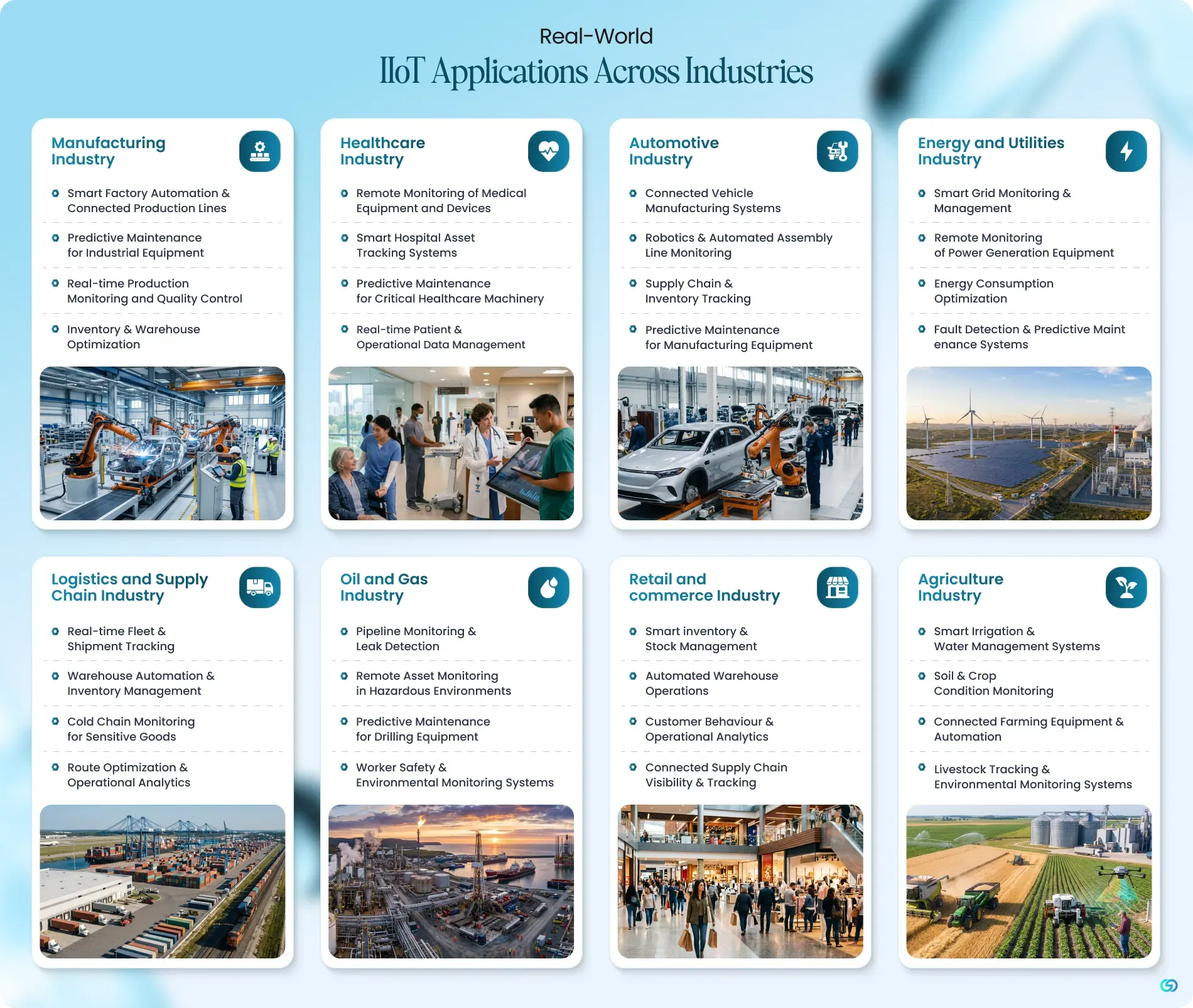
Industrial IoT (IIoT) is transforming industries by enabling connected operations, real-time monitoring, intelligent automation, and data-driven decision-making. From manufacturing and healthcare to logistics and energy, businesses are using IIoT technologies to improve efficiency, reduce operational costs, and build smarter industrial ecosystems.
▶️ Manufacturing Industry
-
Smart Factory Automation and Connected Production Lines
IIoT systems offer the visibility of real-time inventory, helping retailers to maintain optimal stock levels and decrease shortages in the inventory or issues of overstocking. -
Predictive Maintenance for Industrial Equipment
Smart sensors continuously keep a check on the health of the machine, vibration, temperature, and performance of the equipment. Businesses are capable of detecting potential failures before breakdowns happen, helping in decreasing unexpected downtime, enhancing asset reliability, and lowering maintenance costs. -
Real-time Production Monitoring and Quality Control
IoT systems offer real-time visibility into the workflows of production and product quality. Manufacturers are capable of tracking the results of production, finding out inefficiencies immediately, and maintaining consistency in quality standards throughout the manufacturing cycle. -
Inventory and Warehouse Optimization
Connected inventory systems help organizations in monitoring the levels of stock, automating warehouse operations, and streamlining inventory management. This enhances supply chain efficiency while decreasing costs and operational delays.
▶️ Healthcare Industry
-
Remote Monitoring of Medical Equipment and Devices IIoT allows healthcare providers for monitoring of medical devices as well as crucial healthcare equipment remotely. This ensures improved equipment performance, decreases operational risks, and enhances patient care delivery.
-
Smart Hospital Asset Tracking Systems
Connected tracking systems help hospitals in checking the location and usage of medical equipment, wheelchairs, and crucial assets in real-time, enhancing operational efficiency and decreasing equipment loss. -
Predictive Maintenance for Critical Healthcare Machinery
IIoT sensors monitor the condition of ventilators, MRI machines, and other crucial medical equipment to find out maintenance needs before system failures affect healthcare operations. -
Real-time Patient and Operational Data Management Healthcare businesses can collect as well as analyze real-time patient information and operational data, allowing faster decision-making, enhanced resource allocation, and improved healthcare management.
▶️ Automotive Industry
-
Connected Vehicle Manufacturing Systems
IIoT helps automotive businesses in connecting production systems, robotics, and assembly operations for optimizing vehicle manufacturing and enhancing operational efficiency. -
Robotics and Automated Assembly Line Monitoring
Connected robots and automated systems help in monitoring the accuracy of production and workflow efficiency, decreasing production errors, and increasing manufacturing speed. -
Supply Chain and Inventory Tracking
Automotive businesses use IIoT for tracking raw materials, inventory, and spare parts across the supply chain, enhancing coordination and decreasing delays.
- Predictive Maintenance for Manufacturing Equipment
IIoT allows automotive manufacturers to monitor the performance of the machine as well as prevent unexpected equipment failures via predictive maintenance strategies.
▶️ Energy and Utilities Industry
-
Smart Grid Monitoring and Management
IIoT supports real-time monitoring of power grids, assisting the utility providers in enhancing energy distribution, detecting defaults faster, as well as maintain grid stability. -
Remote Monitoring of Power Generation Equipment
Energy businesses can remotely monitor generators, turbines, and power plants for enhancing operational performance and decrease manual inspection needs. -
Energy Consumption Optimization
IIoT systems analyze the usage of energy patterns to help businesses decrease energy waste, enhance operational efficiency, and support sustainability initiatives. -
Fault Detection and Predictive Maintenance Systems
Connected sensors find out abnormalities of the equipment and system failures early, helping utility providers decrease downtime and maintain uninterrupted operations.
▶️ Logistics and Supply Chain Industry
-
Real-time Fleet and Shipment Tracking
IIoT-enabled GPS as well as tracking systems offer real-time visibility into shipment locations and fleet movements, enhancing logistics management and delivery accuracy. -
Warehouse Automation and Inventory Management
Connected warehouse systems help in automating inventory tracking, order processing, as well as warehouse operations, enhancing operational efficiency and decreasing manual errors. -
Cold Chain Monitoring for Sensitive Goods
IIoT sensors monitor temperature-sensitive goods like food products and pharmaceuticals during transportation, ensuring the quality of the product and regulatory compliance. -
Route Optimization and Operational Analytics
Logistics businesses utilize IIoT analytics to streamline delivery routes, decrease fuel consumption, and enhance transportation efficiency.
▶️ Oil and Gas Industry
-
Pipeline Monitoring and Leak Detection
IIoT sensors continuously monitor the pipelines for leaks, pressure changes, and operational anomalies, helping the businesses in enhancing safety and decreasing environmental risks. -
Remote Asset Monitoring in Hazardous Environments
Oil and gas companies utilize IIoT systems to remotely check drilling sites, offshore platforms, and hazardous industrial environments efficiently and safely. -
Predictive Maintenance for Drilling Equipment
Connected equipment monitoring helps organizations in finding out maintenance issues before crucial failures occur, decreasing downtime as well as operational disruptions. -
Worker Safety and Environmental Monitoring Systems
IIoT technologies monitor environmental conditions, worker safety parameters, and gas leaks to enhance workforce safety in high-risk industrial operations.
▶️ Retail and Commerce Industry
-
Smart inventory and Stock Management
IIoT systems offer real-time visibility of inventory, helping retailers maintain the optimal levels of stock and decreasing inventory shortages or overstocking problems. -
Automated Warehouse Operations
Connected warehouse technologies automate, packaging, sorting, and inventory movement, enhancing operational efficiency and speed of order fulfilment. -
Customer Behaviour and Operational Analytics Retailers utilize IIoT powered analytics for understanding the behaviour of customers, purchasing patterns, and store operations, allowing better customer experiences and business strategies.
-
Connected Supply Chain Visibility and Tracking
IIoT enhances the transparency of supply chain by allowing businesses to track products, streamline supplier coordination, and monitor shipments in real time.
▶️ Agriculture Industry
-
Smart Irrigation and Water Management Systems IIoT-based irrigation systems help in monitoring conditions of the weather, soil moisture, and usage of water to streamline the processes of irrigation and decrease water wastage.
-
Soil and Crop Condition Monitoring
Connected sensors help in collecting real-time data on the quality of soil, humidity, crop health, and environmental conditions, helping farmers enhance agricultural productivity. -
Connected Farming Equipment and Automation
IIoT allows smart farming equipment like automated tractors as well as connected harvesting systems to enhance farming efficiency and decrease manual labour. -
Livestock Tracking and Environmental Monitoring Systems
Farmers use IIoT technologies for monitoring livestock, location, feeding patterns, as well as environmental conditions, enhancing animal welfare as well as efficiency of farm management.
Challenges of Implementing IIoT in Industry 4.0
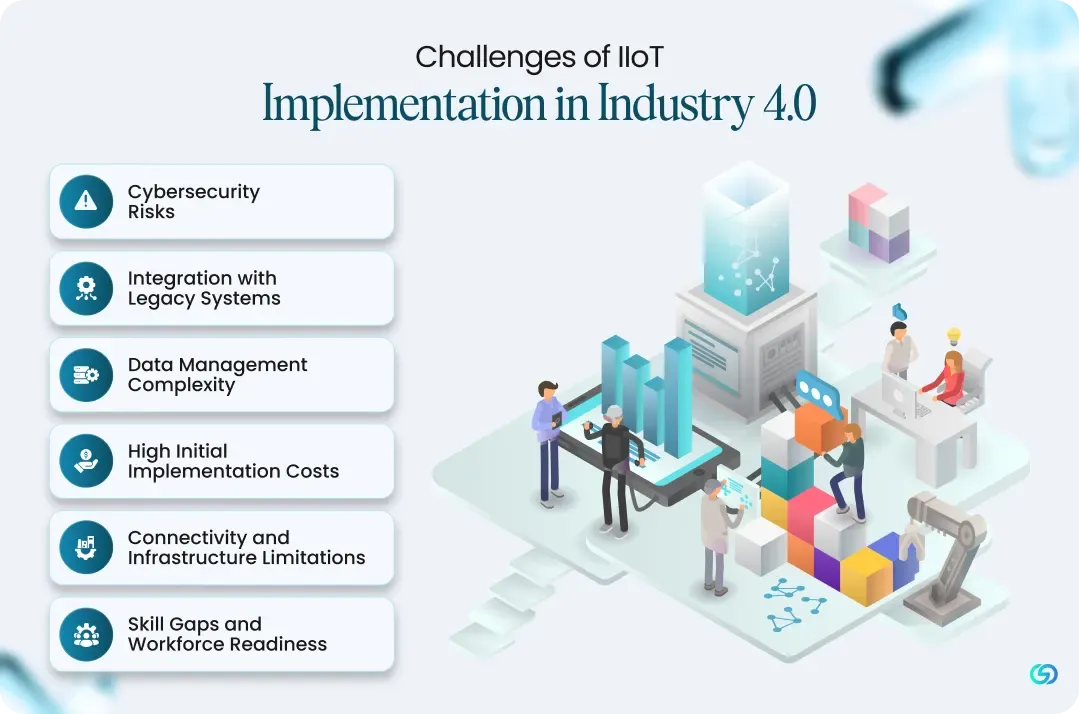
While Industrial IoT (IIoT) provides significant benefits for Industry 4.0, implementing connected industrial ecosystems also comes with various technical, operational, and security-related issues. Businesses should overcome the infrastructure limitations, complications related to integrations, and cybersecurity risks to successfully adopt IIoT technologies and maximize long-term operational value.
➡️ Cybersecurity Risks
As industrial devices and systems become more connected, the risk of cyberattacks also increases. IIoT networks mostly handle sensitive operational and production data, making them attractive targets for cyber threats. Without robust security frameworks, businesses may face breaches of data, operational disruptions, and unauthorized access to crucial industrial systems.
➡️ Integration with Legacy Systems
Several industries still depend on outdated machinery as well as legacy infrastructure that were not developed for connected environments. Incorporating modern IIoT technologies with existing systems can be time-consuming, expensive, and complex. Businesses mostly face issues related to compatibility issues when connecting traditional equipment with sensors, platforms, and advanced analytics tools.
➡️ Data Management Complexity
IIoT devices generate huge volumes of real-time industrial information every day. Handling processing, storing, and analyzing this information efficiently can become a huge challenge for businesses. Without proper data management strategies, businesses may struggle to extract meaningful insights as well as maintain operational efficiency.
➡️ High Initial Implementation Costs
Implementing IIoT infrastructure needs major investment in connectivity solutions, cybersecurity systems, cloud platforms, and employee training. For several businesses, mainly small and mid-sized businesses, the upfront cost of digital transformation can become an obstruction to adoption.
➡️ Connectivity and Infrastructure Limitations
Trustworthy connectivity is important for successful IIoT operations. However, industrial environments mostly face network limitations, poor connectivity in remote locations, and infrastructure challenges that can affect real-time communication between systems and devices.
➡️ Skill Gaps and Workforce Readiness
The successful adoption of IIoT needs talented and skilled professionals who understand cybersecurity, data analytics, automation, AI, and connected technologies. Several industries face talent shortages and gaps in the skill level of the workforce, making it hard to handle and scale advanced Industry 4.0 initiatives effectively.
The Future of IIoT and Industry 4.0
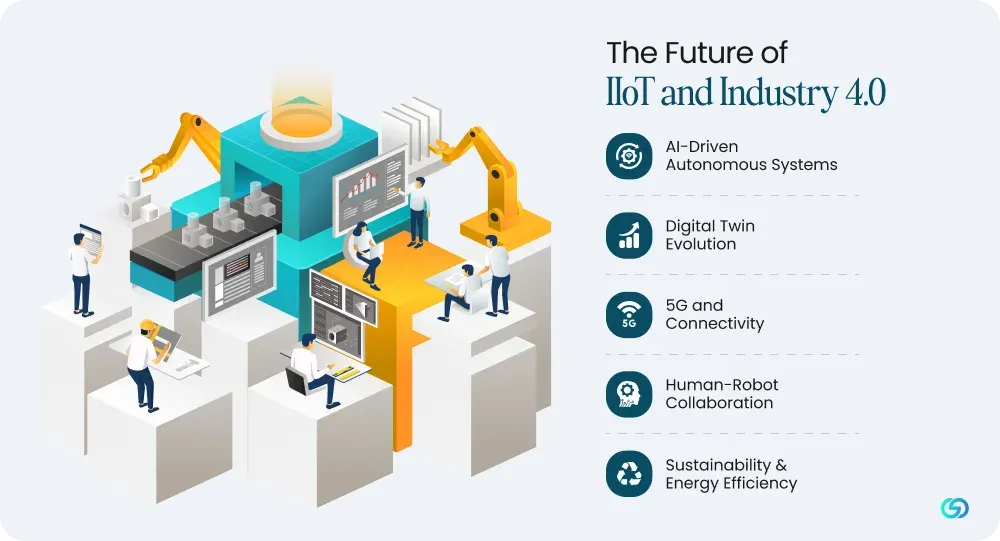
The future of IIoT, as well as Industry 4.0, is making a transition from generic automation to complete automation, AI-driven intelligent systems, digital twins, and edge computing. The main trends include the large-scale adoption of AI-powered predictive maintenance, 5G connectivity for low-latency communication, and human-robot collaboration for enhanced productivity, aiming for sustainable, resilient manufacturing.
🔹 AI-Driven Autonomous Systems: AI will rise from predicting failures to autonomously streamlining production as well as decision-making, transitioning from cloud-based analysis closer to machinery via edge computing
🔹 Digital Twin Evolution: Digital twins are now maturing into “virtual twins” that offer real-time, interactive, and holistic simulation for complete factories, enabling predictive simulation of changes before they are implemented.
🔹 5G and Connectivity: Private 5G networks and specialized cellular technologies will be the standard for powering secure, high-speed, and trustworthy communication required for autonomous machines.
🔹 Human-Robot Collaboration: Technologies are going to focus on improving the experience of the workers, with autonomous mobile robots (AMRs) taking over mundane, manual tasks to enhance worker safety and efficiency.
🔹 Sustainability and Energy Efficiency: IIoT will be crucial in decreasing waste and lowering energy consumption, helping industrial sectors to achieve the goals of decarbonization, mainly in manufacturing sectors.
Conclusion
Industrial IoT is rapidly becoming the driving force behind the rise of Industry 4.0, enabling industries to develop smarter, faster, and more connected operations. Starting from predictive maintenance and intelligent automation to monitoring in real-time and data-driven decision-making, IIoT is enabling businesses to enhance efficiency, decrease operational costs, and improve complete productivity. Despite all the challenges like integration complexities, risks of cybersecurity, and infrastructure limitations, the adoption of IIoT continues to enhance across industries worldwide.
As technologies such as AI, 5G, edge computing, and digital twins continue to evolve, IIoT will be playing a more crucial role in shaping long-term future-ready innovation, operational agility, as well as sustainable growth in a largely connected industrial landscape.
Frequently Asked Question
How can small and mid-sized businesses start adopting IIoT without large investments?
Small and mid-sized businesses can start their IIoT journey by implementing specific solutions focused on particular operational challenges like predictive maintenance, monitoring of equipment, or energy management. Partnering with an experienced technology provider such as ConvexSol helps businesses adopt cost-effective and customized IIoT solutions, aligning with their growth goals and infrastructure needs.
Can IIoT improve product quality in manufacturing?
Yes, IIoT largely enhances product quality by allowing real-time monitoring of production processes, machine performance, and quality parameters. A connected system can quickly find out inconsistencies, decrease production errors and maintain quality standards throughout the management operations.
What factors should businesses evaluate before implementing IIoT solutions?
Businesses should be able to assess their existing infrastructure, cybersecurity readiness, connectivity capabilities, scalability needs, operational objectives, and integration requirements before implementing IIoT solutions. It is also crucial to evaluate long-term maintenance, data management strategies, and employee training for successful adoption.
How does IIoT contribute faster to business decision-making?
IIoT allows speedy business decision-making, offering real-time operational insights via connected devices, sensors, and analytics platforms. Businesses can monitor performance, detect operational issues immediately, and make data-driven decisions that enhance efficiency, productivity, and resource utilization.
Is IIoT only beneficial for large industrial enterprises?
No, IIoT is beneficial for all sizes of businesses. Small and medium–sized businesses can utilize IIoT technologies to enhance operational efficiency, decrease downtime, streamline resources, and strengthen competitiveness without needing large-scale infrastructure investments.
How will IIoT influence the future workforce in industrial sectors?
IIoT will revolutionize the industrial workforce by enhancing demands for skills that are related to AI, cloud computing, cybersecurity, automation, and industrial analytics. Employees will majorly work alongside intelligent systems and automation technologies, developing more technology-powered industrial environments.