- Enterprise web development
- 2026-06-18
A Comprehensive Guide to Enterprise Web Development: Benefits, Process & Trends
Audio Track
Table of Contents
Key Takeaways
- Enterprise web development extends beyond websites to include scalable, robust web applications. These applications support complex work environments, enable integration of multiple systems, and improve organizational efficiency.
- Successful enterprise platforms are developed to handle growth, safeguard sensitive data, and seamlessly connect with multiple business systems.
- Picking the right technology and architecture ensures high-quality performance, long-term flexibility, and maintainability.
- Comprehensive development process and an experienced enterprise development company are primary to delivering trustworthy, future-ready solutions.
- While initial costs may remain high, they provide significant ROI via enhanced efficiency, scalability, automation, and sustained business growth.
Overview: Introducing Enterprise Website Development
Enterprise web development involves building large-scale, high-performing, and secure web applications tailored to address complex business requirements. These solutions extend beyond basic applications and websites, covering platforms such as customer-facing systems, vendor and partner ecosystems, SaaS platforms, and analytics tools. Designed to manage extensive data sets, high traffic volumes, and multiple user roles, these business applications play a critical role in optimizing operations and enhancing user experiences. Unlike standard web development, enterprise web development prioritizes seamless integrations, scalability, advanced security, and long-term flexibility, enabling organizations to adapt, sustain efficiency, and thrive in a digital-first environment.
How Does an Enterprise Web Development Differ from a Small Business Web Development?
Enterprise web development includes developing large-scale websites and web apps that drive business operations, while small business web development focuses on simpler websites that have lower traffic handling, limited functionality, and minimal system integrations.
➡️ Scale, Users & Performance
Enterprise web development helps in supporting websites and web apps that handle huge traffic, high-performance demands, and complex user interactions. These platforms are developed for scaling, unlike small business websites that work with simpler performance requirements and limited users.
➡️ Websites Vs Web Applications Scope
Enterprise development includes both dynamic websites and specialized web apps like dashboards, SaaS platforms, and internal systems. Small business website development mostly focuses on generic transactional websites with limited functionality and interactivity.
➡️ Features, Integrations & Systems
Enterprise platforms need extensive integrations with ERP, CRM, databases, and third-party systems to support operations across departments. In contrast, small business websites depend on generic tools with minimal integrations and low system dependencies.
➡️ Data Handling & Infrastructure
Enterprise apps handle large volumes of operational and user data, needing advanced infrastructure and databases. Small business websites implement standard measures of security, as they deal with lower operational risk and less sensitive data.
➡️ Security, Compliance & Reliability
Enterprise web application development focuses on enterprise-level compliance standards, security, and system trustworthiness because of high-risk exposure. Small business websites and web apps implement standard security measures, as they deal with lower operational risk and sensitive data.
➡️ Scalability & Long-Term Growth
Enterprise platforms are developed to evolve with business growth, supporting new markets, users, and features over time. Small business websites mostly need redevelopment or redesign when scaling beyond their initial capabilities.
Do I Need to Invest in Enterprise Web Development?
If your web application or website plays a crucial role in your business operations, investing in enterprise web development is the right strategy. Enterprise platforms are designed for delivering scalability, performance, and functionality that directly impact conversions, user experience, and long-term growth.
In order to determine whether your business requires web development, consider a few main questions:
- Does your platform struggle to handle increasing users or traffic?
- Do you lack important features or integrations (ERP, CRM, Analytics)?
- Are your user experiences inefficient or outdated?
- Can your existing system scale as your business grows?
If the answers are mostly “no”, it is a direct indication that your business is ready to invest.
One of the biggest benefits of enterprise web development is that it provides customization at scale. It enables you to develop platforms customized to your exact business requirements, whether it is complex checkout systems, advanced workflows, or large-scale management.
Moreover, enterprise solutions help in providing a superior user experience. This helps in ensuring faster performance, intuitive navigation, and easy interactions. This directly enhances customer engagement and satisfaction.
Most significantly, investment in enterprise web development helps in contributing to revenue growth. A streamlined and scalable platform keeps the users engaged for longer, enhances conversions, and supports your business as it expands.
In the present, competitive digital landscape, enterprise web development is crucial for businesses aiming to streamline operations, scale efficiently, and remain ahead of changing market demands.
What are the Benefits of Enterprise Web Development?
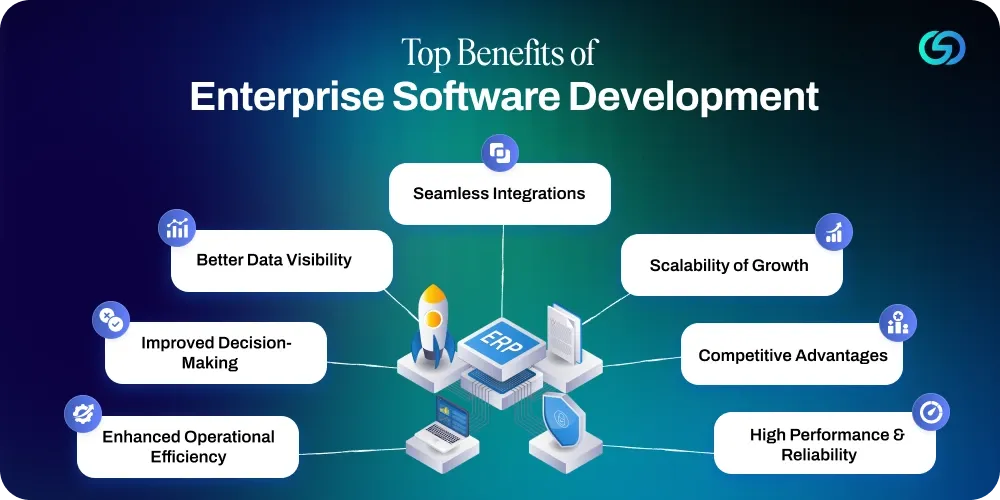
Enterprise web application development empowers businesses with secure, scalable, and high-performing platforms that optimize operations, enhance data accessibility, as well as long-term growth of businesses in a largely competitive and digital-first landscape.
🔶 Enhanced Operational Efficiency
Enterprise web application development optimizes complex business processes by automating workflows and decreasing manual tasks. It helps in centralizing operations across departments, allowing teams to work efficiently while decreasing errors and enhancing overall productivity across the business.
🔶 Improved Decision-Making
Enterprise web application development allows data-powered decision-making by providing correct insights and reports. With centralized data systems and advanced analytics, leadership teams can make more informed, faster decisions, aligning with market trends and business goals.
🔶 Better Data Visibility
With enterprise platforms, businesses get real-time access to crucial data via analytics tools and dashboards. This enhanced visibility helps businesses in monitoring performance, tracking KPIs, and ensuring transparency across various business functions and departments.
🔶 Seamless Integrations
Enterprise solutions easily integrated with ERP, CRM, third-party tools, and payment systems. This ensures easy flow of data across systems, gets rid of data silos, and creates a unified digital ecosystem that improves collaboration and operational efficiency.
🔶 Scalability of Growth
One of the biggest benefits of enterprise web application development is its capability for scaling as your business evolves. Whether it is expanding services, increasing users, or entering new markets, enterprises are developed to grow without performance issues.
🔶 Competitive Advantages
By utilizing enterprise web application development, businesses offer superior user experiences, innovative features, and faster services. This helps them remain ahead of the competitors, adapting to the evolving market needs and developing stronger customer relationships.
🔶 High Performance & Reliability
Enterprise platforms are made to handle high traffic loads as well as complex operations without downtime. Their strong architecture ensures reliability, consistent performance, and availability, which are crucial for maintaining business continuity and user trust.
Key Characteristics of Enterprise Web Platforms
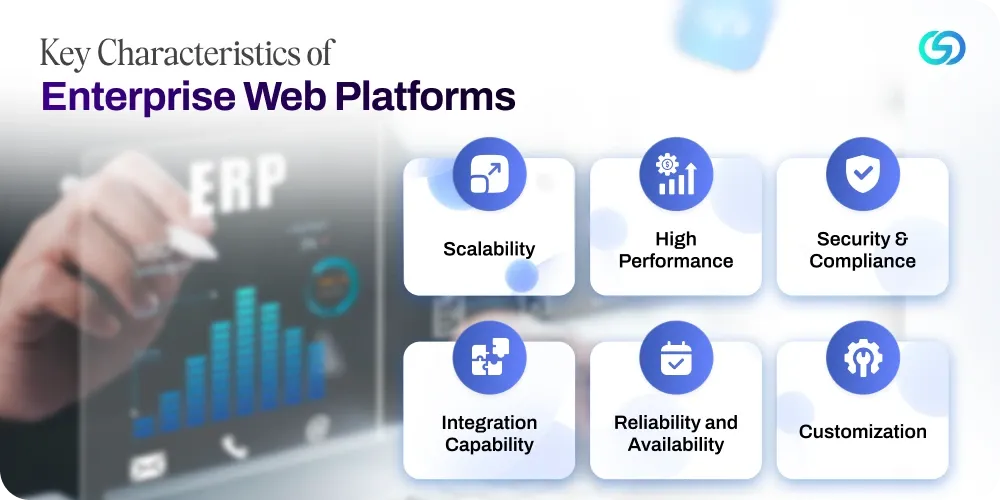
Enterprise web development and the platforms developed are defined by robust capabilities, security, scalability, integration, and performance, allowing businesses for handling complicated operations, huge user bases, and growing demands while ensuring flexibility, reliability, and long-term digital growth.
*️⃣ Scalability
Enterprise web apps are developed for handling exponential user growth, transactions, and data. With scalable architecture such as microservices and cloud, businesses can expand operations easily without compromising user experience and performance as the demand escalates.
*️⃣ High Performance
These platforms are streamlined for speed and responsiveness, ensuring low latency and fast loading times under heavy traffic. Techniques such as CDNS, caching, and load balancing help in maintaining platform consistency across all user interactions.
*️⃣ Security & Compliance
Enterprise systems give priority to security measures like encryption, authentication, and access controls. They also comply with industry standards such as HIPAA or GDPR, ensuring the protection of sensitive business and customer data.
*️⃣ Integration Capability
Enterprise web applications easily incorporate CRM, ERP, APIs, and third-party tools. This ensures seamless data flow across systems, gets rid of silos and allows efficient coordination between various departments and business functions.
*️⃣ Reliability and Availability
These platforms are developed with fault-tolerant systems for ensuring continuous availability and minimal downtime. Even during unexpected failure or high traffic, enterprise apps maintain stability in performance. This ensures uninterrupted business operations and user access.
*️⃣ Customization
Enterprise web apps are customized to particular business workflows and operational needs. This kind of flexibility enables organizations to develop unique features, automate processes, and create solutions aligning well with their business strategies and goals.
Enterprise Web Architectures for Enterprise Web Development
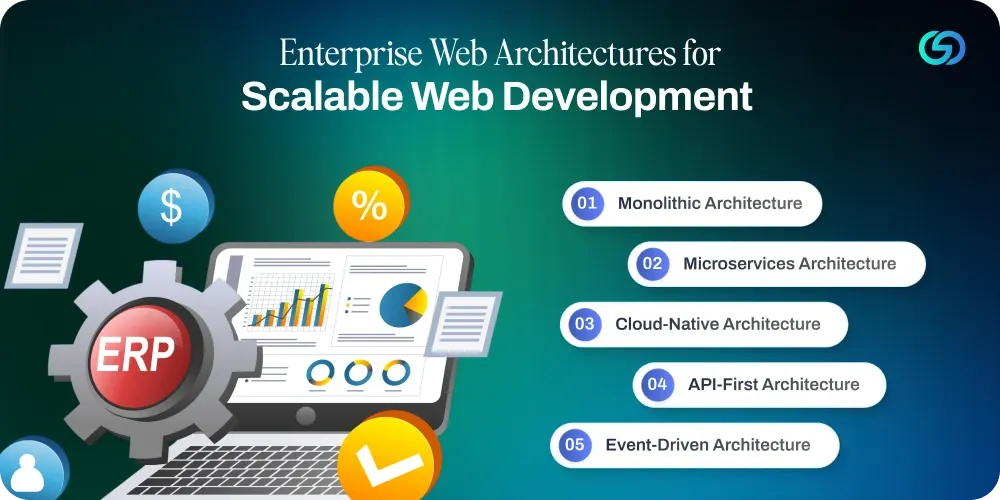
Enterprise web architecture defines how large-scale web apps are connected, structures and streamlined to support complicated enterprise operations. It helps in ensuring performance, scalability, and easy integration across systems, making it a crucial foundation for enterprise platforms.
1️⃣ Monolithic Architecture
Monolithic architecture provides a combination of all components, frontend, backend, and database, into a single unified system. While it is simple to develop and deploy initially, it gets difficult to scale as well as update. This is because even minor changes affected the complete application.
2️⃣ Microservices Architecture
Microservices architecture breaks apps into smaller, independent services that function separately. This kind of approach allows flexibility, great scalability, and faster updates, enabling businesses to adapt faster to the changing needs without affecting the entire system.
3️⃣ Cloud-Native Architecture
Cloud-native architecture is developed to work on platforms such as Azure, AWS, or Google Cloud. It utilizes cloud infrastructure for resilience, scalability, and cost efficiency, allowing businesses to handle dynamic workloads and expand internationally with ease.
4️⃣ API-First Architecture
In an API-first architecture, all the components communicate via APIs, ensuring easy integration between systems. This approach improves flexibility, allows faster development, and enables enterprise platforms for connecting with third-party tools such as ERP, CRM, and external services.
5️⃣ Event-Driven Architecture
Event-driven architecture allows real-time data processing and responsiveness by triggering actions based on events. This kind of model is perfect for apps needing immediate updates, like ecommerce platforms, financial systems, or real-time analytics dashboards.
Types of Enterprise Web Applications
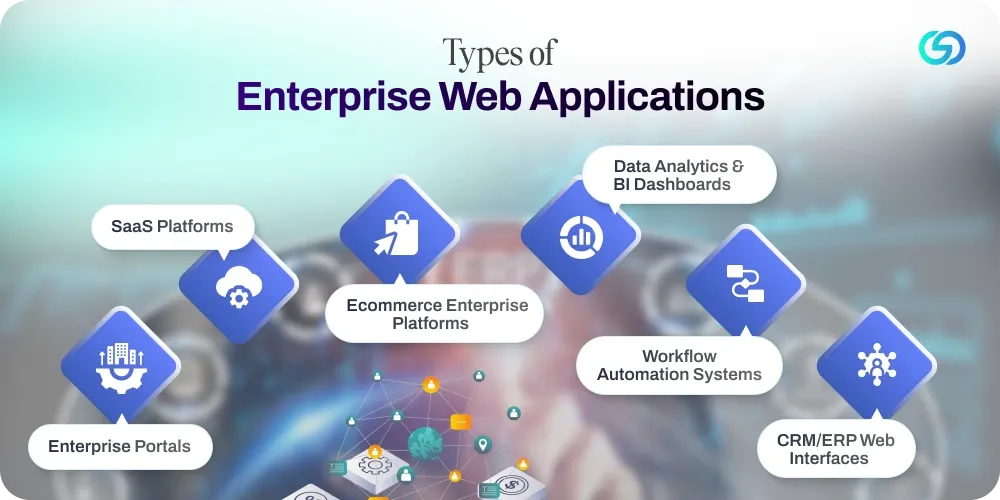
Enterprise web development incorporates a varied range of web apps designed to support several business functions, optimize operations, and improve user experiences. These apps act as a digital backbone of business organizations, allowing automation, integration, and data-driven decision-making.
▶️ Enterprise Portals
Enterprise portals work as centralized platforms where customers, employees, and vendors are capable of accessing relevant services and information. These portals optimize communication, handle workflows, and offer role-based access to information, enhancing collaboration and operational efficiency across the business.
▶️ SaaS Platforms
SaaS platforms can be defined as cloud-based apps delivered through the web, enabling users to access software without installation. These platforms are cost-effective, scalable, and support several users, making them perfect for businesses handling distributed teams and operations.
▶️ Ecommerce Enterprise Platforms
Enterprise ecommerce platforms are developed for handling high transaction volumes, complex integrations, and product catalogs. They connect with payment gateways, inventory, and logistics systems, allowing seamless online selling experiences while supporting enterprise scalability and global operations.
▶️ Data Analytics & BI Dashboards
These apps offer real-time insights via dashboards and reporting tools. This allows businesses to analyze huge datasets, monitor performance metrics, and make informed decisions, enhancing strategic planning and operational transparency across departments.
▶️ Workflow Automation Systems
Workflow automation systems optimize repetitive businesses processes like task assignments, approvals, and reporting. By automating routine work, these apps decrease manual effort, decrease errors, and enhance productivity across enterprise functions.
▶️ CRM/ERP Web Interfaces
ERP and CRM web apps can help in handling customer relationships, inventory, financials, and business processes. These systems improve collaboration, centralize data, and ensure easy integration across departments, making them crucial for efficient enterprise operations.
Technology Stack for Enterprise Web Development
A powerful technological stack is the foundation of successful enterprise web development, combining backend, frontend, databases, cloud infrastructure, and integration tools. The right stack ensures performance, scalability, security, and easy user experiences across enterprise websites and web applications.
🔷 Frontend
The frontend layer has its focus on interface design and user experience. Technologies such as Next.js, React, and Angular are used widely for developing responsive, dynamic, and interactive interfaces that are capable of handling complicated workflows and providing simplified cross-device experiences.
🔷 Backend
The backend powers the logic of the app, data processing, and server-side operations. Technologies like Java, Node.js, and Python allow scalable, high-performance systems that handle APIs, business logic, and real-time functionalities.
🔷 Databases
Enterprise apps need strong databases for handling huge volumes of structured and unstructured data. Solutions such as MongoDB, PostreSQL, Redis ensure fast data retrieval, high availability, and efficient storage of data for complicated enterprise requirements.
🔷 Cloud & DevOps
Cloud platforms and DevOps tools are necessary for deployment and scalability. AWS, Docker, Azure, and Kubernetes allow automated deployments, containerizations, and orchestration, ensuring apps stay flexible, easy to scale, and resilient across environments.
🔷 Integration
Integration technologies ensure simplified communication between systems. Azure, AWS, Docker, and Kubernetes allow automated deployments, containerization, and orchestration. This ensures that the apps stay flexible, resilient, and scale across environments.
Comprehensive Enterprise Web Development Process
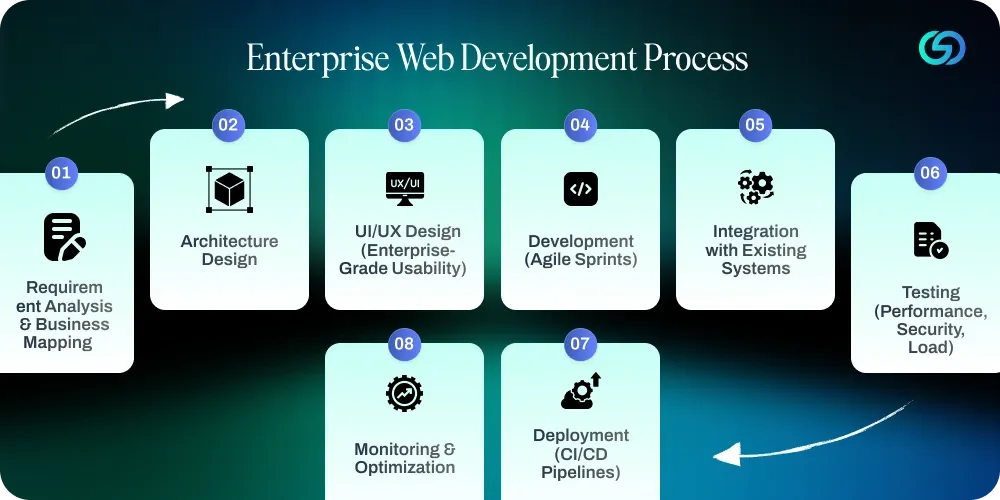
Enterprise web development follows a structured and strategic process to ensure scalability, performance, and alignment with business goals. Each stage is designed to build robust, secure, and high-performing web applications that support complex enterprise operations.
1️⃣ Requirement Analysis & Business Mapping
The process begins with understanding business goals, user needs, and operational challenges. This stage involves gathering detailed requirements, mapping workflows, and identifying key functionalities to ensure the solution aligns with organizational objectives and long-term growth plans.
2️⃣ Architecture Design
A strong architectural foundation is defined to support scalability, flexibility, and performance. This includes selecting the right architecture style, designing system components, and planning how different modules will interact within the enterprise ecosystem.
3️⃣ UI/UX Design (Enterprise-Grade Usability)
Design focuses on creating intuitive, user-friendly interfaces that enhance productivity and user experience. Enterprise applications prioritize accessibility, role-based navigation, and seamless workflows to ensure efficiency for different types of users.
4️⃣ Development (Agile Sprints)
Development is typically carried out in agile sprints, allowing teams to build features incrementally. This approach ensures faster delivery, continuous feedback, and the flexibility to adapt to changing requirements during the development cycle.
5️⃣ Integration with Existing Systems
Enterprise applications are integrated with existing systems such as CRM, ERP, databases, and third-party tools. This ensures seamless data flow, eliminates silos, and creates a unified digital ecosystem across the organization.
6️⃣ Testing (Performance, Security, Load)
Comprehensive testing is conducted to ensure the application performs efficiently under various conditions. This includes performance testing, security validation, and load testing to guarantee reliability, stability, and data protection.
7️⃣ Deployment (CI/CD Pipelines)
The application is deployed using continuous integration and continuous deployment (CI/CD) pipelines. This ensures faster, automated, and error-free releases while maintaining consistency across different environments.
8️⃣ Monitoring & Optimization
After deployment, continuous monitoring is essential to track performance, detect issues, and optimize the system. Regular updates, performance tuning, and improvements ensure the platform remains efficient, secure, and scalable over time.
Key Challenges in Enterprise Web Development
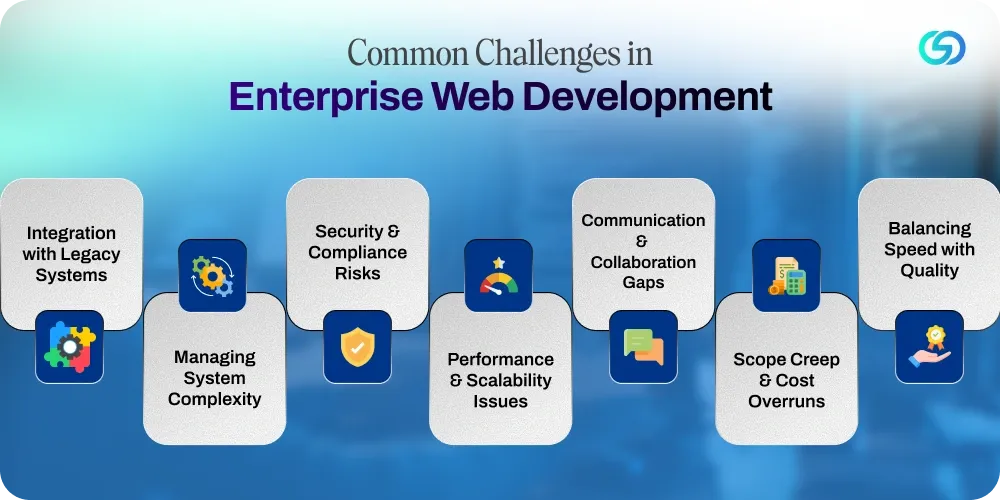
Enterprise web development includes large-scale platforms and building complexes, which bring several technical and operational challenges. Starting from system integration to security risks, enterprises should overcome these hurdles to ensure scalability, performance, and long-term success in a demanding digital environment.
⏺️ Integration with Legacy Systems
A huge challenge in enterprise web development is incorporating modern apps with legacy systems. Older infrastructures mostly lack proper APIs. This makes the exchange of data difficult, resulting in compatibility issues, delays, and complexities in development.
⏺️ Managing System Complexity
Enterprise platforms include several modules, user roles, and workflows, making them inherently complex. Handling this kind of complexity while ensuring seamless functionality across systems needs proper planning, architecture design, and coordination between several stakeholders and teams.
⏺️ Security & Compliance Risks
Enterprise apps manage sensitive business and customer data, making them prime targets of cyber threats. Ensuring robust security compliance and protocols with regulations is challenging but important for preventing breaches, reputational damage, and financial damage.
⏺️ Performance & Scalability Issues
Maintaining high performance under heavy traffic and large loads when data is vital is a challenge. Poor optimization can result in delays in response times, poor user experiences, system crashes, and directly affect business operations and customer satisfaction.
⏺️ Communication & Collaboration Gaps
Enterprise projects mostly involve several teams, external partners, and departments. Miscommunication or lack of alignment can result in rework, delays, and missed objectives, making clear communication and effective collaboration crucial for project success.
⏺️ Scope Creep & Cost Overruns
Unclear needs or frequent changes during development can expand the scope of the project, resulting in increased costs and extended timelines. Handling expectations, as well as maintaining a well-defined roadmap, is crucial to avoiding budget overruns.
⏺️ Balancing Speed with Quality
Enterprises mostly face pressures for delivering faster while maintaining high quality and stability. Striking the correct balance between strong performance and faster development is challenging but critical for success in the long-term.
Enterprise Web Development Best Practices
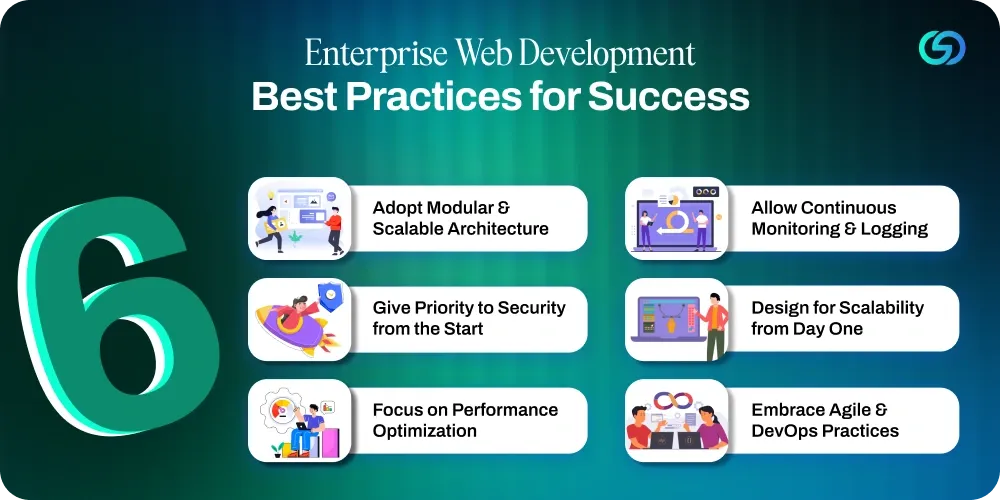
Developing enterprise-level platforms needs more than only development; it needs the best strategic process that ensures security, scalability, performance, and maintainability in the long-term. Following the proven approaches given below help businesses in providing high-performing, trustworthy apps in complicated and fast-changing digital environments.
⏩ Adopt Modular & Scalable Architecture
Design apps utilizing microservices or modular architecture to ensure flexibility and scalability. This kind of approach enables teams to scale, update, or change individual components without affecting the complete system, enhancing maintainability and long-term performance.
⏩ Give Priority to Security from the Start
Security has to be integrated from the initial development phase and not added later. Implement authorization, authentication, encryption, and regular security testing for safeguarding sensitive information, as well as ensure compliance with enterprise-level regulations and standards.
⏩ Focus on Performance Optimization
Enterprise apps should deliver speedy and responsive user experiences even under heavy loads. Use CDNs, caching, streamlined queries, and efficient methods to decrease latency as well as ensure consistency in performance across all user interactions.
⏩ Allow Continuous Monitoring & Logging
Implement centralized logging and real-time monitoring for tracking performance, detecting anomalies, and troubleshooting problems proactively. This ensures the trustworthiness of the system, enhances uptime, and enables teams to streamline apps depending on data insights and real user behavior.
⏩ Design for Scalability from Day One
Plan architecture and infrastructure for handling future growth. Use cloud native solutions, horizontal scaling, and a distributed system to ensure your app can handle increasing data, users, and workloads without affecting performance.
⏩ Embrace Agile & DevOps Practices
Embracing agile & DevOps methodologies allows speedy development cycles, ongoing feedback, and improved collaboration between teams. This approach changes with changing business needs.
Security & Compliance in Enterprise Web Development
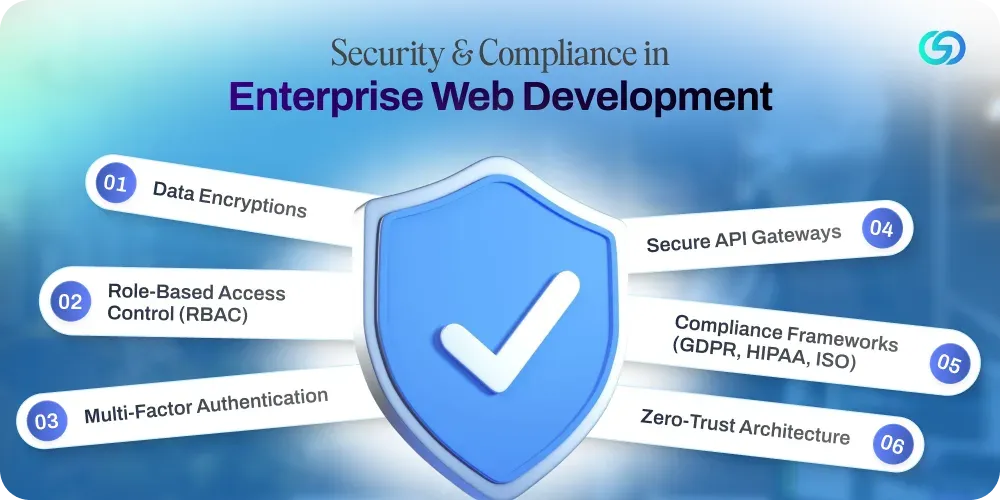
Security and compliance are necessary for enterprise web platforms to safeguard sensitive information, prevent cyber threats, as well as meeting regulatory standards. A strong security framework ensures resilience, trust, and easy operations in the current high-risk digital ecosystem.
↗️ Data Encryptions
Enterprise platforms utilize robust protocols for securing data during storage and transmission. This helps in ensuring sensitive business and user data stay protected from unauthorized access, cyber threats, and breaches across every layer of the system.
↗️ Role-Based Access Control (RBAC)
RBAC restricts access to the system depending on user roles and responsibilities. By assigning permissions as per job functions, big businesses ensure that the users only access relevant information, decreasing the risk of internal misuse and enhancing complete security governance.
↗️ Multi-Factor Authentication
MFA adds an additional layer of security by requiring several verification requirements like OTPs, passwords, or biometrics. This largely decreases the chances of unauthorized access, even if login credentials are compromised.
↗️ Secure API Gateways
API gateways act as a security layer between services, handling and securing the exchange of data. They enforce authentication, rate limiting, and traffic monitoring, ensuring secure communication between internal systems and third-party integrations.
↗️ Compliance Frameworks (GDPR, HIPAA, ISO)
Enterprise applications and platforms should accompany world-wide and industry-specific regulations for ensuring privacy of data and legal protection. Adhering to standards such as HIPAA, GDPR, and ISO helps develop the trust of users and avoid legal complications or penalties.
↗️ Zero-Trust Architecture
Zero-trust security helps in assuming that no system or user is automatically trusted. Every access request is continuously verified, ensuring strict validation of identity and decreasing the risk of breaches within complicated enterprise environments.
Industries Benefiting from Enterprise Web Development
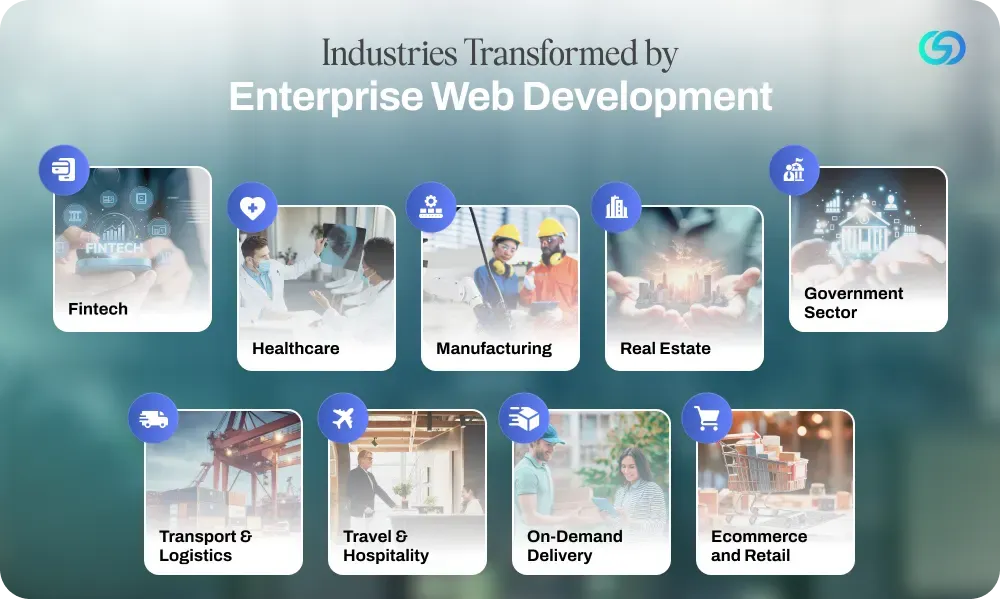
ConvexSol offers enterprise web development solutions customized to industry-specific workflows, help businesses optimize operations, enhance scalability, improve user experiences, and provide long-term digital transformation across varied sectors.
*️⃣ Fintech
We develop scalable and secure enterprise web platforms for fintech businesses, allowing payment processing, analytics, compliance management, fraud detection, and seamless financial operations.
*️⃣ Healthcare
Our enterprise healthcare web solutions optimize patient management, data accessibility, telemedicine, appointment scheduling, and healthcare workflows while ensuring security, compliance, scalability, and enhanced patient experiences across digital platforms.
*️⃣ Manufacturing
We build enterprise manufacturing platforms that streamline production workflows, inventory management, chain visibility, analytics, and operational efficiency while supporting scalability, automation, and real-time decision-making across facilities.
*️⃣ Real Estate
Our enterprise real estate solutions help in simplifying property management, customer engagement, virtual listings, lease tracking, and transaction workflows while improving scalability, operational efficiency, and streamlined experiences for agents and buyers.
*️⃣ Government Sector
We develop secure enterprise platforms for public sector organizations, allowing digital citizen services, workflow automation, document management, secure handling of data, and enhanced accessibility while supporting operational transparency and compliance.
*️⃣ Transport & Logistics
Our enterprise logistics platforms optimize fleet management, route optimization, shipment tracking, warehouse operations, as well as real-time analytics, helping businesses improve efficiency, delivery, and complete supply chain performance.
*️⃣ Travel & Hospitality
We create enterprise travel and hospitality platforms that enhance booking itinerary planning, customer experiences, payment processing, and operational coordination while supporting scalability and personalized digital engagement.
*️⃣ On-Demand Delivery
Our enterprise on-demand delivery solutions enable management of orders, real-time tracking, automated dispatching, customer communication, and operational optimization, helping businesses to provide faster and improve user satisfaction efficiently.
*️⃣ Ecommerce and Retail
We develop scalable enterprise ecommerce platforms with specialized inventory management, payment integrations, personalized shopping experiences, analytics, and omnichannel capabilities, helping retailers enhance conversions, engagement, and operational efficiency.
Enterprise Web Development Trends in 2026
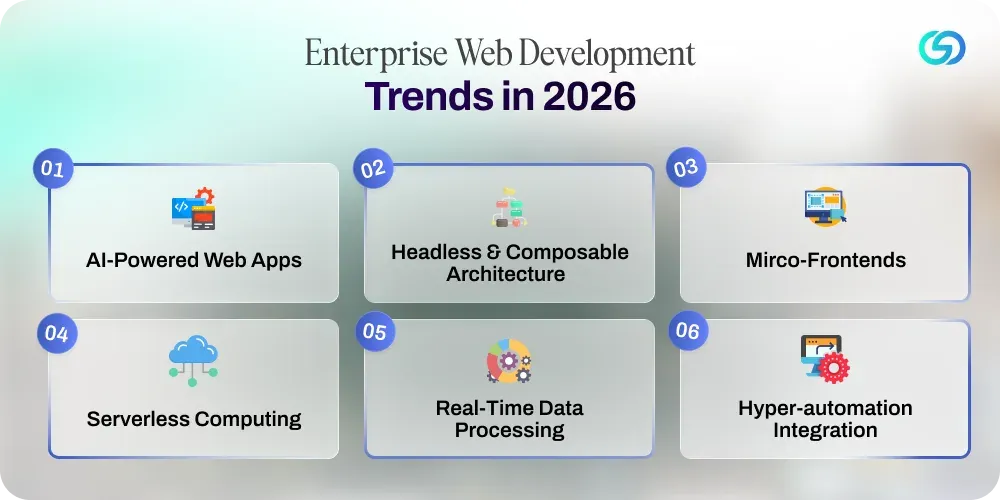
Enterprise web development in 2026 is powered by automation, innovation, and scalability. Emerging technologies are revolutionizing how businesses develop and handle web applications, allowing speedy performance, smart decision-making, and extremely flexible digital ecosystems.
▶️ AI-Powered Web Apps
AI is changing enterprise web apps by allowing personalization, intelligent automation, and predictive analytics. Starting from chatbots to recommendation engines, AI-powered features improve user experience, streamline operations, and support data-powered business decisions at scale.
▶️ Headless & Composable Architecture
Headless and composable architectures separate the frontend from the backend, enabling greater flexibility and faster development. Businesses can develop modular systems, incorporate multiple services, and provide seamless experiences across mobile, web, and other digital channels.
▶️ Mirco-Frontends
Micro-frontends break the frontend into independent, smaller components handled by different teams. This approach enhances scalability, speeds up the development, and enables big businesses to deploy or update particular features without impacting the entire application.
▶️ Serverless Computing
Serverless architecture helps in eliminating the requirement of managing infrastructure, allowing developers to focus on code functionality. It provides automatic scaling, faster deployment, and cost efficiency, making it perfect for dynamic and high-demand enterprise applications.
▶️ Real-Time Data Processing
Big businesses increasingly depend on real-time data to make instant decisions. Technologies allowing live streaming of data and processes enable businesses to respond faster to user actions, check performance, and provide up-to-date insights via dashboards and applications.
▶️ Hyper-automation Integration
Hyper-automation provides a combination of AI, automation, and machine learning tools for optimizing complex business processes. Enterprise web development allows end-to-end automation of workflows, decreasing manual effort, enhancing efficiency, and speeding up digital transformation initiatives.
Cost of Enterprise Web Development
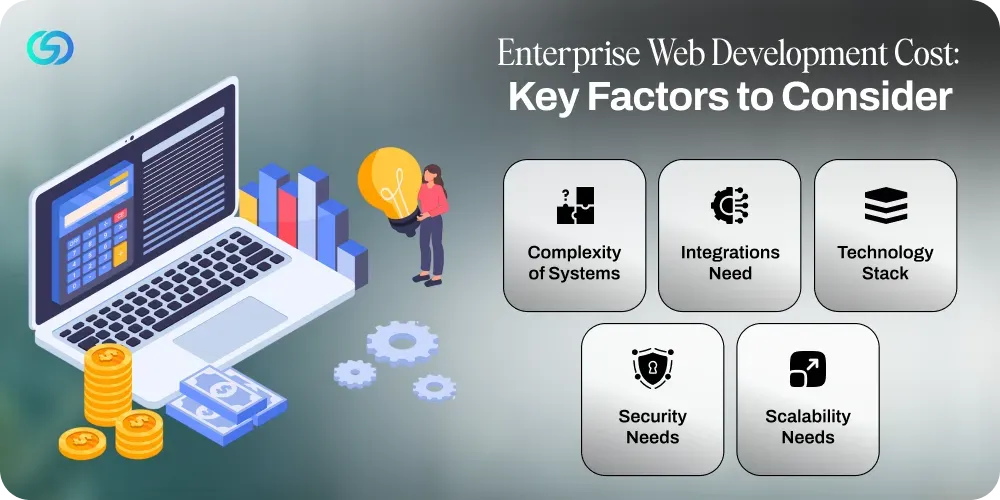
The cost or expense of enterprise web development relies on several technical and business factors, such as integration, scalability, and complexity. Understanding the cost factors given below will help enterprises allocate budgets effectively to invest in high-performing and scalable solutions, providing long-term ROI.
#️⃣ Complexity of Systems
Highly complex business platforms with specialized workflows, real-time functionalities, and multi-user roles need development time and expertise. Mid-level systems typically range between $20,000 to $100,000, while extremely complicated platforms can exceed $100,000 based on needs.
#️⃣ Integrations Need
Enterprise apps mostly integrate ERP, CRM, legacy systems, and payment gateways. The more integrations are needed, the more expensive the cost will be. Projects that require moderate integrations will fall within $20,000 to $100,000. In the case of extensive integrations, costs can go beyond $100,000.
#️⃣ Technology Stack
The technology you choose directly influences the cost of development. Utilizing cloud platforms, advanced frameworks, and modern architecture may require talented developers. While leveraging basic techstacks will cost within $100,000, enterprise-level stacks can go up to $ 500,000+.
#️⃣ Security Needs
Using enterprise-level security measures like compliance, encryption, and authentication systems spikes costs. Applications that have standard security will fall in the mid-range, while extremely secure platforms taking care of sensitive data can exceed $100,000 or more.
#️⃣ Scalability Needs
Applications and other web platforms designed for long-term growth and high volumes of users need scalable architecture and infrastructure. Scalable enterprise platforms mostly fall within the $100,000 to $500,000+ range, mainly when developed to support worldwide users and huge datasets.
How to Choose the Right Enterprise Web Development Partner?
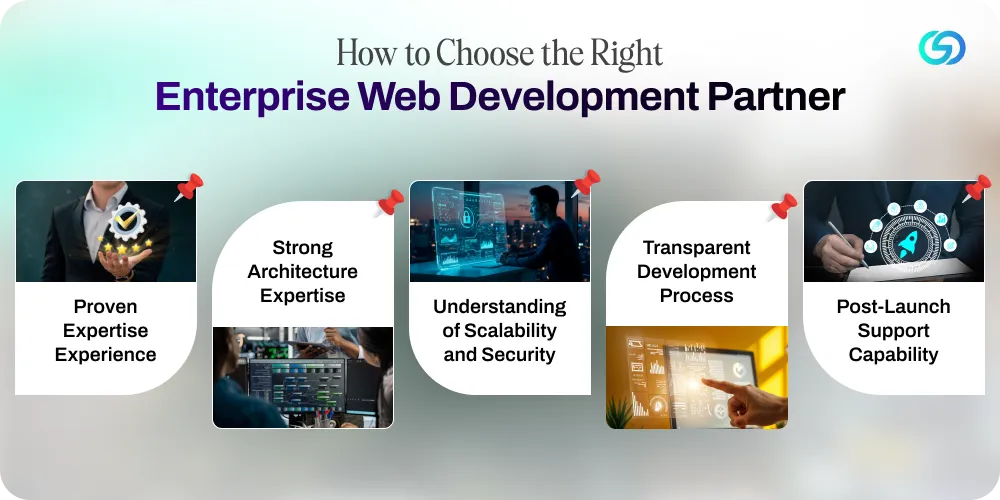
Picking the right enterprise web development company is imperative for developing secure, scalable, and high-performing platforms. The right company not only provides technical expertise but also aligns with your business goals. This helps in ensuring long-term success and ongoing digital growth.
➡️ Proven Expertise Experience
Go for a partner with a powerful portfolio in enterprise web development. Experience in handling complex workflows, big-scale projects, and multi-user systems helps ensure that they understand the challenges and provide trustworthy, high-quality solutions.
➡️ Strong Architecture Expertise
Enterprise platforms need a powerful and scalable architecture. The development company you choose should have comprehensive expertise in designing systems, utilizing cloud-native approaches, microservices, and modular structures to ensure performance, flexibility, and future scalability.
➡️ Understanding of Scalability and Security
A trustworthy partner gives priority to security and scalability right from the beginning. They must be able to build systems that are scalable if handling growth while integrating enterprise-level security practices for safeguarding data and ensuring compliance with industry standards.
➡️ Transparent Development Process
Choose an enterprise web development partner who follows a structured and transparent development approach, like agile methodologies. Clear communication, regular updates, and defined milestones ensure visibility, better collaboration, and on-time project delivery.
➡️ Post-Launch Support Capability
Enterprise apps need ongoing updates, monitoring, and optimization. A trustworthy development partner provides continuous support and maintenance services for ensuring your platforms stay efficient, secured and aligned with the evolving business needs.
Final Thoughts
Enterprise web application development is no longer only a technical investment, but a strategic move that defines how enterprise businesses scale, operate, and compete in a digital-first world. Starting from robust architectures and advanced technology stacks to scalability, security, and seamless integrations, enterprise platforms serve as the backbone for modern businesses.
By staying aligned with trends coming up and adopting the right development approach, businesses will be able to unlock greater efficiency, innovation, and long-term growth.
However, success hugely depends on picking the right partner. Collaborating with an expert enterprise software development company helps in ensuring that your solution is secure, future-ready, and customized to the unique needs of the business, helping you remain ahead in a largely competitive landscape.
Frequently Asked Questions
How do we know if our current system needs an enterprise-level upgrade?
In case your current system is struggling with scalability, performance, and is unable to handle the increasing number of users, or needs frequent manual interventions, you should consider an upgrade. Outdated user experience and limited integrations are also powerful indicators.
What is needed from the business end before starting enterprise web development?
Businesses should have clear objectives, defined needs, and aligned stakeholders before starting. Including key internal teams and important decision-makers, like IT or product managers, ensures improved collaboration, speedy feedback, and a more efficient process.
How do we ensure our enterprise application remains scalable in the future?
ConvexSol ensures scalability by adopting modern architectures such as micro-services, utilizing cloud infrastructure, and designing modular systems. Planning scalability from the start helps in accommodating future growth without significant system overhauls.
How do we measure ROI from enterprise web development?
ROI can be measured via enhanced operational efficiency, decreased manual processes, increased conversions, improved user experience, and the capability for scaling operations without added infrastructure costs.
What risks should we consider before starting an enterprise web project?
Common risks involve unclear needs, integration challenges, scope creep, vulnerabilities in security, and budget overruns. This can be minimized with proper planning, experienced development partners, and an organized development approach.
What level of post-launch support should we expect for enterprise web development?
Post-launch support typically involves ongoing monitoring, optimization of performance, security updates, bug fixes, and feature improvements. Continuous maintenance ensures that the app stays efficient, secure, and tailored to the evolving business needs.