- Enterprise Software Development
- 2026-06-19
Enterprise Software Development for Healthcare: Secure, Connected & Future-Ready Healthcare Systems
Audio Track
Table of Contents
Key Takeaway:
- Enterprise healthcare software connects fragmented systems and allows scalable operations across multi-location healthcare networks.
- AI, automation, and cloud platforms are changing healthcare enterprises into intelligent and highly connected digital systems.
- Security, compliance, integration, and legacy modernization are critical pillars of enterprise software development for healthcare.
- Future-ready healthcare enterprises are investing in connected patient experiences to improve care delivery.
Digital Infrastructure Problem Healthcare Enterprises Can No Longer Ignore
Healthcare enterprises are dealing not just with patient care alone, but managing massive volumes of data, remote consultations, multiple connected devices, and patient expectations, all at the same time.
Many facilities operate on fragmented systems that barely sync with each other. One platform stores patient records, another handles billing; this way, critical data remains trapped in silos. This usually results in disconnected patient experiences, bottlenecks, and healthcare experts spending more time navigating systems rather than focusing on delivering care.
Traditional healthcare software wasn't built to scale. Enterprises today need intelligent systems that support real-time patient data exchange, AI-powered workflow, enterprise-wide visibility, and more without compromising security or compliance. And this is possible with the assistance of healthcare software development company.
Modern platforms transform how organizations work. From centralized data management to predictive analytics, enterprise software is becoming the digital backbone of modern healthcare transformation.
What Is Enterprise Software Development for Healthcare?
The healthcare industry is undergoing a fast transition because hospitals and healthcare networks are operating within a connected ecosystem where every aspect must work together seamlessly.
Healthcare providers face growing hurdles such as increasing patient volumes, burnout, cybersecurity threats, and ensuring strict regulatory compliance. To manage these complexities, secure enterprise healthcare software development is highly necessary.
Enterprise healthcare software solutions help in building large-scale, secure digital systems that unify administrative, clinical, and financial operations on a single platform while ensuring compliance.
Enterprise healthcare platforms are built to be:
- Scalable: To support increasing patient volumes, expanding healthcare networks, and multiple facilities.
- Secure: Developed with enterprise-grade cybersecurity, access controls, and encryption to safeguard sensitive healthcare data.
- Interoperable: Smooth sync between diagnostic systems, EHRs, insurance systems, billing platforms, etc.
- Compliance-ready: Fits with healthcare regulations, like GDPR, HIPAA, and other industry-specific standards.
Enterprise software development benefits the segments:
- Hospitals
- Healthcare networks
- Insurance providers
- Diagnostic chains
- Enterprise healthcare organizations
At its core, it’s about creating intelligent and connected healthcare ecosystems that simplify enterprise-wide healthcare management.
Why Enterprise Software Development for Healthcare Is Essential for Modern Healthcare Organizations
Technology and data have together transformed multiple industries, including healthcare. Large hospitals and hospital chains have to manage thousands of patient records, prescriptions, and insurance claims every day, while staying compliant.
This scale is only growing with each passing day.
The global healthcare IT market is estimated to go beyond $900 billion by 2030. This shows healthcare not experimenting with technology anymore, rather, they are banking on it.
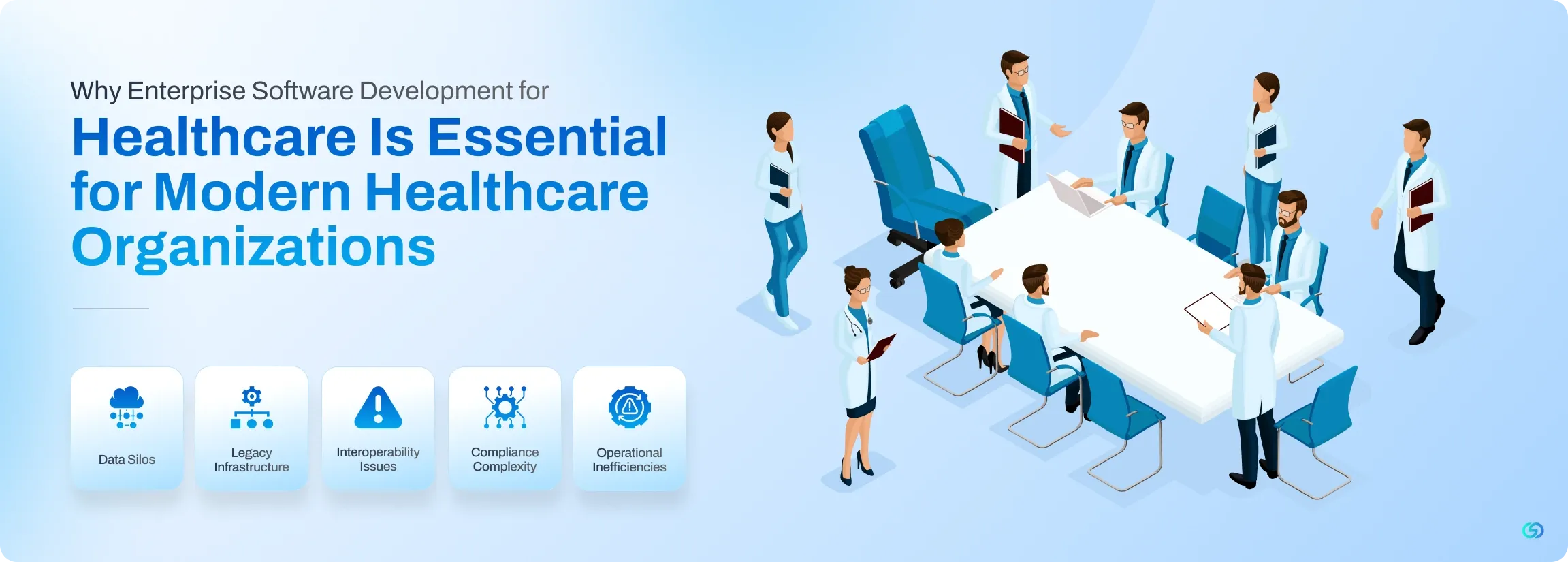
These are some major challenges that enterprise healthcare faces:
▶️ Data Silos
Challenge: Without custom healthcare software development, patient records remain scattered. Not being able to access data across healthcare systems leads to dire consequences. Siloed systems frustrates both patients and healthcare experts.
Enterprise Impact: Patients get tired of filling out the same form for every provider, and healthcare experts burn out with repetitive paperwork. Healthcare teams struggle to access patient records in real-time, which can result in disconnected care experiences.
▶️ Legacy Infrastructure
Challenge: Surprisingly, many health systems depend on outdated technology. What was once the backbone, legacy infrastructure, fails to keep up with the demands of modern healthcare.
Enterprise Impact: Quick-fixing legacy infrastructure time and time again? Every workaround adds another layer of complexity, which affects patient outcomes and revenue. Stability isn’t enough because to move forward, healthcare organizations are turning towards intelligent platforms.
▶️ Interoperability Issues
Challenge: Disconnected Electronic Health Records (EHR) and Electronic Medical Record (EMR) make it tough for healthcare professionals, insurance systems, and third-party platforms to exchange data.
Enterprise Impact: Poor interoperability may cause delay in patient care coordination, create a fragmented patient experience, and reduce efficiency in workflow across healthcare ecosystems.
▶️ Compliance Complexity
Challenge: Healthcare organizations should adhere to strict regulations such as GDPR, HIPAA, and changing patient privacy requirements while handling volumes of sensitive healthcare data.
Enterprise Impact: Healthcare data breaches increased to 17.9% MOM in April 2025, impacting 10.26 million people approx. Consequences like breaches through penalties and affect reputation.
▶️ Operational Inefficiencies
Challenge: Operational inefficiencies compromise the accuracy and timeliness of patient care. Manual systems lead to fragmented data that slows down enterprise healthcare operations.
Enterprise Impact: Admins and healthcare experts lose significant time on administrative tasks such as payroll or scheduling. Other than that, it also affects workflow delays, operational costs, and experiences.
Leveraging modern healthcare enterprise application development will help create connected healthcare ecosystems where data, systems, and workflow work in sync.
Regular Healthcare Software Development vs. Enterprise Software Development for Healthcare
Here are the crucial differentiating aspects of regular software development vs. enterprise healthcare software solutions.
| Aspects | Regular Software Development for Healthcare | Enterprise Software Development for Healthcare |
|---|---|---|
| Scale | Serves single clinic or department | Supports multi-site health systems |
| Handling of data | Manages records within one location | Exchanges and governs patient data across ecosystem in real-time |
| Integration | Limited API connectivity | Connecting to several platforms |
| Compliance | Standard HIPAA requirements | Multi-framework compliance built into architecture |
| Infrastructure | On-premises or basic cloud hosting | Cloud-native or integrated across enterprise infrastructure |
| AI & automation | Limited capabilities | Supports AI-driven analytics, automation, intelligent workflows, and predictive insights |
| Security | Standard healthcare security measures | Enterprise-grade cybersecurity, encryption, and access control |
| Customization | Generic | Deeply configurable |
Core Components of Enterprise Software Development for Healthcare
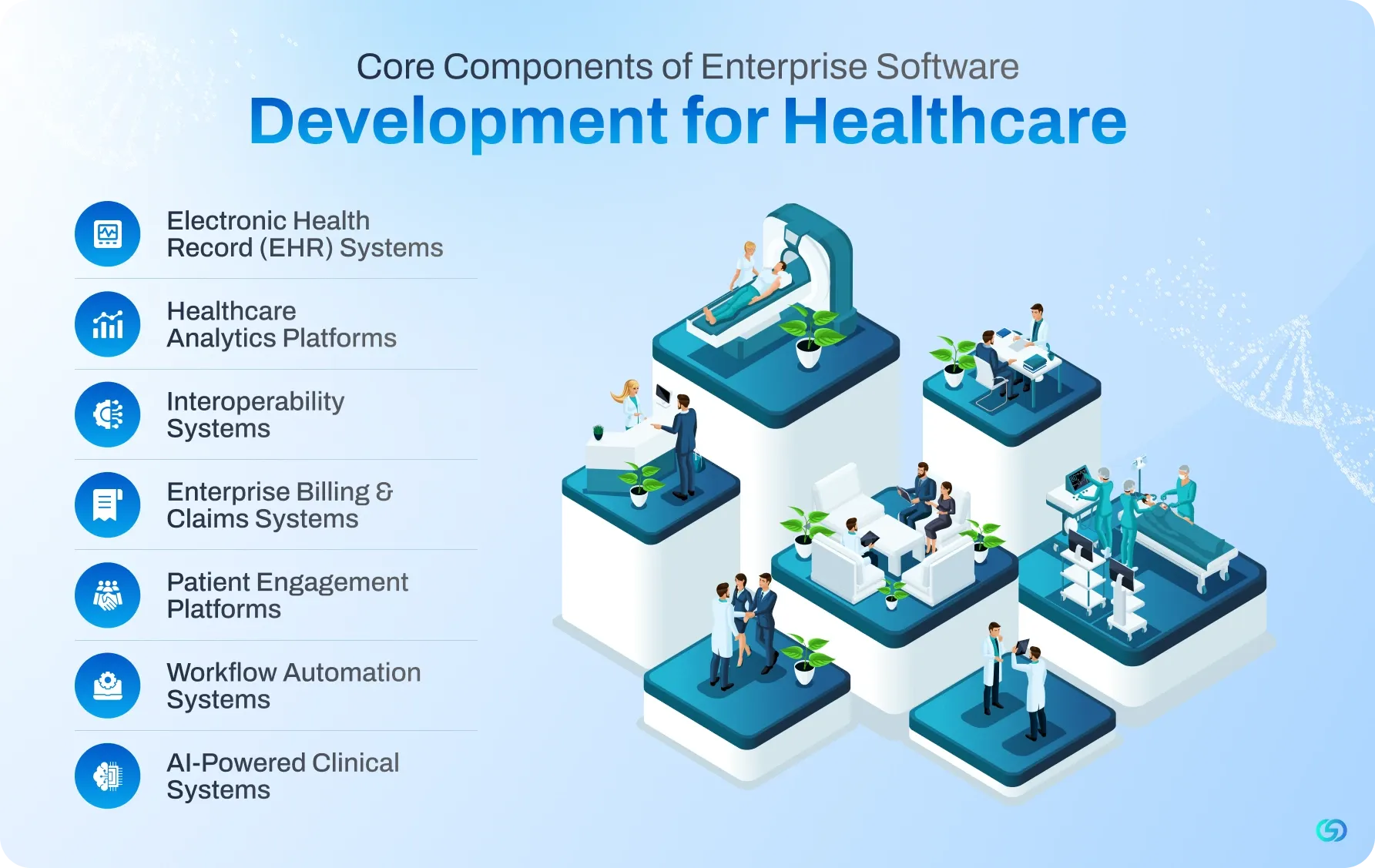
Modern custom healthcare software platforms aren’t built for a single application but are made up of multiple connected systems. This supports patient care, clinical operations, analytics, and enterprise-wide decision-making.
🔶 Electronic Health Record (EHR) Systems
Maintain centralized patient records with enterprise EHR systems across departments and care givers. Healthcare teams can access accurate patient records, which further helps in care coordination and reduces data duplication.
🔶 Healthcare Analytics Platforms
The healthcare system generates large volumes of data and sometimes acts on very little of it. Healthcare analytics platform closes this gap by converting clinical data into faster and more informed decisions.
🔶 Interoperability Systems
Interoperability platforms allow effortless communication between EHRs, healthcare apps, pharmacies, insurance systems, and third-party providers. Without it, every component works in isolation. Standards like HL7 and FHIR play a significant role in securing data exchange.
🔶 Enterprise Billing & Claims Systems
When dealing with billing and insurance at an enterprise scale, you need integrated financial systems that give the finance team complete visibility they didn’t have before. An integrated system streamlines claims processing, reduces errors, and simplifies revenue management workflows.
🔶 Patient Engagement Platforms
Patient engagement software is a health tool supporting complete patient journeys, right from the initial appointment to long-term care. The platform directly connects with your existing EHR system to keep the clinical and billing information synchronized.
🔶 Workflow Automation Systems
In 2026, the industrial automation market is projected to reach $264.69 billion globally. This makes traditional and outdated methods incapable of competing with automated tools and platforms. Workflow automation system streamlines and executes tasks with minimal human intervention.
🔶 AI-Powered Clinical Systems
Every manual step in your administrative workflow today delays patient care and strategic solutions. AI-powered custom healthcare software development supports faster and more accurate decision-making with the aid of intelligent recommendations and data-driven insights that enhance operational outcomes.
Architectural Layer of Enterprise Healthcare Software Solutions
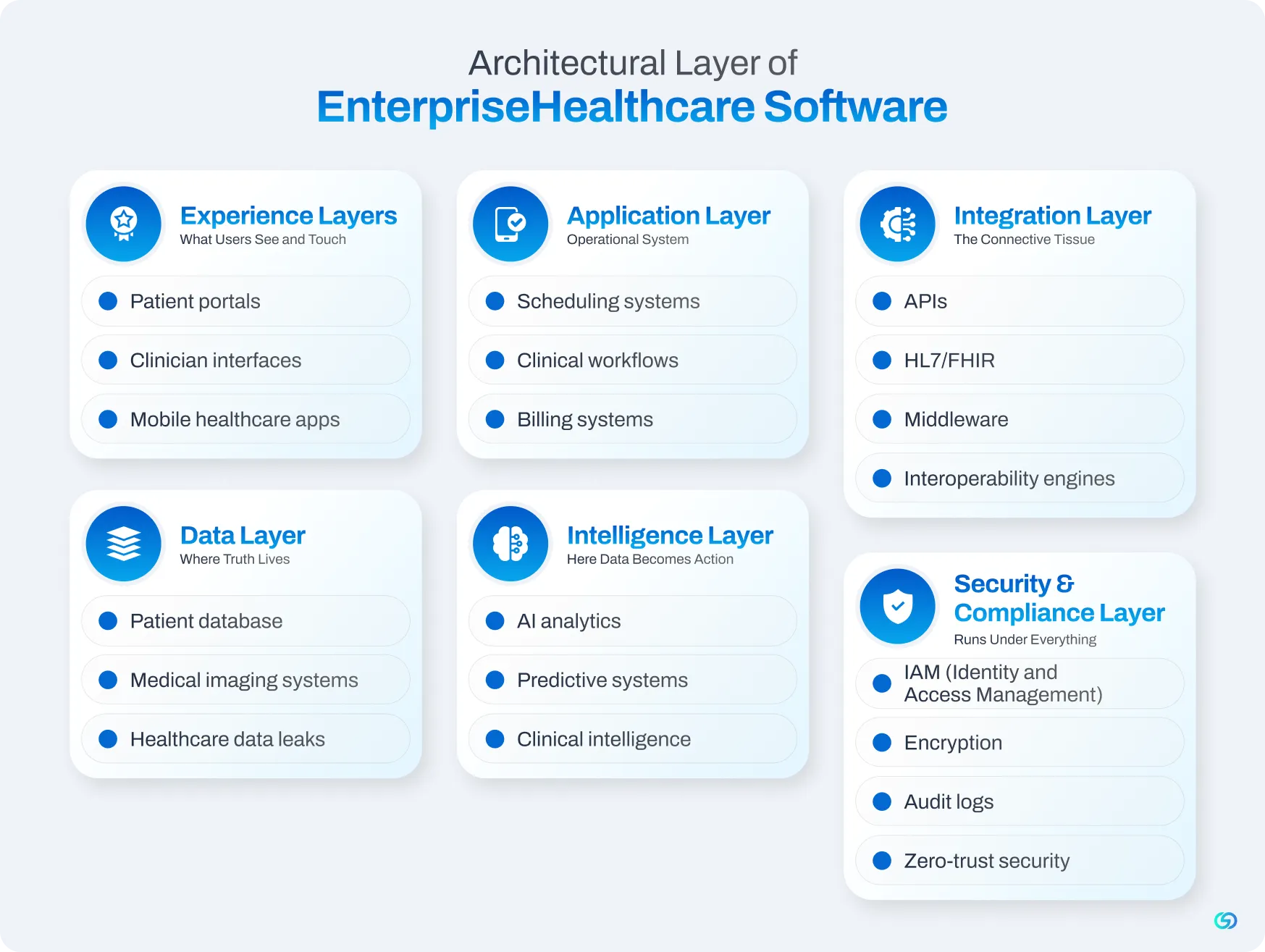
Healthcare enterprises should look for smart and secure software that will deliver scalable results. The architectural layer meets the requirements through enterprise-grade design, with each layer targeting important areas.
⏺️ Experience Layers – What Users See and Touch
The experience layer gets judged in the first 30 seconds by the healthcare experts. If it’s slow or confusing, doctors may avoid leveraging it and find a better way to carry out the task. Patient apps and portals need to be easily navigable. These need to work well on phones and make tasks hassle-free.
- Patient portals: Allow patients to access appointments, prescriptions, and healthcare services.
- Clinician interfaces: Help doctors manage workflows, medical care, and clinical information efficiently.
- Mobile healthcare apps: Remote access to healthcare services, patient engagement, and communication through mobile devices.
Why it matters?
A doctor who needs to click multiple times to access a simple lab result is spending cognitive energy on software instead of patient care.
⏺️ Application Layer – Operational System
Scheduling, billing, and other clinical workflows do not just need to work, but they need to stay in sync. Each application should be connected and share information automatically without the need for manual updates. Each system should use a reliable data source if something goes wrong.
- Scheduling systems: Streamline appointment booking and patient scheduling workflows.
- Clinical workflows: Coordinate care delivery and daily healthcare operations across departments.
- Billing systems: Manage invoicing, claims processing, and payments.
Why it matters?
When applications are not well connected, moving data from one system to another can cause errors or duplication. The application layer in healthcare enterprise application development connects these systems smoothly, so information flows automatically.
⏺️ Integration Layer – The Connective Tissue
In an enterprise, nothing should work in isolation, and integration layers make sure of it. It uses tools and systems to let data move automatically between different applications.
- APIs: Allows healthcare systems and third-party platforms to communicate easily.
- HL7/FHIR: Standardize healthcare data exchange between systems and providers.
- Middleware: Bridges disconnected healthcare apps and platforms
- Interoperability engines: Real-time sync and communication across enterprise systems
Why it matters?
A strong integration layer separates a functioning enterprise from an expensive one that doesn’t connect and share information well.
⏺️ Data Layer – Where Truth Lives
Every layer depends on the quality of data in this one. Every data needs to be structured for regulatory compliance, clinical accuracy, and performance. Bad data structure can cost more to fix than any other layer.
- Patient database: Store medical history, patient records, and healthcare information centrally. Medical imaging systems: Managing diagnostic imaging data, like X-rays, MRIs, and CT scans.
- Healthcare data leaks: Consolidate unstructured and structured healthcare data for analytics and reporting.
Why it matters?
A poorly governed data layer leads to poor clinical decisions. AI systems and clinical decision tools are only as good as the data feeding them.
⏺️ Intelligence Layer – Here Data Becomes Action
The intelligence layer transitions healthcare data into actionable insights. AI analytics and predictive systems need clean and real-time data pipelines, without which, you don’t get clinical intelligence.
- AI analytics: Monitor healthcare data to spot patterns and insights
- Predictive systems: Help forecast patient outcomes, healthcare trends, and resource demands.
- Clinical intelligence: Support data-driven clinical decisions and treatment optimization.
Why it matters?
With custom healthcare software development, healthcare enterprises can transform fragmented data into real-time clinical intelligence and predictive decision-making, which allows improved patient outcomes and smart healthcare ecosystems.
⏺️ Security & Compliance Layer – Runs Under Everything
Security and compliance layers run horizontally across the entire structure. The layer protects sensitive healthcare data while ensuring regulatory compliance.
- IAM (Identity and Access Management): Controls user authentication and access permissions across platforms.
- Encryption: Secures healthcare data during storage and transmission.
- Audit logs: Tracks system activities and user actions for compliance reporting and security monitoring.
- Zero-trust security: Verifies continuously both users and systems to reduce cybersecurity risks across healthcare networks.
Why it matters?
Without security running beneath every layer, even the most advanced healthcare system becomes an expensive liability that puts patient data and lives at risk.
Why Interoperability Matters in Enterprise Software Development for Healthcare
In the healthcare industry, interoperability means the ability of different information devices and systems to access and integrate data across organizational boundaries. This data can be used to improve health and ensure better outcomes.
➡️ Why Interoperability Matters at Enterprise Scale?
- Unified Patient Records: One complete view of each patient, no matter where or how care was delivered.
- Connected Systems: EHRs, imaging, labs, pharmacies, and devices that share data without the need for manual intervention.
- Seamless Data Exchange: Accurate and real-time structured data moving between systems at the time it's needed.
➡️ The Standards that Make It Possible
HL7 (Health Level Seven): This is the foundational messaging standard running the healthcare data exchange since the 1980s. HL7 v2 is still under production. HL7 helps exchange and retrieve electronic health information.
Best for: Legacy EHR integration, lab messaging
FHIR (Fast Healthcare Interoperability Resources): FHIR makes real-time data exchange achievable between modern platforms. It allows faster healthcare data sharing, making it an essential consideration in custom healthcare software development where scalability, interoperability, and connected experiences are priorities. FHIR-native is an acceptable starting point.
Best for: App development, modern EHR APIs.
DICOM (Digital Imaging and Communications in Medicine) : The standard that governs how medical images such as CT scans, X-rays, or MRIs are stored and displayed. Without DICOM, a scan taken at a facility becomes unreadable at another. In enterprise environments, DICOM integration is absolutely necessary.
Best for: Radiology systems, cross-facility imaging workflows
Healthcare Enterprise Interoperability Challenges.
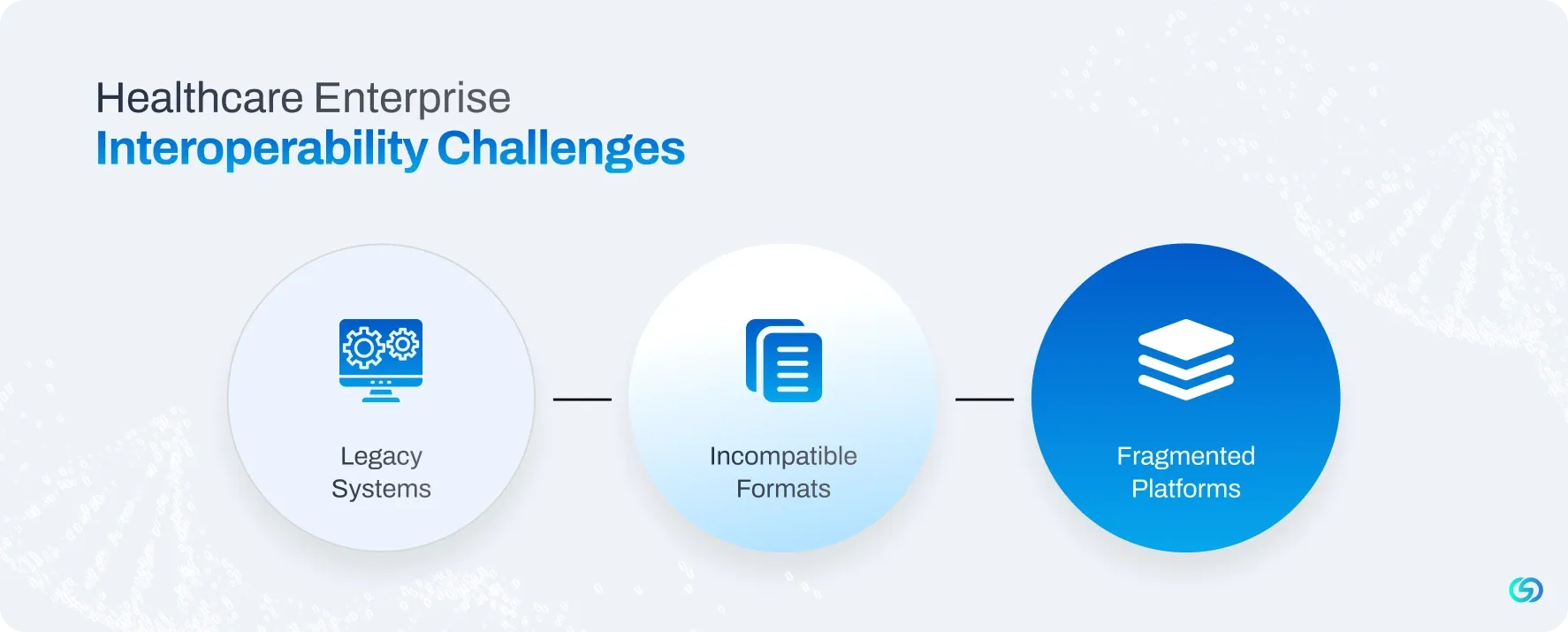
💠 Legacy Systems
Challenge: Healthcare enterprises still depend on outdated systems that were not designed for modern interoperability and cloud integrations.
Solutions: API-first architecture and middleware solutions connect legacy healthcare systems with newer enterprise platforms without the need to replace complete infrastructure.
💠 Incompatible Formats
Challenge: Different healthcare applications store and process data in unstructured formats, which makes seamless communication across systems difficult.
Solutions: HL7 and FHIR, and other healthcare integration platforms help standardize data exchange and improve compatibility between enterprise healthcare applications.
💠 Fragmented Platforms
Challenge: Disconnected healthcare systems create silos where patient details, clinical data, and workflows, remain fragmented across departments and facilities.
Solutions: A centralized healthcare integration software unifies enterprise systems, allowing connected workflows, synchronized data access, and seamless interoperability across the healthcare ecosystem.
The goal isn’t integration. The aim is to create an enterprise healthcare software solution where a patient’s full picture is available to every professional who needs it at any time, without the need to chase it down.
Types of Solutions Driving Enterprise Software Development for Healthcare
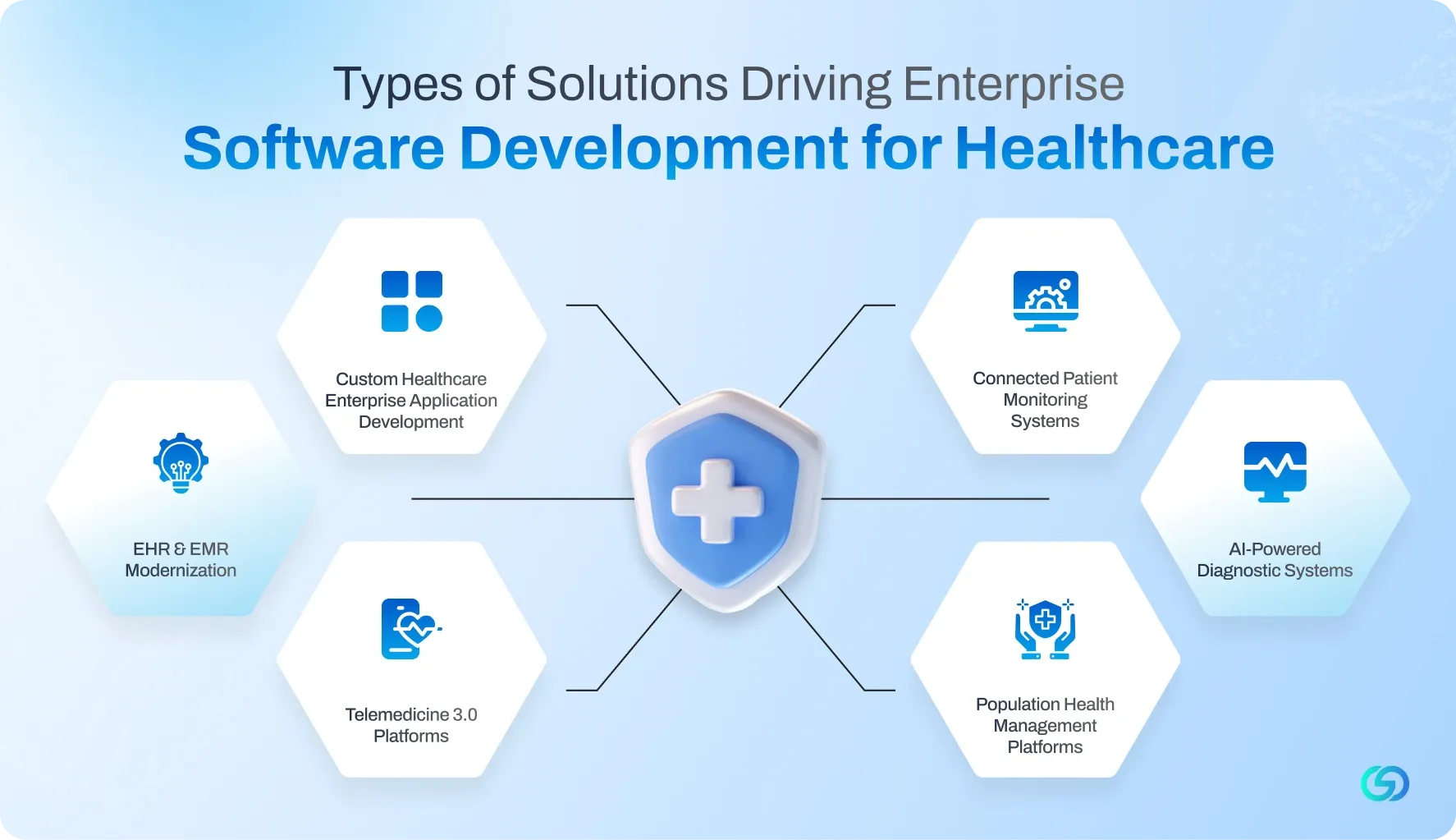
As your organization expands, the need for healthcare enterprise application development becomes inevitable. The growing number of patients, processes, and employees need a reliable and connected system that cuts down chaos.
⏺️ EHR & EMR Modernization
Electronic Health Record (EHR) and Electronic Medical Record (EMR) systems are paving their way into smarter platforms. Today’s EHRs could integrate with cloud infrastructure, patient portals, and AI-backed analytics. This makes health data more secure and visible for patients and providers.
The modernization of EHR and EMR creates a smooth data exchange that allows better clinical decision-making and improves overall patient outcomes by providing updated information.
⏺️ Custom Healthcare Enterprise Application Development
More than 55% of patients depend on their smartphones to access healthcare applications. Each app is unique on its own, and that’s why many healthcare organizations are opting for custom healthcare applications designed around their own workflows, patient journeys, and process priorities instead of forcing teams to one rigid system.
⏺️ Telemedicine 3.0 Platforms
If you think telemedicine is limited to video calls, the picture has completely changed. The current platforms are now integrated with Augmented Reality and Virtual Reality to give an immersive experience when it comes to virtual examinations and surgical support.
AI triage tools prioritize patient requirements and automate the consultation accordingly. These advanced methods allow healthcare companies to reduce patient wait times and provide specialized care remotely.
⏺️ Connected Patient Monitoring Systems
Healthcare enterprises are depending on connected monitoring technologies that allow care providers to track patient health. With the help of IoT-based devices, professionals can monitor chronic conditions, vital signs, and real-time patient data remotely. This eventually reduces hospital readmissions.
⏺️ AI-Powered Diagnostic Systems
AI-powered diagnostic tools give accurate and faster recommendations, be it for radiology or virtual pathology. Systems, such as these, assist healthcare providers in interpreting complex imageries that optimize patient workflows.
With the help of ML algorithms, diagnostic systems can recognize patterns and irregularities that the human eye could miss, resulting in early identification and enhanced patient outcomes.
⏺️ Population Health Management Platforms
Population health solutions help enterprises track risk factors, disease trends, and medical outcomes at scale. Instead of just focusing on individual cases, organizations are now using population health platforms to understand health trends and improve preventive care strategies across patient populations.
Security & Compliance in Enterprise Software Development for Healthcare
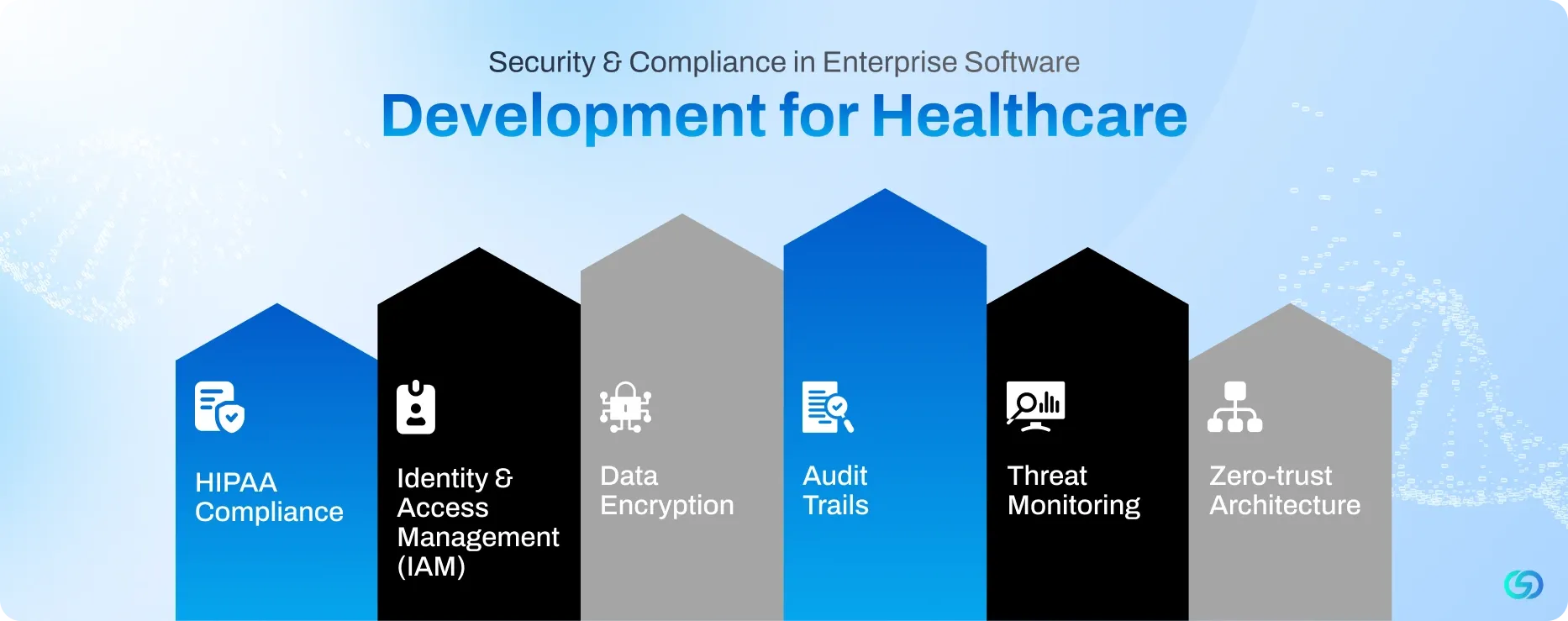
One of the most unskippable aspects of enterprise healthcare software solutions is security and compliance, which must be integrated into the software's core.
In a sector where a single breach averages $7.42 million in costs and compromises hundreds of thousands of patient records overnight, security cannot be left to be added later on.
For modern healthcare enterprises, cybersecurity has become a main part of regulatory compliance and patient trust. As healthcare systems become more connected, the risk of sensitive patient information breaches and ransomware attacks continues to grow.
🔷 HIPAA Compliance
Establishing national standards, HIPAA compliance safeguards the privacy and security of individuals’ health information in the US. It sets rules of how healthcare information is stored, shared, and used. The Office for Civil Rights (OCR) is responsible for enforcing HIPAA.
The compliance offers patients the right to access their Protected Health Information (PHI), track the information they shared, and request corrections. Following HIPAA rules is important because it safeguards patient confidentiality and builds trust between the patient and the enterprise.
🔷 Identity & Access Management (IAM)
In healthcare, the wrong person accessing the incorrect record can lead to a violation of privacy (HIPAA breach). Enterprise IAM controls who is allowed to access what, under what conditions, and maintains an audit record of every access. Organizations deploying custom healthcare software solutions should treat IAM as a foundational architectural decision.
The IAM framework helps control role-based access, multi-factor authentication, and permissions for accessing sensitive healthcare apps and patient details.
🔷 Data Encryption
Every piece of patient information that moves continuously across systems, apps, the cloud, and the environment must be encrypted. For enterprise systems managing files and data, encryption must be designed for both security and performance.
AES 265 for storage, TLS 1.3 for transmission, and end-to-end encryption for patient portals are basic for any system handling PHI.
🔷 Audit Trails
Enterprise healthcare systems must maintain detailed activity logs so that a regulator or investigator can reconstruct what happened, when it happened, and by whom.
Audit trails transform security incidents from crises into manageable investigations. In enterprises, automated audit logging and centralized management are the best approach, rather than having a team manually log in to review each time.
🔷 Threat Monitoring
The average time taken to detect a healthcare breach is 200+ days, yet most damage occurs in the first 72 hours. Yes, healthcare organizations are among the most targeted industries for phishing and ransomware attacks, risking patient safety. Threat monitoring in healthcare enterprise application development involves real-time surveillance of user behavior and systems.
Security Information and Event Management (SIEM) systems, endpoint detection and response, and 24/7 SOC are the enterprise standard for health systems.
🔷 Zero-trust Architecture
Traditional security models assumed that everything in the network perimeter was safe. However, in modern healthcare, that model is completely incompatible, as healthcare teams access systems from personal devices and cloud platforms that extend the security boundaries, making them difficult to define.
Zero-trust architecture follows one principle: no user, system, or device is trusted by default, even if they are already inside the network. All access requests are verified, and sessions are monitored for as long as needed.
AI & Automation in Enterprise Healthcare
Patients expect faster responses, fewer delays, and no need to chase up for updates. People are now comparing healthcare experiences to industries such as e-commerce and fintech, where things just work as intended.
Over time, administrative burdens, scheduling, coordination, and disconnected systems burn out healthcare professionals. This is exactly where organizations realize that traditional systems were never designed to handle this level of complexity.
*️⃣ AI Use Cases
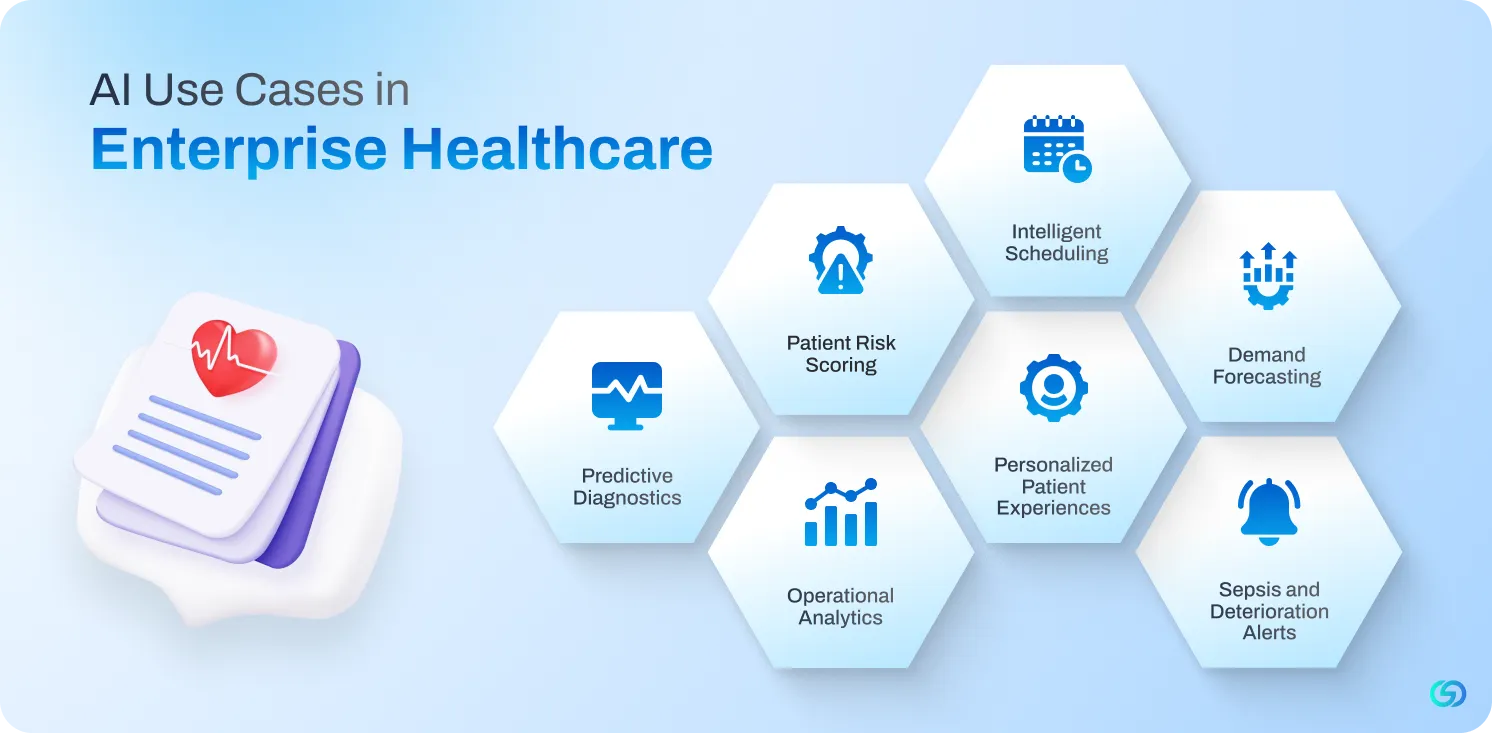
🔹 Predictive Diagnostics
- Detects disease markers earlier than manual clinical review
- Reduces diagnostic errors across workflows
- Analyzes imaging and lab data at scale instantly
🔹 Patient Risk Scoring
- Monitors labs, vitals, and adherence data
- Flag high-risk patients before a crisis occurs
- Allows proactive outreach instead of reactive emergency care
🔹 Operational Analytics
- Predicts bed demands prior to and OR utilization in real-time
- Turns monthly reports into real-time performance intelligence
- Reduces per-patient cost through smart resource allocation
🔹 Intelligent Scheduling
- Predicts no-show probability for each appointment slot
- Increases day-to-day throughput and reduces scheduling gap
- Optimizes calendar schedules automatically, reducing manual coordination
🔹 Personalized Patient Experiences
- Delivers care recommendations personalized according to individual patient history
- Adapts communication channels to patient’s preferences automatically
- Decreases friction across care coordination, scheduling, and follow-ups
🔹 Demand Forecasting
- Predicts the volumes of patients by shifts, units, and seasons
- Matches staffing and resource levels to predicted demand
- Prevents expensive last-minute resource shortages and overstaffing
🔹 Sepsis and Deterioration Alerts
- Monitors inpatient vitals for early warning signs
- Detects sepsis up to six hours before symptoms appear
- Tied to reduced inpatient mortality outcomes
*️⃣ Automation Use Cases
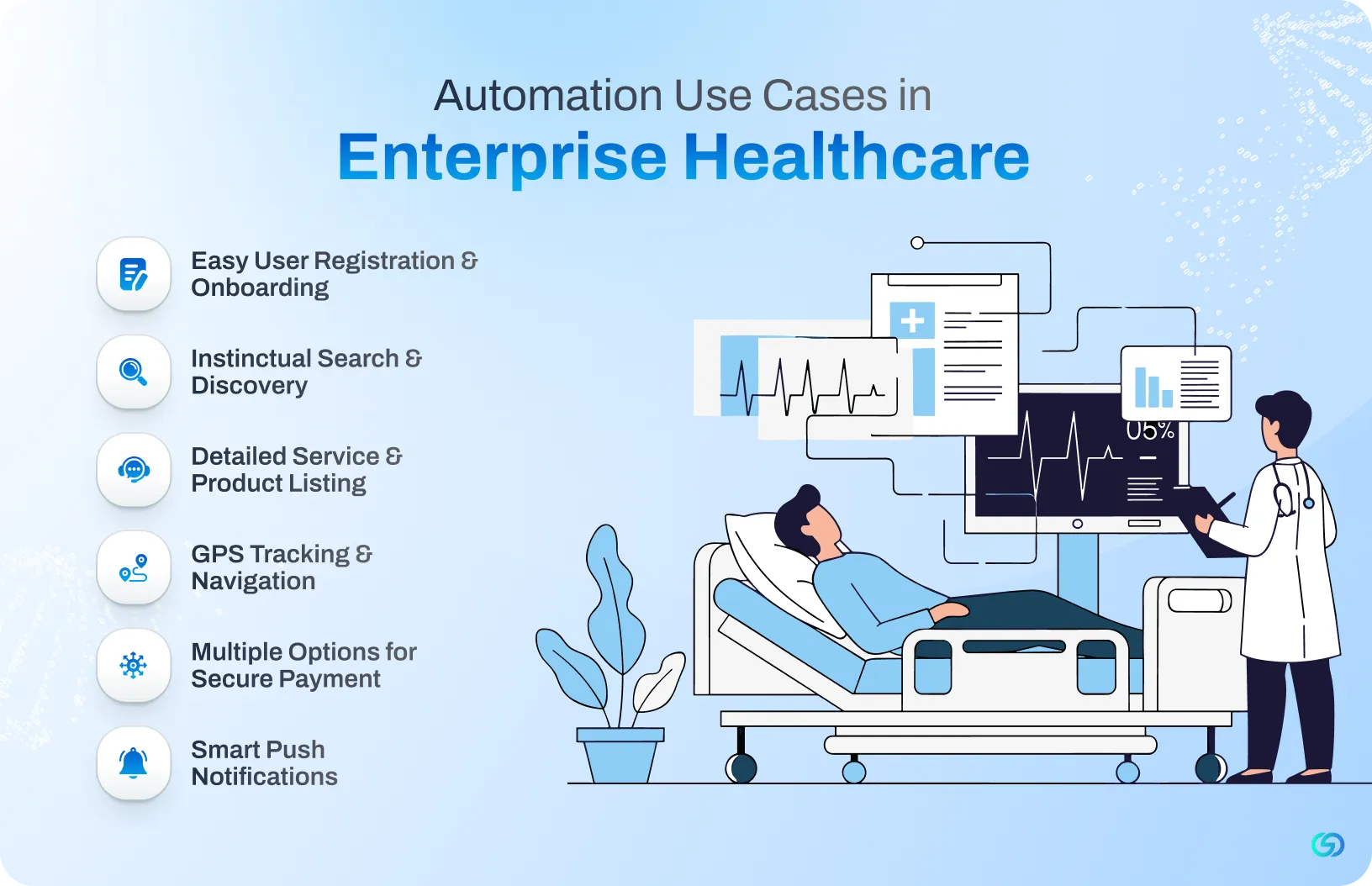
🔹 Billing Workflows
- Assigns diagnosis codes and submits claims automatically
- Sends exceptions to human coders for review only
- Few coding errors and accelerates revenue cycles
🔹 Claims Processing
Discovers claim errors before they reach the payer Automatically routes denials based on value and appeal probability Generates higher denied revenue compared to manual workflows
🔹 Patient Onboarding
Verifies insurance and collects consents
Automatically import patient care history, eliminating manual data entry
Reduces new patient onboarding time by half
🔹 Document Management
Automatically indexes clinical documents on arrival Eliminates manual filling across documents Reduces misfiled records and associated clinical risk
🔹 Staff Scheduling and Workforce Management
Matches shift staffing automatically to predicted patient demand Factors certifications, overtime policies, and float pool availability Reduces reliance on agency staff and overtime, saving 15–25%
🔹 Compliance Reporting
Auto-generates audit-ready reports across HIPAA and regulatory frameworks Flags compliance gaps before they become regulatory violations Maintains tamper-evident documentation trails across all enterprise systems
🔹 Patient Follow-up and Care Gap Closure
Spots patients overdue for screenings and chronic care check-ins Contacts patients through preferred channels without the need for staff involvement Improves preventive care completion rates
Integration Challenges in Enterprise Software Development for Healthcare
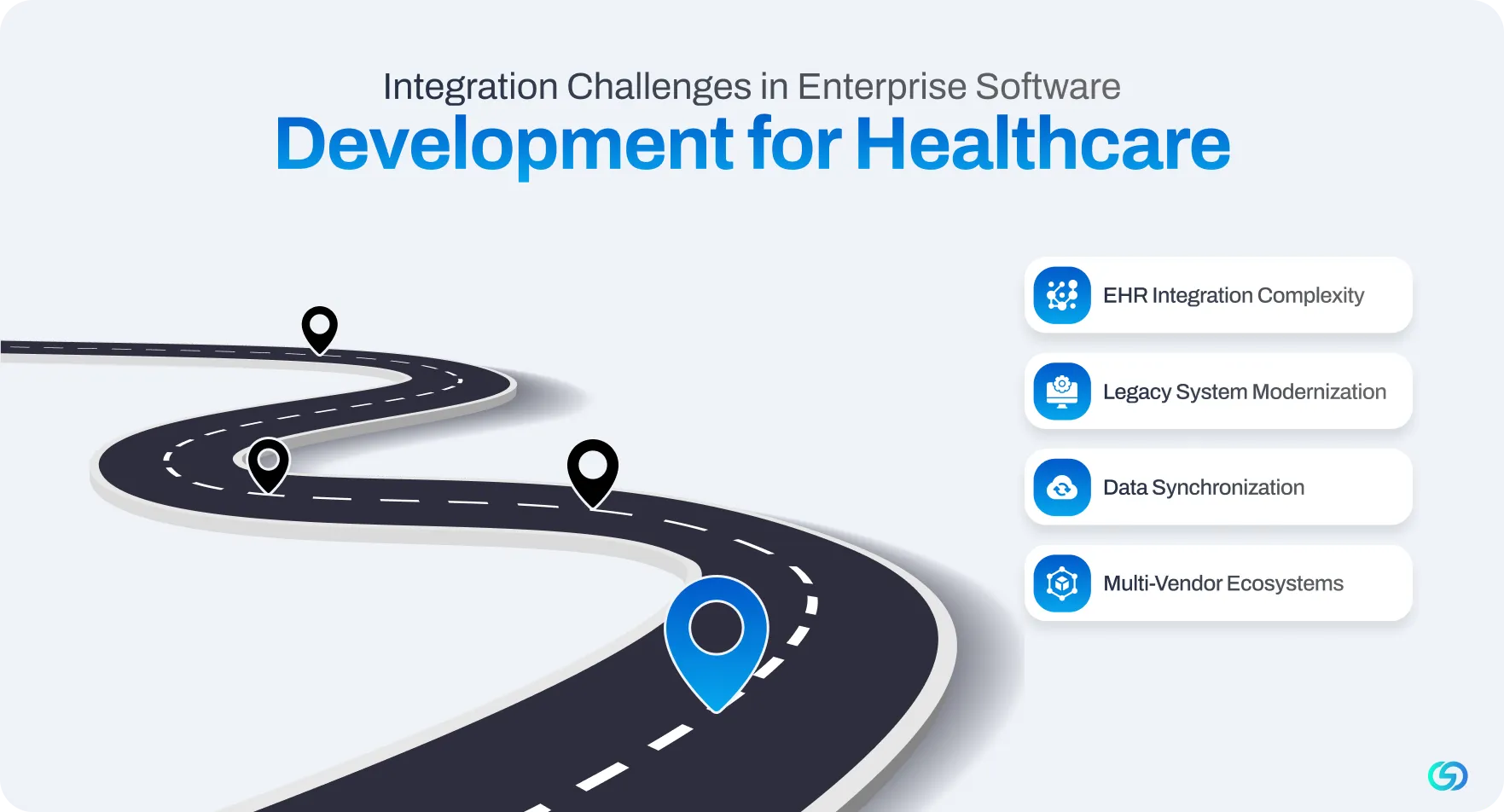
As healthcare enterprises adapt to new digital platforms, integration has become one of the biggest challenges in modern healthcare infrastructure. It’s a discipline that must be designed right from the start or paid in technical debt every year.
⏩ EHR Integration Complexity
Enterprise healthcare software solutions often integrate multiple EHR and EMR systems developed using different standards and technologies. When integrating these systems, maintaining real-time patient data exchange becomes highly complex.
⏩ Legacy System Modernization
Most enterprise health systems are connecting new platforms to infrastructure that was configured when smart devices didn’t exist. Legacy systems lack native API support and hold several years of patient data that cannot be migrated or turned off. Modernizing these systems without disrupting everyday operations remains a major enterprise challenge.
⏩ Data Synchronization
Healthcare companies that employ multiple systems in an enterprise environment often see data moving across various departments, applications, and sometimes even to external systems. Keeping patient details and clinical data synchronized in real-time is important for consistency and for reducing delays in care.
⏩ Multi-Vendor Ecosystems
Third-party platforms, billing systems, diagnostic tools, cloud services, and so on are often involved with enterprise healthcare systems. These technologies should communicate seamlessly with one another and require a robust integration strategy.
Advanced healthcare enterprise application development depends on an integration-first strategy that prioritizes interoperability and seamless data exchange across the entire ecosystem.
Cloud and Scalability in Custom Healthcare Software Development for Enterprises
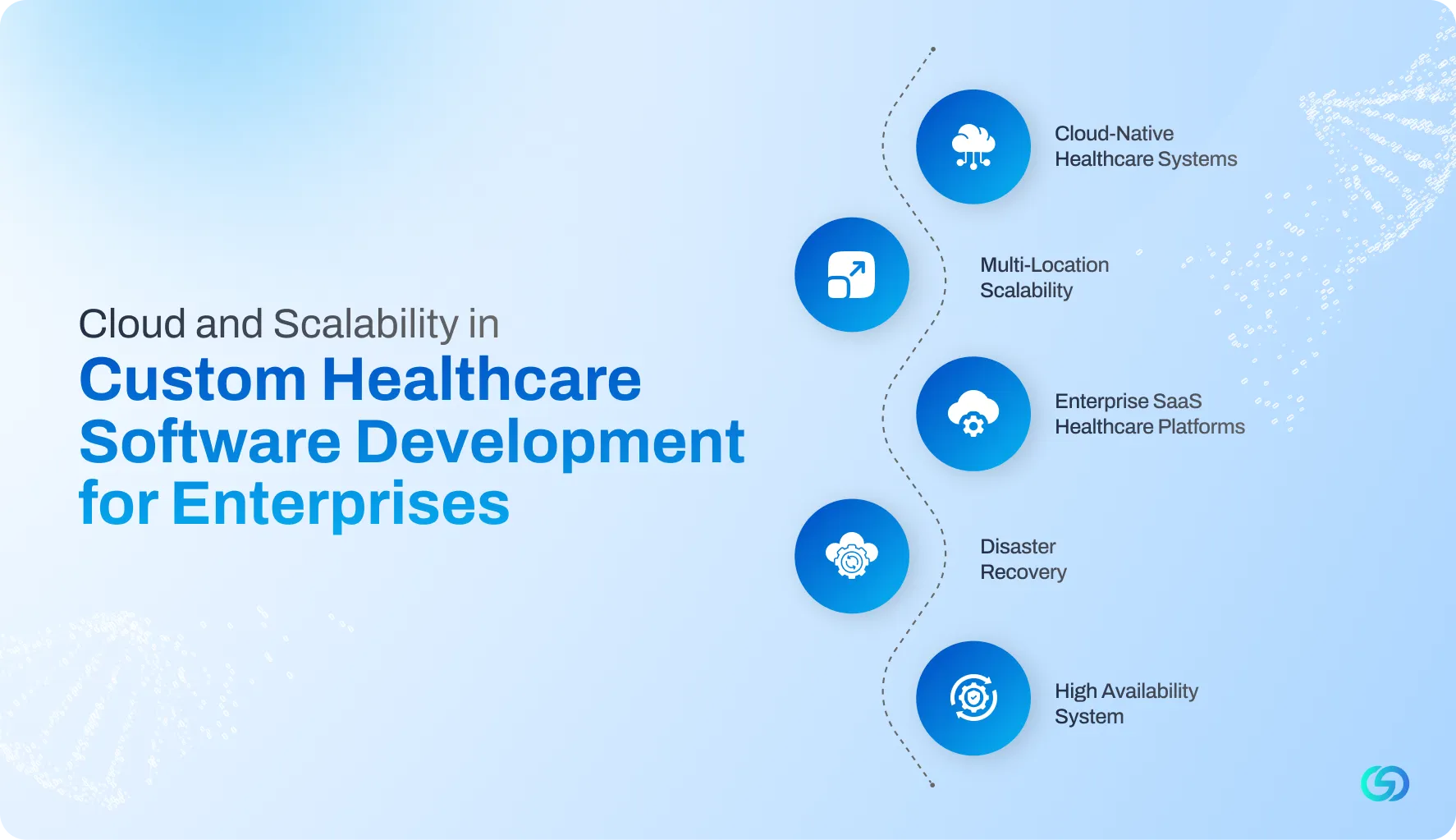
The healthcare sector is ever-evolving, and the cloud is one of the trendy innovations adopted by enterprise healthcare providers. Cloud computing allows you to access software applications online without the need for any internal storage devices.
In 2025, the global healthcare cloud computing market size was valued at $63.9 billion and is estimated to grow from $75.17 billion in 2026 to $312.97 billion by 2035.
Enterprise health systems span multiple locations, serve millions of patients, and experience unpredictable workload spikes. Cloud and scalability architecture make it manageable without increasing infrastructure risk.
*️⃣ Cloud-Native Healthcare Systems
Modern healthcare enterprises are adopting cloud-native systems that are architected from the ground up for speed and regulatory compliance and not retrofitted from on-premise infrastructure that was never designed to scale.
*️⃣ Multi-Location Scalability
Healthcare businesses need systems that can completely support operations across clinics, hospitals, and healthcare networks smoothly.
*️⃣ Enterprise SaaS Healthcare Platforms
Enterprise SaaS eliminates the infrastructure management burden from health system IT teams while helping organizations update software, deploy systems faster, and securely access applications across healthcare locations.
*️⃣ Disaster Recovery
A reliable recovery system for healthcare enterprises is essential to safeguard critical healthcare data and ensure smooth operations.
*️⃣ High Availability Systems
Healthcare systems should remain accessible at all times to support patient care and enterprise operations.
Benefits of Enterprise Software Development for Healthcare
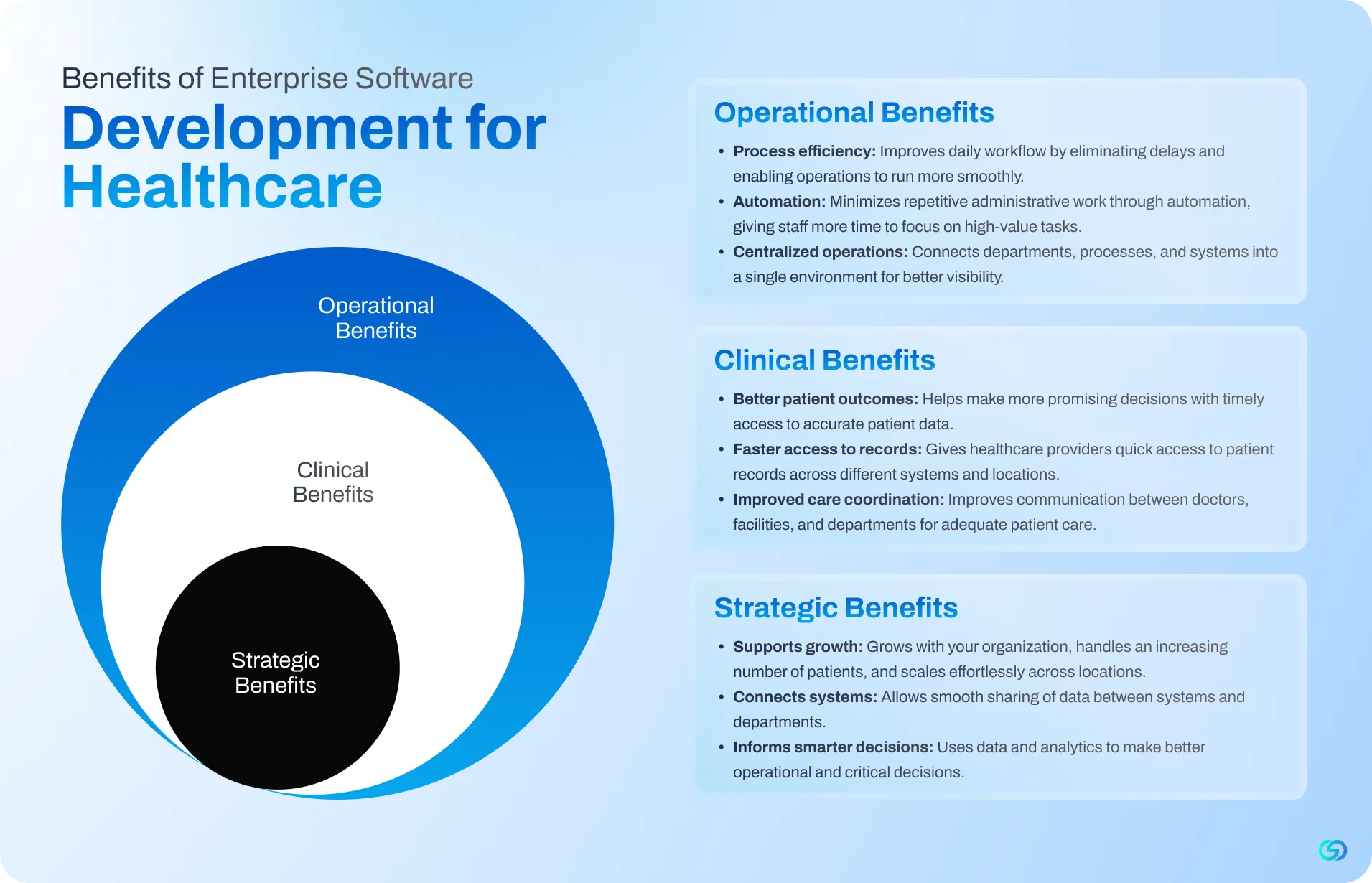
Enterprise healthcare software solutions deliver exceptional digital experiences for patients, providers, and other partners who are connected to health systems. Custom software solutions empower healthcare experts to refine medical services and transform workflows.
Here are the benefits that healthcare organizations' software brings to modern organizations.
🔷 Operational Benefits
Enterprise software allows healthcare workflows to simplify complex tasks and eliminate inefficiencies across departments.
Process efficiency: Improves daily workflow by eliminating delays and enabling operations to run more smoothly.
Automation: Minimizes repetitive administrative work through automation, giving staff more time to focus on high-value tasks.
Centralized operations: Connects departments, processes, and systems into a single environment for better visibility.
🔷 Clinical Benefits
Today’s healthcare platforms allow providers to deliver faster, connected, and better-informed patient care.
Better patient outcomes: Helps make more promising decisions with timely access to accurate patient data.
Faster access to records: Gives healthcare providers quick access to patient records across different systems and locations.
Improved care coordination: Improves communication between doctors, facilities, and departments for adequate patient care.
🔷 Strategic Benefits
Digital healthcare solutions help organizations develop future-ready, and scalable ecosystems.
Supports growth: Grows with your organization, handles an increasing number of patients, and scales effortlessly across locations.
Connects systems: Allows smooth sharing of data between systems and departments.
Informs smarter decisions: Uses data and analytics to make better operational and critical decisions.
Common Challenges in Enterprise Healthcare Software Projects
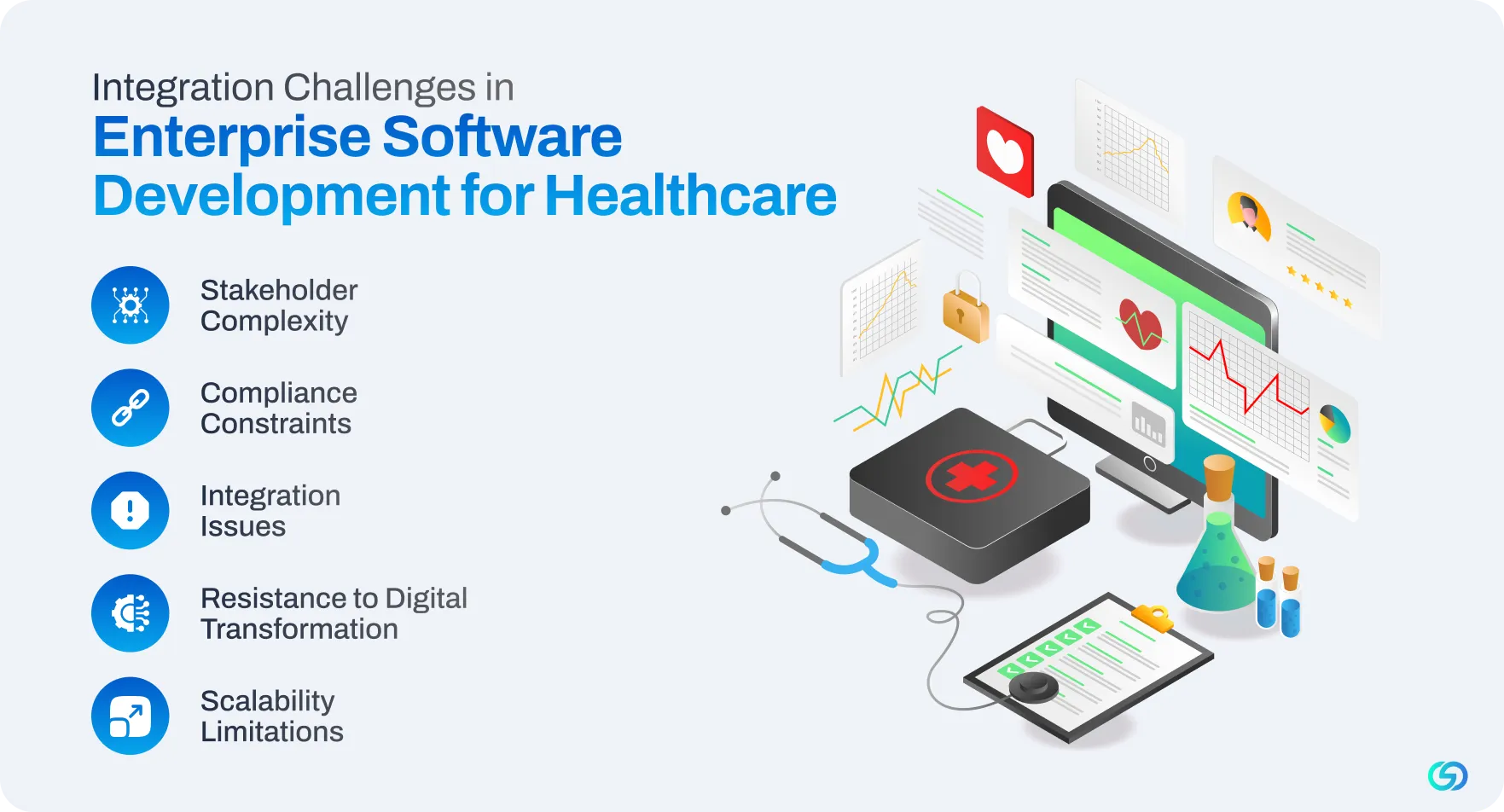
Most healthcare software development projects struggle or fail due to competing priorities, old systems, and teams that aren’t quite ready to change. The only way out is to understand these challenges and plan them before the project begins.
↗️ Stakeholder Complexity
- Clashing team priorities and operational targets
- Complicated approval and lengthy decision-making processes
- Varying dependencies among healthcare staff
↗️ Compliance Constraints
- Constantly changing healthcare regulations
- Stringent patient data privacy requirements
- Extensive compliance audits and documentations
↗️ Integration Issues
- Legacy systems with limited connectivity
- Healthcare data stored in different formats causes inconsistencies
- Standalone third-party systems that don't communicate with each other
↗️ Resistance to Digital Transformation
- Staff are reluctant to adopt new workflows
- Low uptake of new and innovative healthcare technologies
- Difficulties in onboarding and upskilling staff
↗️ Scalability Limitations
- Rapidly growing patient and operational information
- Systems are unable to keep up with organizational growth
- Performance issues when system usage spikes
Custom Healthcare Software Development Roadmap for Healthcare Transformation
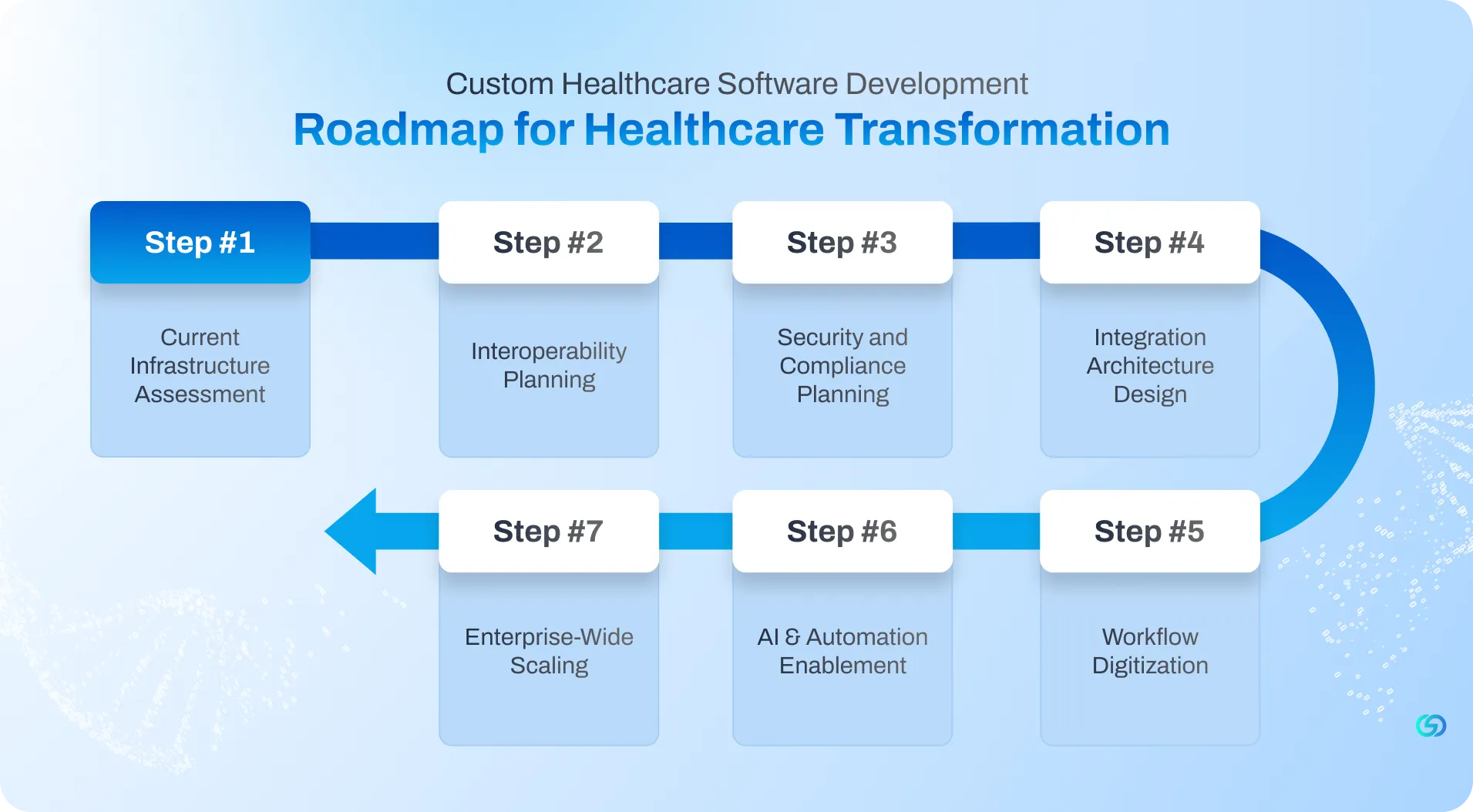
A single deployment doesn’t give rise to digital transformation in healthcare. Instead, it happens in sequence. Healthcare enterprise software that skips ahead usually underdelivers and eventually results in team burnout.
Step 1: Current Infrastructure Assessment
Before building anything, evaluate your existing healthcare system and audit everything in and out. It’s best if you can map each system, analyze workflow gaps, and integrate across all locations.
Step 2: Interoperability Planning
In the next step, decide the way data will move from one system to another. With the help of an enterprise software development company, establish FHIR R4 as the standard for data exchange and plan your Master Patient Index from the beginning.
Step 3: Security and Compliance Planning
GDPR, HIPAA, and zero-trust architecture are designed in this step and not added later. In enterprise software, compliance built into the foundation costs a fraction of what it does when retrofitted after launch.
Step 4: Integration Architecture Design
After security, map every connection in the system, plan system connections, define API rules, and set data governance before coding because rushing this step will cost you technical issues in healthcare IT.
Step 5: Workflow Digitization
The right custom healthcare software development partner will study how your team actually works before redesigning even a small process. Broken workflows will not fix themselves by replacing them with new software; they need expert hands to rebuild them.
Step 6: AI & Automation Enablement
Deploying AI without the right foundation is an expensive mistake in the healthcare industry. With the right partner, identify where AI can deliver real value and build the data infrastructure it needs to actually perform.
Step 7: Enterprise-Wide Scaling
Scaling enterprise healthcare software means adapting to various locations and legacy systems without losing the security and performance on which the entire organization depends.
Health systems that run directly to achieve step #5 or #6 before starting with #1 won’t move faster. They move toward the wrong destination, resulting in misaligned outcomes.
Future Trends in Enterprise Healthcare Systems
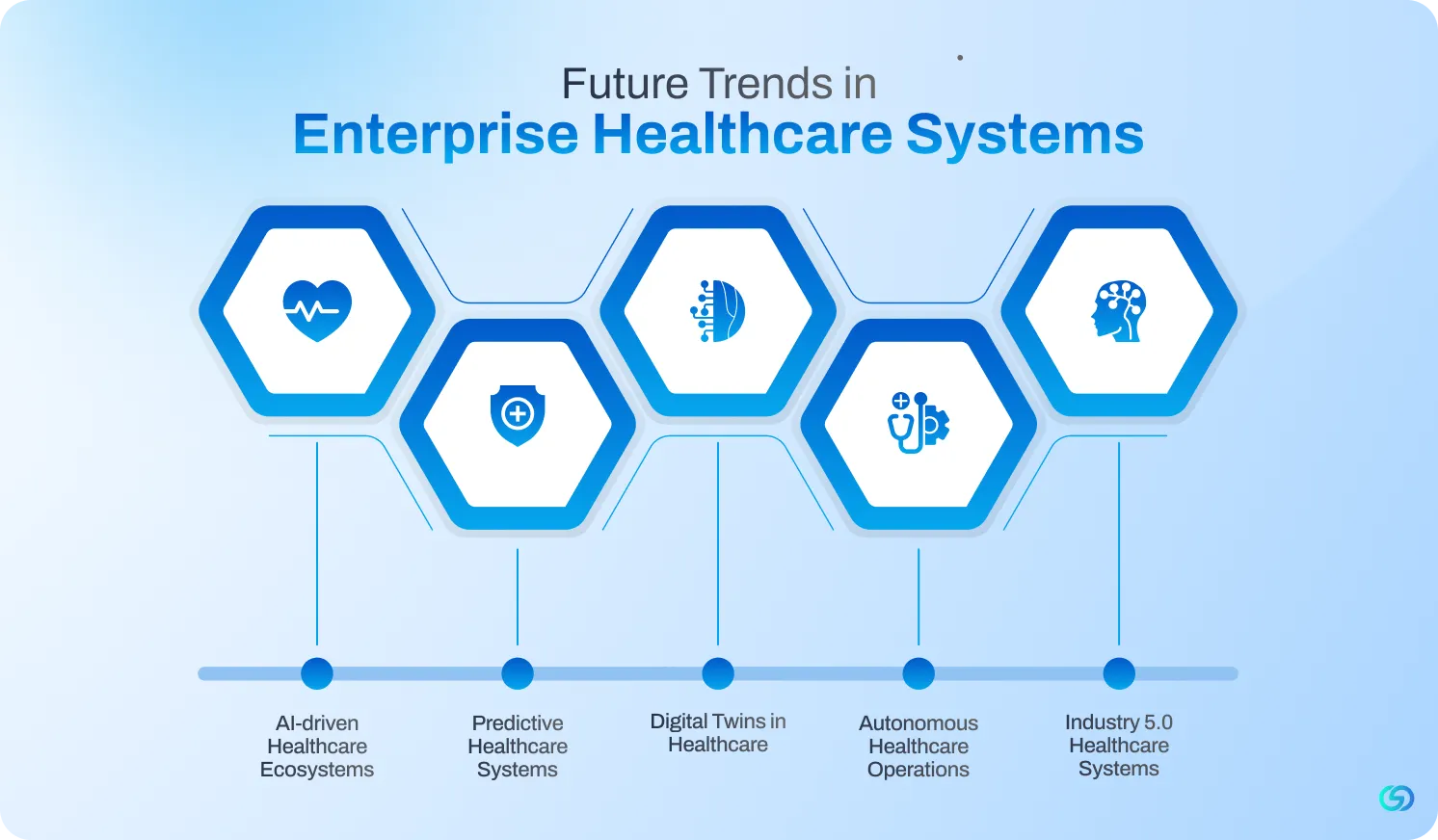
We’re well past the debate that the healthcare industry needs digital adoption. This is because, to give proper care fast and accurately, all while scaling your existing healthcare business, advanced software integrations are mandatory.
Most hospitals and medical facilities have already retired from the old infrastructure and shifted to a complete healthcare digital transformation. Enterprise healthcare’s next transformation isn’t coming soon, it’s already unfolding.
⏺️ AI-driven Healthcare Ecosystems
The transition happening right now isn’t about adding AI to your existing system but building the entire healthcare ecosystem where AI is the ‘connectivity core.’ Each aspect, such as scheduling, diagnostics, documentations, and revenue cycles, is powered by AI.
⏺️ Predictive Healthcare Systems
Waiting until a system breaks and a patient's health is affected before intervening is not how modern enterprise healthcare works. Healthcare systems are integrating genomic, wearable, social, and clinical data to predict risks and automate patient care decisions. Delivering this across a large population will require major enterprise infrastructure, and the time to invest is now.
⏺️ Digital Twins in Healthcare
A digital twin is a real-time virtual model of a hospital, patient, or healthcare system. For patients, it can simulate treatments and predict responses before care begins. For hospitals, it helps test capacity, staffing, and other operational scenarios. Enterprise deployments are live and are leading health systems today.
⏺️ Autonomous Healthcare Operations
Autonomy in healthcare means removing humans from the aspects that don’t require them, like supply reordering, shift gap detection, claims routing, and appointment optimization. The enterprises investing now are addressing a fundamental staffing reality. The healthcare workforce is shrinking while demand continues to grow, making operational automation essential in managing the gap.
⏺️ Industry 5.0 Healthcare Systems
Industry 4.0 is about automation, and Industry 5.0 goes beyond simple digital tools, focusing on connected, human-centric healthcare ecosystems. Healthcare 5.0 improves functionality by leveraging smart technology to deliver more personal and faster care. It allows doctors to make quick decisions and keeps patients more focused on their health, preventing issues before they even start.
Why ConvexSol for Enterprise Software Development for Healthcare
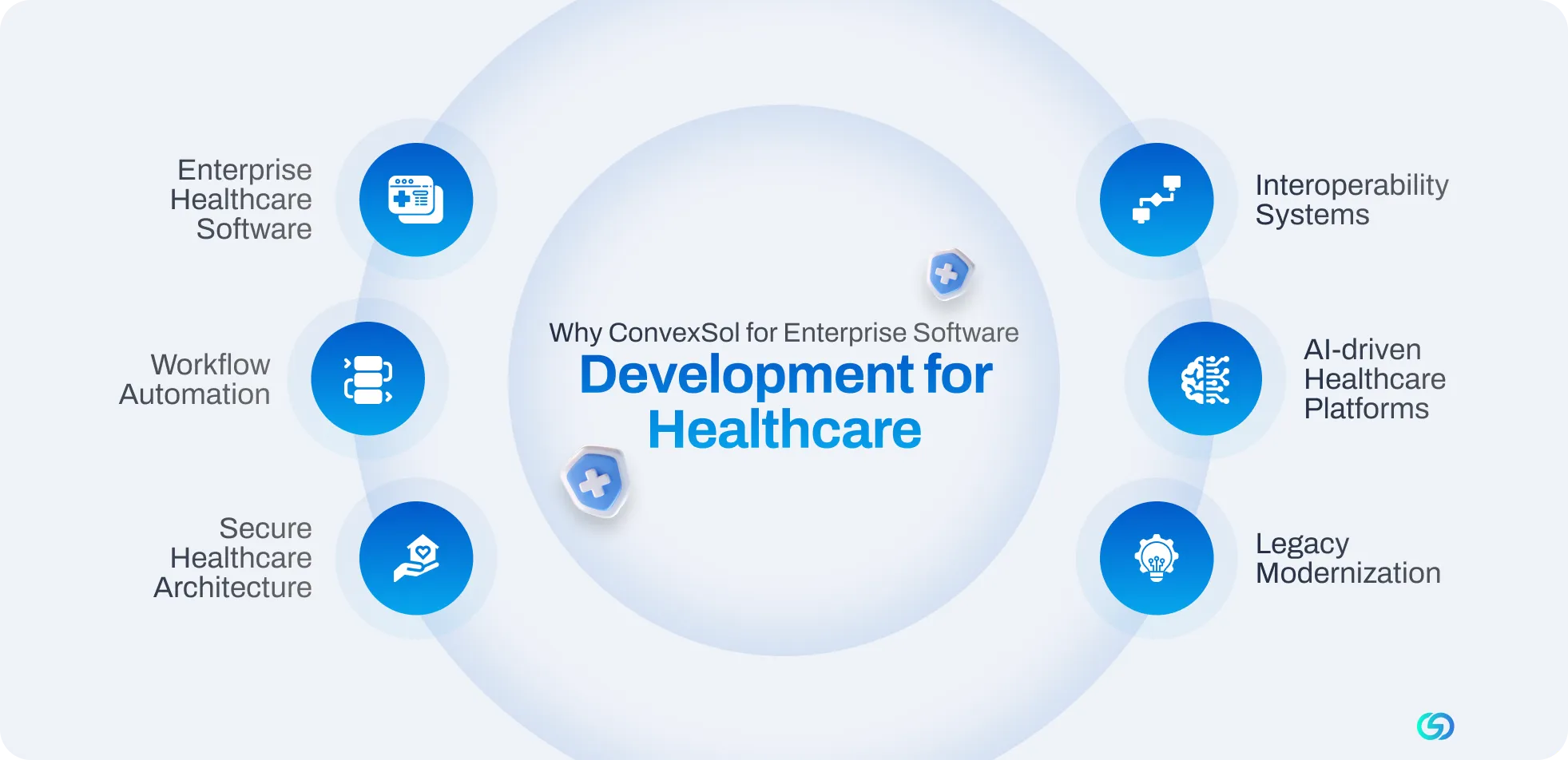
The adoption of new healthcare trends is changing the way patient care is delivered. With the coming of new tools and innovative technologies, a personalized way of delivering care is now at the center of modern healthcare. What hasn’t changed is the need for a development team that understands this industry well enough to build a robust healthcare enterprise application.
ConvexSol brings that depth. Every solution is built around how healthcare works. Let’s help you understand that in detail.
🔶 Enterprise Healthcare Software
- We build scalable, HIPAA-compliant systems for complex enterprises
- Design around your workflow and not generic templates
- We deliver platforms that grow with your evolving needs
🔶 Interoperability Systems
- Connect EHRs, devices, labs, etc., seamlessly
- FHIR-native architecture is built for data exchange in real-time
- Reduces the data silos that slow down care delivery
🔶 Workflow Automation
- Automates billing, scheduling, and administrative processes
- Removes manual effort from workflows that shouldn't need it
- Free clinical staff to prioritize patient care
🔶 AI-driven Healthcare Platforms
- We embed AI into documentation, diagnostics, and decision-making
- Deploy use cases with ROI
- Built on clean foundation because AI actually performs there
🔶 Secure Healthcare Architecture
- HIPAA compliance and zero-trust security built from the initial day
- Protects PHI across every device, system, and user touchpoint
- Designed to meet 72-hour recovery mandates without compromise
🔶 Legacy Modernization
- We modernize outdated infrastructure without disrupting the existing operations
- Migrate past patient records with full integrity and compliance
- Replace technical debt with architecture built for the next decade
Infrastructure You Build Today Determines the Care You Can Deliver Tomorrow
Healthcare depends on the systems that run underneath it. Patients are looking to personalize care delivery and have a smooth experience. Clinicians need tools that ease practice and do not focus solely on software. Compliance and security aren’t slowing down, and the tolerance for operational failure keeps shrinking.
The healthcare systems that are getting this right aren’t the ones with the big budget. These are ones that made the decision early to build a connected system that safeguards patient trust.
Those who invest in intelligent digital ecosystems today will lead in operational resilience tomorrow.
This decision starts now, and it starts with who you build it with.
Frequently Asked Questions
How long does it typically take to build enterprise healthcare software?
Enterprise healthcare software development is now a priority for clinics, hospitals, and startups worldwide, and one-size-fits-all doesn’t work. This makes development timelines vary depending on the type of software, feature complexity, regulatory requirements, data security, and development approach.
- Enterprise-grade basic app: 3 to 6 months
- Enterprise intermediate app: 6-8 months
-Advance enterprise app: 8+ months
These estimates are based on clear requirements, a professional team, and advanced integrations, which can further extend timelines.
How is enterprise healthcare software secured?
Enterprise healthcare software is secured through multiple layers to safeguard sensitive patient data, ensure compliance, and reduce cybersecurity risks across connected healthcare environments.
This includes IAM, access control, data encryption, API security and interoperability, continuous monitoring, and threat detection. Modern healthcare follows strict compliance frameworks such as HIPAA and GDPR to remain protected across apps, devices, and healthcare networks.
Do we need to replace our existing EHR to work with you?
The right approach depends on several factors, including existing infrastructure, scalability goals, and existing bottlenecks. At ConvexSol, we assist healthcare businesses in integrating, modernizing, and even extending their current EHR systems without replacing them. We do this through HL7 and FHIR, scalable integrations, and middleware solutions. This allows enterprises to improve connectivity and improve system performance.
How do you handle data migration from legacy systems without disrupting operations?
We follow a phased migration approach that includes secure data mapping, infrastructure assessment, backup planning, and parallel testing. This allows healthcare enterprises to modernize legacy systems while maintaining uninterrupted workflows and daily healthcare operations throughout the transition.
Can you build software that works across multiple countries with different compliance requirements?
Yes, we build enterprise healthcare software with compliance-ready architectures that can adapt to different regional regulations such as GDPR, HIPAA, and country-specific healthcare standards. This allows healthcare organizations to work securely across multiple locations while maintaining data privacy and regulatory compliance requirements.
What happens after the software is deployed? Do you provide ongoing support?
The post-deployment part is critical for healthcare enterprise application development. Our team provides continuous performance optimization, monitoring, compliance support, security updates, system maintenance, and technical assistance to keep the platform secure at all costs and aligned with evolving needs.