- Ecommerce Web Development
- 2026-06-09
Ecommerce Web Development Playbook: From Storefront to Sales Engine
Audio Track
Table of Contents
Key Takeaways:
- Ecommerce web development means creating an online platform where businesses can buy and sell products and services.
- A business can choose between custom ecommerce web development or platform-based solutions.
- One can also pick between various kinds of ecommerce platforms, depending on what fits the business needs.
- There are many benefits of having an online presence for a store through an ecommerce platform, as it helps with scaling.
Your Ecommerce Platform is Your Strongest Sales Asset
An ecommerce platform is a 24/7 salesperson, brand ambassador, and revenue engine rolled into one entity. It is much more than just a digital catalog of items, and it is one of the most scalable assets an ecommerce web development company can have. That being said, understanding the platform and the landscape becomes crucial when building an ecommerce platform.
Global ecommerce sales are projected to reach $8 trillion by 2027, reflecting an increase in consumer demand year after year. However, demands are not enough to drive conversions. Today’s shoppers expect fast load times, a seamless mobile experience, and, most importantly, a secure checkout process.
Even a few seconds' worth of delay can lead to reduced sales on a page. Hence, this comprehensive guide will walk you through the critical steps of planning and launching an ecommerce site that looks good and sells efficiently.
What is Ecommerce Web Development?
Ecommerce web development creates online platforms where businesses can sell products and services digitally. It is much more than creating product pages and checkout options. A fully furnished ecommerce website incorporates proper design, fleshed-out user experience, backend logic, payment systems, inventory management, and SEO into one cohesive system.
The following are the core components that an ecommerce website must include:
- User-friendly front-end interfaces
- Secure payment gateway integration
- Inventory management systems
- Order processing workflows
- Customer relationship management (CRM)
- Analytics and reporting tools
When an ecommerce website is executed properly with the inclusion of the core elements, the platform becomes a successful revenue-generating machine that scales alongside your business growth.
Custom Development vs Platform-Based Solutions
While both custom development and platform-based solutions have their own list of disadvantages, it is generally a good idea to explore both options before making an absolute decision for your ecommerce journey. Let’s examine their pros and cons before you make a decision.
⏺️ Custom Ecommerce Development
Picking the custom ecommerce development approach involves building your own online store from scratch with the help of technologies such as React, Node.js, or Laravel. This method allows complete control over the process, from design to integration. It can also be tailored for your unique needs.
| Pros | Cons |
|---|---|
| Full control over features and functions. | High initial investment. |
| Limitless customization possibilities. | Long development times. |
| Unique user experience tied to brand. | Needs ongoing maintenance. |
| No platform restrictions or hidden fees. | More risk in development. |
This approach is the best for catering to unique requirements, complex workflows, or specialized business models.
⏺️ Platform-Based Solutions
Platform-based solutions make use of pre-built ecommerce systems such as Shopify, WooCommerce, or BigCommerce that offer ready-made infrastructure. They offer templates, built-in features, and hosting, which lets businesses launch faster without extensive technical development.
| Pros | Cons |
|---|---|
| Fast time-to-market. | Monthly subscription fees. |
| Built-in security and compliance features. | Limited flexibility in customization options. |
| Regular updates and maintenance. | Platform dependency and restrictions. |
| Low initial cost. | Transaction fees on some platforms. |
| Extensive application ecosystem. |
Platform-based solutions are great for medium-sized businesses that require proven and scalable solutions quickly.
Types of Ecommerce Platforms
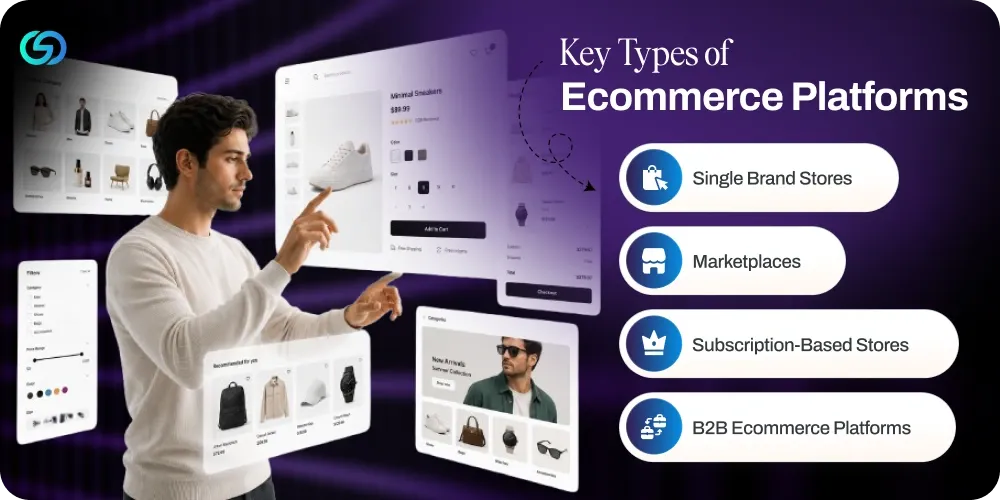
There are various types of ecommerce websites and web applications that one can browse. Each of them serves a different purpose. Let’s go through them:
🔶 Single Brand Stores
These are direct-to-consumer (D2C) brands that sell their own products exclusively. These stores are the best for businesses that want complete control over branding, pricing, and customer experience without relying on market fees.
🔶 Marketplaces
These platforms are to host multiple sellers with thousands of products on their website. Traditional marketplace platforms require vendor dashboards, commission systems, advanced filtering, review mechanisms, and a scalable architecture that can handle high transaction volumes.
🔶 Subscription-Based Stores
The subscription-based stores are recurring revenue models that offer monthly product deliveries and service access. Meal kits, beauty boxes, and software-as-a-service (SaaS) products are prime examples of this ecommerce website type.
🔶 B2B Ecommerce Platforms
Platforms with a business-to-business (B2B) model offer bulk ordering, tier-based pricing, and quote management. Features for this type include custom pricing, purchase orders, multi-user accounts, and approval of workflows.
Ecommerce Platform Features You Must Incorporate
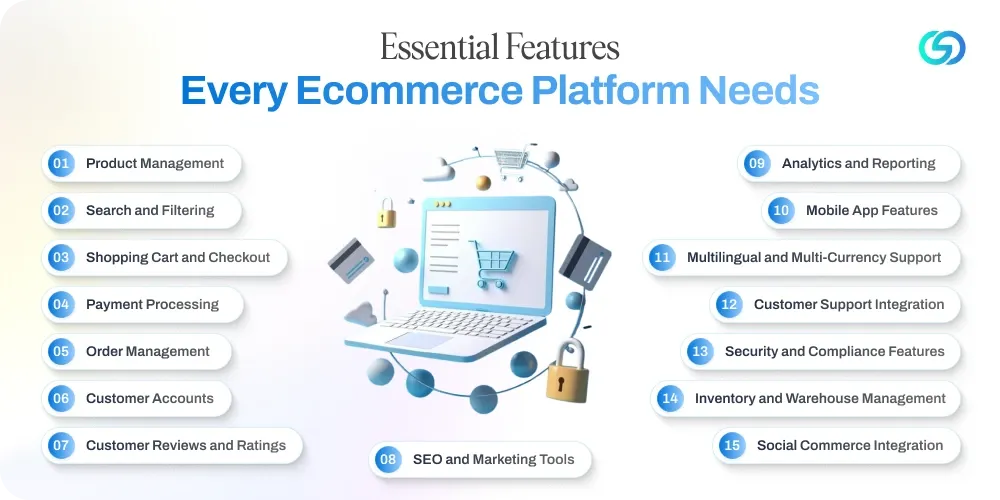
Essential features usually determine whether a visitor will just browse or actually purchase something. Missing out on critical functionality can frustrate a customer and kill conversions.
Your ecommerce platform demands features across product management, customer experience, payment processing, and finally, analytics. Here’s what makes a professional store better compared to an amateur attempt.
💠 Product Management
An efficient product management system will keep your catalog organized and discoverable for the customer.
Must-have capabilities are as follows:
- Catalog organizations with categories, subcategories, and tags.
- Inventory tracking with automatic low-stock alerts.
- Product variations include sizes, color, material, and style.
- Bulk uploads, along with editing for massive catalogs.
- SKU management and barcode integration.
💠 Search and Filtering
Customers who can find products faster will purchase more as well. Poor search leads them to competitors.
The critical features for this involve:
- Intelligent search with auto-complete suggestions.
- Advanced filters by price, category, brand, and attributes.
- Sort options based on relevance, price, ratings, and new arrivals.
- Search result optimization.
- Voice search compatibility.
💠 Shopping Cart and Checkout
Cart abandonment is quite common in most industries. A streamlined checkout experience can help recover lost revenue.
A few essential cart features for this include:
- Persistent cart across devices and sessions.
- Guest checkout option without forced registration.
- Quantity adjustment and easy removal buttons.
- Promo code and discount applications.
- Multiple currency support.
For checkout optimization, a few more features are required:
- Single-page or progress-indicator checkout.
- Autofill for address and payment details.
- Multiple shipping options with delivery estimates.
- Editing options at the final review stage.
💠 Payment Processing
Limited amount of payment options can cost you sales. Most modern customers expect flexibility and security.
Payment gateway integration includes:
- Credit and debit card processing.
- Digital wallets.
- Buy Now, Pay Later (BNPL) options.
- Local payment methods by region.
- Cryptocurrency acceptance for global markets.
Security essentials:
- PCI-DSS compliant payment processing.
- Tokenization that protects sensitive card data.
- 3D secure authentication adds verification.
- SSL encryption for every transaction.
💠 Order Management
A transparent order management system can help build trust in customers and lessen support tickets.
Order processing essential features:
- Automated order confirmation emails.
- Real-time order tracking with carrier integration.
- Order status updates via email or SMS.
- Order history access to customer accounts.
- Return and refund request processing.
💠 Customer Accounts
Account features often encourage repeat purchases and build customer loyalty.
Account management includes:
- Quick registration with social login options.
- Secure login with two factor authentication.
- Wishlist and favorites for later purchase.
- Saved payment methods for faster checkouts.
- Address book with multiple shipping addresses.
💠 Customer Reviews and Ratings
Reviews and customer engagement are known for increasing conversion rates massively. One thing to remember is that authentic feedback builds credibility.
Review system features:
- Star ratings and written reviews.
- Photo and video uploads for reviews.
- Verified purchase badges.
💠 SEO and Marketing Tools
Built-in SEO capabilities determine the platform’s search visibility and organic traffic.
The SEO essentials your ecommerce website must have are:
- SEO-friendly URLs and clean site structure.
- Customizable meta titles and descriptions.
- Schema markup for rich search snippets.
- XML sitemap automatic generation.
- Canonical tags preventing duplicate content.
Essential marketing features to have on the site:
- Email capture with pop-up and inline forms.
- Abandoned cart recovery emails.
- Product recommendation engine.
- Discount and coupon code management.
💠 Analytics and Reporting
Data-driven decisions can separate growing stores from the stagnant ones.
Crucial analytics capabilities:
- Real-time sales and revenue tracking.
- Traffic source analysis and attribution.
- Conversion funnel visualization.
- Product performance metrics.
- Customer behavior tracking.
- Cart abandonment rate monitoring.
Integration with:
- Google Analytics for comprehensive tracking.
- Facebook Pixel for ad optimization.
💠 Mobile App Features
Mobile applications drive higher engagement and repeat purchases compared to mobile websites.
The essential app features are:
- Push notifications for promotions and updates.
- Offline browsing capabilities.
- One-tap checkout with saved preferences.
- Barcode scanning for quick product lookup.
- Augmented reality try-on features.
💠 Multilingual and Multi-Currency Support
Global expansion demands localization beyond simple translation.
Important internationalization features:
- Multiple language support
- Automatic currency conversion based on location.
- Localized payment method options.
- Country-specific shipping rules.
💠 Customer Support Integration
Accessible support reduces friction and increases customer satisfaction.
Support Channels:
- Live chat with real-time assistance.
- AI-powered chatbots for 24/7 responses.
- Help center with searchable FAQs.
- Ticket system for complex issues.
💠 Security and Compliance Features
Security breaches can destroy customer trust for good. Protection for your platform isn’t optional.
Security measures you must implement:
- SSL certificates and HTTPS encryption.
- Regular security audits and penetration testing.
- Secure admin access with role permissions.
- GDPR and CCPA compliance tools.
- Data encryption at rest and transit.
💠 Inventory and Warehouse Management
Backend efficiency usually impacts the frontend customer experience directly.
These are the important inventory features:
- Real-time stock level tracking.
- Multi-warehouse management.
- Inventory forecasting and analytics.
- Supplier management integration.
- Backorder and pre-order handling.
💠 Social Commerce Integration
Social platforms have the ability to drive significant ecommerce traffic and direct sales.
Social features to incorporate:
- Instagram and Facebook shop integration.
- Social sharing buttons on products.
- Social proof widgets showcasing recent purchases.
Major Benefits of Ecommerce Web Development
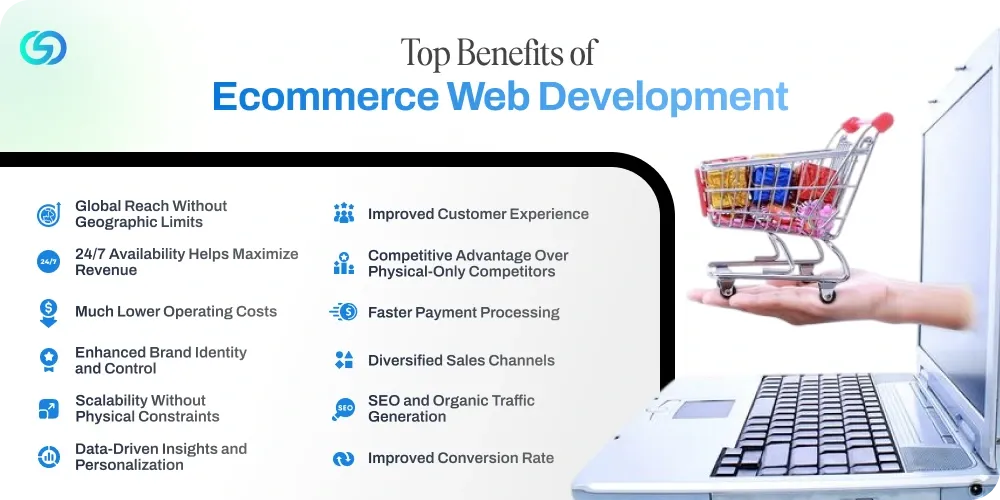
Professional ecommerce web development can transform a business by expanding its reach, reducing costs, and generating revenue streams operating 24/7. Whether you launch your first online store or upgrade an existing infrastructure, quality development will always deliver satisfactory returns.
Here’s why investing in ecommerce web development will change your business’s pace and aid in its growth:
⏩ Global Reach Without Geographic Limits
Physical stores cater to local customers during business hours, but ecommerce websites can sell products globally, around the clock. The geographic expansion benefits the business in accessing international markets without physical presence, serving customers across various time zones, generating revenue while you sleep, and has no limitations regarding traffic and regional boundaries.
For example, a store in New Jersey can easily serve customers in New York, London, and Tokyo simultaneously, without adding staff or extending hours.
⏩ 24/7 Availability Helps Maximize Revenue
Your ecommerce platform can efficiently operate through holidays, weekends, and nights without closing. The ‘Always-On’ model has its advantages, as it allows customers to shop whenever its convenient, capture on impulse purchases occurring outside business hours, accommodate shift workers and international buyers, and automate transactions without human intervention. Ecommerce platforms are a consistent revenue stream regardless of time.
⏩ Much Lower Operating Costs
Ecommerce platforms eliminate major expenses associated with physical retail, which is a massive plus point for entrepreneurs. One can see cost reduction from no rent from prime retail locations, minimal utility bills, low maintenance costs, small staff requirements, reduced inventory storage, low overhead from centralized warehouse operations, and the elimination of physical store buildout expenses.
⏩ Enhanced Brand Identity and Control
Custom ecommerce development creates unique brand experiences that a traditional marketplace fails to deliver. Brand-building advantages incorporate full control over design, messaging, and customer journey, consistent brand experience across all touchpoints, no competition from marketplace rival listings, custom features reflecting brand values, and ownership of customer relationships and data.
Selling on a platform like Amazon can make your product more generic. However, your own website can build brand equity and customer loyalty.
⏩ Scalability Without Physical Constraints
Digital infrastructure scales much faster and more easily than brick-and-mortar locations. Scaling capabilities extend to better handling of traffic spikes during sales without turning customers away, adding unlimited products without space restrictions, expanding to new markets instantly without construction, growing infrastructure that matches revenue, and testing new product lines with minimal investment risk.
⏩ Data-Driven Insights and Personalization
Ecommerce platforms collect valuable customer behavior data that a physical store cannot match. The reason is that a digital platform can track every customer interaction and purchase pattern, identify high-performing products and optimize inventory, personalize recommendations, increase average order value, perform A/B test pricing, design, and messaging strategies, and predict trends through analytics.
It is a strong asset to track marketing based on the purchase history of a customer. Amazon’s recommendation engine alone generates 35% of its revenue through data-driven personalization.
⏩ Improved Customer Experience
Professional development prioritizes user experience that delivers higher satisfaction. Experience enhancements can improve with faster load times and lower bounce rates, a mobile-responsive design for on-the-go shopping, intuitive navigation helping customers find products quickly, streamlined checkout minimizing cart abandonment, and multiple payment options accommodating preferences.
Moreover, options like order tracking can also offer transparency and trust. Even seconds of delay can significantly reduce conversions.
⏩ Competitive Advantage Over Physical-Only Competitors
Businesses without ecommerce presence can lose market share easily in the digital-first landscape. The competitive benefits of an online platform offer swift customer capture, the ability to compete with large brands, respond faster to market changes and trends, and offer broader product selection.
Small businesses that use ecommerce can compete nationally against enterprises through their intelligent digital presence in the market. This aids them in scaling their business and standing their ground.
⏩ Faster Payment Processing
Online transactions eliminate delays that you would usually see in traditional payment methods. A faster payment processing has its own advantages, such as instant payment registration, automated invoicing and receipt generation, reduced waiting periods in the mail, more payment gateway options, low transaction fees, and improved cash flow.
This is a great benefit point for service-based businesses that can see accelerated payment cycles significantly through online billing.
⏩ Diversified Sales Channels
Ecommerce adds revenue streams beyond physical locations or marketplace dependencies. Through channel diversification, one has the advantage of direct-to-customer sales alongside marketplace presence, less reliance on Amazon or third-party platforms, control over pricing without marketplace restrictions, and the ability to build email lists and customer relationships.
Moreover, diversified sales channels also allow for cross-selling and upselling opportunities along with various revenue sources, reducing business risk. Think of it this way: selling on marketplaces can make you vulnerable, but your own website can offer stability and control.
⏩ SEO and Organic Traffic Generation
A well-developed ecommerce website can generate traffic consistently through search engines, and for free. Through SEO, you can benefit your platform by ranking product-related keywords, building long-term visibility, target consumers actively, establishing authority and credibility, and generating compounding returns.
Through SEO, organic traffic generation becomes extremely effective as it is cost-effective compared to paid advertising. Organic traffic costs zero per click while delivering higher conversion rates than paid ads.
⏩ Improved Conversion Rate
Professional development can implement proven strategies that can maximize conversions. Conversion optimization includes tailored checkouts, which reduce friction, trust signals like security badges, personalized product recommendations, abandoned cart recovery systems, exit-intent popups capturing leaving visitors, and A/B testing that identifies high-performing elements.
Custom ecommerce web development focuses on your audience's behaviors, which drives higher conversion rates compared to generic templates.
Key Steps in Ecommerce Development
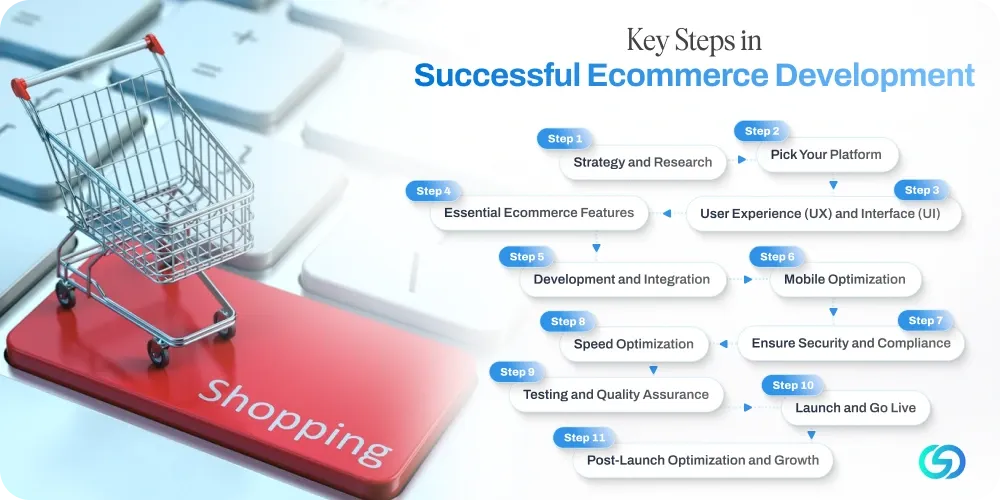
Building an ecommerce platform is not an easy task. It requires going through crucial steps that will eventually build a website to attract customers and sell products. Here are the key steps one must follow in their ecommerce web development journey:
Step 1: Strategy and Research
Successful projects begin with a deep understanding of the platform. To define your business model, ensure to ask yourself and your team these questions:
- Who are your target customers?
- What problems does your product solve?
- Who are your direct competitors?
- What is your unique value proposition?
For market analysis, ensure to target demographic behavior and preferences, perform competitor feature analysis and pricing strategies, analyze market size and growth potential, and understand customer pain points through interviews.
Also, perform proper budget planning for your platform. Depending on your outsourcing or in-house approach, costs may vary. After the calculation, include a buffer for unexpected expenses.
Step 2: Pick Your Platform
Your platform selection shapes everything that follows in your ecommerce web development journey. When you are starting out, ensure to consider the following factors:
- Product catalog size and complexity
- Expected traffic volumes
- Required third-party integrations
- Customization needs and technical capabilities
- Long-term scalability goals
You can go for open-source platforms such as WooCommerce and Magento. However, they demand hands-on technical management, while offering maximum scalability, and need dedicated development resources.
Alternatively, SaaS platforms such as Shopify and BigCommerce offer convenience and automatic updates but limit deep customization and include subscription costs.
Step 3: User Experience (UX) and Interface (UI)
Your ecommerce website’s design is much more than mere decoration. It is a tool for persuasion and conversion. Your UI and UX design must focus on the following:
UI
- Brand consistency across all touchpoints
- Visual hierarchy guiding attention
- Trust-building elements
- Clear call-to-action (CTA) placement
UX
- Intuitive navigation and architecture
- Seamless user flow from start to end
- Spotting and removing friction points
- Mobile first responsiveness
Focus on creating user journey maps that cover new visitor registration process, product discovery and filtering, add-to-cart and checkout experience, and repeat purchase workflows, customer service interactions. Make sure to test wireframes with 15-20 real users before the final design to identify confusing elements.
Step 4: Essential Ecommerce Features
A website cannot function without essential features that will help it keep customers and scale with the market. As mentioned above, focus on essential features such as:
- Product management
- Search and filtering
- Shopping cart and checkout
- Payment processing
- Order management
- Customer accounts
- SEO optimization
Each and every feature mentioned in the above list is essential for your ecommerce platform. These features are heavily focused on the end-user and ensure they have a seamless experience on the website.
Step 5: Development and Integration
Frontend development creates visible user interfaces with the help of HTML, CSS, and JavaScript alongside frameworks such as React and Vue.js.
Backend development, on the other hand, powers server logic, database management, API integrations, and business workflows using Node.js, PHP, Python, or Ruby.
Focus on key integrations, which include:
- CRM systems: Salesforce and HubSpot, for customer relationship management.
- ERP systems: SAP and Oracle for inventory and orders.
- Email marketing: Mailchimp and Klaviyo for campaigns.
- Analytics: Google Analytics and Hotjar for behavior tracking.
- Shipping: ShipStation and EasyPost for multi-carrier management.
- Social media: Facebook and Instagram shops are used for social commerce.
Make sure your code is clean and well-documented, as it is one of the most important parts for development and technology integration.
Step 6: Mobile Optimization
Mobile commerce is constantly reaching new heights, as it is capitalizing on a large portion of ecommerce sales in the current landscape.
- Touch-friendly interfaces with large tap targets
- Thumb-zone optimization for one-handed use
- Swipe gestures for intuitive browsing
- Simplified forms and autofill
- Collapsible menus that lessen clutter
Moreover, focus on performance optimization of the platform with image compression, lazy loading, reduced HTTP requests, and AMP implementation.
Step 7: Ensure Security and Compliance
Security is crucial for your website as it is fundamental to customer trust. Focus on essential measures as well as other features such as:
- Fraud prevention: IP blocking, transaction monitoring, and address verification.
- Data protection compliance: GDPR for Europe, and CCPA for California.
- Best practices: Clear privacy policies, cookie consent, frequent security audits, and 2FA.
Aside from this, work with tools such as OneTrust and Cookiebot to help maintain compliance automatically.
Step 8: Speed Optimization
Even a second delay can decrease the conversion rate significantly. A good number of visitors regularly abandon websites that take more than 3 seconds to load. Focus on the following to fix this issue:
- Image compression
- Content Delivery Networks
- Minimal HTTP requests
- Browser caching
- Progressive Web Apps (PWAs)
Popular brands like Alibaba use PWAs to achieve increased engagement and conversions.
Step 9: Testing and Quality Assurance
A platform should not be launched without comprehensive testing. Here’s the type of tests you should conduct:
- Functional testing: Verify all features, test user flows, and validate edge cases.
- Usability testing: Real users complete specific tasks, measure task completion, and spot confusing UI.
- Performance testing: Simulate high concurrent loads, stress tests, and optimize database queries.
- Security testing: Penetration testing, SQL injection prevention, XSS protection, and authentication validation.
- Compatibility testing: Test multiple devices, including desktop, tablet, and mobile, alongside browsers and operating systems (OS).
Along with this, also ensure to meet the acceptance criteria before launch.
Step 10: Launch and Go Live
Launching your own ecommerce web platform can be scary after all the work you have just put in. Hence, follow a simple checklist:
- Complete final quality assurance testing
- Configure the domain name and the SSL certificate
- Set up a hosting environment and CDN
- Configure analytics and tracking tools
- Establish backup and recovery systems
Along with this, also focus on technical launch requirements for DNS configuration, SSL/HTTPS implementation, payment gateway activation, email server configuration, and XML sitemap submission.
Step 11: Post-Launch Optimization and Growth
Launching your ecommerce website is just the beginning of the process. You must also focus on continuous improvement, which will separate you from the stagnant stores. Here’s what you must follow:
- Performance monitoring: Track conversion rates, average order value, cart abandonment, page load times, and bounce rates.
- Scaling infrastructure: Implement auto-scaling, database optimization, caching layers like Redis, load balancing, and CDN expansion.
For expansion, continue launching new regions and add complementary products to grow your reach.
Understanding Ecommerce Web Development Costs: A Regional Breakdown
Ecommerce costs can vary depending on various factors. Most importantly, it depends on the complexity, features, platform choice, and development location.
Understanding the pricing structure for your ecommerce web development project will help you plan your budget and pick up the correct development partner for your goals. So, let’s go through the development costs by region:
Cost Per Region
| Country/Region | Basic Store | Professional/Mid-Range | Enterprise Level |
|---|---|---|---|
| USA | $15000 or more | $50000 or more | $150000 or more |
| Eastern Europe | $12000 or more | $40000 or more | $120000 or more |
| Western Europe | $5000 or more | $15000 or more | $50000 or more |
| Middle East | $10000 or more | $25000 or more | $75000 or more |
Popular Ecommerce Trends to Look Out For
With ecommerce becoming more of a common business model in the current competitive market, here are a few important trends you should look out for:
▶️ AI and Machine Learning
- AI-powered chatbots for customer service 24/7.
- Personalized product recommendations.
- Predictive analytics for inventory management.
- Dynamic pricing optimization.
- Visual search capabilities.
▶️ Voice Commerce
- Customers enjoy hands-free shopping with the help of Alexa, Google Assistant, and Siri.
- Voice search optimization becomes crucial for product discovery.
▶️ Augmented Reality (AR)
- Visual try-on for clothing and accessories.
- Furniture placement in home spaces.
- Makeup testing applications.
- Car customization visualizations.
▶️ Social Commerce
- Shoppable posts on Instagram, Facebook, and TikTok.
- Direct purchases without leaving social platforms are driving impulse purchases.
▶️ Headless Commerce
- Decoupling frontend and backend for flexibility.
- Allow omnichannel experiences across web, mobile, IoT devices, and in-store kiosks.
▶️ Sustainability Features
- Carbon footprint tracking tool.
- Eco-friendly packaging options.
- Ethical sourcing transparency.
- Green shipping alternatives.
Real-World Examples of Ecommerce Development

Real-world success stories of an ecommerce web platform often demonstrate how strategic ecommerce web development transforms a business into a measurable growth generator.
These examples showcase various approaches across industries, platforms, and business models that show effective development delivers promising results.
*️⃣ Amazon: From Bookstore to a Store for Everything
Amazon’s hyper-personalization strategy goes beyond mere product suggestions. It leverages browsing history, purchase patterns, demographics, and voice interactions to build well-informed customer profiles.
Personalization technologies include:
- Machine learning recommendation algorithms.
- Real-time retail personalization adjusts displays based on immediate actions.
- Dynamic homepage layouts reflect demonstrated preferences.
- Personalized email marketing, analyzing purchase frequency, and seasonal habits.
- A/B testing with informative and comprehensive statistical models.
Results: Amazon’s recommendation engine generates over 35% of the total company revenue. Hyper-personalization recommendations offer significantly more conversion rates compared to generic recommendations, while personalized experiences boost session duration and page views on a massive scale.
Key Takeaway: Data-driven personalization can transform casual browsing viewers into loyal customers, even with small personalization tweaks such as “recently viewed items” on the website.
*️⃣ YETI: Mobile-First Design That Sees Huge Conversion Boost
YETI is a premium outdoor gear brand that revamped its ecommerce platform by prioritizing a mobile-first user experience in the year 2022.
Here are the development strategies the brand implemented:
- Immersive browsing with background video without extending load times.
- Unique scrolling features that guide users through shopping journeys.
- Thumb-navigation optimization specifically for one-handed mobile use.
- AI-powered personalization using Commerce Cloud Einstein.
- Product recommendations based on past purchases, geographic region, and outdoor activities.
Results: YETI flawlessly achieved a 63% year-over-year increase in mobile conversion rate through customer-first design. This alone demonstrates how investing in seamless and immersive mobile experiences can significantly boost conversions and engagement.
Key Takeaway: Mobile users behave a lot differently than the ones browsing on desktops. Focus on building mobile-specific experiences rather than shrinking desktop sites, as it will deliver much better conversion performance for your ecommerce platform.
*️⃣ Alibaba: AI-Powered Recommendation Driving Massive Conversion Growth
Alibaba revolutionized its ecommerce platform, Taobao and Tmall, by implementing advanced AI-driven personalization through its proprietary system of Artificial Intelligence Recommendation.
The development strategy for Alibaba includes:
- Multi-algorithm recommendation engines combine collaborative filtering and real-time behavior analysis.
- AI-powered search optimization reduces no-result rates.
- LLM-powered generative AI chatbot (Taobao Wenwen) for personalized shopping assistance.
- Real-time personalization utilizes video tagging and user interest modeling.
- Strategic placement across product pages, shopping carts, and homepages.
Results: Alibaba has achieved a significant conversion rate with its AI recommendation engines. The average order value has grown by 20% through intelligent product bundles. Search optimization also delivered a 9% boost in transaction conversion. Singles’ Day 2017 was noted to generate 20% higher conversion rates on their personalized pages.
Key Takeaway: Advanced AI recommendation systems combining various algorithms with strategic placement significantly improved product delivery, which transformed browsers into buyers while also increasing average order values.
Why Go for ConvexSol for Your Ecommerce Journey?
Ecommerce web development is not just about building websites. It is about building revenue engines that can scale up the market. Every decision can impact the customers' trust, whether they revisit your website or not. Poor development costs sales, but professional development pays for itself with high conversions, better search visibility, and seamless scalability.
ConvexSol brings Dubai-based expertise with a deep understanding of the global ecommerce market. We are here to offer our clients data-based design decisions, a clean and scalable structure, and security-first development that protects their customers and businesses. We offer complete optimization for mobile devices, and help one capture traffic from smartphones, while our SEO-friendly technical foundations help search engines find you.
With the growing global ecommerce market, it is time that you capitalize on the race with the help of cutting-edge technology and our expert consultancy. Consumers' expectations on speed, seamless experience, and optimization have never been higher. Meaning, the margin of error is zero with modern ecommerce platforms. Contact ConvexSol today and let us turn your ecommerce goals into a profitable reality.
Frequently Asked Questions
How long does it take to develop an ecommerce platform from scratch?
Platform-based solutions can take around 4 to 8 weeks to launch. However, custom ecommerce development takes 3 to 6 months, depending on the complexity, features, and integrations. Timelines can vary on factors like catalog size, design customization, third-party integrations, and team availability.
What happens if something breaks after my ecommerce platform launches?
Reputable agencies often provide post-launch support for a set of time, where they cover development-related bugs. Ongoing maintenance packages handle security updates, performance monitoring, and other technical issues. Without such support, vulnerabilities and conflicts can impact sales. Critical issues like payment failure demand immediate attention from professionals for business continuity.
Is it possible to add changes to my ecommerce platform in the post-launch phase?
Yes, changes are always possible through technological help. Minor updates like content and pricing are manageable with the help of admin dashboards. Significant modifications that need new features, design changes, or architectural updates require developer involvement. Well-built platforms with modular architecture make future updates easier and much more cost-effective compared to poorly structured sites.
How to pick between making products myself or sourcing from suppliers?
Making products offers higher margins, quality control, and uniqueness, but also demand time, skills, and equipment investment. Sourcing offers fast scaling, lower commitment, and a broader selection. However, the latter reduces margins and product differentiation. If you must do it, start sourcing proven products, then add proprietary items as your revenue grows
Which ecommerce type is the most profitable?
Subscription-based models generate the highest lifetime value through recurring revenue. B2B ecommerce typically has larger order values than B2C. Digital products offer 80 to 95% profit margins with no inventory costs. Profitability ultimately depends on niche selection, operational efficiency, and customer acquisition costs rather than business type alone.
Are LLMs viable for scalable web development?
LLMs assist with code generation, debugging, and documentation, but cannot replace skilled developers with complex ecommerce platforms. The reason being that they accelerate repetitive tasks, suggest solutions, and improve productivity. Architecture decisions, security implementation, performance optimization, and business logic demand human expertise. LLMs are good for complementing developers, rather than substituting them.