- Enterprise Software Development
- 2026-06-16
Enterprise Software Development for Manufacturing: Building Scalable, Intelligent & Industry 4.0-Ready Systems
Audio Track
Table of Contents
Key Takeaways
- Enterprise software development for manufacturing helps enterprises develop scalable, connected, and industry 4.0 ready operational ecosystems that enhance efficiency.
- Custom manufacturing software development enables manufacturers to automate workflows, integrate MES/ERP/SCM systems, and address operational challenges resulting from disconnected legacy systems and infrastructure.
- Enterprise manufacturing software solutions support smart factories via AI-driven operations, IIoT connectivity, automation, predictive analytics, and real-time operational intelligence across manufacturing environments.
- Modern manufacturing enterprises need scalable, secure, and integrated digital systems that support cloud infrastructure, cybersecurity, operational monitoring, and multi-location manufacturing management efficiently.
- Emerging technologies like digital twins, edge AI, hyper automation, and Industry 5.0 are revolutionizing the future of enterprise manufacturing software and intelligent industrial transformation.
Overview: The Digital Transformation of Manufacturing Enterprises
Modern manufacturing enterprises are going through operational complexities driven by inefficiencies, disconnected systems, legacy infrastructure, and real-time visibility across operations. Traditional software solutions mostly struggle to support enterprise-level manufacturing environments; changing Industry 4.0 needs and real-time data processing. As factories are now becoming smarter, and supply chains are getting more connected, manufacturers require intelligent digital ecosystems that automate workflows, unify operations, and enhance decision-making. Enterprise software development is becoming the operational backbone of modern manufacturing, allowing scalable, data-driven, and Industry 4.0-ready systems that improve productivity, long-term business competitiveness, and agility across the manufacturing ecosystem.
What Is Enterprise Software Development for Manufacturing?
Enterprise software development for manufacturing refers to the process of developing integrated operational platforms and scalable digital systems that help manufacturers in managing, automating, and streamlining complex enterprise operations. These systems develop connected manufacturing ecosystems where machines, data, and departments, as well as processes, work together in real-time to enhance visibility, decision-making, and efficiency across the business.
Modern enterprise manufacturing software is developed to support critical business functions like production management, tracking and coordination in the supply chain, quality control, analytics, and workflow automation. By incorporating technologies such as MES, ERP, cloud computing, IIoT, and AI-driven analytics, manufacturers can optimize operations, decrease downtime, and achieve greater operational agility.
Unlike traditional standalone apps, enterprise manufacturing systems work as unified ecosystems that offer real-time visibility across warehouses, supply chains, and factories. These platforms allow manufacturers to automate repetitive processes, monitor production performance, handle assets efficiently, and make data-powered decisions at scale. As Industry 4.0 continues to revolutionize manufacturing, enterprise software development has become crucial for developing intelligent, connected, and future-ready manufacturing operations.
Why Do Manufacturing Enterprises Need Custom Enterprise Software?
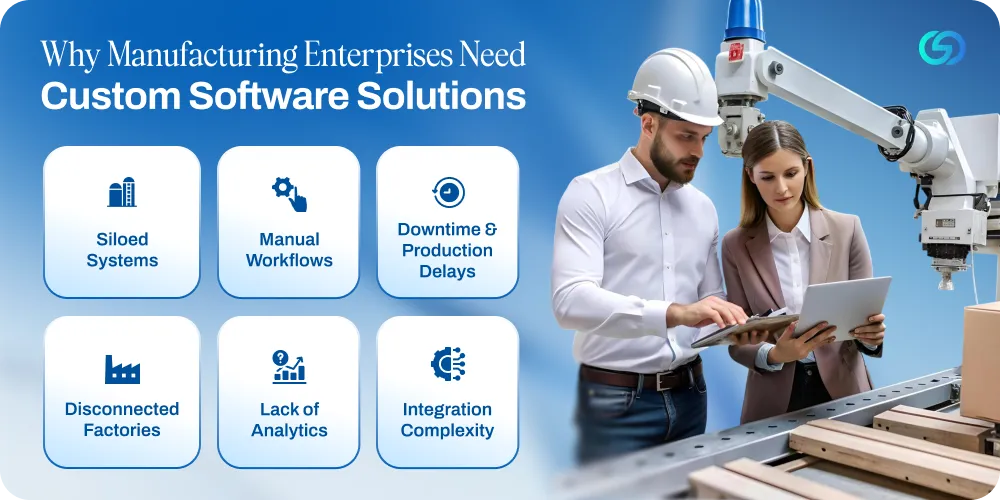
Enterprise software development for manufacturing helps businesses in eliminating disconnected workflows, automating operations, and developing intelligent, scalable, and connected ecosystems that enhance efficiency, visibility, and enterprise-wide decision-making.
➡️ Siloed Systems
Enterprise software development for manufacturing helps you connect departments, production units, and business systems into a single centralized ecosystem, enhancing collaboration, operational visibility, and real-time data sharing across manufacturing businesses.
➡️ Manual Workflows
Manufacturers who depend on manual processes mostly face delays, errors, and operational inefficiencies. Enterprise software development for manufacturing automates repetitive workflows, enhancing productivity, process accuracy, and enterprise-wide work efficiency.
➡️ Downtime & Production Delays
Unplanned downtime affects productivity, timelines of delivery, and operational costs. Intelligent enterprise software systems allow predictive monitoring, tracking of equipment, and proactive maintenance for minimizing disruptions and delays in production.
➡️ Disconnected Factories
Disconnected manufacturing facilities develop data inconsistencies as well as communication gaps. Enterprise software development for manufacturing allows centralized control, synchronized operations, and real-time visibility across multi-location manufacturing environments.
➡️ Lack of Analytics
Without real-time analytics, manufacturers find it difficult to make informed decisions. Enterprise software development for manufacturing allows centralized controls, real-time visibility, and synchronized operations across multi-location manufacturing environments.
➡️ Integration Complexity
Legacy systems, as well as incompatible apps, increase the complexity in operations. Enterprise software development for manufacturing integrates MES, ERP, supply chain, and industrial systems to develop connected, scalable, and future-ready manufacturing ecosystems.
Custom Vs Off-the-Shelf Manufacturing Software
Making a choice between custom and off-the-shelf manufacturing software depends on complexities in operations, scalability goals, integration needs, and long-term digital transformation strategies across enterprise manufacturing environments.
| Factors | Custom Manufacturing Software | Off-the-Shelf Manufacturing Software |
|---|---|---|
| Customization | Designed specifically for enterprise manufacturing workflows, operational goals as well as business needs. | Offers standardized features with limited customization flexibility for manufacturers |
| Integration Capability | Easily integrates with MES, ERP, SCM, IIoT and existing enterprise systems. | Scalability limitations may appear as manufacturing operations expand over time. |
| Scalability | Seamlessly scales across multi-location factories and evolving Industries 4.0 needs. | Scalability limitations may appear as manufacturing operations increase over time. |
| Flexibility | Supports unique production processes, automation strategies as well as enterprise-level operational models. | Businesses mostly require to adapt workflows as per software limitations |
| Long-Term Value | Provides better operational efficiency. Long-term ROI, and competitive differentiation. | Lower initial investment but recurring licensing and upgrade expenses may increase later. |
Core Features of Enterprise Manufacturing Software
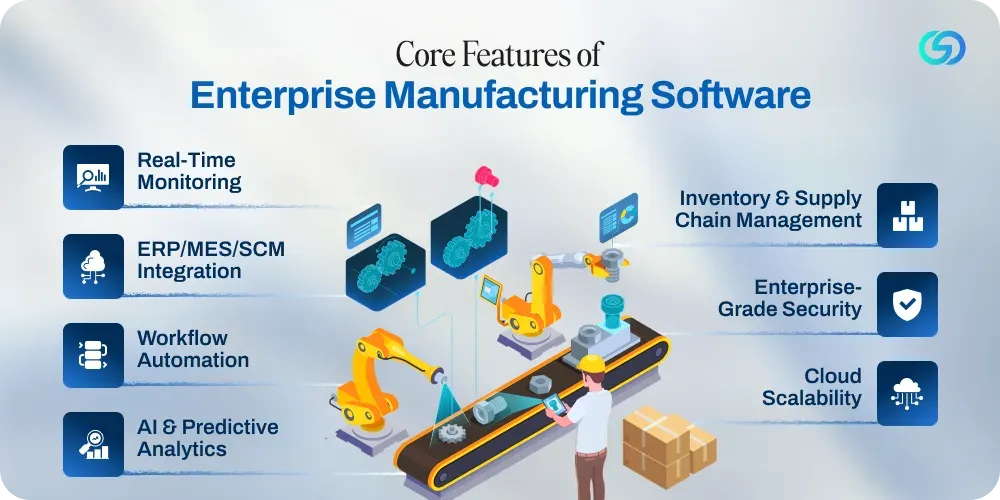
Enterprise manufacturing software solutions offer intelligent, scalable, and connected capabilities that help manufacturers automate operations, enhance visibility, streamline production workflows, and support efficient enterprise-wide manufacturing management.
🔶 Real-Time Monitoring
Enterprise manufacturing software solutions offer real-time monitoring capabilities that help manufacturing businesses to track machine performance, production activities, and operational metrics for enhanced visibility, faster response times, and efficient factory management.
🔶 ERP/MES/SCM Integration
Integrated ERP, MES, and SCM systems create unified enterprise ecosystems where inventory, production, procurement, and supply chain operations work together easily for enhancing operational coordination and enterprise-wide efficiency.
🔶 Workflow Automation
Enterprise manufacturing software solutions automate repetitive manufacturing workflows, decrease manual operations, and enhance process consistency, helping businesses increase productivity, decrease errors, and streamline enterprise-level operational management.
🔶 AI & Predictive Analytics
AI-powered analytics and predictive technologies help manufacturing businesses in finding out operational inefficiencies, forecasting maintenance needs, and supporting intelligent decision-making via real-time insights, performance optimization, and production analysis capabilities.
🔶 Inventory & Supply Chain Management
Specialized inventory and supply chain management features help manufacturers streamline stock levels, enhance procurement planning, and ensure seamless operational coordination across warehouses, suppliers, production facilities, and distribution networks.
🔶 Enterprise-Grade Security
Enterprise manufacturing software solutions include advanced security capabilities like compliance management, role-based access control, and secure data handling for safeguarding critical manufacturing operations, systems, and enterprise information.
🔶 Cloud Scalability
Cloud-enabled enterprise manufacturing software solutions help in supporting multi-location manufacturing operations, remote accessibility, and scalable infrastructure, allowing enterprises to expand operations efficiently while maintaining unified visibility and operational control.
Enterprise Manufacturing Architecture
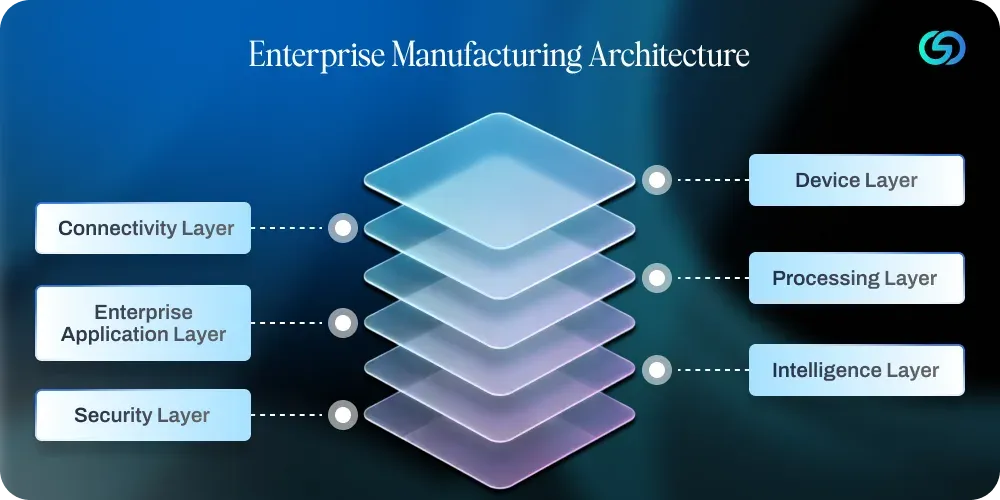
Enterprise manufacturing architecture develops a connected digital ecosystem where applications, machines, data, and intelligent technologies work all together to support automated, scalable, and Industry 4.0-ready manufacturing operations.
Modern enterprise manufacturing solutions depend on a multi-layered architecture that allows simplified communication between operational systems, industrial devices, and intelligent business apps.
⏺️ Device Layer
The device layers form the base of enterprise manufacturing architecture and involve industrial sensors, machines, PLCS, as well as connected production equipment. These devices continuously collect production and operational data from the factory floor to support automation, real-time monitoring, and performance tracking across manufacturing environments.
⏺️ Connectivity Layer
The connectivity layer enables communication between enterprise systems, industrial devices, and digital platforms via IIoT technologies, middleware solutions, and APIs. This layer helps manufacturers incorporate machines, apps, and production systems into a connected manufacturing ecosystem with easy data exchange.
⏺️ Processing Layer
The processing layer handles data processing via edge computing and cloud computing infrastructure. Edge systems process crucial manufacturing data near production environments for speedy response times, while cloud platforms support unified scalability, storage, and enterprise-wide operational accessibility.
⏺️ Enterprise Application Layer
This layer involves enterprise apps like ERP, MES, SCM platforms, and operational dashboards. These systems help the manufacturing businesses handle production planning, supply chain coordination, inventory, quality management, and industry-wide operational workflows from centralized platforms.
⏺️ Intelligence Layer
The intelligence layer utilizes AI, analytics, and automation technologies for converting manufacturing data into actionable insights. Manufacturers can utilize predictive analytics, intelligent automation, and real-time intelligence to enhance decision-making, streamline production, and decrease operational inefficiencies.
⏺️ Security Layer
The security layer helps in protecting manufacturing infrastructure, enterprise apps, and operational data across the complete digital ecosystem. It involves role-based access control, network protection, cybersecurity frameworks, and compliance management for protecting connected manufacturing operations from operational risks and cyber threats.
Enterprise Systems That Can Be Used in the Manufacturing Industry
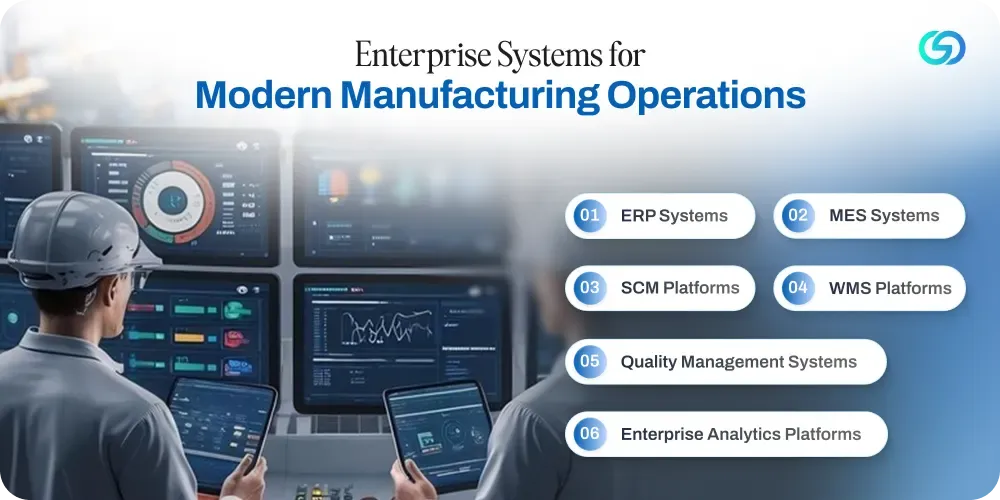
Modern manufacturing enterprises depend on an integrated system for handling production, supply chains, inventory, operational workflows, and quality control across connected and data-driven manufacturing environments. Enterprise manufacturing software solutions provide a combination of several business and operational systems for creating connected manufacturing ecosystems. These enterprise systems help the manufacturers in enhancing visibility, optimizing operations, automating workflows, as well as supporting real-time decision-making across warehouses, factories, and supply chain networks.
⏩ ERP Systems
Enterprise Resource Planning (ERP) systems help manufacturers handle primary business operations like procurement, inventory, finance, human resources, and production planning from a unified platform. ERP systems enhance operational coordination, utilization of resources, and enterprise-wide visibility across manufacturing works.
⏩ MES Systems
Manufacturing Execution Systems (MES) manage and monitor production activities on the factory floor in real time. MES platforms help manufacturers track machine performance, operational efficiency, production schedules, and work-in-progress data to enhance productivity and decrease downtime.
⏩ SCM Platforms
Supply Chain Management (SCM) platforms help manufacturers handle procurement, supplier coordination, product distribution, and logistics processes. These systems enhance the visibility of the supply chain, inventory planning, and operational coordination across connected manufacturing networks.
⏩ WMS Platforms
Warehouse management systems (WMS) help manufacturers streamline warehouse operations, order fulfillment, inventory tracking, and material movement processes. WMS platforms enhance storage efficiency, inventory accuracy, and operational productivity across warehouse environments.
⏩ Quality Management Systems
Quality management systems (QMS) help manufacturing businesses maintain the quality of product, monitoring compliance standards, and tracking defects in production throughout manufacturing operations. These systems support defect tracking, quality inspections, and ongoing improvement of the processes, ensuring consistent manufacturing performance.
⏩ Enterprise Analytics Platforms
An enterprise analytics platform helps manufacturers convert operational information into actionable insights via reporting systems, real-time dashboards, and predictive analytics tools. These platforms collect information from MES, ERP, IIoT, and supply chain systems for supporting performance monitoring, operational intelligence, and data-driven decision-making. Enterprise analytics platforms help manufacturers in finding out inefficiencies, streamline strategic planning across a connected manufacturing environment.
Industry 4.0 & Enterprise Manufacturing Software
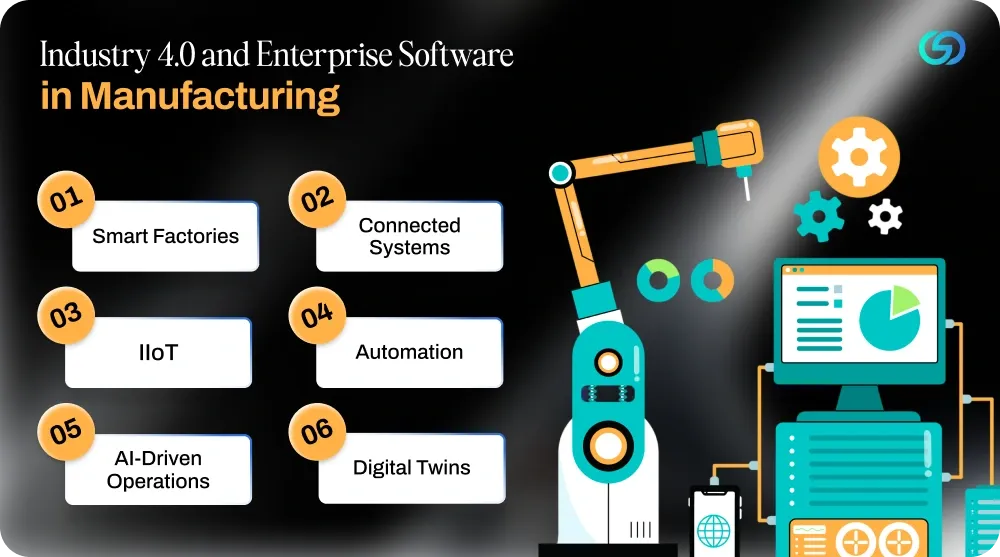
Industry 4.0 is transforming manufacturing through intelligent technologies, connected systems, and real-time automation. Enterprise manufacturing software acts as the digital foundation that enables smart factories, IIoT integration, AI-driven operations, and scalable industrial innovation across modern manufacturing environments.
1️⃣ Smart Factories
Smart factories use enterprise manufacturing software to connect machines, production systems, and operational workflows into intelligent ecosystems. These factories leverage automation, real-time monitoring, and data-driven decision-making to improve productivity, operational visibility, and manufacturing efficiency across connected industrial environments.
2️⃣ Connected Systems
Connected manufacturing systems integrate ERP, MES, SCM, and industrial devices into one unified operational ecosystem. Enterprise manufacturing software enables seamless communication between departments, factories, and supply chains, helping manufacturers achieve synchronized operations, centralized visibility, and improved enterprise-wide coordination.
3️⃣ IIoT
Industrial Internet of Things (IIoT) technologies allow machines, sensors, and equipment to collect and exchange real-time operational data. Enterprise manufacturing software uses IIoT connectivity to improve equipment monitoring, predictive maintenance, operational efficiency, and intelligent factory-wide communication across manufacturing ecosystems.
4️⃣ Automation
Automation technologies help manufacturers reduce manual operations, streamline workflows, and improve production consistency. Enterprise manufacturing software supports intelligent automation across inventory management, production scheduling, quality monitoring, and operational processes to enhance efficiency and reduce operational complexity in modern manufacturing environments.
5️⃣ AI-Driven Operations
AI-driven manufacturing operations use enterprise software, machine learning, and predictive analytics to optimize production performance and operational decision-making. Manufacturers can identify inefficiencies, forecast maintenance needs, and improve resource planning through intelligent systems that continuously analyze manufacturing data and operational activities.
6️⃣ Digital Twins
Digital twin technology creates virtual replicas of manufacturing systems, production environments, and industrial equipment. Enterprise manufacturing software uses digital twins to simulate operations, monitor equipment performance, and optimize manufacturing processes through real-time insights, predictive analysis, and intelligent operational modeling.
AI & Automation in Enterprise Manufacturing
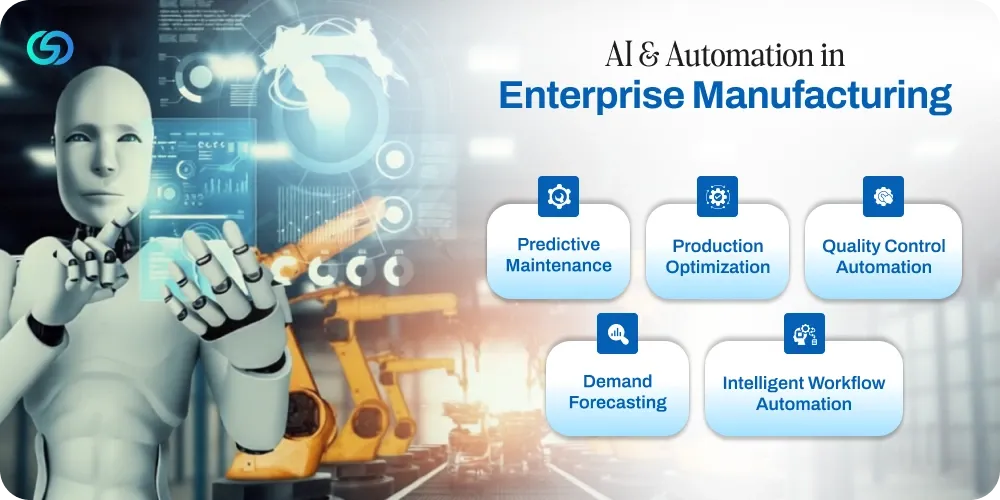
AI and automation technologies are transforming enterprise manufacturing by enabling intelligent decision-making, predictive operations, and automated workflows. Enterprise manufacturing software solutions use real-time data, analytics, and machine learning to improve efficiency, reduce downtime, and support scalable Industry 4.0-ready manufacturing operations across connected industrial environments.
▶️ Predictive Maintenance
AI-powered predictive maintenance helps manufacturers monitor machine health, detect performance anomalies, and predict equipment failures before disruptions occur. Enterprise manufacturing software solutions collect real-time sensor data from industrial equipment and use predictive analytics to identify maintenance requirements proactively. This reduces unexpected downtime, minimizes repair costs, and improves equipment lifespan across manufacturing facilities. Predictive maintenance also helps manufacturers optimize maintenance schedules, improve production continuity, and enhance operational efficiency. By replacing reactive maintenance with intelligent monitoring systems, manufacturing enterprises can achieve greater reliability, better asset utilization, and more consistent production performance across connected factory environments.
▶️ Production Optimization
AI-driven production optimization enables manufacturers to improve operational efficiency, reduce waste, and maximize production output through intelligent process analysis. Enterprise manufacturing software solutions analyze production data, machine performance, and operational workflows in real time to identify inefficiencies and optimize manufacturing processes. AI systems can improve scheduling, resource allocation, and production planning while reducing bottlenecks and operational delays. Manufacturers can also use automation technologies to streamline repetitive processes and maintain production consistency across facilities. Production optimization helps enterprises increase productivity, improve operational agility, and support scalable manufacturing operations in rapidly evolving Industry 4.0 environments.
▶️ Quality Control Automation
AI and automation technologies improve manufacturing quality control by enabling real-time defect detection, automated inspections, and intelligent quality analysis. Enterprise manufacturing software solutions use machine learning, computer vision, and data analytics to monitor production quality and identify defects more accurately than manual inspection methods. Automated quality control systems help manufacturers reduce product inconsistencies, minimize waste, and maintain compliance with industry standards. Real-time quality monitoring also allows manufacturers to identify operational issues early and implement corrective actions quickly. This improves product reliability, operational efficiency, and overall customer satisfaction across enterprise manufacturing operations.
▶️ Demand Forecasting
AI-powered demand forecasting helps manufacturers predict market demand, optimize inventory levels, and improve supply chain planning through intelligent data analysis. Enterprise manufacturing software solutions analyze historical sales data, production trends, and market patterns to generate accurate demand forecasts. These insights help manufacturers improve procurement planning, reduce inventory shortages, and avoid overproduction. AI-driven forecasting also supports better resource management and operational coordination across manufacturing and distribution networks. By improving forecasting accuracy, manufacturing enterprises can reduce operational costs, enhance customer responsiveness, and maintain greater supply chain efficiency in competitive market environments.
▶️ Intelligent Workflow Automation
Intelligent workflow automation helps manufacturers streamline operational processes, reduce manual tasks, and improve enterprise-wide productivity. Enterprise manufacturing software solutions automate repetitive workflows such as inventory management, production scheduling, reporting, and approval processes using AI and automation technologies. Automated workflows improve operational consistency, reduce human errors, and enable faster decision-making across manufacturing environments. AI-driven automation systems can also adapt to changing production requirements and optimize workflow performance in real time. This helps manufacturers increase efficiency, improve operational scalability, and create connected, data-driven manufacturing ecosystems that support long-term digital transformation goals.
Challenges in Enterprise Integration for Manufacturing Businesses
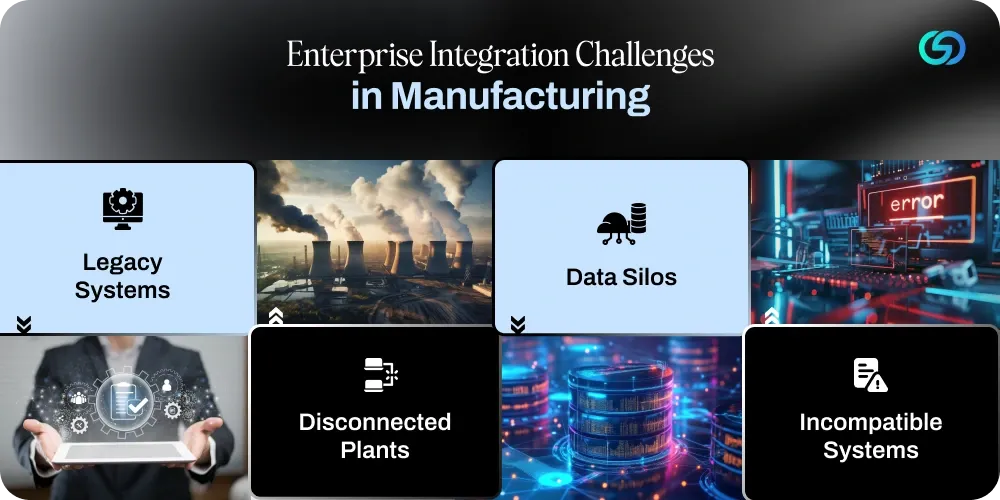
Manufacturing enterprises mostly struggle when it comes to integrating legacy infrastructure, fragmented data environments, and disconnected operational systems. Enterprise manufacturing software solutions help in streamlining communication, unify systems, and create connected digital ecosystems that support scalable, efficient and manufacturing operations that are Industry 4.0 ready.
🔷 Legacy Systems
Manufacturing enterprises struggle with integrating disconnected operational systems, legacy infrastructure, and fragmented data environments. Enterprise manufacturing software solutions help in unifying systems, streamlining communication, and creating connected digital systems that support efficient, scalable, and Industry 4.0-ready manufacturing operations.
🔷 Disconnected Plants
Manufacturing facilities operating in isolated environments struggle with limited operational visibility, inconsistent communication, and inefficient coordination. Disconnected plants make it difficult for the manufacturing enterprises to share operational data and maintain centralized control across several manufacturing locations.
🔷 Data Silos
Data silos happen when operational information remains isolated within apps, departments, or production systems. This helps in preventing manufacturers from achieving enterprise-wide visibility, informed decision-making, and real-time analytics across production, supply chain, and operational management processes.
🔷 Incompatible Systems
Manufacturing enterprises mostly utilize multiple software platforms and industrial technologies that lack compatibility with each other. Incompatible systems increase operational complexity, create integration challenges, and slow down digital transformation initiatives across connected manufacturing systems.
Security in Enterprise Manufacturing Systems
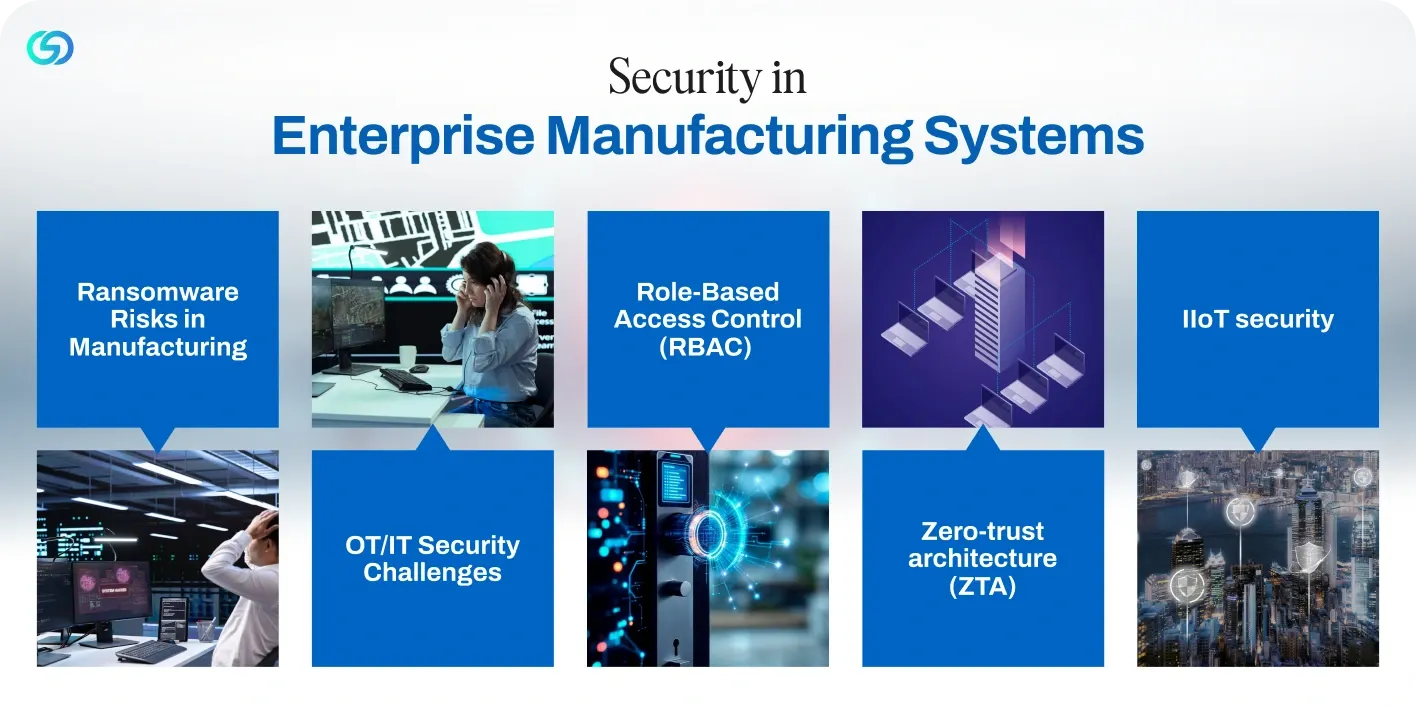
Manufacturing cyber incidents spiked with ransomware attacks against OT/IT environments, heavily targeting downtime to force extortion payments. Securing enterprise systems needs an integrated approach that mitigates IIoT vulnerabilities and stops lateral movement using modern zero-trust strategies.
*️⃣ Ransomware Risks in Manufacturing
Manufacturing enterprises are largely targeted by ransomware attacks that affect both IT systems and operational technology environments. Cybercriminals mostly disrupt production operations and critical industrial processes forcing extortion payments. These attacks can lead to downtime in production, disruptions, and financial losses across manufacturing facilities. Enterprise manufacturing software solutions should include advanced detection of threats, backup strategies, and industrial cybersecurity frameworks for enhancing resilience against ransomware threats. Security standards like IEC 62443 help manufacturers strengthen industrial automation security and safeguard connected enterprise manufacturing systems from operational cyber risks.
*️⃣ OT/IT Security Challenges
Manufacturing enterprises work with both Information Technology (IT)systems and Operational Technology (OT) environments, serving different operational purposes. IT systems prioritize data security and business processes, while OT systems prioritize production uptime, operational continuity, and industrial safety. As Industry 4.0 connects enterprise networks with factory-floor systems, manufacturing businesses face enhanced cybersecurity risks from interconnected environments. Enterprise manufacturing software solutions help secure communication between OT and IT while maintaining operational reliability, enterprise-wide protection, and system visibility across connected manufacturing ecosystems.
*️⃣ Role-Based Access Control (RBAC)
Role-Based Access Control helps manufacturing businesses restrict system access as per employee roles and operational responsibilities. Enterprise manufacturing software solutions use RBAC to ensure the users can only access the apps, systems, and operational functions needed for their work activities. This decreases unauthorized access risks, strengthens enterprise security management, and prevents operational misuse. Manufacturers also implement multi-factor authentication across MES platforms, ERP systems, and remote access portals for improving identity verification as well as enterprise-level security protection across manufacturing environments.
*️⃣ Zero-trust architecture (ZTA)
Zero-trust architecture abides by the principle of “never trust, always verify” across enterprise manufacturing environments. Enterprise manufacturing software solutions utilize zero-trust frameworks to continuously verify users, applications, and connected devices before granting access to operational systems. Manufacturers can develop micro-segmented security environments that isolate OT, IT, and IIoT networks to prevent cyber threats from spreading across connected operations. Industrial demilitarized zones (IDMZs), network segmentation, and ongoing monitoring strategies further strengthen manufacturing cybersecurity and enhance enterprise-wide operational resilience against advanced cyber threats.
*️⃣ IIoT security
Industrial Internet of Things (IIoT) devices play a crucial role in connected manufacturing operations, but they also introduce a new cybersecurity vulnerability. Several industrial sensors and monitoring systems lack robust default security configurations and regular software updates. Enterprise manufacturing software solutions help secure IIoT ecosystems via device monitoring, access management, and ongoing detection of threats. Manufacturers are capable of improving operational visibility and detecting suspicious activities early by implementing centralized IIoT security frameworks that safeguard interconnected industrial devices, production systems, and enterprise manufacturing environments.
Benefits of Enterprise Software for Manufacturing
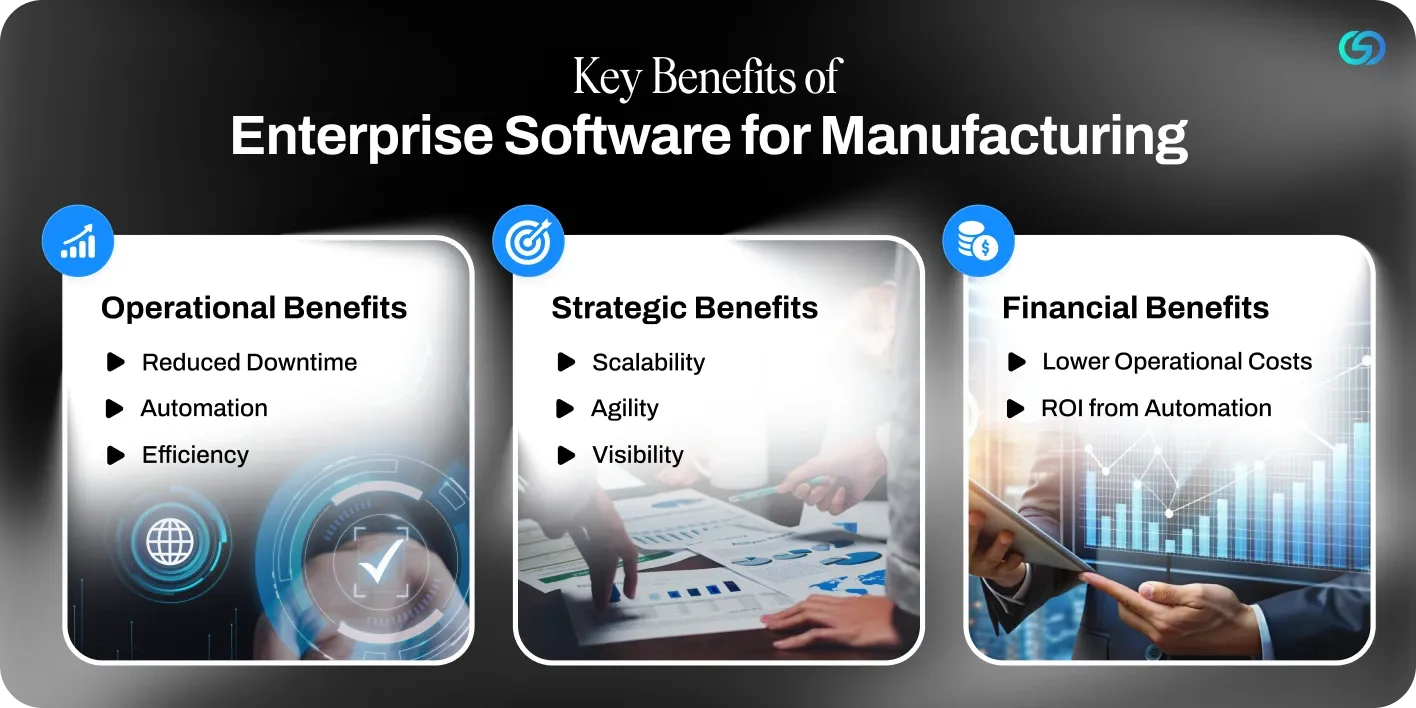
Enterprise software development for manufacturing helps businesses enhance operational efficiency, support scalable growth, and decrease long-term business costs via connected systems, intelligent automation, and data-driven manufacturing.
1️⃣ Operational Benefits
- Reduced Downtime
Enterprise software development for manufacturing allows predictive maintenance, automated alerts, and real-time monitoring that help manufacturing businesses decrease equipment failures, enhance production continuity, and reduce costly operational disruptions across manufacturing environments. - Automation
Automation capabilities optimize repetitive manufacturing workflows, decrease manual intervention, and enhance operational consistency. Enterprise software development for manufacturing helps businesses increase productivity, decrease human errors, and accelerate enterprise-wide process execution. - Efficiency
Enterprise manufacturing systems enhance workflow coordination, resource utilization, and operational visibility across connected departments and production facilities. This helps the manufacturing businesses optimize processes, enhance decision-making, and improve overall operational efficiency.
2️⃣ Strategic Benefits
- Scalability
Enterprise software development for manufacturing helps in supporting scalable operations by allowing manufacturers to expand the capabilities of production, integrate new technologies, and manage multi-location manufacturing environments without compromising system reliability and operational performance. - Agility
Modern enterprise software solutions help manufacturing businesses respond faster to changing market needs, operational challenges, and customer needs via real-time access to data, flexible workflows, and adaptive manufacturing processes across enterprise environments. - Visibility
Enterprise manufacturing software solutions offer unified operational visibility via real-time dashboards, reporting systems, and analytics. Manufacturers are capable of monitoring production, inventory, and supply chain activities to support speedy and data-driven business decisions.
3️⃣ Financial Benefits
- Lower Operational Costs
Enterprise software development for manufacturing decreases operational costs by minimizing downtime, automating workflows, and enhancing resource management. Connected enterprise systems also decrease maintenance expenses and eliminate inefficiencies caused by disconnected operations. - ROI from Automation
Automation technologies offer long-term return on investment by enhancing productivity, decreasing labor-intensive processes, and increasing accuracy in operations. Enterprise manufacturing software solutions help businesses achieve sustainable growth via intelligent operational optimization.
Common Challenges in Enterprise Manufacturing Projects
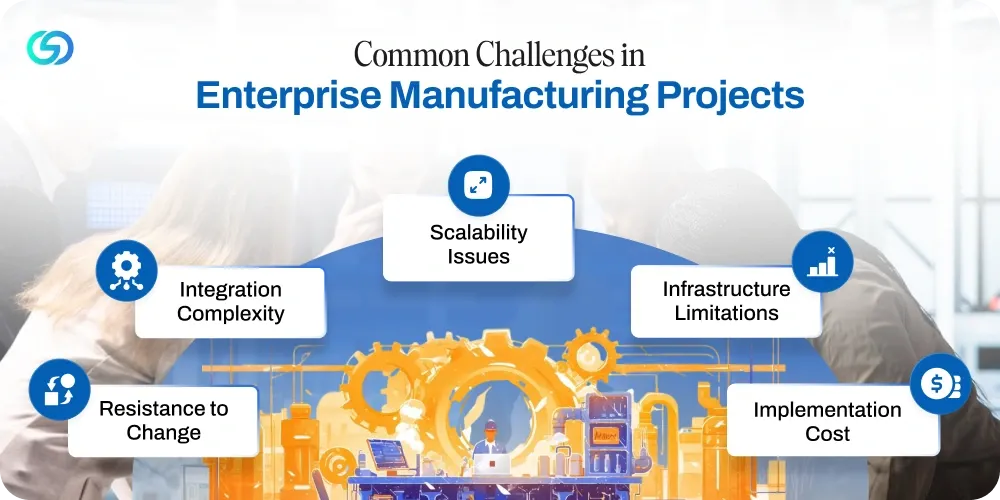
Enterprise manufacturing projects mostly include complicated operational environments, legacy infrastructure, and growing business needs. Successfully implementing enterprise manufacturing software solutions requires overcoming integration barriers, concerns related to scalability, organizational resistance, and cost-related challenges while ensuring continuity of operations and long-term digital transformation success.
💠 Resistance to Change
Manufacturing employees and the operational teams mostly resist adopting new technologies because of unfamiliar workflows, training concerns, and fear of disruptions in operations. Enterprise manufacturing software products need effective change management, stakeholder engagement, and workforce training to enhance adoption rates as well as ensure seamless digital transformation across manufacturing environments.
💠 Integration Complexity
As manufacturing operations grow, enterprise systems should support increased production demands, additional facilities, and expand operational complexity. Poorly designed software architectures mostly struggle to scale efficiently, limiting operational flexibility and future Industry 4.0 readiness for manufacturing enterprises.
💠 Scalability Issues
As manufacturing operations grow, enterprise systems should support increased demands of production, additional facilities, and expand operational complexity. Poorly designed software architectures mostly struggle to efficiently scale, limiting operational flexibility and future Industry 4.0 readiness for manufacturing organizations.
💠 Infrastructure Limitations
Outdated infrastructure, aging operational systems, and unsupported hardware can restrict manufacturing modernization initiatives. Enterprise manufacturing projects mostly need infrastructure upgrades, cloud integration, and modern connectivity frameworks for supporting analytics, automation, and connected manufacturing ecosystems effectively.
💠 Implementation Cost
Enterprise manufacturing software implementation includes development, infrastructure modernization, integration, training, and long-term maintenance expenses. Without proper planning of project and phase strategies for deployment, manufacturing enterprises will experience budget overruns, operational delays, and decreased return on investment during implementation.
Steps for Implementing Enterprise Manufacturing Software?
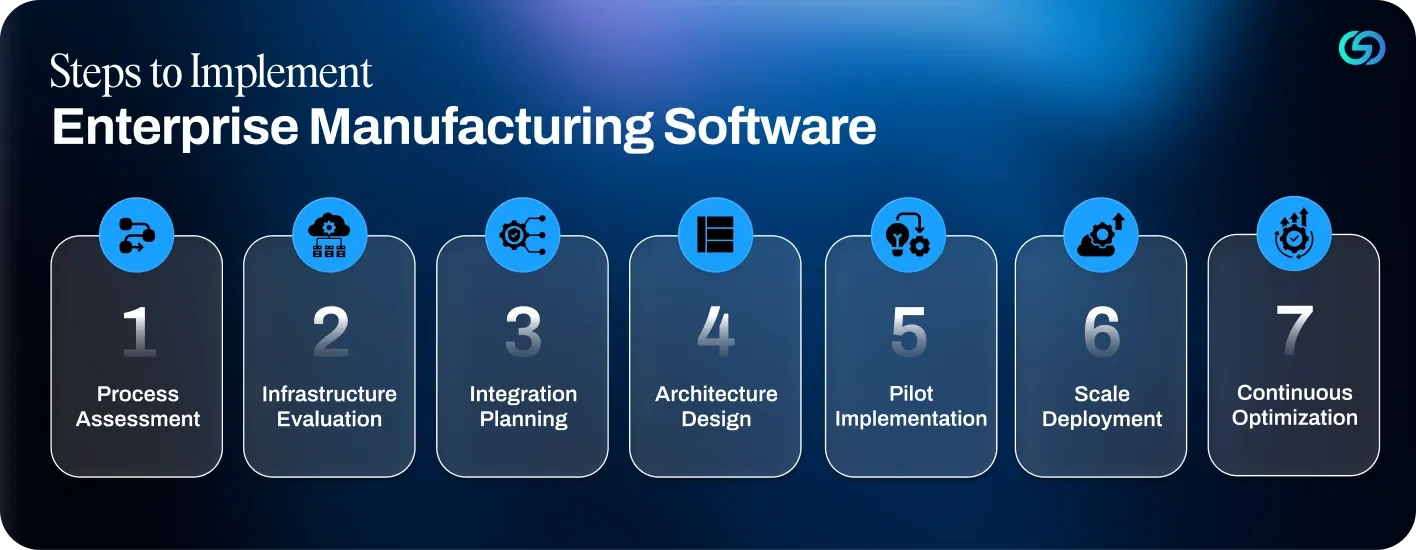
Successful enterprise manufacturing implementation needs a structured roadmap tailored to the aligned business processes, technology infrastructure, and operational goals. A phased process of implementation strategy helps the manufacturers in decreasing operational risks, enhancing system adoption, and developing scalable, Industry 4.0 manufacturing environments.
1️⃣ Process Assessment
The very first step in implementing enterprise manufacturing software is evaluating the existing processes of businesses, operational workflows, and manufacturing challenges. Manufacturers should find out inefficiencies, disconnected systems, and opportunities for automation in order to define clear project objectives and priorities of implementation. A comprehensive process assessment helps businesses in aligning enterprise software capabilities with operational needs and long-term business goals.
2️⃣ Infrastructure Evaluation
Manufacturers should assess their current IT and operational technology infrastructure before implementing enterprise manufacturing software solutions. This includes evaluating industrial networks, hardware systems, cloud readiness, and legacy technologies to determine the infrastructure's scalability and compatibility needs. Infrastructure evaluation helps enterprises in finding out modernization needs as well as preparing connected manufacturing environments for digital transformation.
3️⃣ Integration Planning
Enterprise manufacturing software solutions should easily integrate with Manufacturing Execution Systems (MES), Enterprise Resource Planning (ERP), Supply Chain Management (SCM), Industrial Internet of Things (IIoT) devices, and current operational systems. Integration planning includes finding system dependencies, data exchange needs, and communication frameworks that support connected operations and unified visibility across manufacturing environments. Proper integration planning minimizes operational disruptions and enhances implementation efficiency.
4️⃣ Architecture Design
A scalable enterprise manufacturing architecture is important for supporting connected operations, Industry 4.0 initiatives, and automation. Manufacturers should design system architecture that supports real-time processing of data, AI capabilities, and enterprise-wide operational accessibility. Well-designed architectures enhance flexibility, scalability, and long-term operational performance.
5️⃣ Pilot Implementation
Pilot implementation enables manufacturers to test enterprise software solutions within controlled operational environments before full-scale deployment. This stage helps businesses find technical issues, evaluating the performance of systems, and gathering feedback from employees while minimizing operational risks. Pilot testing enhances implementation accuracy as well as supports seamless enterprise-wide adoption.
6️⃣ Scale Deployment
After successful pilot testing, manufacturers will be able to deploy enterprise manufacturing software solutions across departments, operational locations, and production failures. Scale deployment needs training of employee training, workflow alignment, and ongoing monitoring for enduring adoption in consistency and operational continuity throughout the implementation process.
7️⃣ Continuous Optimization
Enterprise manufacturing software implementation is a continuous process that needs ongoing optimization and improvement of performance. Manufacturers should regularly monitor operational data, evaluate the performance of systems, and update workflows to support changing business needs, Industry 4.0 technologies, and long-term digital transformation goals.
Future Trends in Enterprise Manufacturing Software
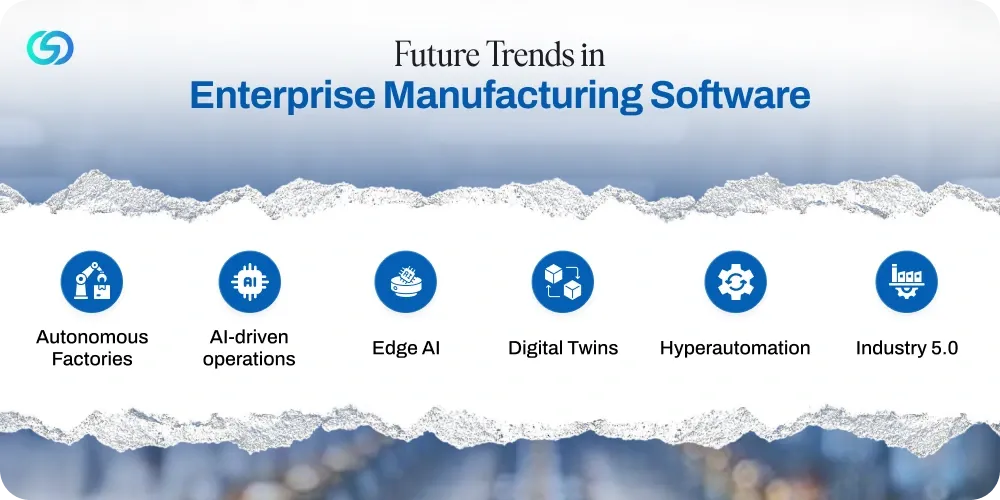
Enterprise manufacturing software solutions are continuously evolving to support connected ecosystems, intelligent automation, and next-generation industrial innovation. Emerging technologies like edge computing, AI, and Industry 5.0 are revolutionizing how manufacturers streamline operations, enhance efficiency, and develop future-ready manufacturing environments.
*️⃣ Autonomous Factories
Autonomous factories represent the next stage of smart manufacturing. In this, machines, enterprise systems, and AI-driven technologies work with minimal human intervention. Enterprise manufacturing software solutions allow automated production workflows, autonomous decision-making, and real-time operational coordination throughout connected manufacturing environments. These intelligent factories enhance efficiency, decrease operational errors, and support continuous production optimization via specialized automation technologies.
*️⃣ AI-driven operations
AI-driven operations are changing the manufacturing sector via predictive analytics, real-time decision-making, and intelligent automation. Enterprise manufacturing software solutions utilize AI to streamline production planning, enhance operational efficiency, and monitor equipment performance across enterprise environments. AI technologies also help manufacturing businesses decrease downtime, enhance forecasting accuracy, and develop data-driven manufacturing ecosystems that support Industry 4.0 initiatives.
*️⃣ Edge AI
Edge AI allows manufacturers to process operational information directly near industrial devices and machines, instead of relying completely on centralized cloud systems. Edge AI refers to artificial intelligence performed locally at the device level. Enterprise manufacturing software solutions use edge AI to improve response times, reduce latency, and support real-time automation across connected factory environments. This technology advances production monitoring, intelligent decision-making, and predictive maintenance within modern manufacturing ecosystems.
*️⃣ Digital Twins
Digital twin technology enables manufacturers to develop virtual replicas of machines, production systems, and complete manufacturing facilities. Enterprise manufacturing software solutions utilize digital twins for simulating operations, monitoring performance, and streamline production processes with predictive insights and real-time analytics. Digital twins help businesses improve operational planning, decrease inefficiencies, and support intelligent manufacturing innovation across Industry 4.0-driven environments.
*️⃣ Hyperautomation
Hyperautomation combines robotic process automation, AI, machine learning, and specialized analytics for automating complex enterprise workflows. Enterprise manufacturing software solutions utilize hyper automation for streamlining production processes, enhancing operational coordination, and decreasing manual intervention across manufacturing operations. This helps manufacturers enhance productivity, improve scalability, and create extremely efficient manufacturing ecosystems.
*️⃣ Industry 5.0
Industry 5.0 focuses on human-centric manufacturing where advanced technologies collaboratively work with human expertise to enhance sustainability, innovation, and operational resilience. Enterprise software development for manufacturing solutions supports Industry 5.0 initiatives by allowing intelligent collaboration between AI systems, humans, and connected industrial technologies. This kind of approach helps manufacturers achieve personalized production, sustainable operations, and more adaptive manufacturing environments.
How ConvexSol Helps Manufacturing Enterprises with Cutting-edge Enterprise Manufacturing Software?
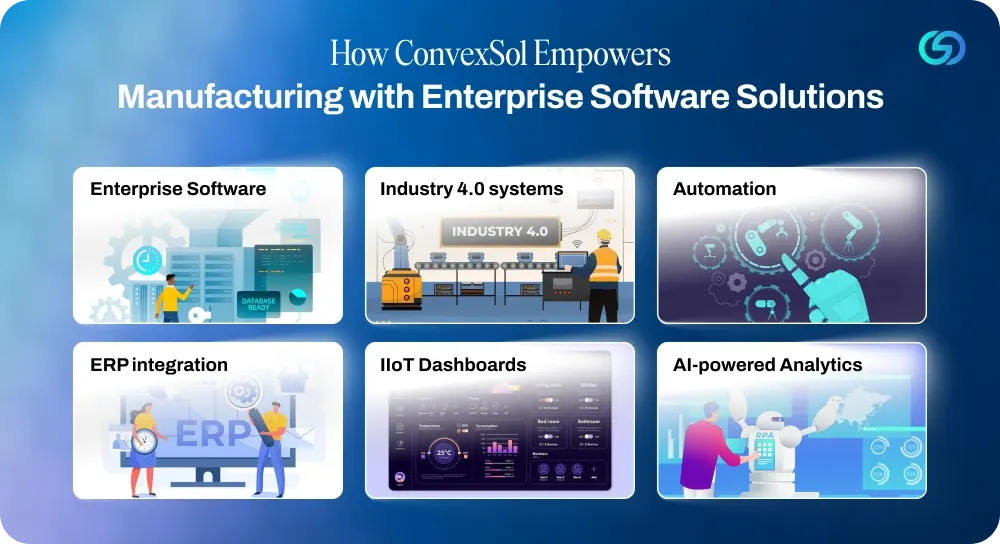
ConvexSol empowers manufacturing with intelligent enterprise software development for manufacturing, Industry 4.0 solutions, and enterprise-wide manufacturing efficiency.
✅ Enterprise Software
ConvexSol develops a scalable enterprise software solution helping manufacturers optimize workflows, centralize operations, and enhance operational efficiency across inventory, production, supply chain, and business management systems.
✅ Industry 4.0 systems
ConvexSol helps manufacturing businesses in implementing Industry 4.0-ready systems for supporting connected operations, real-time monitoring, smart factory initiatives, and intelligent manufacturing environments powered by specialized digital technologies.
✅ Automation
ConvexSol allows manufacturing automation via intelligent workflows, process streamlining, and connected operational systems that decrease manual tasks, enhance productivity and improve operational systems that decrease manual tasks, enhance productivity and improve operational consistency across manufacturing environments.
✅ ERP integration
ConvexSol provides easy ERPO integration solutions that connect enterprise apps, operational systems, and manufacturing workflows into unified digital ecosystems for enhanced coordination, visibility, and enterprise-wide operational management.
✅ IIoT Dashboards
ConvexSol crafts IIoT-enabled dashboards that offer equipment monitoring, operational visibility, and production analytics to help manufacturers enhance decision-making and streamline connected manufacturing operations efficiently.
✅ AI-powered Analytics
ConvexSol utilizes AI-powered analytics solutions to help manufacturers analyze operational data, find out efficiencies, predict maintenance needs, and support intelligent decision-making across enterprise manufacturing environments.
Conclusion
Enterprise software development for manufacturing is helping modern manufacturing enterprises in developing connected, scalable, and intelligent operational ecosystems that support long-term growth as well as Industry 4.0 transformation. Starting from AI-driven analytics to ERP integration and IIoT connectivity, enterprise manufacturing software solutions allow businesses to enhance efficiency, decrease downtime, and achieve real-time operational visibility.
As the manufacturing environments continue to evolve, custom manufacturing software development becomes crucial for overcoming operational complexity, improving competitiveness, and supporting scalability. By investing in future-ready enterprise systems, manufacturing enterprises can develop agile, data-powered, and resilient operations prepared for the next generation of smart manufacturing innovation and digital transformation.
Frequently Asked Questions
Can enterprise manufacturing software offer multi-location factory management?
Yes. Enterprise manufacturing software solutions can be customized as per the business requirements to help manufacturers handle multiple factories via centralized operational visibility, connected workflows, and real-time monitoring. These systems help in synchronizing production, supply chain, inventory, and reporting processes across distributed manufacturing environments for enhancing coordination, efficiency, and enterprise-wide operational control.
How does enterprise software improve manufacturing decision-making?
Enterprise software enhances manufacturing decision-making by offering centralized dashboards, real-time operational data, and AI-powered analytics. Manufacturers are capable of monitoring the performance of production, inventory levels, and efficiency of equipment for making data-driven, faster decisions that enhance productivity, decrease downtime, and optimize manufacturing operations.
Can enterprise manufacturing software integrate with legacy industrial systems?
Yes. Modern enterprise manufacturing solutions utilize APIs, cloud integration technologies, and middleware for connecting legacy infrastructure with MES platforms, ERP systems, IIoT devices, and other enterprise apps. This helps manufacturing enterprises to modernize operations without fully replacing existing industrial systems.
How does enterprise manufacturing software help reduce production waste?
Enterprise manufacturing software solutions decrease production waste via predictive analytics, automation, inventory optimization, and real-time quality monitoring. These systems help manufacturers find inefficiencies, minimize material wastage, enhance the accuracy of processes, and optimize workflows across manufacturing operations.
What factors should manufacturers consider before choosing enterprise software solutions?
Manufacturers should evaluate integration capabilities, scalability, operational needs, cloud readiness, security features, customization flexibility, as well as Industrial 4.0 compatibility before selecting enterprise manufacturing solutions. Long-term future expansion requirements and business goals should also be considered during software selection.
How do enterprise manufacturing systems improve supply chain resilience?
Enterprise manufacturing systems enhance resilience in the supply chain via real-time visibility, centralized operational coordination, and predictive analytics. These systems help manufacturing businesses in monitoring supplier performance, handling inventory efficiently, and responding faster to disruptions, delays, and changing market demands across connected supply chain networks.
How does enterprise manufacturing software support sustainability goals?
Enterprise manufacturing software solutions support sustainability goals by helping manufacturers monitor energy consumption, decrease operational waste, streamline resource utilization, and enhance production efficiency. Intelligent analytics and automation technologies also help businesses implement more sustainable and environmentally responsible manufacturing practices.