- Hotel Web Developmen
- 2026-06-11
A Comprehensive Roadmap for Hospitality and Hotel Web Development in 2026.

Audio Track
Table of Contents
Key Takeaways:
- Hotel web development is a comprehensive process of strategic planning, designing, building, and then maintaining the website.
- The main goal is to ensure that the hotel website successfully becomes the brand image of the organization, converting visitors into customers.
- Developers must ensure that the hotel website has all the essential features and ranks well in the SEO for maximum online presence.
- Hotel web development also demands the utilization of a perfect technological stack, so the output is flawless.
How Strategic Web Development Can Drive Growth in the Hospitality Industry
Hotel web development encompasses a comprehensive and strategic process of planning, designing, building, and maintaining a functional website that stands out from its competitors and provides a warm presence for users entering the site. The goal is simple: a hotel website design company should focus on building a website that captivates the users and makes them stay in their establishment without a second thought.
For this to work without flaws, developers must focus on specialized features like integrated booking engines, property management system connections, and guest-centric design elements that drive conversions. The hospitality industry has started shifting towards digital-first interactions, as it is easier to make a mark on users through first impressions.
However, this does not mean that a hotel web development company should only focus on your online presence, but also on building a revenue-generating platform that can compete with other hotels.
Benefits of Having a Hotel Website in the Modern Competitive Market

A modern hotel website design can drastically improve your chances of conversion more than you think. There is a plethora of benefits you can gain from it. Let’s dive into them:
🔷 Complete Brand Control
Strategic hotel website development enables shaping every aspect of how your guests perceive the property. As the owner, you get to control the narrative, imagery, and tone, which can connect with your target audience. Whether highlighting eco-friendly practices, high-class amenities, or local partnerships, the website is the definitive source for your brand story.
This level of control helps elevate your position in the market by building trust and setting accurate expectations before the guest arrives. This also leads to lower disappointments, flourishing reviews, and strong loyalty from customers over time.
🔷 Significant Revenue Growth Through Direct Bookings
Looking at industry growth, the financial impact of hotel web development is undeniable. On a regular basis, hotels earn the majority of their direct bookings with the help of their websites alone. This represents more revenue per reservation without any sort of commission or hidden fees.
A good hotel website acts as an intermediary between the business and the customer. It also elevates the user experience and how they view the business, which leads to better revenue generation, as customers are more inclined to spend money on a positive space.
🔷 Better Customer Service and Guest Communication
A well-developed hotel website easily becomes a customer’s primary channel for booking, raising inquiries, and support without long wait times or miscommunication. Modern hotel website design features aspects like live chat, comprehensive FAQs, review collection, and preference tracking for a personalized experience.
With ample positive features, users' requirements are met with standards as they browse for their required service, while also ensuring beforehand that their stay is good, without any hindrances. Immediate response improves customer satisfaction and encourages positive reviews, which also improves marketing.
🔷 Top-Tier SEO Performance and Market Visibility
Your property will forever remain invisible to travelers who research and book online, unless you have a properly developed website. Hotel web development with proper SEO practices allows your property to appear in Google results when potential guests search for accommodations in your area.
Key visibility factors for a good SEO-friendly website include fast-loading, mobile-friendly architecture, structured content with search intent, local SEO optimization for geographic-specific queries, and schema markup displaying room rates and reviews directly in search results. The speed of the website matters for search engine priorities.
Crucial Features to Add in Your Hotel Web Development Project for Maximum Growth
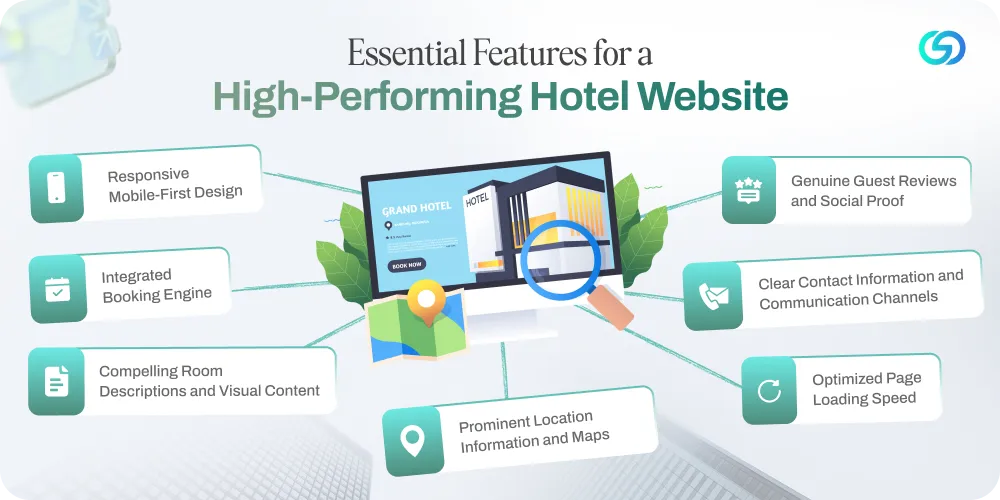
A successful hotel website is made through following proper principles and essential feature inclusion. Without it, a hotel website design will fail to deliver the required results for conversion. The crucial features are as follows:
➡️ Responsive Mobile-First Design
With the majority of the hotel website visits coming from mobile devices, responsive design is a non-negotiable for a hotel website design company. Your development process must prioritize mobile-first users and then scale for larger screen sizes. Google’s algorithm updates favor mobile-friendly websites in search engine rankings.
Essential mobile elements include:
- Thumb-friendly and streamlined navigation.
- Fast-loading images that are optimized for cellular connections.
- Tap-friendly CTAs with proper button size.
- Simple booking forms and straightforward autofill capabilities.
- Mobile wallet integration, like Apple Pay and Google Pay.
Hotels that are adapting to mobile-first designs are seeing significant growth in mobile booking numbers.
➡️ Integrated Booking Engine
Your web development project must include a secure and fully integrated booking engine that can offer a smooth path from browsing to confirming reservations.
Modern booking engines must offer:
- Real-time availability synchronized with property management systems.
- Interactive rate calendars and multiple booking configurations.
- Secure payment processing with PCI compliance.
- Mobile-optimized checkout flows.
Properties that use advanced booking engines often gain more bookings.
➡️ Compelling Room Descriptions and Visual Content
Your hotel website design must showcase rooms with the help of high-quality imagery and professional photography. It should also include detailed descriptions. Make sure to include the following when showcasing your rooms online:
- Multiple angles showcasing room layouts and amenities.
- Authentic images rather than stock photography.
- 360-degree virtual tours for transparent exploration.
- Compressed images that load fast without loss in quality.
One must remember that visual storytelling creates emotional connections while maintaining fast page speeds.
➡️ Prominent Location Information and Maps
Always include visible Google Maps integration with your actual address and nearby attractions highlighted.
- Location pages should target geo-specific keywords.
- They should also answer common proximity questions.
This allows for more positive user interactions and boosts reliability for your establishment.
➡️ Genuine Guest Reviews and Social Proof
Focus on displaying authentic reviews and ratings from past guests prominently on your website.
- Social proof builds credibility.
- Influences booking decisions.
- Travelers can compare properties and encourage choices.
Genuine reviews work the best for hospitality-based businesses, as it builds confidence among customers to approach your business.
➡️ Clear Contact Information and Communication Channels
Ensure that guests can reach you effortlessly, including:
- Working phone numbers with a click-to-call function.
- Contact forms with minimal required fields.
- Email addresses are displayed clearly.
- Business hours and expected response times.
Clear communication enhances interaction with customers and leads to better conversion.
➡️ Optimized Page Loading Speed
Fast load times can directly reduce the bounce rate for your page. Hence, it is important to pay attention to it during your hotel web development project. You must prioritize:
- Image compression and modern formats (WebP, AVIF).
- Minified code and reduced server requests.
- Content delivery networks for global speed.
- Performance budgets tied to Core Web Vitals (LCP, INP, CLS).
Optimizing page loading speed will encourage viewers to browse through more sections of your website.
A Step-by-Step Guide for an Optimized and Fast-Loading Hotel Website
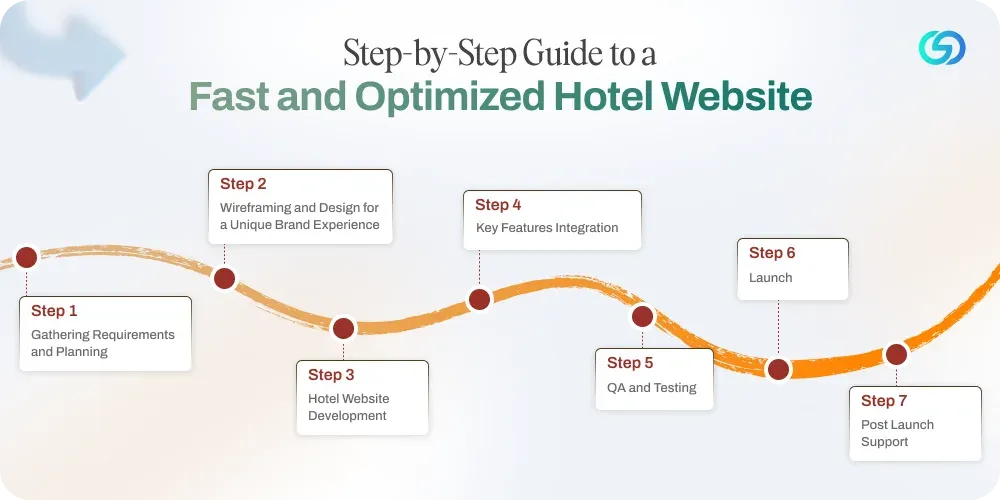
Beginning your hotel website development project can sound daunting, especially when you have an overwhelming amount of information. However, following a simple guideline can ease your task and help you progress faster.
🔶 Step 1: Gathering Requirements and Planning
It is crucial to understand the project’s goal before you begin working on the hotel website itself. Without proper research, you may fail to deliver a website that is warm and welcoming to the target audience. One should also research the desired features for the website.
Before the core development process begins, ask yourself a few important questions, such as:
- Is our target audience tourists, business travelers, or families?
- What key features should we incorporate?
- What is our brand’s identity?
- Are third-party integrations, such as payment gateways or booking APIs, required?
Once you are confident with your answers, focus on the deliverables. Work on a defined project scope, functional and technical requirements, design direction, and brand preferences, along with an agreed timeline and budget.
🔶 Step 2: Wireframing and Design for a Unique Brand Experience
The second step involves crafting wireframes to showcase the hotel website’s layout and navigation structure. After finalizing the wireframe, start by creating the visual design for your website, ensuring it has a unique brand experience for users.
Here’s how you should proceed:
- Wireframing: Sketch basic page layouts and design mockups using tools like Figma, Adobe XD, or Sketch.
- Responsive Design: Make sure your website works on different screen sizes, from mobile and tablets to laptops.
- User Experience (UX) Design: Ensure the user navigation experience is smooth and easy, alongside factors like clear call-to-action buttons.
- User Interface (UI) Design: Work with color schemes that are easy on the eyes, and use images that align with the hotel brand.
Your team should focus on offering a clean UI and UX to the users, so interactivity is easier, and navigation saves time.
🔶 Step 3: Hotel Website Development
The actual hotel website development process is divided into two important phases, namely: frontend development and backend development.
Frontend Development
Frontend development involves bringing the visual design to life using HTML, CSS, and JavaScript. It is coded with interactivity in mind.
- HTML/CSS: These languages structure site content and apply styles.
- JavaScript: With JS, the website receives functionality and interactive features.
- Responsive Design: Make sure the hotel website adjusts well on mobile and tablets.
- Frameworks/Libraries: Frameworks such as Bootstrap work well for responsive design, and libraries like React or Vue for interactive components on the site.
Backend Development
The backend development side handles logic and server-side functionality of the website.
- Content Management System (CMS): Platforms such as WordPress, Joomla, or a custom CMS solution can be valuable for easy content updates.
- Database Setup: Room availability, bookings, and guest information can be stored in databases like MySQL, PostgreSQL, or other similar solutions.
- Booking System: Either develop a custom-built booking system or utilize third-party solutions such as Booking.com API or Hotelbeds.
- Payment Integration: Integrate a strong payment gateway into your hotel website, such as Stripe or PayPal, to streamline booking payments.
- User Accounts: If required, make sure to implement user login functionality for actions like guest management or loyalty programs.
During this stage, your team should focus on delivering proper static and dynamic pages, strong databases, and flawless backend services.
🔶 Step 4: Key Features Integration
In this step, it is crucial to focus on adding important features to your website. These features will ensure that your hotel site goes a long way and converts users.
- Room Booking System: Custom build or integrate a booking system for customers so they can check for available rooms, prices, and reserve them if needed.
- Features: Ability to view calendar, pricing table, and receive booking confirmation email is mandatory.
- Hotel Gallery: Make sure to add image sliders or galleries to showcase hotel rooms, amenities, and surrounding attractions to customers.
- Customer Reviews: Third-party review systems like Google Reviews or TripAdvisor aid your site’s online presence greatly. You can also go for integrating a custom review system.
- Special Offers: Ensure your hotel website is constantly highlighting discounts, special packages, or events from the hotel.
Your hotel's website will be more complete for customers through a proper booking system, gallery, and review sections.
🔶 Step 5: QA and Testing
After the core development part is over, it is time to go through thorough testing before the site goes live. It is an essential part of hotel web development.
These are the types of testing you must conduct before launch:
- Functional Testing: Make sure important features like the booking system, payment gateway, and contact forms are working flawlessly.
- Usability Testing: Ensure the navigation is easy for customers, the call-to-action buttons are simple, and the overall design is user-friendly.
- Performance Testing: Test for load speeds and ensure the site doesn’t break under heavy traffic.
- Security Testing: Make sure your website data is encrypted, especially the payment processing. Also, ensure there are no vulnerabilities against SQL injection and XSS attacks.
- Cross-Browser Testing: Ensure your hotel website looks good on all resolutions, browsers, and devices.
Focus on bug reports, performance test results, and conduct a thorough security audit to ensure your hotel website is working without any issues.
🔶 Step 6: Launch
After ideation, design, core development, and testing, it is time to launch your hotel website. However, it is important that you follow a few strict steps to ensure a smooth deployment.
The steps are as follows:
- Set up a proper web hosting through AWS, Bluehost, SiteGround, or your preferred hosting services.
- Migrate your hotel website to the live server from a staging environment.
- Ensure all your added features are working fine and monitor the website’s uptime.
- Make sure the analytics is set up properly and tracking user behavior.
🔶 Step 7: Post Launch Support
After you launch your hotel website, you must make sure that it receives continuous maintenance support to ensure everything works perfectly and stays up to date. Moreover, post-launch support is also important for the regular security of the website.
Make sure you are doing the following after the website launch:
- Frequently update the website software, security patches, and plugins to ensure safety.
- Monitor things like server uptime and page load times to ensure smooth performance.
- Track feedback given by users and keep making adjustments for improvements.
Tech Stacks for Custom Hotel Web Development
Going for custom development instead of a pre-built CMS platform can also be a good option. And for that, you need to pick up the correct technology stack for gaining optimal performance, scalability, and integration capabilities.
MERN (MongoDB, Express.js, React, Node.js)
JavaScript-based full-stack solution with a unified language.
- MongoDB: Flexible NoSQL database.
- Express.js: Lightweight backend framework.
- React: Fast-loading, dynamic user interfaces.
- Node.js: Efficient server-side processing.
This stack is the best for mid-sized hotels that need real-time booking updates, interactive UIs, and rapid development cycles.
Next.js with Headless CMS (Next.js, Contentful, PostgreSQL)
Modern JAMstack architecture with performance.
- Next.js: React framework with server-side rendering.
- Contentful: Headless CMS offering API-driven content management.
- PostgreSQL: Relational database for transactional booking data.
- Vercel/AWS: Serverless deployment, which is great for automatic scaling.
This stack works great for performance-focused properties that prioritize page speed, SEO rankings, and seamless integration of booking channels.
Laravel with Vue.js (Laravel, Vue.js, MySQL, Tailwind CSS)
A PHP-based enterprise stack that balances productivity.
- Laravel: Comprehensive PHP framework with built-in security.
- Vue.js: Progressive JavaScript framework for responsive frontend.
- MySQL: Reliable relational database for structured hotel data.
- Tailwind CSS: Good for rapid and consistent UI development.
Hotel chains and large properties needing enterprise-grade security can greatly benefit from this technology to stack through its various abilities.
Each stack on the list integrates flawlessly with hotel-specific demands, including PMS connections, channel managers, payment gateways, and analytics platforms. That being said, your choice should align with the development team’s expertise, maintenance structure in the long-term, and specific feature requirements.
Real-World Impact of Hotel Website Design
Hotel web development in 2026 is reaching new heights. A hotel website which is designed through following the correct principles can serve its clients flawlessly for a long time. It helps with conversion and maintaining brand identity.
🔷Responsive Hotel Booking Platform
A responsive hotel booking platform can elevate the customer experience when it comes to booking rooms or services on a property. It has the potential to deliver something elegant even when a user is browsing their options on a phone.
ConvexSol successfully delivered a responsive hotel booking platform for a leading client in the hospitality and travel industry.
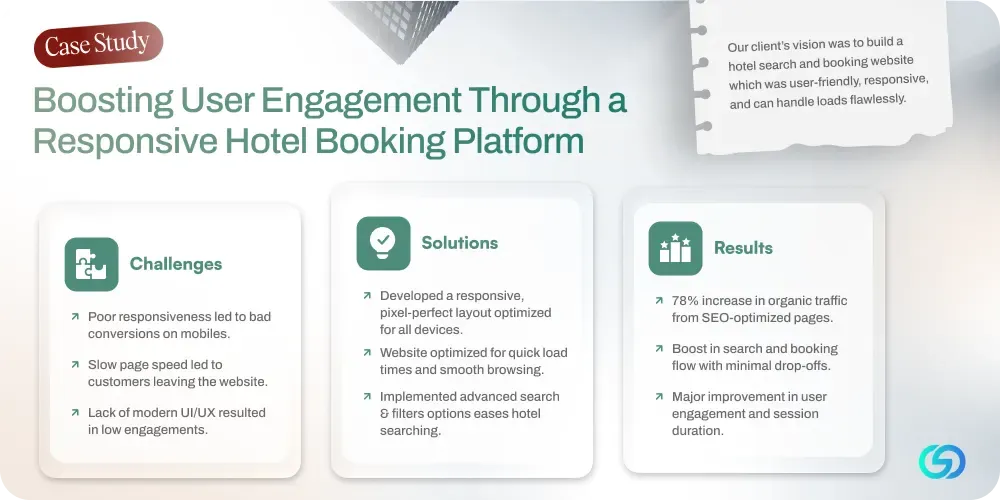
Case Study: Boosting User Engagement Through a Responsive Hotel Booking Platform
Our client’s vision was to build a hotel search and booking website which was user-friendly, responsive, and can handle loads flawlessly.
🔹Challenges:
- Poor responsiveness led to bad conversions on mobiles.
- Slow page speed led to customers leaving the website.
- Lack of modern UI/UX resulted in low engagements.
🔹Solutions:
- Developed a responsive, pixel-perfect layout optimized for all devices.
- Website optimized for quick load times and smooth browsing.
- Implemented advanced search & filters options eases hotel searching.
🔹Results:
- 78% increase in organic traffic from SEO-optimized pages.
- Boost in search and booking flow with minimal drop-offs.
- Major improvement in user engagement and session duration.
Common Challenges in Hotel Web Development and How to Overcome Them
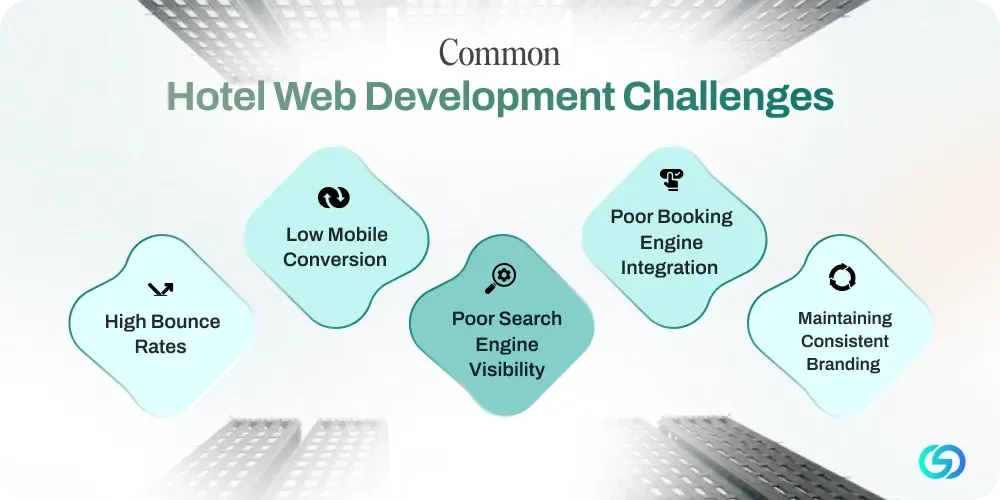
Despite careful planning, hotel web development projects can go sideways and go through obstacles that have the potential to derail timelines, budgets, and performance goals. Understanding these challenges and implementing proven solutions will ensure that your site can deliver maximum ROI from the launch day itself.
➡️ Challenge 1: High Bounce Rates
High bounce rates can happen due to slow page loading speeds or poor content style.
Solutions:
- Implement optimized image compression using WebP or AVIF formats along with lazy loading for below-the-fold content.
- Use content delivery networks (CDNs) and minimize CSS/JavaScript files to ensure fast server response.
➡️ Challenge 2: Low Mobile Conversion
Low mobile conversion can happen due to unfriendly mobile design and complicated paging structure for small screens.
Solutions:
- Redesign your booking engine with a mobile-first architecture that features larger buttons, simple forms, and one-tap payment options.
- Reduce booking steps to three or fewer screens and enable the autofill function for contact features.
➡️ Challenge 3: Poor Search Engine Visibility
Low visibility on search engines usually leads to poor organic traffic and reduced page views over time.
Solutions:
- Conduct comprehensive keyword research that targets long-tail, location-specific terms and optimize all page titles, meta descriptions, and on-page content accordingly.
- Build quality backlinks through local tourism partnerships, guest posting, and Google Business Profile to strengthen local search presence.
➡️ Challenge 4: Poor Booking Engine Integration
Difficulty in integrating booking engines with existing property management systems is a common challenge faced by hotel businesses.
Solutions:
- Choose booking platforms specifically designed for hospitality with pre-built PMS integrations and API connectivity.
- Work with developers experienced in hotel technology stacks and understand channel manager synchronization requirements.
➡️ Challenge 5: Maintaining Consistent Branding
Hotels face a challenge in maintaining consistent branding when they use template-based website builders.
Solutions:
- If you must go for one, go for website builders that offer extensive customization options for colors, fonts, layouts, and component styling.
- Invest in professional photography and custom graphics that reflect your unique property’s unique identity rather than relying on stock imagery.
Strengthening Your Hospitality Website with Strategic Content
The correct content, which is suited for your hotel website, can elevate your user presence and increase brand visibility significantly. Content creation is a critical component of successful hotel web development.
Your website content must simultaneously serve search engines while remaining engaging and aligned with your brand's voice.
⏺️ Homepage Content
The hotel homepage should answer:
- Where is the property located?
- What type of accommodation does it offer?
- What makes the hotel unique?
- How can interested visitors book a room?
You must focus on keeping the homepage as concise as possible, with 150 to 300 words of content to establish credibility and guide visitors towards other key sections.
⏺️ Room and Suite Pages
Focus on dedicating individual pages to each type of room category:
- Detailed descriptions that highlight the unique features.
- Comprehensive list of amenities with bullet points.
- High-quality images showcase various angles.
- Square footage and information on occupancy.
- Pricing transparency or “Check Rates” CTAs.
Integration of secondary keywords naturally.
⏺️ Amenity and Facility Pages
Create separate pages for significant amenities:
- On-site restaurants and dining options.
- Spa and wellness facilities.
- Meeting and event spaces.
- Recreation areas.
- Business services and technology offerings.
Each of the website pages should be targeting specific keywords while offering valuable information that travelers seek.
⏺️ Location and Attraction Content
Develop your content that highlights the advantages of your location.
- Proximity to airports, major roads, and railway stations.
- Tourist attraction spots nearby.
- Nearby restaurants, entertainment hubs, and shopping places.
- Seasonal events and local experiences.
- Interactive maps with distance calculations.
Location-based content can capture travelers who want to reach specific destinations.
Making the Hospitality Website Responsive for Mobile Users
Most of the hotel website visits originate from mobile devices; hence, responsive design is a non-negotiable in hotel web development. Mobile-optimized websites directly impact revenue, as most travel planning and bookings now occur on smartphones.
Responsive hotel web development should ensure that a website can automatically adjust layout and function to fit any screen size, be it desktop, tablet, or smartphone.
⏩ Mobile-First Development Essentials
The mobile-first methodology commences designing with the smallest screen. This ensures clean experiences that can scale up for larger devices. Key priorities for this include:
- Streamlined and thumb-friendly navigation.
- Increased button sizes for easy taps.
- Simple booking system with forms and minimal fields.
- Fast-loading images optimized for cellular connections.
- Mobile wallet integration like Apple Pay or Google Pay.
⏩ Critical Mobile Optimization Requirements
Speed and Performance
Most mobile users lack patience and cannot handle slow load times. It is important to accelerate performance through aggressive image compression, minimized code files, browser caching, and content delivery networks.
Mobile Booking Functionality
Offer a seamless booking experience through booking engines that convert visitors into guests. Ensure clear checkout flows, few booking steps, autofill support, safe mobile payments, and instant confirmation of delivery.
Navigation Enhancements
Add smooth hamburger menus, sticky headers to keep CTAs accessible, click-to-call phone numbers, and GPS-powered directions to your property.
Monitoring Mobile Performance
Utilize Google Analytics to track mobile bounce rates, session durations, conversion rates, and cart abandonment. If the mobile bounce rates cross more than half or conversions are much lower than desktop, then it is a critical issue that demands immediate attention to prevent revenue loss.
Final Thoughts
Hotel Web Development in 2026 is much more than just building an attractive online presence. It is about building a strategic revenue channel that reduces dependence on commission-heavy OTA platforms. It should work as your front desk, brand storyteller, and booking engine simultaneously.
Successful web development for hotels should always prioritize mobile-responsive design, integrated booking technology, fast loading speeds, and comprehensive SEO optimization. Through focusing on user experience and clear calls-to-action, your website becomes a competitive advantage, driving more direct bookings and superior market visibility.
Your hotel web development project must continue to evolve alongside traveler expectations and technological advancements of the industry itself. This is why working with a leading company like ConvexSol will ensure that your property benefits from specialized hospitality expertise, cutting-edge technology integration, and strategic optimization. This keeps your hotel business competitive in the digital marketplace.
With years of experience and hundreds of positive feedback from our clients under our belts, we, as a professional partner, understand the nuances of hotel operations, booking psychology, and conversion optimization. Choose to invest wisely in hotel web development, so your business can grow and become a powerful, revenue-generating asset.
Frequently Asked Questions
What is the timeline and cost of building a hotel website?
Basic hotel websites can cost between $5000 to $15000 and take 2 to 4 weeks. Custom websites with advanced features can range from $15000 to $50000 and require 8 to 16 weeks. Enterprise platforms often exceed $50000 and can take 4 to 6 months of development, testing, and launch with complex integrations.
How often should one update their hotel website?
Update your CMS platforms immediately when a new version is available with security patches. Refresh content monthly with special offers and blog posts for SEO. Make weekly backups before major changes. Also, update your photo galleries and guest reviews on a quarterly basis so you can maintain authenticity and social proof.
Is WordPress good for small hotel websites?
Yes, WordPress is excellent for small hotels. It delivers thousands of hospitality-specific themes and booking plugins like WP Hotel Booking. Its user-friendly interface does not require any technical expertise, features strong SEO functions with Yoast, and offers cost-effective solutions with both free and premium options available.
What are the known ADA compliance requirements for hotel websites?
Hotel websites should meet WCAG 2.2 standards for accessibility. The requirements include screen reader compatibility, keyboard navigation, sufficient color contrast, video captions, and image alt text. Always display detailed accessibility information regarding physical features like roll-in showers, bed configurations, and accessible amenities with legal accessibility statements.
Do I need separate mobile and desktop versions of my hotel website?
No, building the hotel website with a responsive design in mind can eliminate the need for a separate version. Modern hotel websites use responsive architecture that automatically adapts to all screen sizes, from desktops and laptops to tablets and smartphones. This approach is cost-effective, ensures consistent branding, and performs better in search engine rankings compared to maintaining multiple versions.
Is it possible to migrate from an existing hotel website to a new platform without losing SEO rankings?
Proper migration planning will preserve SEO rankings, so it is possible. Implement 301 redirects from old URLs to the new page, maintain existing meta titles and optimized content, and preserve URL structures when possible. Submit updated XML sitemaps to Google Search Console immediately and monitor analytics for 30 to 60 days after the migration.
What are some of the security measures that I should include in my hotel website beyond SSL certificates?
Install security plugins offering firewall protection, malware scanning, and brute force prevention. Implement automated backup, two-factor authentication for admin access, and PCI-DSS compliance for payments. Apply security headers, disable file editing in CMS platforms, limit login attempts, and conduct frequent audits for security.
Can LLMs do SEO for my hotel website?
Large Language Models (LLMs) can help you with SEO tasks like keyword research, content optimization, meta description writing, and generating SEO-friendly blog topics. They cannot independently execute technical SEO implementations, build backlinks, or replace human oversight for strategy. LLMs can work as a tool that supports an overall SEO strategy, but not as a standalone solution.
Is there a difference between template-based and custom hotel website development timelines?
Yes, timelines can differ slightly. Template-based websites typically launch within 4 to 6 weeks with standard features. Custom websites require 8 to 12 weeks for unique designs and integrations. Complex multi-property platforms often need 16 to 24 weeks because of advanced features, extensive integrations, and thorough testing requirements.