- 2025-11-19
How Microsoft Power Apps Are Revolutionizing the Healthcare Industry?
Audio Track
Table of Contents
Key Takeaways:
- Microsoft Power Apps is a versatile platform, helping businesses with patient management, data management, and offering streamlined workflows.
- The global healthcare IT market is estimated to reach $974.5 billion in 2027.
- Traditional healthcare app development and Power App development differ in terms of development speed, ease of use, deployment and cost, scalability, and project complexity.
- Top use cases of Power Apps in healthcare include remote patient monitoring and telehealth support, automation of administrative tasks, resource allocation and staff scheduling, simplifying compliance and reporting, and more.
- Apart from Power Apps delivering personalized patient experiences, it also offers an increase in staff productivity, robust security, seamless integration, smart decision-making, and scalability.
Why Are Power Apps Transforming Healthcare?
Think about it: Your hospital’s outdated scheduling system crashes right before a busy day. Or your medical staff remains consumed by paperwork, failing to meet the patient's needs. These kinds of situations can disrupt the daily work process of a healthcare facility, a place that sees numerous patients walking everyday.
But that’s the bitter truth; healthcare organizations are grappling with the same challenge. So, the question arises of how you modernize the operations without breaking the bank or waiting for years for IT to deliver something that’s not already outdated.
The answer is Power Apps for healthcare.
The global healthcare IT market is estimated to reach $974.5 billion in 2027, highlighting the demand for a scalable, cost-effective, and robust digital solution.
Traditional app development methods take several months to even years to develop and use. Power Apps transform the entire script in just a few days.
What Power Apps Brings to Healthcare Organizations?
A versatile platform, Microsoft Power Apps empowers businesses to opt for custom apps. The healthcare sector has diverse needs, such as patient management, data management, and the need for streamlined workflows, and Power Apps in healthcare can greatly benefit in many ways.
Power Apps shortens the development time and allows customization, aiding healthcare businesses to digitize processes faster with the help of skilled developers who understand healthcare operations.
Power Apps for healthcare enable healthcare professionals to use a wide range of apps, like patient monitoring or Electronic Healthcare Records. The easy-to-use interface and pre-built templates help the healthcare industry get started with application development.
How Power Apps Differs from Traditional Healthcare App Development?
Confused between continuing to use your traditional system vs. opting for Power Apps? Let us clarify it for you:
| Aspect | Power Apps | Traditional Apps |
|---|---|---|
| Development Speed | Renowned for rapid development, allowing users to create functional apps in a matter of a few days or even hours. | A slow process, involving manual coding, complex development process, and thorough testing. |
| Ease of Use | Provides medical professionals & customers with a smooth visual interface. | Need higher coding expertise—less accessible to non-technical individuals. |
| Faster Deployment & Cost-Efficiency | Offers rapid and cost-effective scalability, allowing frequent updates and fixes without large financial investments. | Used for complex projects that require a unique user experience and customization—justifying longer development cycles. |
| Scalability and Project Complexity | Best for apps with moderate scalability that prioritizes speed of development rather than extreme scalability. | Way to go for large apps that need extensive functionality. |
Top Use Cases of Power Apps in Healthcare
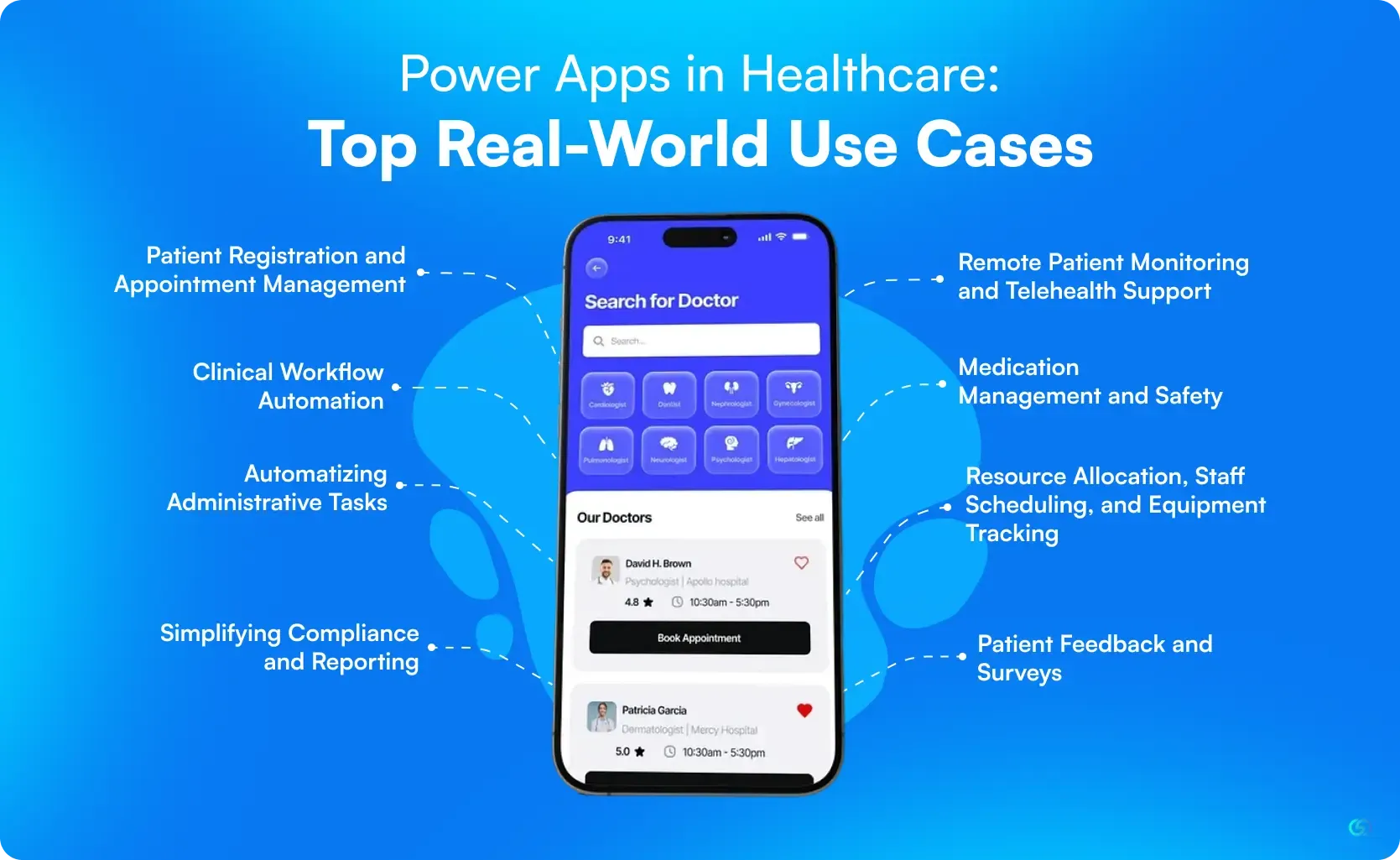
Microsoft Power Apps in healthcare sector develops advanced applications that carry out crucial business activities while on the go. As healthcare professionals come across various difficulties throughout the day, Power Apps are here to improve patient care and boost their experience all the while streamlining the workflow.
Power Apps have already started showing their impact. As per a Forrester report, businesses leveraging Power Apps witnessed more than 180% ROI over three years.
Whether you’re a healthcare startup, hospital admin, or part of a large medical network, partnering with experienced Power Apps developers will transform the manual workflow into an automated one without disrupting the ongoing care process.
With the advancement in technology and change in user demand, we have identified a few stand out benefits and use cases of Power Apps in healthcare. Let’s look into it:
🔷 Patient Registration and Appointment Management
Ever since the advent of Power App in healthcare, patient registration and appointment management have transformed. Earlier, this manual process involved endless phone calls and manual data entry, which sometimes led to inefficiencies, lost records, and long queues. Power Apps offer custom solutions that automate the patient registration and appointment management process.
For example, patients can fill out forms online and securely enter personal details, like insurance information or medical history. Due to the user-friendly interface, patients can view available slots in real-time. Additionally, it also delivers personalized experiences for patients that boost user engagement.
🔷 Remote Patient Monitoring and Telehealth Support
In cases where patients reside in remote locations, they are unable to attend hospitals or clinics but require high-quality care; Power Apps prove to be highly beneficial. Leveraging Power Apps to develop a telehealth app is an excellent choice. The rise of telemedicine apps has completely changed healthcare, offering great patient care experience.
AI-powered tools can access patient data and notify regarding their health even before the consultation. Telehealth offers video conferencing, which is best for patients living in remote areas. Additionally, digital prescriptions can be sent for medicine availability and delivery securely.
🔷 Clinical Workflow Automation
Traditional clinical operations included a massive number of manual tasks, right from appointment scheduling, patient check-ins, results tracking, and more. Such tasks were time-consuming and often led to errors, hampering patient care. Power Apps in healthcare can address these hurdles by building customized apps that automate and eventually streamline workflows.
For example, Power Apps automate check-in processes, allowing patients to self-register appointments online. The data is securely and automatically updated in the Electronic Health Record (EHR) system, which doesn't require the users to enter data manually. This leads to minimal human errors and enhanced outcomes.
🔷 Medication Management and Safety
Traditional medication management requires manual tracking, whereas Power Apps automates tracking and administering medications with custom apps. For example, medical institutions can build a medication management app that helps patients receive medication schedules or set reminders for dosages. This improves patient experience and better health outcomes.
🔷 Automatizing Administrative Tasks
Myriads of administrative tasks in the healthcare industry can be automated with the help of Power Apps. These apps make the patient registration and onboarding process easy, reducing wait times and manual data entry. Customized apps streamline patients’ intake forms to make sure the details are accurate.
Inventory management is important in the healthcare sector, and it’s best to avoid stock shortages or overstocking. Power apps allow healthcare facilities to streamline inventory management systems. Real-time insights can signal low inventory and expiration of medical items.
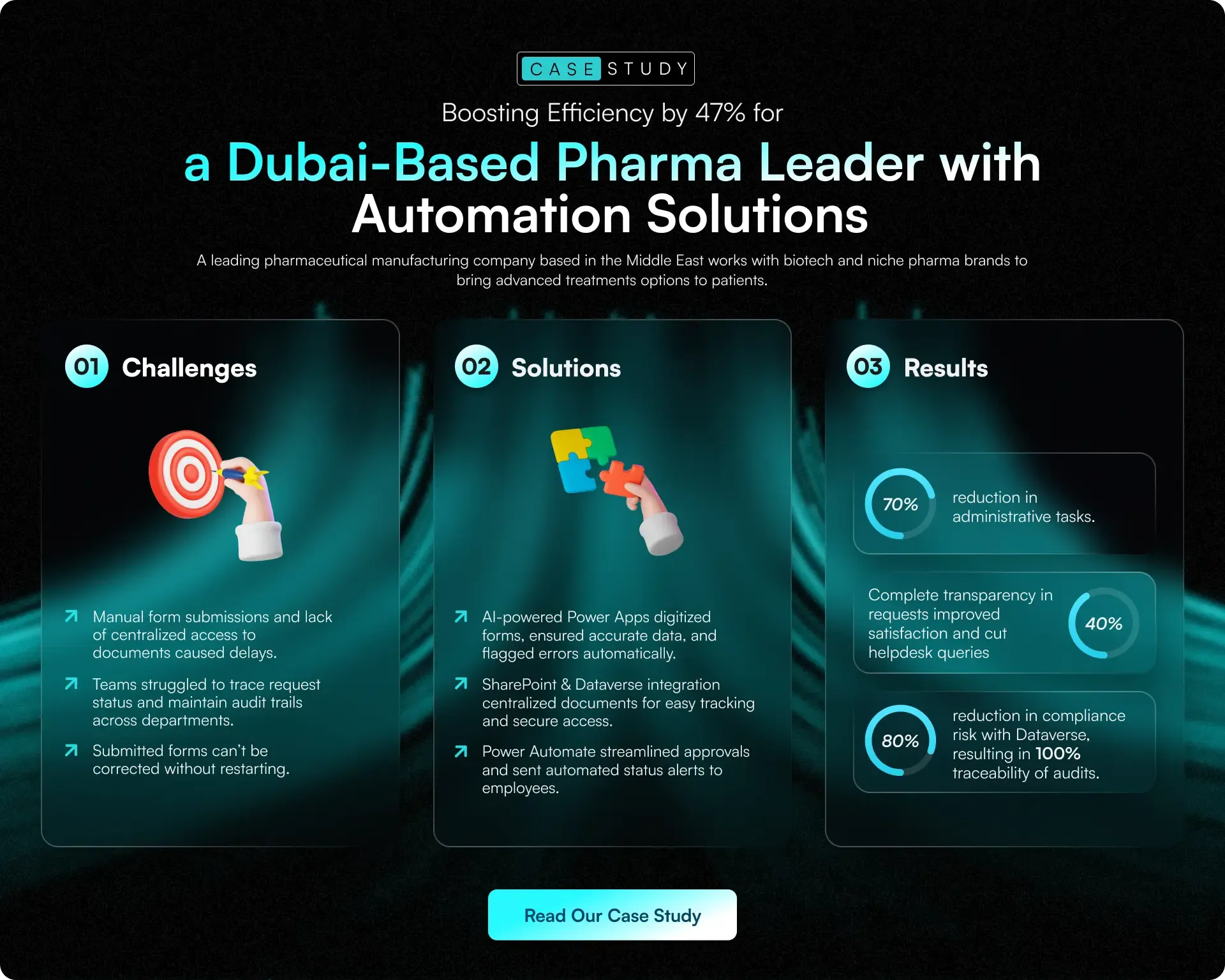
Building on these possibilities, we helped our client automate complex administrative workflows and boost efficiency, learn how:
🔷 Resource Allocation, Staff Scheduling, and Equipment Tracking
Healthcare businesses must manage medical supplies, staff, and equipment. Power Apps for healthcare manage operations by offering smart solutions to optimize resource allocation.
Staff Scheduling
Burnout is quite frequent in the healthcare sector; therefore, to prevent this, balancing your staff's workload is quite important. Power Applications automates patient appointment scheduling, which means the medical staff is allotted to the task based on their availability, efficiency, and workload.
- Smart shift scheduling minimizes overtime for medical staff
- AI-powered notifications alert staff regarding any changes in the schedule.
Equipment Tracking
Medical equipment is a crucial factor in healthcare. Power Apps aids corporate hospitals to keep track of equipment maintenance and their repair status.
- Integration with procurement systems ensures timely equipment replacement, helping maintain uninterrupted patient care.
- Automated reminders lead to on-time maintenance, increasing the overall efficiency of the hospital.
- Medical device and equipment tracking in real-time gives important data to admins to maintain the entire setup.
🔷 Simplifying Compliance and Reporting
The healthcare industry needs to adhere to strict guidelines due to crucial patient data. HIPAA and GDPR regulations need to be followed to avoid facing lawsuits. Healthcare institutions can automate compliance with workflows with Power Apps, reduce overheads, and ensure regulatory adherence.
Power Apps is developed and designed to ensure compliance with the following standards by:
- Encrypting patient sensitive data both in transit and at rest.
- Using Role-Based Access Control (RBAC) to restrict unauthorized access to data.
- Maintaining audit trails to track when data is accessed and modified.
- Ensuring easy integration with cloud-based solutions that are compliant, such as Microsoft Azure, to securely store data.
Power Apps allow medical organizations to build trust among patients and comply with regulatory needs easily.
🔷 Patient Feedback and Surveys
The traditional way of collecting patient feedback involved the use of paper forms or basic online questionnaires that failed to provide insights to improve patient care delivery. Enter Power Apps—a smart way that addresses the healthcare industry challenges and helps organizations develop custom survey apps that allow patients to provide real-time feedback and suggestions.
Power Apps create engaging survey forms customized to each patient to power high response rates. The feedback and surveys allow healthcare experts to create a culture of continuous improvement and a more patient-centric experience.
Key Benefits of Power Apps for Healthcare Organizations
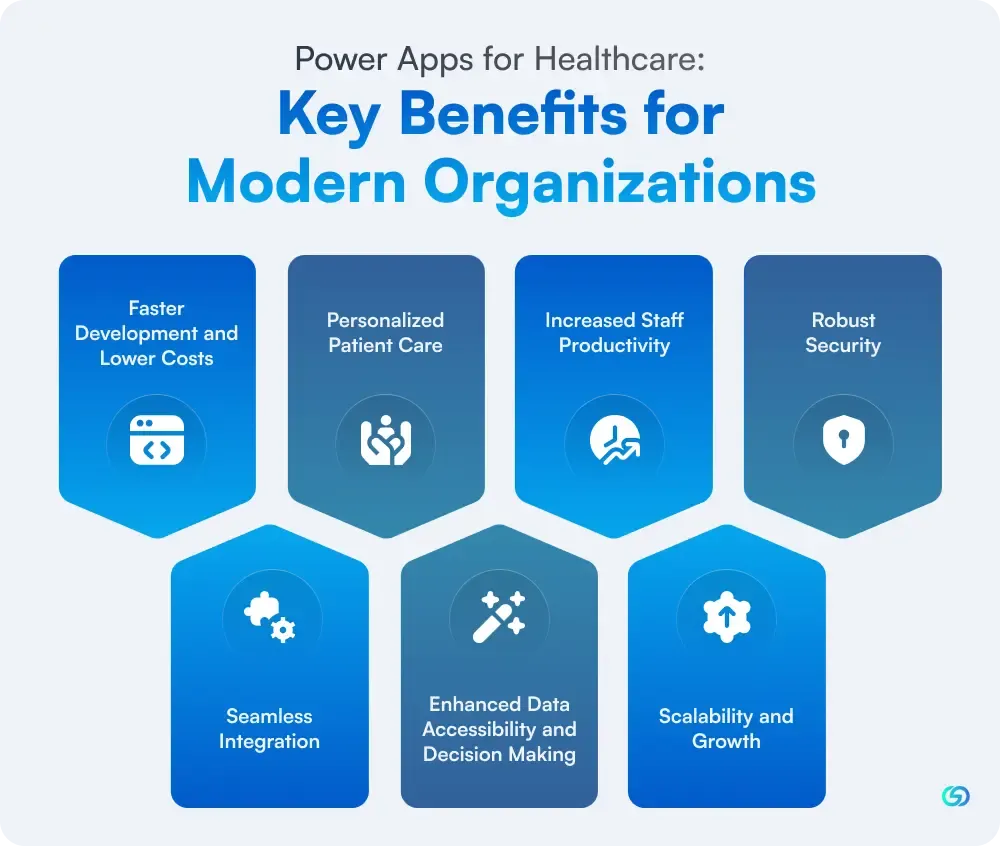
Today, healthcare apps that are just “good enough” are simply not enough. Microsoft Power Apps is revolutionizing healthcare apps, and partnering with expert providers who offer a unique blend of innovation, agility, and quality. In a sector where every second and resource matters, Microsoft Power Apps offers multiple benefits. Let’s look at Power App healthcare benefits:
➡️ Faster Development and Lower Costs
Typically, healthcare app development requires lengthy timelines, complex coding, and heavy investment in large IT teams. With Power Apps, healthcare organizations can create apps much more quickly through a low-code framework.
When experienced development partners take care of this for the healthcare organization, they provide fully customized solutions with a much quicker timeline and cost than building from scratch. This means a faster timeframe for deployment, less reliance on large internal teams, and more budget available for core patient care.
➡️ Personalized Patient Care
The use cases of Power Apps in healthcare go far beyond simple digitization; they address real-world challenges faced by medical experts everyday. Power Apps deliver personalized patient experiences with custom-built apps. Medical professionals can help access patient data, track progress, and offer tailored plans in real-time. For example, clinicians can create apps that monitor chronic patient conditions, send follow-up reminders, all aligned with the patient’s health journey.
➡️ Increased Staff Productivity
Power Apps free up valuable time for the doctors, nurses, and other medical staff, which eventually results in streamlined workflows. A healthcare provider leveraging Power Apps can cut down more than 500 hours of admin work annually. These time savings help medical experts focus on patient care and reduce burnout.
➡️ Robust Security
Leveraging Power Apps for healthcare ensure your patient data is protected at all times with advanced RBAC and built- in compliance features. Only authorized individuals can access the particular data, reducing the risk of data breaches.
One of the major benefits is the ability to integrate with Microsoft’s various security tools, safeguarding your sensitive information. Power Apps also complies with a range of industry standards, ensuring that the app meets strict security requirements.
➡️ Seamless Integration
Power Apps can seamlessly integrate with Teams, Power BI, SharePoint, and Dynamics 365, creating a unified data ecosystem. Integration prevents data silos, which ensures that the patient’s details remain easily accessible across various platforms. A unified view of data enables healthcare providers to make well-informed decisions based on the patient’s medical history and current health status.
➡️ Enhanced Data Accessibility and Decision Making
Facilitating better data accessibility and management, Power Apps ensures that patient’s sensitive data is handled securely. Healthcare professionals can leverage the app to easily access data on the go, enabling smart decision-making and more personalized patient care. Be it patient records, lab results, or medication details, Power Apps makes it accessible during emergencies.
➡️ Scalability and Growth
Power Apps offer robust platforms for developing apps that can adapt and grow with your business. Power Apps offers flexibility, allowing you to expand your existing app as your business evolves. Power Apps help scale your app without having to start from scratch and improve existing features or add new functionality.
Additionally, Power Apps collaborates with teams, allowing multiple users to work on app development, making it easier to iterate and enhance apps quickly. This collaborative environment, along with the ease of integration with other Microsoft tools, makes Power Apps a robust solution for healthcare businesses looking to stay responsive and agile in the ever-changing market.
Why Choose ConvexSol for Power Apps for Healthcare Solutions?
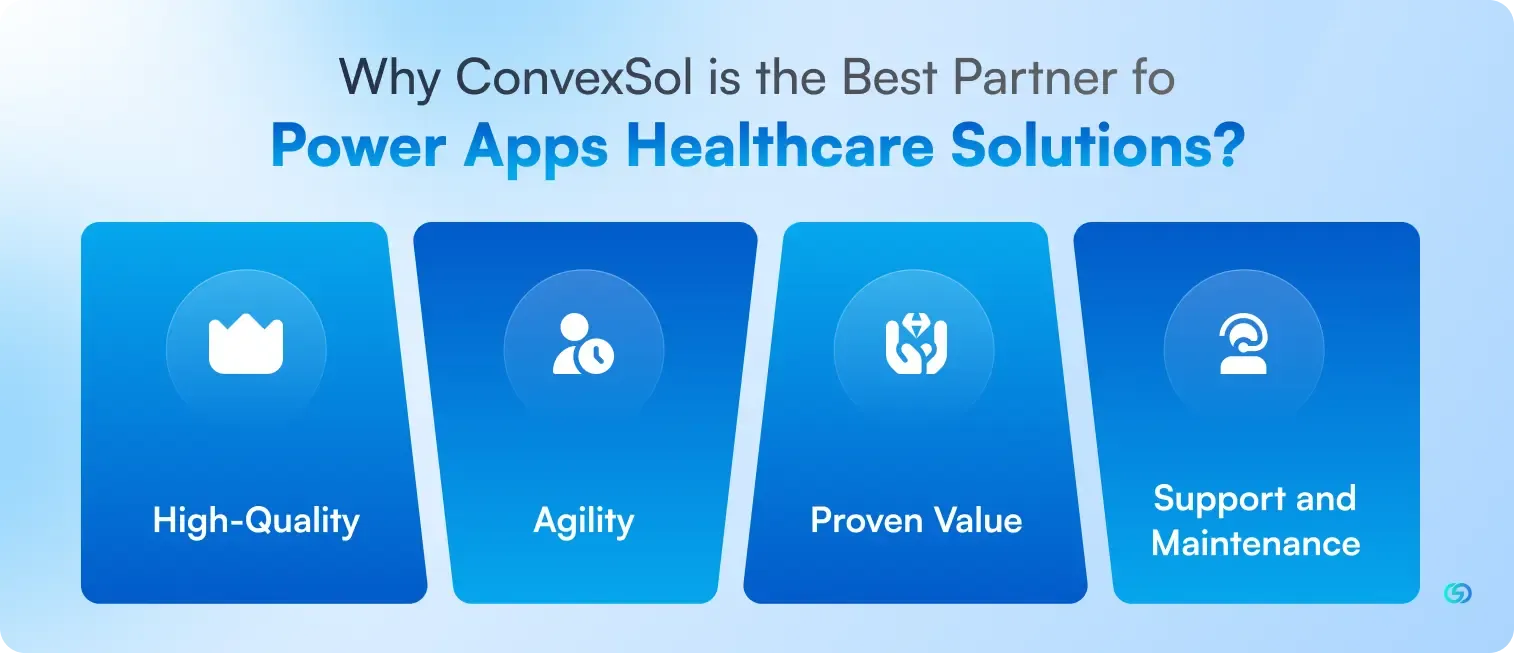
When it comes to the healthcare industry, remember your choices have far-reaching consequences. That’s why the development of Power Apps in healthcare industry can transform the way patients interact, make business more streamlined, and medical staff find more time for patient care.
Healthcare digital transformation needs more than just technical knowledge; it requires domain skills, a security-first mindset, and a client-oriented approach. At ConvexSol, we bring all of this to the table with hands-on expertise. As your go-to company, we provide secure, scalable, and compliant Power Apps.
Here’s why businesses from across the world trust us for Power Apps in healthcare solutions:
1️⃣ High-Quality
While developing Power Apps, we provide security audits and test everything, like backend connections and user interactions, to ensure everything works smoothly for the users.
2️⃣ Agility
Backed by years of experience in healthcare application development, we have designed processes that help respond quickly. Collaborating with us ensures that you don’t need to wait around for years for your next innovation.
3️⃣ Proven Value
Not just healthcare, we have delivered unparalleled solutions to the finance, legal, and education industries where accuracy and compliance are highly essential. Traversing through major and multiple industries offers us a unique understanding of regulatory frameworks and risk management, providing measurable outcomes for our healthcare clients.
4️⃣ Support and Maintenance
ConvexSol offers ongoing support and maintenance services, which include scalability and feature enhancement options that ensure your Power App solutions evolve along with your organization. Partnering with us allows you to deploy your solution faster without compromising on quality.
Conclusion
Healthcare is evolving at all stages, and patient expectations are rising. Collaborating with the right partner can help you understand the difference between delayed care and transformative efficiencies with Power Apps. We have expertise and an efficient team that can build secure and compliant solutions.
Have you been waiting for the perfect time to change your existing processes? Accelerate innovation, streamline care delivery, and let us build meaningful digital experiences with Power Apps.
Frequently Asked Questions
Are Power Apps secure for healthcare data?
Yes, Power Apps offer enterprise-grade security suitable for healthcare data. Key security features include end-to-end encryption, role-based access control, multi-factor authentication, data loss prevention policies, audit logging and monitoring, network isolation options, and more. However, companies must maintain proper governance to ensure ongoing security.
Can Power Apps integrate with existing healthcare systems?
Absolutely. Power Apps offer extensive integration capabilities with varied systems such as EHR, lab, imaging, scheduling, Microsoft ecosystems, custom APIs, and legacy systems. This integration eliminates data silos and creates unified workflows.
How do Power Apps ensure compliance and security?
ConvexSol helps healthcare businesses ensure Power App compliance and security through various mechanisms, such as HIPAA compliance setup, access control, data protection, integration security, monitoring, and training. By implementing these mechanisms, our team ensures healthcare businesses meet regulatory requirements while maintaining robust security for patient data.
What role does AI play in Power Apps for healthcare?
AI in Power Apps for healthcare automates tasks, helps make smart decisions, and personalizes patient care by integrating AI Builder models. AI Builder extracts details from medical forms, detects patterns in patient records, and assists with early diagnosis by integrating predictive models.