- Taxi App Development
- 2026-06-10
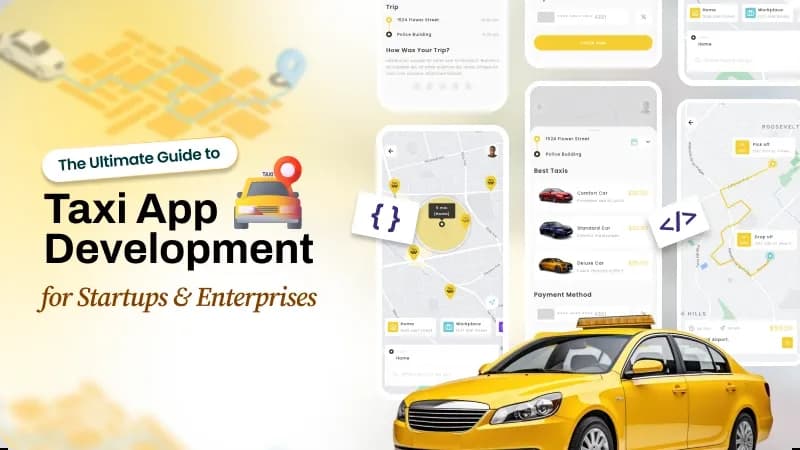
The Ultimate Guide to Taxi App Development for Startups & Enterprises
Audio Track
Table of Contents
Key Takeaways
- Successful taxi platforms need 3 main components, such as rider app, a driver app, and an admin dashboard, working easily together for ensuring seamless operations and user satisfaction.
- Important functionalities such as real-time GPS tracking, fare estimation, secure payments, ride scheduling, and safety tools directly affect customer reliability and complete platform success.
- The complexity of the app, feature set, technological stack, choice of platform, and third-party integrations largely influence the complete development budget.
- AI-powered dispatch systems, autonomous vehicles, EV integration, and Mobility-as-a-Service platforms are redefining taxi app development’s future.
- Partnering with an experienced Taxi app development company ensures security, scalability, performance optimization, and long-term competitive benefit in the ride-hailing market.
Overview- The Taxi App Market Landscape
The taxi industry has undergone various changes over the years. It is no longer about waving your hand to stop a taxi or calling a dispatcher to get a rise has now changed into something much bigger. At present, people expect to book rides via apps, and brands such as Uber and Lyft have become the norm.
Taxi apps have generated $59.6 billion in 2024, which was a 27.6% increase than the previous year. The Uber application made the maximum revenue, contributing to 42% of the total market revenue. In 2024, 425 million people used taxi applications. Uber had a market share of 76% in the US and about 70% in the UK. In the Indian share market, Rapido had the highest market share, beating out Uber and Ola Cabs.
In this writeup, we will explore the benefits, type, features, taxi app development process, costs, latest trends, and so on.
Business Benefits of Taxi App Development
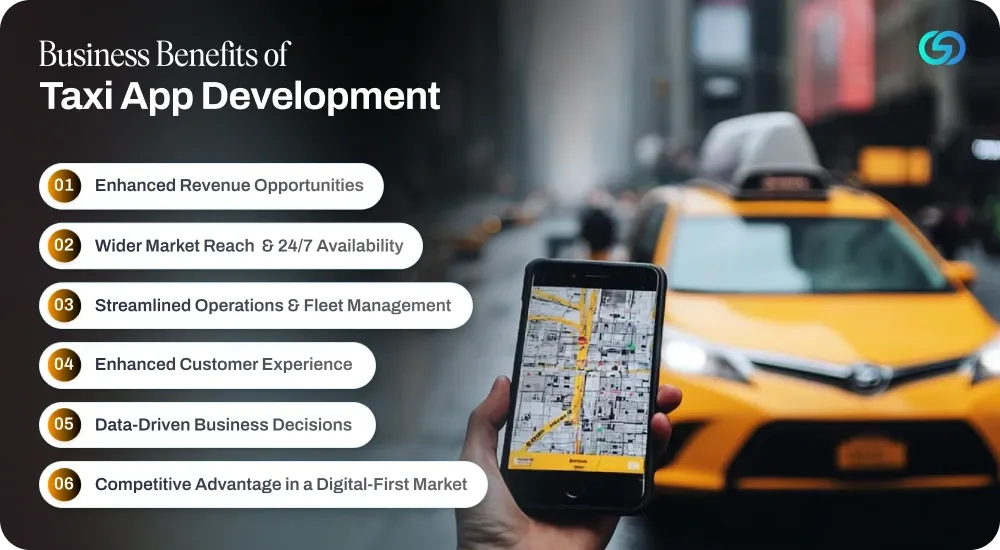
The worldwide ride-hailing industry, led by platforms such as Lyft and Uber, has transformed the way people travel daily. For business owners, fleet owners, and transportation companies, investing in taxi app development is not an option but a strategic move towards digital growth. Here are the main business benefits:
▶️ Enhanced Revenue Opportunities
A taxi app develops several streams of revenue beyond the standard ride fares. Businesses are capable of implementing subscription plans, surge pricing, commission-based driver models, in-app advertisements, and premium ride categories. This kind of diversified approach of monetization largely boosts profitability in comparison to traditional taxi services.
▶️ Wider Market Reach & 24/7 Availability
Unlike the offline taxi services, which are limited by call-based bookings or by physical presence, a mobile app allows customers to book rides anywhere and anytime. With automated dispatching and real-time GPS tracking, businesses are capable of expanding their area of service and serving a broader customer base without increasing the manual workload.
▶️ Streamlined Operations & Fleet Management
Taxi apps help in centralizing driver allocation, ride requests, trip tracking, and payments, everything within a single system. Admin dashboards enable business owners to monitor fleet performance, handle commissions, track driver activity, and analyze ride data, decreasing operational errors and enhancing efficiency.
▶️ Enhanced Customer Experience
Features like fare estimation, real-time ride tracking, several payment options, ratings and reviews, and immediate notifications improve user convenience. A simplified digital booking experience develops trust, encourages repeat bookings, and strengthens loyalty of the brand.
▶️ Data-Driven Business Decisions
Taxi apps collect crucial data on the behaviour of the user, peak booking times, popular routes, and driver performance. This data helps businesses in optimizing the pricing strategies, allocating the drivers efficiently, finding out high-demand zones, and plan strategies of expansion depended on actual demand trends.
▶️ Competitive Advantage in a Digital-First Market
With the increasing dominance of app-based transportation services, traditional taxi operators risk losing customers without a digital presence. A professionally developed taxi app positions your business as reliable, modern, and tech-enabled, enabling you to effectively communicate with established ride-hailing platforms.
The Most Popular Taxi Applications in the World
| App | General Info | Description | Key Statistics |
|---|---|---|---|
| Uber | Founded in 2009 Location: Founded in the USA, it works in Australia & New Zealand. Bangladesh, India, Hong Kong, Japan, and South Korea in Asia. Bahrain, Saudi Arabia, and the United Arab Emirates in the Middle East. Canada, Mexico, and the United States are in North America. Germany, Spain, Italy, and Portugal are in Europe. Colombia, Chile, and Brazil are in South America. | Uber is an indisputable market leader of taxi apps. The app owns 71% of the global market share in the industry of ridesharing. | Market share: 71% Revenue: $14.46 billion 93 million monthly app users 1.44 billion rides completed every quarter |
| Lyft | Founded in 2012 Location: Founded in the USA, it works in the USA and Canada in North America. It operates in France, Austria, Greece, Germany, Italy, Ireland, Spain, Poland, and the United Kingdom. | Lyst is the second most used taxi app in the list. The company covers around 25% of the USA’s ride-hailing services. | Market share: 29%. Revenue: $3.2 billion. 13.5 quarterly active rides. |
| Curb | Founded in 2012. Location: Curb was founded in New York. It operates mainly in the United States in cities including Chicago, New York City, Los Angeles, Las Vegas, and Miami. | Curb is a renowned solution for taxi rides in the USA that provides a range of B2C, B2B, and B2G services. | Revenue: $ 12.6 million. 10+ monthly trips. 100K+ drivers |
| DiDi | Founded in 2012 Location: Founded in China, it also operates in Brazil, Mexico, Colombia, Peru, Costa Rica, Panama, Argentina, and the Dominican Republic. | DiDi is a Chinese version of Uber and is the only taxi riding solution in China. | Revenue: $21.63 billion. 60 million daily grips world-wide. 15 million annual active drivers |
| Ola Cabs | Founded in 2010 Location: Founded in India, it operates in 250+ cities in India. It also works in various cities in Australia, New Zealand, and the UK. | Ola Cabs is the largest ride-sharing application in India that works in 250+ cities. | Market share: 50% of the ride-hailing market in India. Revenue: $340 million. 1.5 million daily rides. |
| Grab | Founded in 2012 Location: Founded in Malaysia, it operates in Malaysia, Singapore, Philippines, Indonesia, Thailand, Vietnam, Cambodia, and Myanmar in Southeast Asia. | Grab is a multinational taxi-hailing solution offering transportation services, food delivery, and digital payments services. | Revenue: $82.8 million. 48 million daily rides. 187 million users. 2.8 million drivers. |
| Bolt | Founded in 2013.Location: Founded in Estonia, it operates in UK, Germany, Poland, France, Romania, Estonia, Latvia, etc, in Europe. South-Africa, Ghana, Tanzania, Kenya, Egypt and Uganda. Geogia, Azerbaijan, Saudi Arabia, Kazakhstan, Iraq, and UAE. | Bolt is another multinational ride-hailing solution that wors in 35 countries in North America, Europe, Africa, and the Middle East. | Revenue: $82.8 million. 48 million daily rides. 187 million users. 2.8 million drivers. |
| Cabify | Founded in 2011. Location: Founded in Spain, it operates in Madrid, Barcelona, Valencia, Alicante, Murcia, etc. Santiago, Calama, Valparaíso, Concepción, and Iquique. | Cabify is one of the most well-known providers of taxi-hailing in Spain, South America, and Portugal. | Revenue: $516 million. 33 million users registered. 400,000 drivers |
| Careem | Founded in 2016. Location: Founded in Dubai, UAE, it operates in Egypt, Bahrain, Jordan, Iraq, KSA, Kuwait, Morocco, UAE and Qatar. | Careem is a taxi company in the Middle East and the most popular solution for transportation in Dubai. In 2020, Uber acquired Careem for $3.1 billion. | 4.3 million yearly rides. 46% of users turn to Careem for the leisure trips. 52% of customers in the UAE utilize Careem for the leisure trips. |
Type of Taxi Booking App
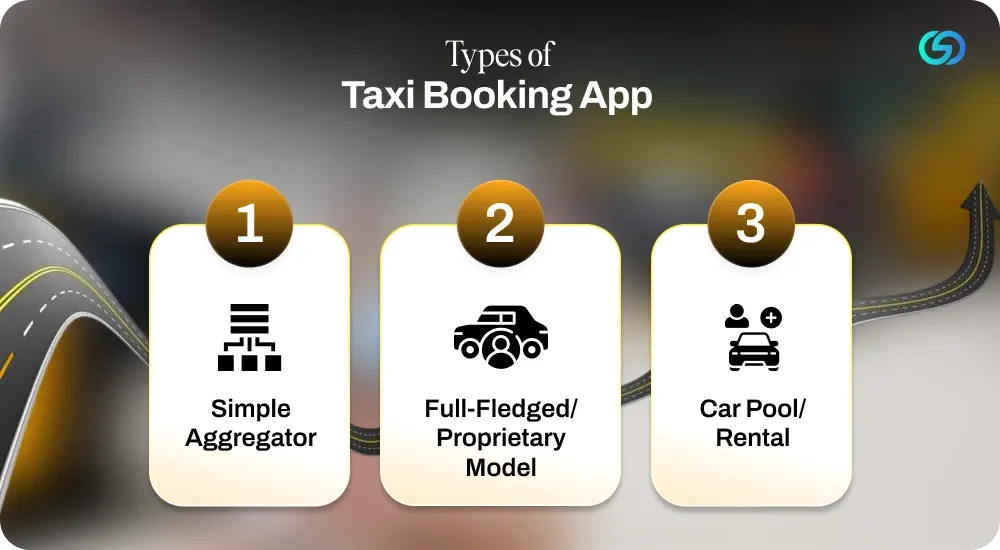
As deciding to develop a taxi app is a big decision for your business, the type of app you go for drastically impacts the cost of taxi app development.
1️⃣ Simple Aggregator: This app type connects users to the already existing taxi companies. It does not handle its own drivers or fleet. It is the most affordable option. It only routes requests.
2️⃣ Full-Fledged/Proprietary Model: Think about Uber or Lyft. This is a complete end-to-end ecosystem. It needs three separate apps, i.e., passenger app, driver app, and a complex Admin Panel. This is expensive. You require real-time tracking, payment processing, and complex driver management. This model involves high complexity.
3️⃣ Car Pool/Rental: This involves add-on features such as handling peer-to-peer car sharing. This adds unique logistical challenges. Expect higher development time. The more the features, the higher the cost of development will be.
Core Components of a Taxi App
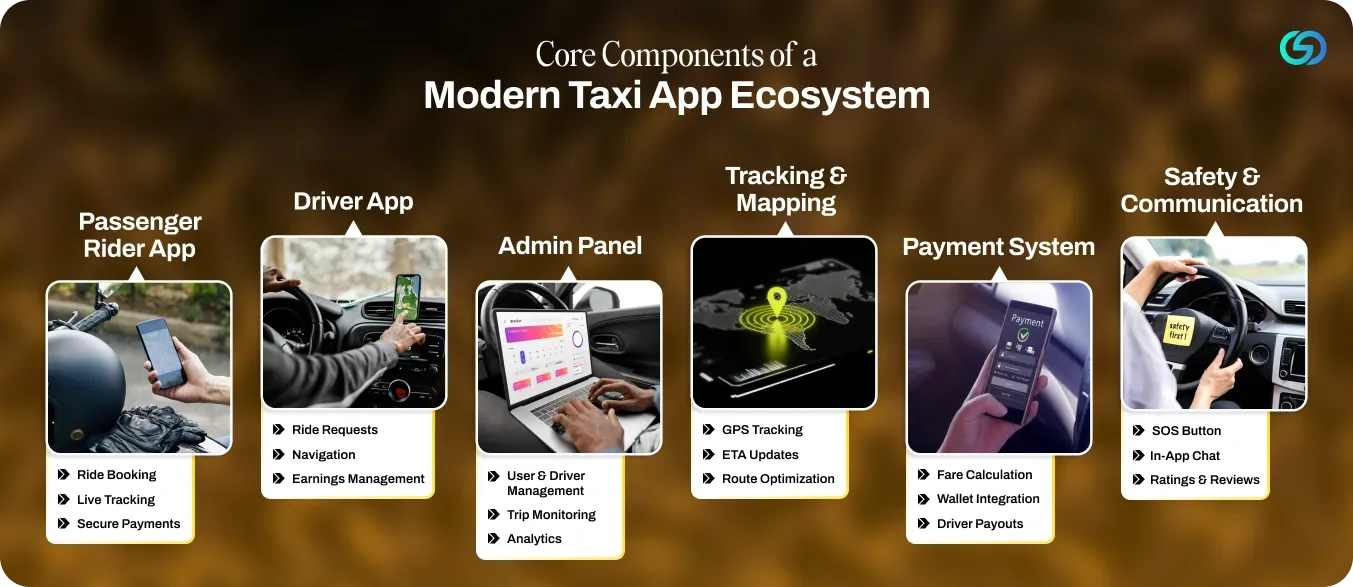
A high-performing taxi platform is not developed around a single application; it is an ecosystem of interconnected modules that work together easily. Starting from rider booking to navigation of the driver and backend analytics, each layer plays a strategic role in user satisfaction and operational efficiency. Partnering with an experienced Taxi app development company ensures that these components are crafted for security, scalability, and long-term growth.
⏩ Passenger Rider App
Purpose:
The rider app is the customer-facing interface that enables users to track, book, and handle rides seamlessly.
Key Features
- User registration and profile management
- Ride booking along with the selection of pickup and drop location
- Real-time GPS tracking and ETA updates
- Multiple payment options (card, wallet, cash)
- Fare estimation before ride confirmation
- Ride history and invoice access
Business Value:
A smooth ride experience enhances customer retention, increases the frequency of rides, and strengthens brand loyalty.
⏩ Driver App
Purpose
The driver app allows drivers to accept ride requests, navigate efficiently, and manage their earnings.
Key Features
- Secure driver onboarding and verification of documents
- Ride request notifications
- In-app navigation and optimized route mapping
- Earnings dashboard and payout tracking
- Availability status
Business Value:
An efficient driver interface decreases ride cancellations, enhances the quality of service, and improves operational reliability.
⏩ Admin Panel & Dashboard
Purpose
The admin panel acts as the main control system for handling users, drivers, rides, and financial transactions.
Key Features
- Real-time trip monitoring
- Rider and driver management
- Payment and transaction oversight
- Dispute resolution and support tools
- Commission and pricing configuration
- Analytics and performance reporting
Business Value:
This backend control helps in ensuring seamless operations, improved decision-making via analytics, and enhanced profitability.
⏩ Real-Time Tracking and Mapping System
Purpose:
GPS integration allows accurate tracking of the ride, route optimization, and live driver and passenger coordination.
Key Features:
- Automated ETA calculations
- Route Optimization
- Traffic-aware navigation
- Live driver location tracking
Business Value:
Accurate tracking improves transparency, decreases delays, and improves customer trust.
⏩ Payment & Revenue Management System
Purpose:
A safe payment infrastructure handles ride payments, driver payouts, and commission calculations.
Key Features:
- Integrated payment gateways
- Promo codes and discounts
- Automated fare calculation
- Digital wallet integration
- Commission management
Business Value:
A trustworthy payment system ensures seamless transactions, develops user confidence, and supports scalability.
⏩ Communication & Safety Module
Purpose
This component is important for ride safety and allows seamless communication between riders and drivers.
Key Features
- SOS/emergency button
- In-app chat and call masking
- Ride-sharing details with trusted contacts
- Systems for ratings and reviews
Business Value
Strong safety features enhance user trust, decrease disputes, and improve platform credibility.
App Features and Functionality
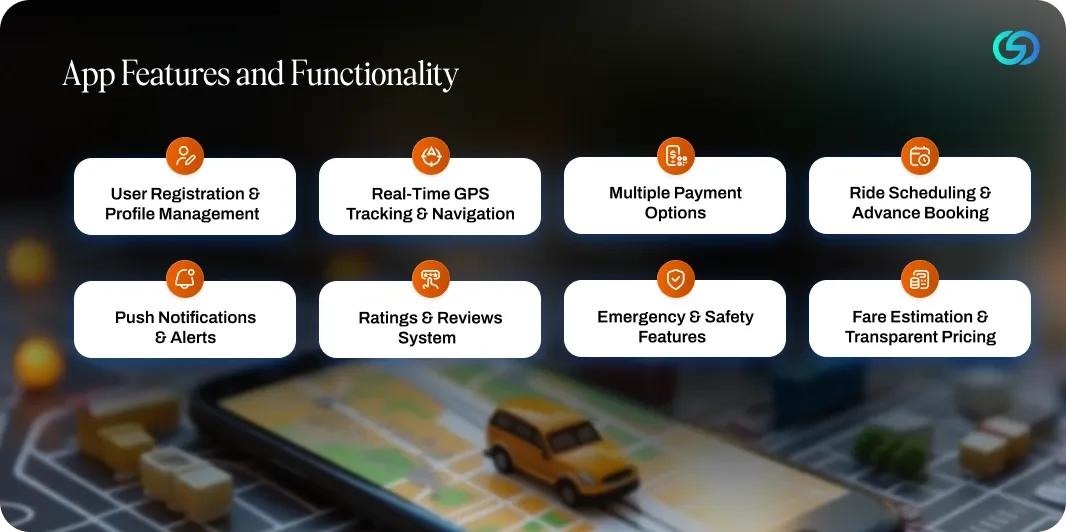
A powerful taxi app thrives on clear, intuitive, and reliable features that enhance both rider and driver experiences. These functionalities form the backbone of a successful ride-hailing platform built by a Taxi App Development Company, ensuring seamless service delivery and high user satisfaction.
1️⃣ User Registration & Profile Management
This feature offers riders and drivers a simple yet secure way to sign up and manage accounts. It supports email, phone, or social logins, and allows users to update personal details, payment info, and preferences easily.
2️⃣ Real-Time GPS Tracking & Navigation
Real-time tracking lets riders monitor their booked taxi’s location from request to arrival, while drivers receive turn-by-turn navigation. This enhances transparency, reduces wait times, and improves overall ride accuracy and satisfaction.
3️⃣ Multiple Payment Options
Supporting various payment methods like credit/debit cards, digital wallets, UPI, or cash ensures convenience for all users. Secure payment integration also builds trust and encourages more frequent app usage.
4️⃣ Ride Scheduling & Advance Booking
This functionality lets riders schedule future trips in advance, perfect for early morning airport runs or business appointments. It enhances flexibility and positions your taxi app as a reliable travel companion.
5️⃣ Push Notifications & Alerts
Timely alerts for ride confirmations, driver arrivals, or promotions keep users informed and engaged. This communication layer ensures riders and drivers never miss key updates or ride changes.
6️⃣ Ratings & Reviews System
A feedback loop allows both riders and drivers to rate their experiences after each trip. This boosts accountability, improves service quality over time, and builds a trustworthy community within your platform.
7️⃣ Emergency & Safety Features
Safety tools like an SOS button, live ride sharing, and driver verification reassure users of secure travel. These features are essential in building credibility and user confidence.
8️⃣ Fare Estimation & Transparent Pricing
Before confirming a ride, users can view accurate fare estimates based on distance, time, and traffic conditions. Transparent pricing helps reduce cancellations and enhances user trust.
Platform Choice (iOS, Android, or Both)

The app needs to reach your audience. So, where are your users? Are they using Apple or Android phones?
➡️ Single Platform: Developing only for iOS or only for Android is cheaper. It helps in cutting down the time of development roughly in half. This is good for testing the market fast.
➡️ Dual Platform: Developing separate, native applications for both Android and iOS is the most expensive and provides the best performance.
➡️ Cross-Platform: Utilizing frameworks such as Flutter or React Native. This uses a single codebase for both platforms. It is generally less expensive and faster than dual native development. Performance can, at times, suffer slightly compared to the native. Decide if speed or just seamless performance is your priority.
Best Ways to Launch a Taxi App
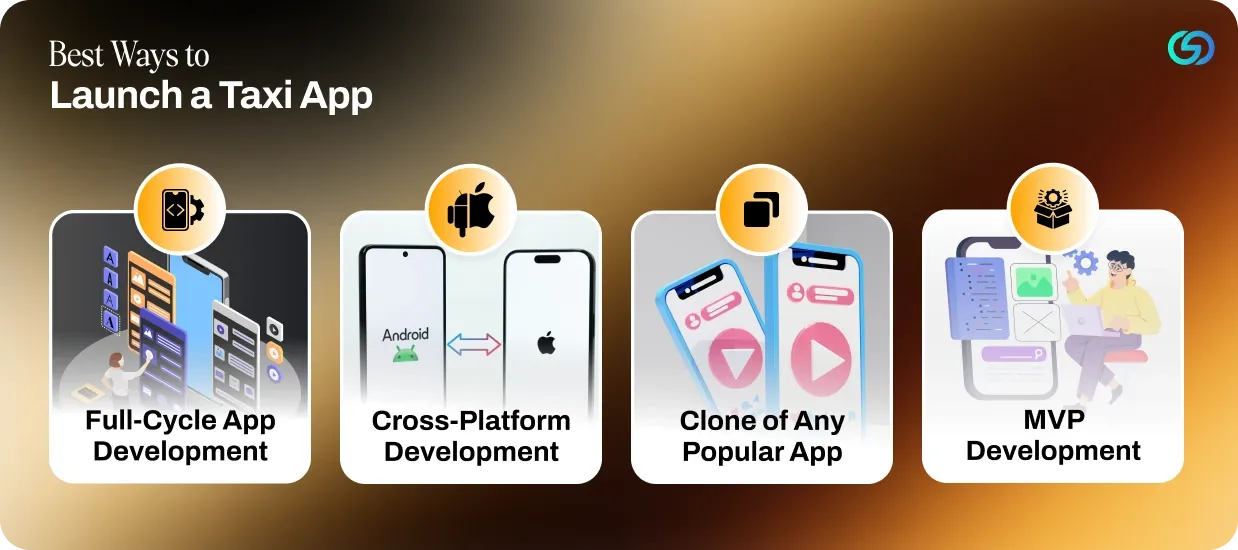
There are many startup ideas to start with AI taxi app development seamlessly. However, investing in the right way is crucial. This helps businesses in finding the right approach for controlling costs, testing the market, and moving with confidence. However, it depends on your business budget and vision. Thus, whether you are a growing market, these methods support a seamless and smart beginning:
🔶 Full-Cycle App Development
In case you have a long-term business plan, a full-cycle development is a great option to choose. This approach enables businesses to develop a feature-packed taxi app with complete control over design, brand direction, and user flow. Starting from driver modules to rider panels, every element aligns with your plan. Although it requires more time, it supports complete identity and long-term market presence.
🔶 Cross-Platform Development
For the entrepreneurs who are willing to launch their taxi business with both iOS and Android app development, choosing cross-platform development can be an accurate choice. It saves costs and time by utilizing a single codebase for both platforms. It also enables the startups to analyze performance across devices without developing two separate applications. Cross-platform development provides flexibility and allows reaching a wider market base from the outset.
🔶 Clone of Any Popular App
Startups can also invest in a taxi app, like Uber or Ola, to develop a quick launch version. These clones use reliable features and proven structures while saving development time. With small changes in feature style or branding, you can still stay unique. This approach helps in supporting faster entry into the market without taking the risk of developing from scratch.
🔶 MVP Development
This method helps in suiting startups with big ideas and a minimal budget, mainly those who want to test their application idea in the market. You launch a taxi application that has basic and essential features, including ride tracking, booking, and driver profiles. This will help you get early user feedback and real data for planning your next update. It decreases risk, shortens the time-to-market, and offers the needed momentum for your taxi business.
Taxi Mobile App Development: Step-by-Step Guide
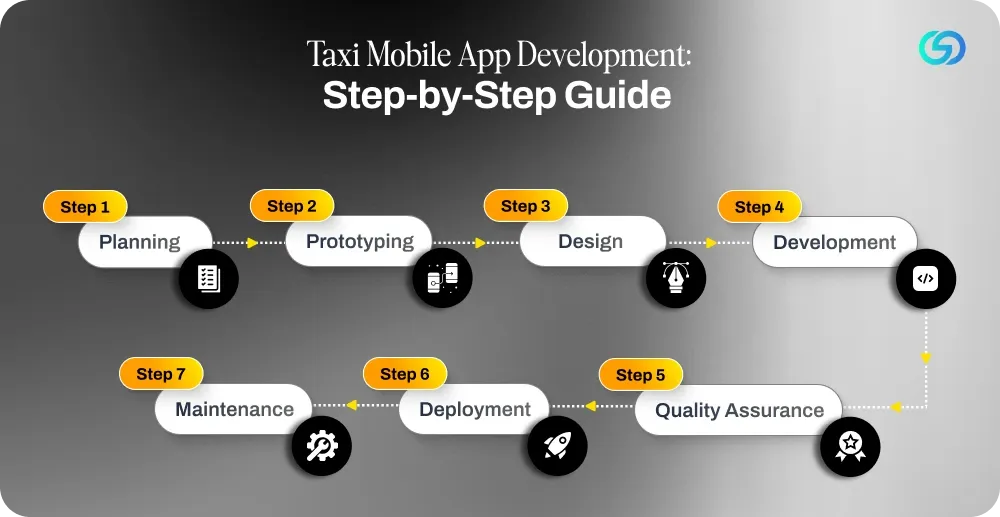
Developing a successful taxi app includes several important steps. Given below is a breakdown of the process:
1. Planning
The first step is to figure out what your app is going to do. Define your goals and set clear objectives, as well as decide what features your app requires. Market research should look at competitors, find out what is missing in the market, and think about your USP. Whether you are developing a taxi booking app or an aggregator app, having a transparent vision is important.
2. Prototyping
Once the plan is ready, develop a prototype, i.e., a basic version of the app that lets you see how it operates. At this stage, the taxi app development company helps you in finding out issues earlier and adjusting features and designs before the development starts.
3. Design
Design is where the UX and UI come together. The user experience, or the UX, helps in defining how the application operates, while the user interface focuses on how it looks. A good design is important for ensuring the users remain engaged. Seamless transitions, clean layouts, and intuitive navigation.
4. Development
This is where the coding starts. The frontend and backend of the app are developed. It is an important phase where the applications start taking their shape, and the functionality is incorporated.
5. Quality Assurance
After the development process, thorough testing is important. The goal is to fix the bugs, enhance usability, and ensure everything works well across all devices.
6. Deployment
Once the testing is done, your app is ready for launch. This application gets uploaded to platforms such as Google Play and App Store, making it available so that users can download and start booking rides.
7. Maintenance
After your app becomes live, the work does not stop. Continuous maintenance ensures that the application remains up to date, fixes any bugs that pop up, and keeps improving based on the feedback of the users.
Advanced Features Impacting the Expense of Developing a Taxi Application
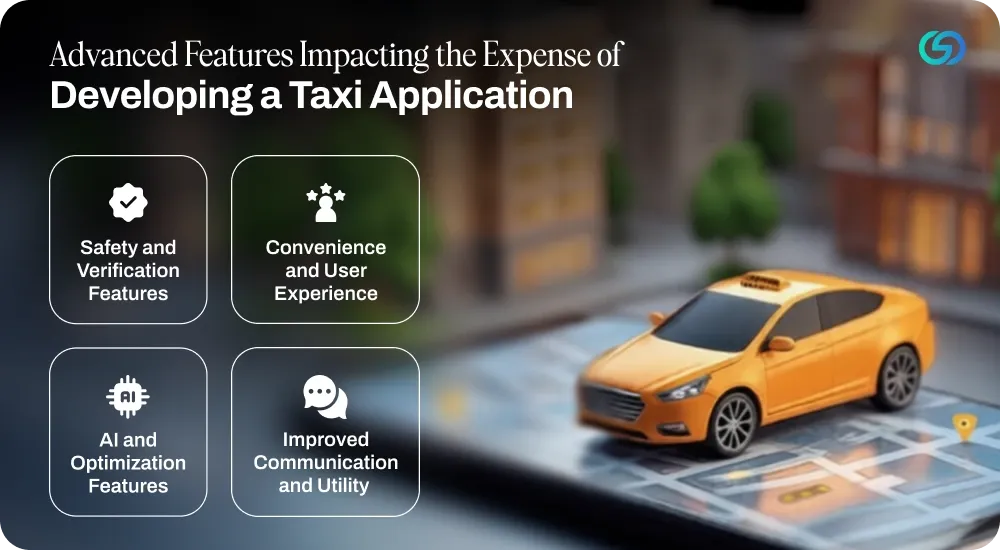
When it comes to incorporating advanced features, the cost is likely to have a huge spike. Incorporating these complicated features and functionalities demands more developer hours, specialized integrations, and complex backend logic. So, here are the advanced features of taxi app development spiking the price of developing taxi booking apps.
🔷 Safety and Verification Features
It involves implementing safety features such as live ride tracking, an SOS button, and driver or rider verification.
The Cost Impact: $10,000- $25,000 (Additional to the base price)
Why it is high: Live tracking is high-frequency and constant data exchange, which is a big load on the backend infrastructure. Verification requires integrating with third-party APIs for things such as document processing or background checks. Dedicated compliance and rigorous coding measures are needed, which takes time.
🔷 Convenience and User Experience
It includes implementing safety features such as the tracking of live ride, the SOS button, and driver/rider verification.
The Cost Impact:$ 15,000- $ 35,000 (Additional to the base price)
Why it is high: Multi-stop booking is tricky. It requires complicated route recalculation algorithms each time the user touches the app. A safe in-app wallet needs high-level security incorporation and financial compliance, such as PCI DSS adherence. These features need deep UI changes as well as intricate database logic across both the driver and rider apps.
🔷 AI and Optimization Features
The intelligent systems implementation, such as AI-powered route suggestions and dynamic pricing, makes the taxi app development expensive.
The cost Impact: $20,000- $45,000 (Additional to the base price)
Why it is high: Ride sharing utilizes complicated matching algorithms or groups concurrent riders efficiently. Geofencing mandates complicated map-based logic for enforcing city zones and rules. Incorporating voice/video calls requires dedicated communication service APIs, adding both recurring service fees and development costs. These features need substantial allocation of resources.
🔷 Improved Communication and Utility
Are you looking for features such as ride-sharing or carpooling, geofencing, and in-app voice or video calls? You should be ready for an added price as they add up to another layer of complexity.
The cost Impact: $18,000 - $40,000 (Additional to the base price)
Why it is high: Ride-sharing utilizes complex matching algorithms to group concurrent riders effectively. Geofencing mandates complicated map-based logic for enforcing zones or city rules. Incorporating voice or video calls requires dedicated communication service APIs, adding up both the cost of development and recurring service fees. The features need substantial allocation of resources.
Factors That Influence Development Cost

Taxi app development depends on several strategic decisions, including platform selection, feature depth, customization level, team location, and technology stack. Understanding these factors enables businesses to practically plan budgets and avoid unexpected expenses during development.
⏺️ Features and Complexity
Simple apps with basic features such as payments, booking, and notifications are less expensive. However, if you need advanced features such as real-time driver tracking or AI-powered route suggestions, expect to pay more.
⏺️ Platform (iOS, Android, or Both)
Developing an app for only one platform, such as Android or iOS, is generally more cost-effective in comparison to developing for both. However, if you are willing to reach a broader audience base, you should consider developing for both the plarforms, although it will come at a higher cost.
⏺️ Development Team Location
Where your taxi app development company is located also plays a crucial role in the complete cost of developing a taxi application. For instance, hiring a development company in Western Europe or North America can be more costly, while outsourcing in Asia or Eastern Europe can provide more cost-effective rates without compromising on the quality.
⏺️ Customization Needs
A custom-built application designed particularly for the needs of your business will need more effort and time, making it more expensive than using an off-the-shelf or pre-built solution. While it might be more costly upfront, a customized app gives more control as well as better suits your unique requirements.
⏺️ Technology Stack
Utilizing cutting-edge tech for payment gateways, GPS, or backend systems can enhance expenses. The more complicated the techstack the higher the cost; however, this can also result in a more efficient and trustworthy mobile app for your users.
How to Tackle Common Challenges in Taxi App Development
Developing a taxi application is not easy all the time. You are going to face issues along the way, such as freezing your applications or the GPS not working properly. However, you can avoid issues by choosing robust technology and testing it all before the application is live.
It is also necessary to keep the drivers happy. Provide them with faster payments, goods rewards, and useful tools such as easy-to-follow routes. For the passengers, it is completely about making their experience seamless. Users want to book their rides faster, share the promos with contacts, and get rewards for staying loyal.
Moreover, as the taxi businesses are extremely competitive, you have to stand out. Find out things that are not usually done in your area. You can consider providing eco-friendly rides or extra features, making your app special.
Future Trends in Taxi App Development
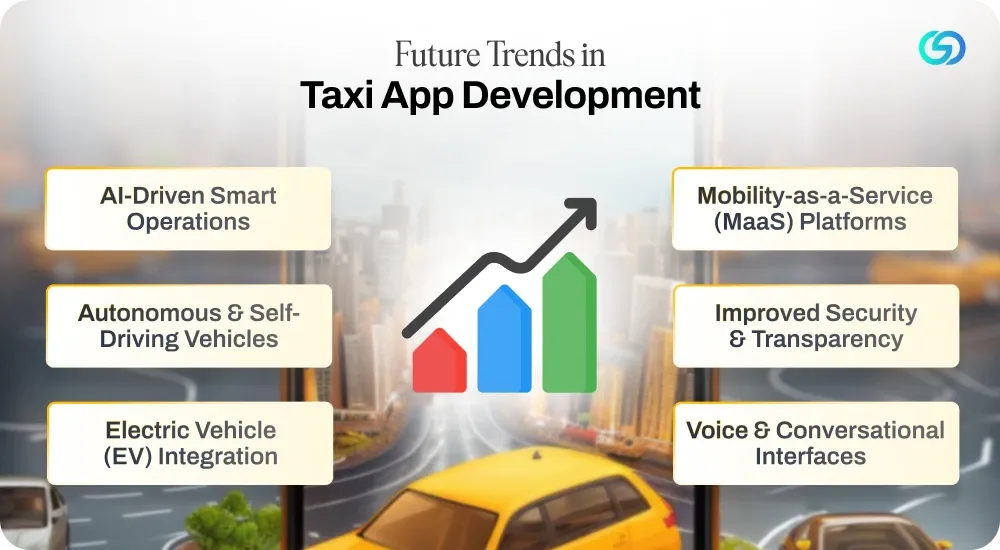
The world of taxi app innovation and development is evolving faster as the technology transforms how riders travel and the businesses grow. Looking ahead, the industry is all set to embrace smarter operations, greener operations, and a more integrated experience. Given below are the trends that every taxi app development company should know to remain competitive:
➡️ AI-Driven Smart Operations
AI is becoming a primary component of the functionalities of taxi apps, starting from predictive demand forecasting and dynamic pricing to streamlined routing and automated dispatch. Smarter systems decrease wait times, enhance driver efficiency, and improve user satisfaction.
➡️ Autonomous & Self-Driving Vehicles
No-driver cars are transitioning from concept to reality. Crucial ride-hailing platforms are testing autonomous cabs signalling, a future where apps easily incorporate robotaxi services, decrease operational expenses, and expand options of mobility for the users.
➡️ Electric Vehicle (EV) Integration
Sustainability is driving the adoption of EVs within taxi fleets. Future taxi applications will incorporate EV-specific features like charging station locators and eco-route planning, which cater to the eco-conscious riders and decreasing complete emissions.
➡️ Mobility-as-a-Service (MaaS) Platforms
Taxi apps are moving toward the comprehensive ecosystems of mobility. This involves incorporating public transport, scooter rentals, and bike rentals, and a unified system of payments, enabling users to plan and pay for several-modal journey in a primary interface.
➡️ Improved Security & Transparency
With the increasing data concerns, technologies such as advanced verification systems and blockchain are being explored for ensuring transparent fare breakdowns, secure payments, and protected user identities, developing trust on every ride.
➡️ Voice & Conversational Interfaces
AI-powered chatbots and voice commands are simplifying interaction within taxi applications. Users will increasingly check prices, book rides, and get hands-free support, enhancing accessibility and user engagement.
Wrap-Up
In the current fast-evolving mobility landscape, taxi app development is not just about developing a booking platform anymore. It is about developing an intelligent, scalable, and user-centric transportation ecosystem. Starting from defining the primary components and important features to understanding the cost factors and the future trends, each decision plays a crucial role in understanding the long-term success of your app. A well-developed solution should balance easy rider experience, efficiency, secure payments, data-driven insights, and real-time tracking.
At ConvexSol, a reliable taxi app development company, we combine industry expertise, innovation, and scalable technologies for developing high-performance taxi apps customized to your vision. So, if you are ready to launch your ride-hailing platform, ConvexSol can turn your idea into a robust digital mobility solution.
Frequently Asked Questions
How can I ensure safety and trust in my taxi app?
Safe features in an efficient taxi app may include an SOS button, driver verification, ride-sharing details with family, two-way rating systems, as well as secure in-app payments.
Should I build a custom taxi app or use a white-label solution?
Custom development provides unique branding, scalability, and flexibility of features. White-label solutions are faster and more affordable to launch but may limit customization and long-term scalability.
What ongoing costs should I expect after launching the taxi app?
Post-launch expenses include app maintenance, server hosting, customer support, payment gateway fees, marketing, and compliance costs.
How can a taxi app compete with established platforms?
Focus on niche markets, localized pricing strategies, better customer support, corporate tie-ups, subscription benefits, and superior user experience can help new entrants compete effectively.
Is it better to build a native app or a cross-platform taxi app?
Native apps provide high performance, while cross-platform frameworks decrease development time and cost. The right pick depends on timeline, budget, and scalability goals.
What post-launch updates are typically required for a taxi app?
Regular updates include bug fixes, feature enhancements, OS compatibility updates, performance optimization, UI enhancements, and security patches.