- Industry 4.0
- 2026-05-29
Industry 4.0: A Complete Guide to Smart Transformation Across Industries
Audio Track
Table of Contents
Key Takeaways:
- Industry 4.0 connects data and intelligence to create faster and more responsive operations.
- Real value is driven by integrating existing systems and solving bottlenecks with measurable ROI.
- Core technologies like AI, cloud, analytics, IIoT, and automation work best as one connected ecosystem.
- The future of Industry 4.0 depends on autonomous systems, hyperautomation, smart ecosystems, and the transition towards Industry 5.0.
Why Industry 4.0 Matters and Why It Can’t Wait?
Manufacturing and industrial operations are standing at an inflexion point because the systems that drove success for years are no longer equipped to meet the demands of today.
To excel in the industrial landscape today, one needs to eliminate operational inefficiencies and make intelligent decisions quickly. This is because the traditional infrastructure simply cannot keep up with the pace. They fall short when it comes to:
- Real-time data handling
- Optimizing operations across multiple systems
- Proactively recognizing and eliminating inefficiencies
- Competing in a global connected economy
Industry 4.0, or the Fourth Industrial Revolution, is quite relevant and essential in manufacturing for a host of reasons. It has brought about the next wave of technology, refining workflows for efficiency. And failing to adopt the newest technologies may result in the organization falling behind.
But let there be no doubt. Industry 4.0 solution is not solely a technology upgrade but a complete transformation because those who are embracing it are becoming more adaptive and competitive at a global level.
What Is Industry 4.0?
Industry 4.0 is a profound shift where physical systems are integrated with digital technologies. This helps in creating a connected and highly responsive ecosystem.
Industry 4.0 builds on the innovations of the Third Industrial Revolution that brought electronics, computers, and the Internet, which started from the 1950s to the early 2000s. Industry 4.0 advances these innovations even further.
Today, Industry 4.0 is defined by the convergence of various technologies in unison, bringing automation, AI, IoT, and cloud computing together.
This allows for real-time, data-driven decision-making across every layer of the organization. Basically, Industry 4.0 revolutionizes traditional industries into a smart system that can think, learn, and improve with time.
The Evolution of Industry: From Steam to Smart
In order to understand the significance of Industry 4.0, it is crucial to understand the journey that has brought us here. Every industrial revolution redefined the last one. Let’s analyze the shift in how businesses operate, produce, and scale.
| Phase | Focus |
|---|---|
| Industry 1.0 | Utilization of energy sources, like steam-power and coal |
| Industry 2.0 | Introduction of electricity, invention of new technologies, such as the assembly line |
| Industry 3.0 | Digital revolution; computer-based systems, emergence of internet, robotic production lines, and automated factories |
| Industry 4.0 | Automation and digitization; using automation and data exchange; development of IoT, AI, and ML |
Core Technologies Powering Industry 4.0
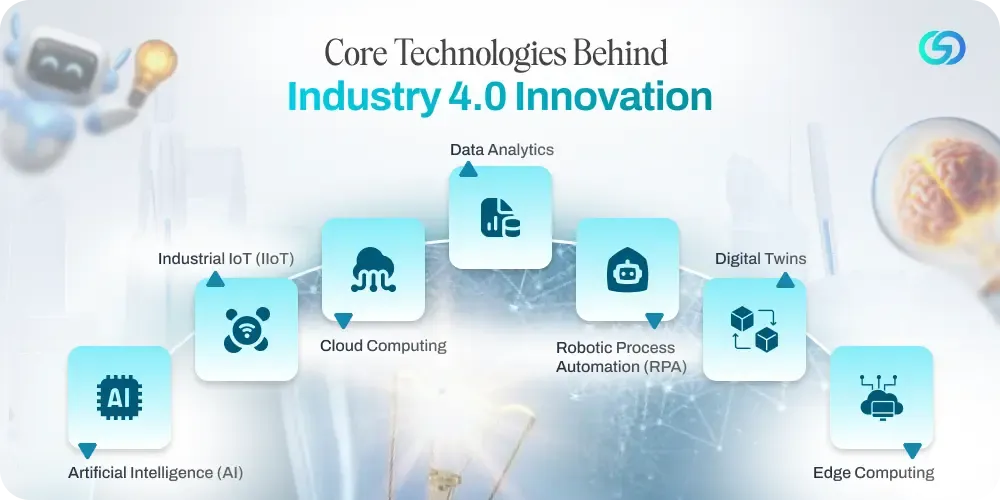
Industry 4.0 isn’t built on a single innovation, but it’s powered by a stack of interconnected technologies that work together to create responsive and intelligent industrial systems.
Each technology listed below plays a particular role, however, the real value emerges when they operate as a unified ecosystem.
These are the core technologies driving the Industry 4.0 transition:
🔷 Artificial Intelligence (AI)
AI runs in industrial operations nowadays, for it allows predictive analytics, automated quality control and real-time decision-making. This way, businesses can anticipate failures before they occur, optimize production, and improve performance accordingly.
🔷 Industrial IoT (IIoT)
Industrial Internet of Things (IIoT) connects with sensors, machines, and devices across the production environment. This helps in collecting and sharing data for complete visibility into the operations, right from the health of machines to production output. This is the cornerstone of connected operations across industries.
🔷 Cloud Computing
Transparency and sharing of data are highly crucial to Industry 4.0. Cloud platforms offer infrastructure needed to store, manage, and process large volumes of industrial data. This helps businesses centralize control and remote access to systems, which makes it easy to manage functions across multiple locations.
🔷 Data Analytics
Raw data alone has no value until it transforms into insights. With the help of advanced analytics tools, large datasets can be processed to understand the inefficiencies and opportunities. This, therefore, helps in making businesses faster and more informed decisions.
🔷 Robotic Process Automation (RPA)
For rule-based, repetitive tasks, RPA takes over. By automating high-volume work, RPA reduces manual effort and minimizes errors right from production scheduling to ensuring reporting. It frees humans to focus on more strategic work.
🔷 Digital Twins
Digital twin technology pushes forward the advancement of Industry 4.0. It creates virtual replicas of physical systems or entire facilities. These models allow engineers to test scenarios and optimize performance in a digital environment prior to applying them in practice.
🔷 Edge Computing
Edge computing makes smart manufacturing actually smart because, without this, Industry 4.0 cannot be reached. With edge computing, the speed of Industry 4.0 is not bottlenecked. When processing data closer to machines, the technology allows for faster decision-making, responses, and efficient use of resources. It eases the pressure on storage and ensures manageable analytics.
Key Features of Industry 4.0
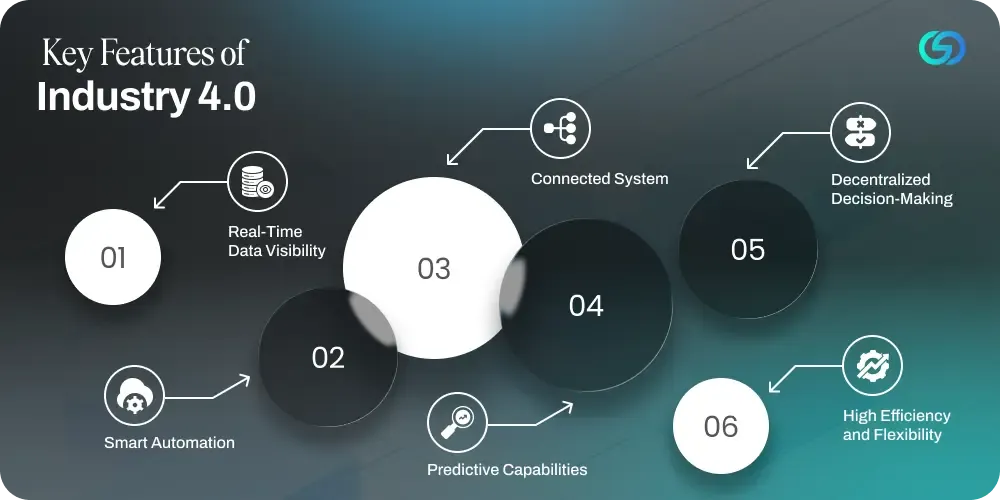
With the coming of digital transformation across industries, the market has experienced a paradigm shift in a way industries work. And every major technological shift comes with a list of features. So, here is what Industry 4.0 looks like in practice.
▶️ Real-Time Data Visibility
See everything as it happens. For several years, industrial experts made decisions based on yesterday’s reports or gut instinct. Real-time data visibility offers an unfiltered view of operations, so when something goes wrong, you don’t need to find out later.
▶️ Smart Automation
In Industry 4.0, smart automation goes far beyond running pre-set programs, so, this isn’t just simple automation that follows basic rules. These automated systems monitor their own performance, flag anomalies, and adjust to changing conditions. This implies that the factory floor becomes a system that manages itself.
▶️ Connected System
When you think of traditional setups, operational silos create bottlenecks. Industry 4.0 breaks these barriers, connecting software, machines, and platforms, allowing seamless communication across the entire operation.
▶️ Predictive Capabilities
This could be the single most valuable feature that Industry 4.0 delivers. Instead of reacting to equipment failures, quality issues, or supply chain disruptions, businesses can anticipate them well in advance. The transition from reactive to predictive is a fundamentally different way of operating.
▶️ Decentralized Decision-Making
Every decision doesn’t require waiting for human input. In Industry 4.0, machines can make certain decisions autonomously based on real-time data, speeding up operations, and quick responses in tough situations.
▶️ High Efficiency and Flexibility
Markets change quickly, and Industry 4.0 is built for that. Whether the goal is to scale up or stay agile, improve efficiency, or respond to changing demand, connected systems make life easier. Firms adjust workflow, reallocate resources, and expand capabilities without disrupting performance.
Benefits of Industry 4.0 for Businesses
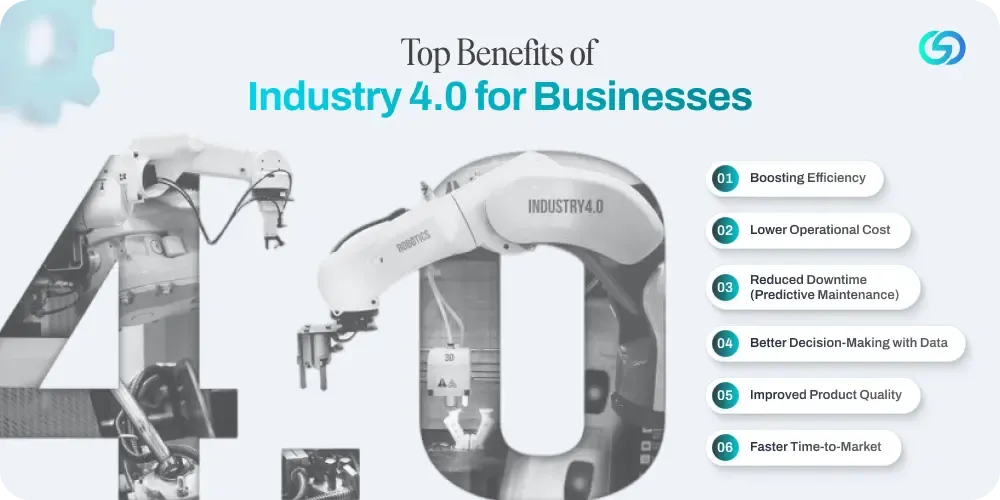
Industry 4.0 gives immediate benefits that completely alter business processes. Reduced downtime, improved production quality, and much more with the aid of advanced technologies.
These are the benefits of the fourth industrial revolution you don’t want to miss out on to remain competitive.
💠 Boosting Efficiency
Industry 4.0 solutions enhances your organization’s productivity by reducing the need for manual work and automating tasks. This keeps the process of production running smoothly with fewer disruptions.
Eventually, you will experience fewer disruptions due to predictive maintenance, which can predict issues even before they happen. This allows you to implement changes, so these issues don’t result in unnecessary downtime. This means your production process will run more consistently.
Smart systems use real-time data from connected devices, which allows quick decision-making, since the data you require will be right in front of you. Therefore, everything remains connected, and your businesses’ different parts communicate with each other seamlessly without delays.
💠 Lower Operational Cost
Manufacturing businesses can cut costs in multiple ways with Industry 4.0. Such as when leveraging technologies like Industrial Internet of Things (IIoT) or automation can significantly reduce material waste and energy consumption.
Real-time monitoring gives better control over energy usage, which minimizes lower utility bills. Smart systems optimize your production processes, ensuring that the materials are used efficiently. With a smooth operation and less downtime, you will eventually avoid expensive errors.
💠 Reduced Downtime (Predictive Maintenance)
When downtime is unexpected, it can cause disruption of production and increase costs. Industry 4.0 prevents this through predictive maintenance. Here, the sensors monitor machine health and detect warning signs such as performance drops or abnormal temperatures instead of waiting for the equipment to fail.
All of this results in consistent production and emergency repairs. With time, businesses spend less, and you are ensured a reliable operation.
💠 Better Decision-Making with Data
Gain access to real-time data with Industry 4.0 instead of relying on mere assumptions or delayed reports. When the systems and devices are well-connected, they continuously send insights into performance, process effectiveness, and resource usage.
Conversely, this means that the supervisors can easily spot trends, look for inefficiencies, and respond to issues much faster. Because when the right information is available at the right time, decisions become faster. Eventually, you can make confident conclusions that support your long-term growth.
💠 Improved Product Quality
For the manufacturing industry, maintaining consistent product quality is one of the top goals. And this becomes much easier when production is monitored in real-time. Industry 4.0 software is able to detect irregularities early on.
Teams can correct issues across the line of production, resulting in reduced rework, less waste, and reliable output. When the quality is better, the operational losses are lower, strengthening customer trust and brand reputation.
💠 Faster Time-to-Market
Speed is a major advantage in Industry 4.0, helping businesses move faster at every stage. When the workflow is automated, systems are connected accurately across departments, and managers get real-time visibility; everything else is streamlined, be it production planning or execution.
Teams can respond and resolve issues quickly because processes become more synchronized and agile, allowing the products to move from planning to delivery much faster.
Real-World Applications of Industry 4.0 Across Sectors
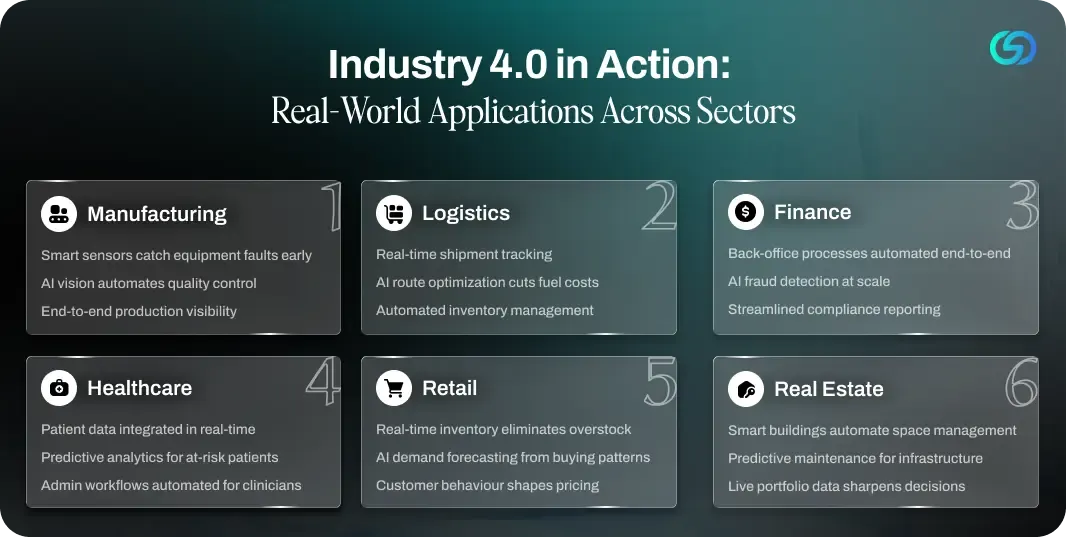
By now, we know that the Fourth Industrial Revolution is being totally embraced by different sectors worldwide because of the pace at which we are moving ahead, automation is not an option but a complete necessity.
Even though manufacturers have been using digital technologies for several years now, technological maturity has only now reached a point where effective solutions can be implemented.
Let’s zoom in on the top industries that have undergone transformation due to Industry 4.0.
1️⃣ Manufacturing
Manufacturing is the niche that has experienced a real paradigm shift with Industry 4.0, which has quite literally ushered in a new era of connected processes and smart factories.
Here, Audi is a good example, which collects and analyzes a large volume of data from different sources within to gain insights into quality.
Predictive maintenance provides a data-driven approach, which reduces downtime and ensures machines operate at their peak.
- Sensors detect equipment issues before breakdowns
- AI-powered vision systems automate quality control
- End-to-end production visibility
2️⃣ Logistics
Industry 4.0 has reached the logistics sector, where it is reshaping the way organizations manage their supply chains. Innovations like data analytics and AI have completely changed the entire logistics process.
From inventory management and route optimization, real-time tracking to order fulfillment, businesses are depending on smart systems to reduce costs and enhance efficiency.
- Real-time shipment tracking across warehouses, vehicles, and handoff points
- AI-driven route optimization cuts fuel costs
- Automated inventory systems know what's running low before the team does
3️⃣ Finance
Financial operations run on data, and Industry 4.0 solutions turn that data into greater value than ever before. In an industry where every second and margins are important, failing automation isn’t an option, but it’s dangerous.
- Repetitive back-office processes automated end-to-end
- AI fraud detection analyzes thousands of transactions per second
- Compliance reporting is streamlined through workflow automation
4️⃣ Healthcare
The next niche is healthcare, which can undergo digital transformation due to Industry 4.0 technologies.
Modern technologies enhance supply management, but data analytics and smart sensors help clinics and hospitals keep records of their inventory in real-time. This allows medication and other essential supplies to be tracked, ordered, and restocked right on time.
- Patient data integrated across devices and departments in real-time
- Predictive analytics identifies at-risk patients
- Administrative workflows are automated, so clinicians spend more time with patients
5️⃣ Retail
The new era of smart tech in retail 4.0 is here, with retail technologies advancing to the point where retailers can access real-time data and stay connected. Automation in retail improves production and makes the entire process flexible.
Industry 4.0 allows retail businesses to automate inventory management and forecast demand as well as respond to changing customer behavior.
- Real-time inventory eliminates overstock and out-of-stocks
- AI-backed demand forecasting analyzes buying patterns and market signals at the same time
- Customer behavior data feeds into merchandising and pricing decisions
6️⃣ Real Estate
Traditional real estate workflow faces major transparency issues that result in conflicts between buyers and sellers. Industry 4.0 has altered the landscape of real estate with a multitude of advantages.
Property transactions can be recorded securely, reducing errors and fraud. Other than that, the latest innovation helps property owners and managers monitor assets in real-time.
- Smart building systems automate space management, security, and energy
- Predictive maintenance catches infrastructure issues early on
- Live data across property portfolios sharpens investments
The Architecture Behind the Intelligence: How Industry 4.0 Systems Are Built
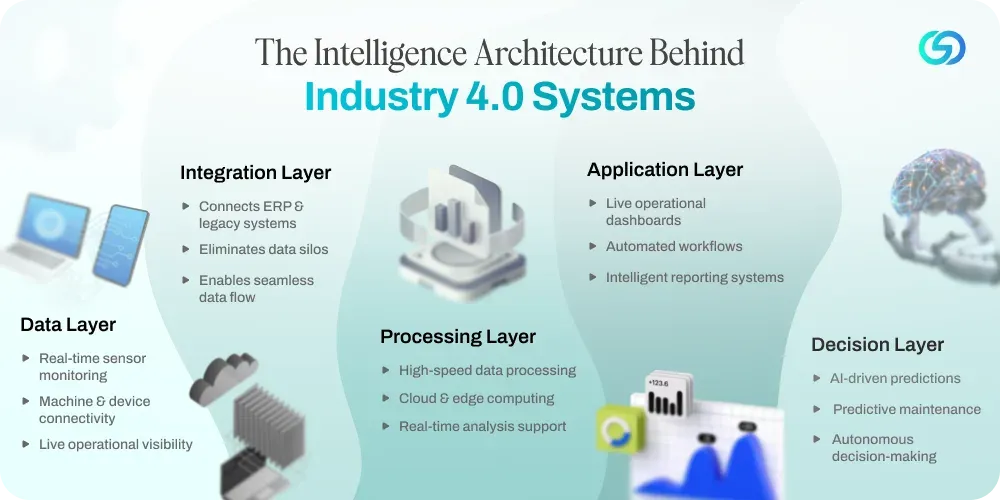
Sure, Industry 4.0 may look quite complex from the outside, but at its core, it works like a connected ecosystem, where every layer has a specific role.
Nearly 91% of industrial firms are investing in digital factory transformation with ROI expectations and clear goals for the coming five years.
It may seem almost magical because of the dashboard, the automation, and predictive alerts. But, behind every intelligent system is a structured architecture where five layers work to turn raw data into real business decisions.
Let’s help you understand the layers of how Industry 4.0 delivers what it promises:
💠 Data Layer
This is where everything initiates. The network of sensors, IoT devices, and connected machines collects data from the shop floor. Think of it as the nervous system of the whole operation.
- Sensors monitor speed, temperature, and hundreds of other variables
- Connects physical assets to digital systems
- Creates visibility into what is happening on the ground
💠 Integration Layer
This is where systems are made to talk to each other. Raw data is only valuable when it moves across systems. The integration layer uses APIs, middleware, and connectors to link to ERP platforms, legacy software, and business apps.
- Breaks down data silos across departments
- Smooth communication between traditional and new systems
- Creates a connected flow of information
This is the layer where either Industry 4.0 succeeds or fails.
💠 The Processing Layer
Here, the data becomes meaningful. When the data is collected, it is processed quickly. This is done through cloud and edge computing platforms. Cloud systems handle large-scale storage and analysis while edge computing processes data closer to the machines for faster response.
- Processes large volumes of industrial data
- Reduces delays in operational decisions
- Supports real-time monitoring and analysis
💠 Application Layer
This is where teams interact with intelligence. The application layer converts processed data into a format that teams actually use.
- Real-time dashboards give operators live window into operations
- Automation tools execute workflows and initiate responses without human input
- Reports and control systems bring intelligence to the people who need it
💠 Decision Layer
Here, intelligence drives action. At the top of the stacks is where the most powerful layer sits. This is where AI, ML, and advanced analytics help businesses predict failures and recommend actions.
- Predictive maintenance and anomaly detection
- AI models analyze patterns across the entire data stack
- Smarter, faster, and autonomous decisions
This layer makes Industry 4.0 fundamentally different from everything that came before it.
The real strength of Industry 4.0 lies in the way all these layers connect. Each layer has its own power, but when all five function as a single entity, every part of the operation moves in sync.
Common Challenges in Industry 4.0 Adoption
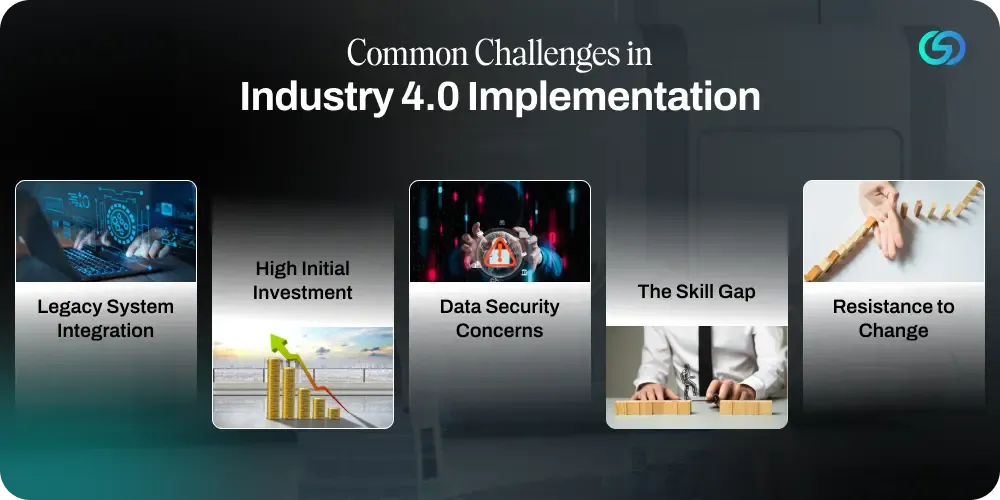
No journey comes without a few hurdles, however, there are certain things to consider, including the challenges that individuals across sectors are facing today when they embrace Industry 4.0 technologies.
Challenge #1: Legacy System Integration
Most organizations still depend on traditional systems that weren’t designed to connect with modern digital platforms. This leads to data silos and a lack of real-time visibility across the workflow.
Solutions: In such cases, a phased integration process works best. Instead of replacing everything at once, businesses can connect legacy infrastructure through APIs and custom integration layers that bridge old and new systems.
Challenge #2: High Initial Investment
Industry 4.0 implementation is not cheap. The upfront cost of software platforms, sensors, infrastructure upgrades, and automation tools can cause Industry 4.0 to seem like a major financial commitment.
Solutions: Businesses that want to scale stop thinking about Industry 4.0 as a cost and treat it like a capital investment with returns. Start small and allow organizations to demonstrate ROI before going for full-scale deployment.
Challenge #3: Data Security Concerns
If you are thinking of connecting more systems and data streams, you could be wrong because simply doing that won’t create opportunities. Every connection is vulnerable, and in an Industry 4.0 environment, a single breach can be catastrophic.
Solutions: Security should be a part of the architecture from day one. It needs to be architected into every layer. Strong access controls and regular monitoring protect business-related crucial information.
Challenge #4: The Skill Gap
You can deploy Industry 4.0 infrastructure into your business, but it depends on capabilities, like automation management, data analytics, and system integration. And many teams lack these skills in the first place.
Solutions: You need to upskill your existing team and bring in specialized professionals who can close the gap and support successful Industry 4.0 adoption.
Challenge #5: Resistance to Change
Sometimes, even the most well-designed digital system can slow down the team when individuals are hesitant to adopt new processes. This happens because familiar systems feel safer than adopting new ways of working.
Solutions: With clear communication, team involvement in the transformation process, and leadership alignment, adoption improves and resistance reduces.
Most Industry 4.0 challenges occur because the strategy is unclear. When you draw a clear and practical roadmap, the transition becomes successful.
Industry 4.0 vs Industry 5.0: What's the Difference and Why Does It Matter?
So far, it’s established that Industry 4.0 refers to integrating automation and exchanging data across workflows in different industries. However, Industry 5.0 focuses on the collaboration of machines and humans, where the motto is to deliver sustainable products and services.
| Features | Industry 4.0 | Industry 5.0 |
|---|---|---|
| Focus | Automation and technology for improving efficiency | Driving sustainable processes |
| Emphasis | Leverages data and analytics for process optimization | Importance of human collaboration and interaction |
| Use | Autonomous machines for hazardous and repetitive tasks | Fostering new skills and competencies among human employees |
| Competencies | AI, ML, IoT for task automation | Blends advanced technologies with human and creativity |
| Technologies | Digital twins for production process | Modern technologies, like biotechnology and nanotechnology for producing new materials |
| Factories | Smart factories | Flexible production system to adapt to customer demand and trends |
| Efficiency | Remote monitoring, predictive maintenance, and real-time data analysis | Sustainable production practices to reduce environmental impact |
In simple terms, Industry 4.0 makes business smarter while Industry 5.0 makes them more human-centered.
How to Actually Implement Industry 4.0: A Practical Roadmap
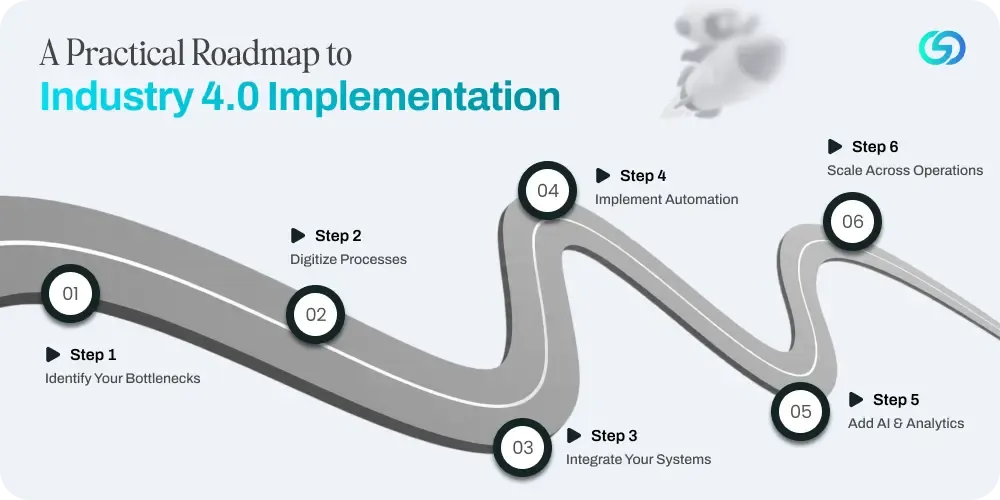
Do you think adopting Industry 4.0 means transforming workflow overnight? Absolutely not. The smartest approach is to start with clear priorities and solve important problems first, and then scale gradually.
Here we have listed a sequence of steps not to be missed, otherwise the whole thing wobbles down.
Step 1: Identify Your Bottlenecks
Before you sign up for any new technology, you need to know where the gap in your operation is or where the information gets lost.
Everyone talks about Industry 4.0, but only a handful get it. So, start by auditing your work and letting the pain points tell you where to focus.
Step 2: Digitize Processes
You will fail to connect what isn’t digital yet. So, before the systems can talk to each other, you need to move away from paper-based processes, manual records, and disconnected spreadsheets. Digital system stores and captures operational data in real-time.
The work could be hectic, but it’s the foundation on which everything else is built.
Step 3: Integrate Your Systems
Data is only powerful when the systems are all well connected. Data lives in silos in most companies and other systems such as ERP, CRM, and finance systems operate in isolation.
Integration layer work, like API, data pipelines, and middleware, tears down the wall and delivers a single, connected system. This is the step where Industry 4.0 starts to feel real.
Step 4: Implement Automation
Once you have a digitized system in place, automation becomes natural. You can start with repetitive and high-volume tasks, the ones that consume most human time.
RPA or Robotic Process Automation is one of the many examples that can be deployed here for immediate impact. Your teams can stop the work that machines do better and focus on strategic work.
Step 5: Add AI & Analytics
At this stage, your operations stop being smart and start being intelligent. With an automated and connected system, AI and advanced analytics can find patterns and produce insights at a tough speed. This stage is where predictive maintenance, demand forecasting, and decision-making start being anticipatory.
Step 6: Scale Across Operations
Once you have proved the value in one area with one facility being transformed, a process being optimized, and a department running smarter than ever before. Now comes the main stage of rolling out what worked across the organization. This doesn’t mean replication, but continuously refining and pushing what operations are capable of.
The businesses implementing Industry 4.0 aren’t the largest or most well-funded ones, but those that respect sequence and commit to each step without jumping straight to AI. This is exactly what a roadmap is.
The Role of Automation and Software in Industry 4.0
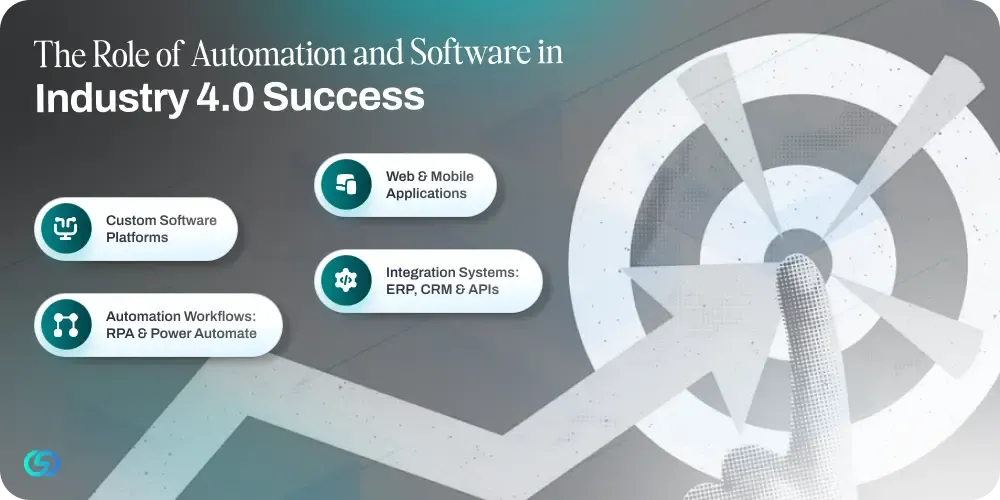
You know Industry 4.0 in terms of machines, AI, and sensors, while those elements are important, there's one thing that is holding it all together.
That's software.
Without proper software, integration, and automation, your company's valuable information never reaches the right people in the system that needs it the most.
Industry 4.0 solutions run on the digital infrastructure built around the hardware.
⏭️ Custom Software Platforms
Understandably, every business has a unique operational need. With custom software platforms, businesses can build systems around their operations—their specific workflow or reporting needs instead of forcing operations to abide by rigid tools.
⏭️ Web & Mobile Applications
Web and mobile apps bring real-time operational data, alerts, approvals, and performance metrics to people who need it. Whether they are halfway across the world or on the factory floor, the right app turns complex data into an actionable interface that anyone in the company can act on right away.
⏭️ Automation Workflows: RPA & Power Automate
Your teams save a tremendous amount of time when you have tools like RPA and Power Automate. These two tools are effective in automating repetitive and rule-based tasks such as data transfers, report generation, approvals, compliance checks, and executions accurately.
⏭️ Integration Systems: ERP, CRM & APIs
The true power of an organization lies in its data. Thanks to integration systems that make it possible. Integrating production systems with ERP platforms, CRM tools, and other business applications through APIs connects every platform into a single ecosystem, allowing Industry 4.0 to become a genuinely intelligent operation.
Without software, Industry 4.0 wouldn’t exist. Therefore, it's clear that the engine that makes Industry 4.0 possible is software itself.
How ConvexSol Enables Industry 4.0?
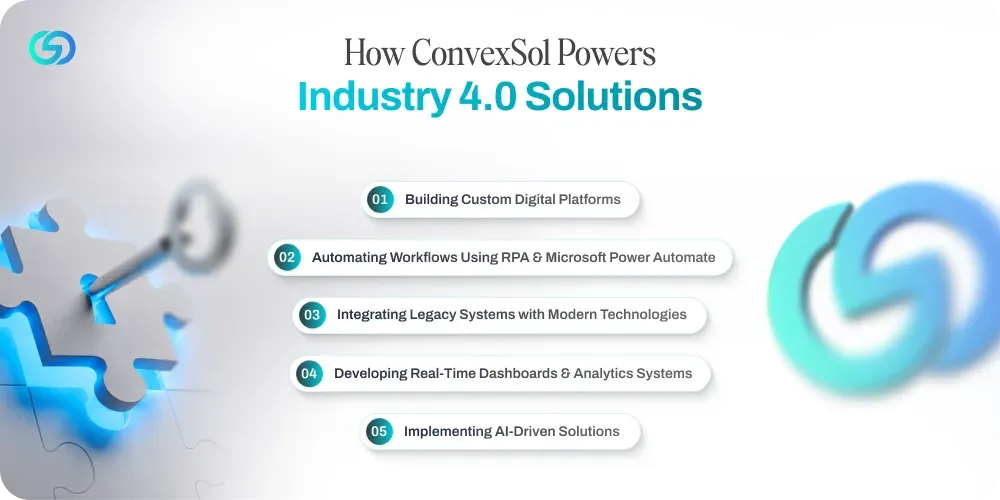
What Industry 4.0 can do for your business is one thing, and having the right expert by your side to build one is absolutely another.
ConvexSol, a leading software development and digital transformation company, focuses on customer solutions for businesses across sectors. We offer end-to-end engineering expertise for Industry 4.0, from core platforms to intelligent automation.
➡️ Building Custom Digital Platforms
Every business is different, and we build tailored platforms around your needs.
- Custom business workflows and processes
- Scalable architecture that grows with your business
- Centralized control
➡️ Automating Workflows Using RPA & Microsoft Power Automate
Automation reduces repetitive work and boosts speed and accuracy.
- Comprehensive automation of repetitive and large business processes
- Seamless deployment of RPA and Power Automate across departments
- Faster execution of routine workflows
➡️ Integrating Legacy Systems with Modern Technologies
Let us strengthen your existing infrastructure with a well-connected system built for smarter operations.
- Legacy systems connected to modern platforms without expensive replacements
- API and middleware-based integrations
- Minimal disruption to current operations
➡️ Developing Real-Time Dashboards & Analytics Systems
Data is powerful during real-time visibility that helps businesses make faster decisions.
- Live tracking of performance metrics
- Quick reporting and operational alerts
- Role-based visibility across processes and departments
➡️ Implementing AI-Driven Solutions
When intelligence is built into your system, your business moves from handling issues as they arise to planning ahead with data-driven insights.
- Predictive insights for maintenance and performance
- AI models tailored to your industry and specific business challenges
- Smarter recommendations for quicker decisions
Future of Industry 4.0: What Comes Next Is Already on Its Way
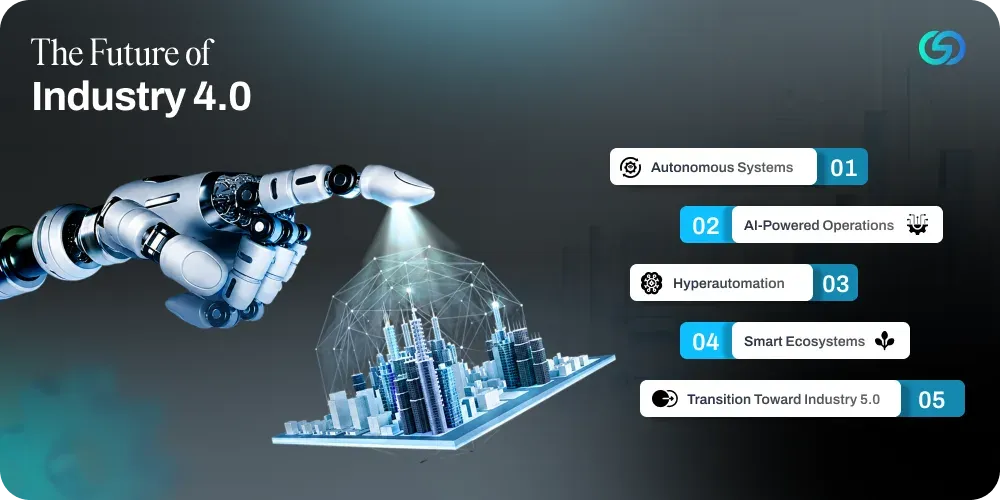
Most businesses are still figuring out how to implement Industry 4.0, however, the world isn’t waiting. The next wave of the industrial revolution is already here, and businesses that are paying attention today will be the ones in the lead tomorrow.
Here’s where it’s all heading:
🔶 Autonomous Systems
The future of Industry 4.0 focuses on transitioning from automated to completely autonomous systems, leveraging AI, Agentic AI, and cyber-physical systems. These advanced systems promise 24/7 operations and superior quality control.
🔶 AI-Powered Operations
AI is more than just being analytical in Industry 4.0, it spots patterns, flags risks, and much more. What’s upcoming is operational AI, where systems don’t recommend decisions but make them easily. Businesses respond to market shifts before a user even notices them.
🔶 Hyperautomation
Hyperautomation is here, making tasks much easier and more efficient. Today, automation targets specific tasks while hyperautomation targets the entire organization. It is the convergence of AI, ML, RPA, and the process of intelligence into a single force. This helps in continuously optimizing functions across businesses. Think of it not as a tool but as a strategy.
🔶 Smart Ecosystems
The boundaries that exist between industries and supply chains are quickly dissolving. Smart ecosystems are connecting networks of businesses like manufacturers, suppliers, and customers into one intelligent environment, where data flows freely, and everyone benefits. One of the advantages of the future will be how intelligently it connects with everything around it.
🔶 Transition Toward Industry 5.0
This is what all of this is moving to build: Industry 5.0. It doesn’t discard Industry 4.0, but it elevates it. Industry 4.0 asks how we make operations efficient, and on the other hand, Industry 5.0 asks how we can make technology work more humanized. It is the collaboration between people and machines where personalization and resilience are the strong focus.
Frequently Asked Question
Does Industry 4.0 require replacing all existing legacy systems?
No, Industry 4.0 does not need to replace all existing legacy systems. If your existing system still supports operations, then the smart move is usually integration. Our experts connect legacy software with tools, so data flows better, and teams work without major disruption.
Is Industry 4.0 only for large enterprises?
Industry 4.0 isn’t limited to large enterprises, it offers enormous potential for small, SMEs, and large corporations, opening new prospects for employees and organizations. Starting with one focused improvement, innovative technology improves decision-making and delivers impressive results without the need for large-scale transformation.
What is the first Industry 4.0 project a company should start with?
Mostly, the best starting point for Industry 4.0 is where there’s an operational friction. Common starting projects include:
- Production visibility dashboards
- Manual reporting automation
- Machine downtime tracking
- Compliance automation
How much does an Industry 4.0 project cost?
Industry 4.0 implementation needs a fair amount of investment. Although that still depends on multiple factors such as the number of systems involved, project scope, automation level, and customized needs. Several businesses focus on pilot projects to validate ROI before scaling across operations.
How do you measure ROI from Industry 4.0 services?
Team ConvexSol measures Industry 4.0 by tracking business improvements such as:
- Lower operation cost
- Reduced downtime
- Fewer manual errors
- Faster reporting
- Better resource utilization
ROI comes when technology outcomes are aligned with measurable operations and financial performance.
What kind of support should businesses expect after implementation?
After implementation, we help businesses across industries expect complete support, such as system monitoring, issue resolution, user training, upgrades, and overall refinement. Our team makes sure your system remains reliable and scalable.
What usually happens if our project stops midway?
Project stalling midway or requirement changes are common occurrences. If a project stops midway, the first step is to assess what remains usable and where dependencies exist. A structured recovery plan is essential to protect your investment and restart implementation in phases.
How secure is cloud-based industrial data?
It is highly secure if the system is designed properly. Security depends on access controls, user permissions, encryption, and complete monitoring. A well-managed cloud environment is well-protected compared to scattered local files or disconnected systems.