- Logistics Mobile App Development
- 2025-11-18
The Expert’s Guide to Logistics Mobile App Development
Audio Track
Table of Contents
Key Takeaways:
- Logistics apps are transforming industry with real-time visibility, coordination, and predictive insights.
- Types of logistics mobile apps include fleet management apps, warehouse management apps, inventory management apps, delivery tracking apps, and more.
- Unlike off-the-shelf solutions, custom apps ensure data ownership, scalability, seamless integration, and tailored features.
- Upcoming trends include digital twins, autonomous and electric delivery vehicles, smart control towers, and sustainable logistics, enabling businesses to stay ahead of competitors.
What Makes Logistics Mobile Apps Essential in 2025
Have you noticed how fast deliveries have become lately? Whether it’s groceries or e-commerce, there’s something that’s silently working behind the scenes: logistics mobile applications.
The global logistics management software market is expected to grow from $19 billion in 2025 to $77 billion by 2033, driven by a boom in demand and innovation for mobile logistics solutions.
Moving goods isn’t just about going from Point A to Point B. It’s about real-time visibility, coordination, and predictive insights. Both businesses and customers need instant answers now, and fortunately, mobile technologies are making that possible.
If you think your business is still juggling calls and manual updates, then upgrading to mobile technology with the help of the logistics mobile app development team can bring every aspect together and streamline workflow into one smart platform.
How Does a Logistics Mobile App Work?
A logistics app development is designed to streamline transportation, supply chain, and logistics by automating every aspect. Logistics mobile app development experts offer custom solutions to manage fleet, shipment, and inventory effortlessly.
Logistics mobile app development integrates advanced technologies, reducing manual labor and showcasing remarkable efficiency.
Whether you need to optimize the route or automate daily work, the best mobile app developers can help you get started.
The Evolution of Supply Chain Management Through Mobile Technology
In earlier times, supply chain management was more oriented towards workflow efficiency, such as warehouse cost reductions and distributing goods.
Supply chain management has evolved over the past couple of decades, transforming traditional logistics operations into a smarter and knowledge-driven approach by integrating advanced technologies such as AI, ML, IoT, and more. The increase in globalization adds further complexity, where businesses shift towards adopting cloud-based solutions that bring visibility to every step of the process.
Today, real-time communication and proof of delivery within the logistics app have made operations faster, transparent, and responsive.
Types of Logistics Mobile Applications
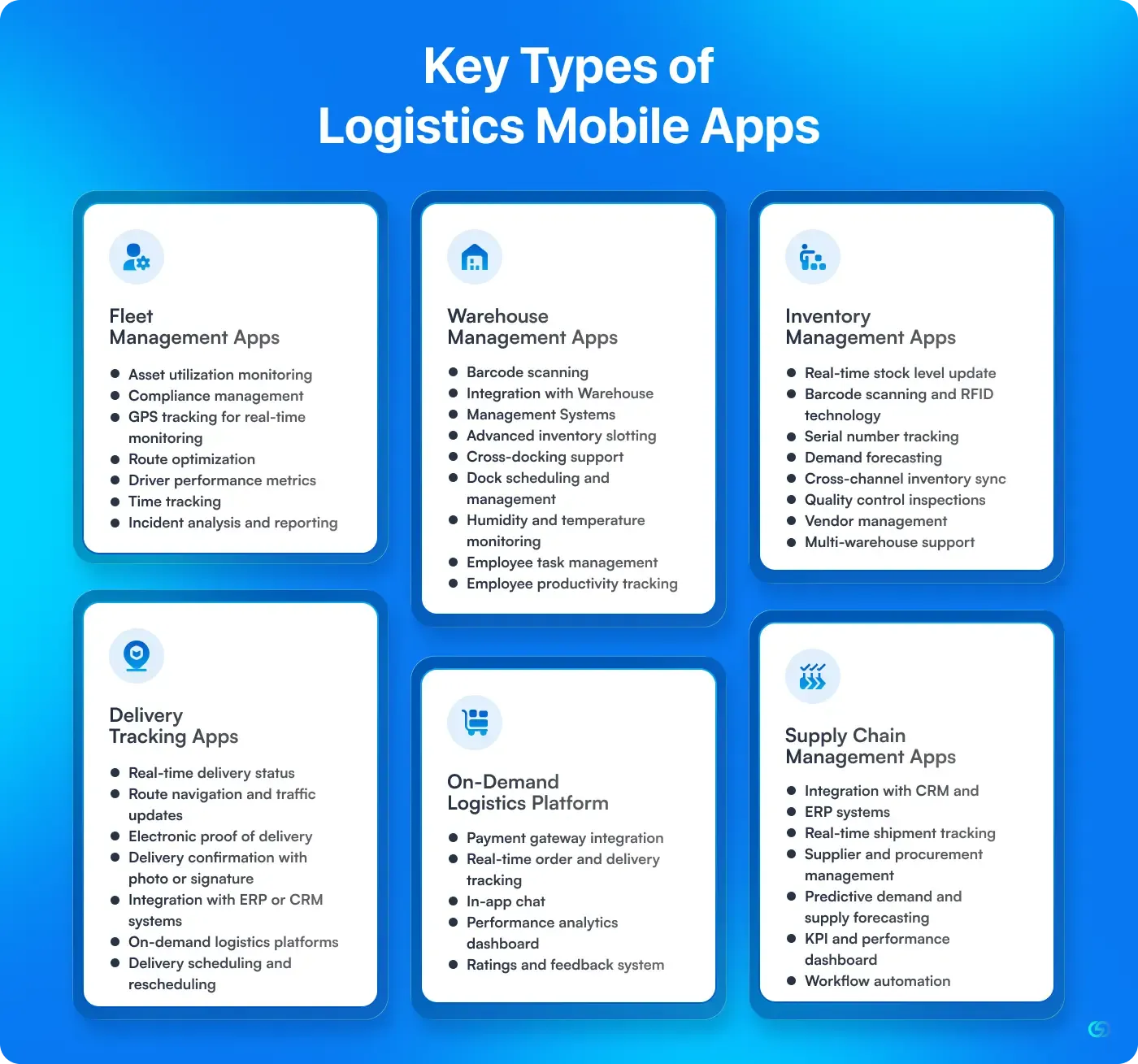
Know which type of logistics apps tackle which tasks and the advantages they bring. Here are the core categories:
🔹Fleet Management Apps
Fleet management apps monitor vehicle locations and optimize routes with the help of GPS tracking. Maintain seamless, real-time communication to enhance customer satisfaction. Fleet management reduces fuel consumption, guarantees fleet safety, and timely deliveries.
Main Features:
- Asset utilization monitoring
- Compliance management
- GPS tracking for real-time monitoring
- Route optimization
- Driver performance metrics
- Time tracking
- Incident analysis and reporting
🔹Warehouse Management Apps
Activities such as receiving items, picking, packing, and shipping need to be streamlined, and warehouse management apps do exactly that. Improving accuracy and workflow efficiency in warehouse processes, these apps optimize storage space and boost employee productivity.
Main Features:
- Barcode scanning
- Integration with Warehouse Management Systems
- Advanced inventory slotting
- Cross-docking support
- Dock scheduling and management
- Humidity and temperature monitoring
- Employee task management
- Employee productivity tracking
🔹Inventory Management Apps
Streamline tracking and management processes with inventory management apps with the help of RFID technology and barcode scanning, which allows you to manage inventory and optimize stock levels. These apps reduce the chances of stockouts, improve warehouse productivity, and facilitate inventory management.
Main Features:
- Real-time stock level update
- Barcode scanning and RFID technology
- Serial number tracking
- Demand forecasting
- Cross-channel inventory sync
- Quality control inspections
- Vendor management
- Multi-warehouse support
🔹Delivery Tracking Apps
With a delivery tracking app, ensuring transparency throughout the delivery process is effortless. Both businesses and customers can track shipments in real-time, reduce delivery queries, and missed updates.
Main Features:
- Real-time delivery status
- Route navigation and traffic updates
- Electronic proof of delivery
- Delivery confirmation with photo or signature
- Integration with ERP or CRM systems
- On-demand logistics platforms
- Delivery scheduling and rescheduling
🔹On-Demand Logistics Platform
Connect your business with delivery partners with on-demand logistics platform, ideal for e-commerce deliveries, courier services, or a same-day logistics provider. These platforms match orders with available drivers and manage payments, resulting in scalability and efficient operations.
Main Features:
- Payment gateway integration
- Real-time order and delivery tracking
- In-app chat
- Performance analytics dashboard
- Ratings and feedback system
🔹Supply Chain Management Apps
Supply chain management apps provide end-to-end visibility. They integrate multiple functions like inventory control, supplier management, and transportation planning in a centralized dashboard. With analytics and automation, these apps can predict demand, reduce risks, and make smarter decisions.
Main Features:
- Integration with CRM and ERP systems
- Real-time shipment tracking
- Supplier and procurement management
- Predictive demand and supply forecasting
- KPI and performance dashboard
- Workflow automation
Must-Have Features in Logistics Mobile App Development
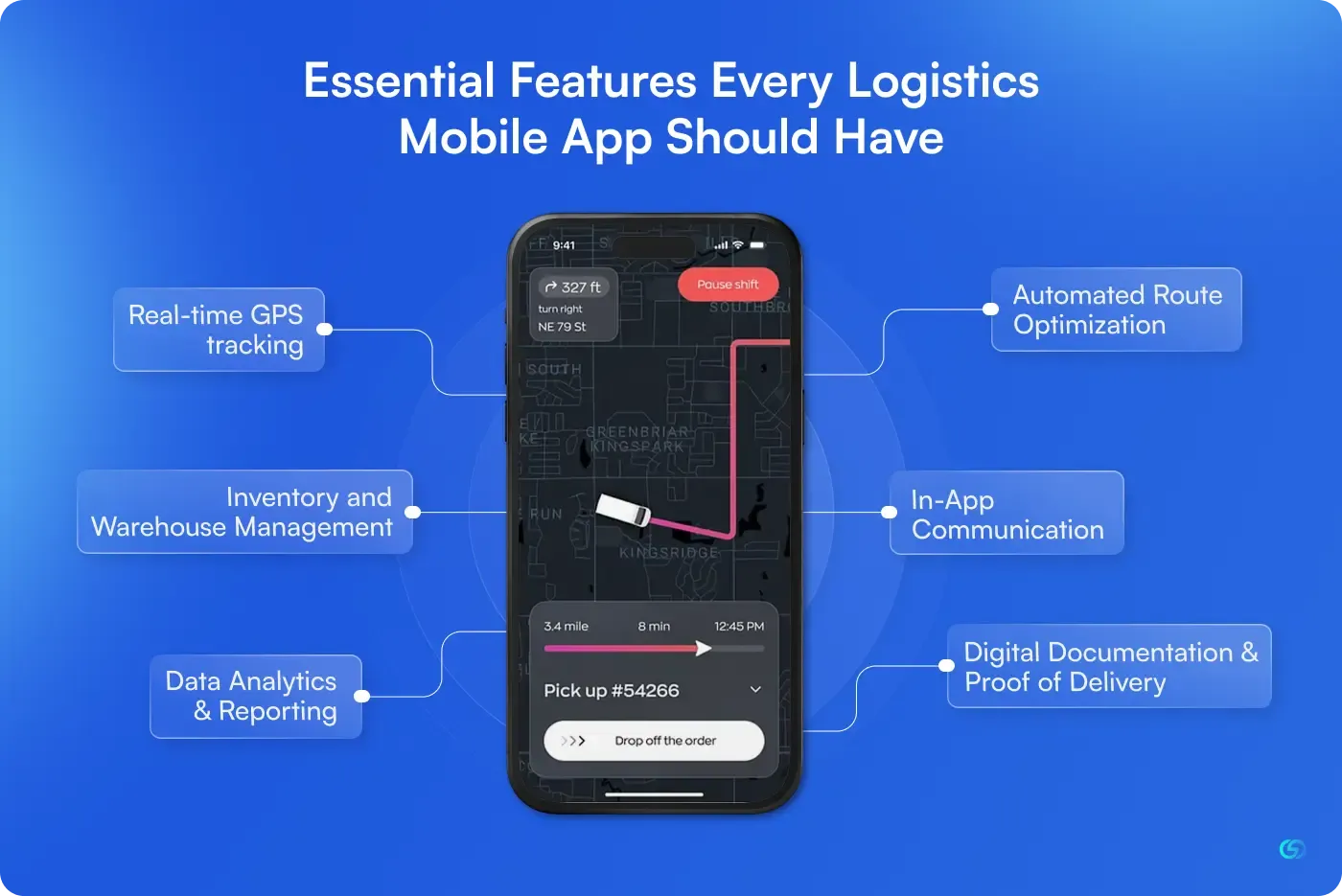
All the logistics applications listed above pack a certain range of features, but a custom app brings all the essential functionalities in one convenient platform.
1. Real-time GPS tracking
Real-time GPS tracking is crucial for customers and logistics businesses. It lets dispatchers see the shipment location, predict delivery times, and handle unforeseen delays.
2. Automated Route Optimization
Automated route optimization helps drivers take the most efficient route and reduce fuel costs. This is a must-have feature that improves delivery speed and decreases costs by analyzing weather, traffic conditions, and other factors. It is best for businesses involving time-sensitive deliveries, like e-commerce or courier services.
3. Inventory and Warehouse Management
Logistics app development with a focus on storage allows for seamless inventory management. Complete warehouse tracking allows store managers to simplify maintenance and keep everything in sight. These apps prove to be beneficial for retailers and e-commerce providers.
4. In-App Communication
Delivery services or dispatch teams can benefit from in-app communication. This feature keeps all communication channels open through voice or chat messages to improve coordination. This clarifies details, sends alerts for delays, and more without relying on external platforms to send notifications.
5. Data Analytics & Reporting
In logistics app development, data analytics and reporting is a crucial feature, which provides valuable insights into the logistics chain. The data-driven insights adjust route planning and resource management.
6. Digital Documentation & Proof of Delivery
Digital documents reduce paperwork and provide traceable records for every delivery. Digital signatures or photo confirmation act as proof of delivery and add transparency and client trust, giving businesses an edge in the fiercely competitive landscape.
Role-Based Feature Requirements in Logistics App Development
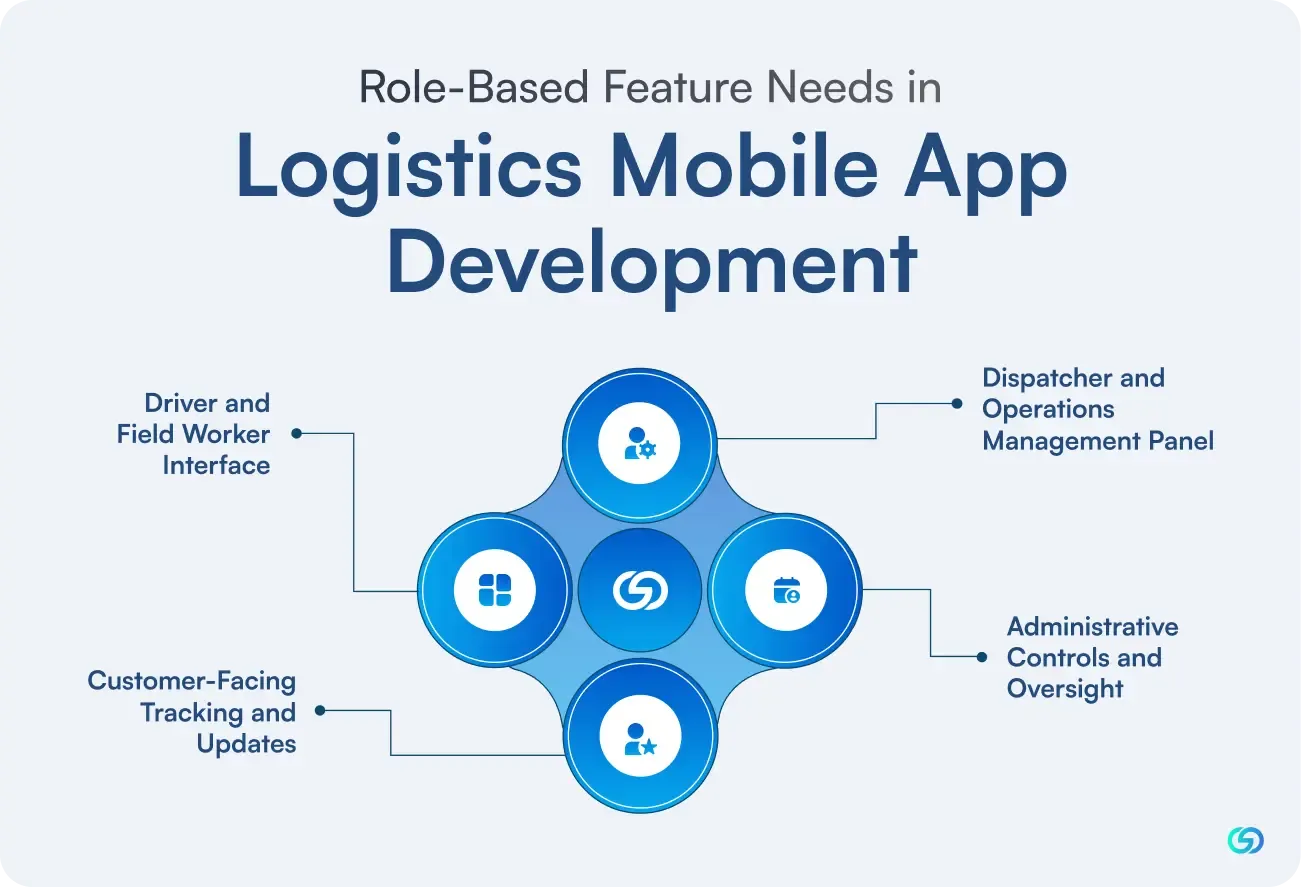
In logistics app development, role-based features ensure that different users see and interact only with tools relevant to their specific tasks.
▶ Driver and Field Worker Interface
Best for delivery agents and field staff to simplify their daily operations. Drivers can receive alerts for the next task, view routes, update delivery status, and report problems in real-time. Instant communication ensures quicker issue resolution and smooth workflow.
▶ Dispatcher and Operations Management Panel
The dispatcher panel acts as the center for logistics operations. It enables managers to assign tasks, optimize routes, and monitor deliveries in real-time. Advanced features such as traffic updates, predictive ETA, and resource allocation reduce bottlenecks and improve efficiency.
▶ Customer-Facing Tracking and Updates
Customers expect transparency and instant information. A customer-facing module offers real-time tracking, alerts for shipment changes, evaluates delivery times, and provides delivery confirmations. This reduces queries, keeps customers informed, and enhances overall satisfaction.
▶ Administrative Controls and Oversight
Admins and higher management need an end-to-end overview of the logistics ecosystem. Logistics mobile app development allows this by providing access to analytics, performance reports, compliance monitoring, and user management. With centralized control, businesses can identify inefficiencies and scale operations efficiently.
Logistics Mobile App Development Real-World Use Cases
Following are some renowned businesses that have leveraged mobile app development for logistics and got customized results:
1️⃣ Amazon
The e-commerce leader, Amazon, developed its own logistics software named Amazon Flex for its delivery network. Amazon Flex allows contractors to track packages, delivery routes, and communicate seamlessly with their logistics team.
2️⃣ XPO Logistics
The global software logistics company, XPO Logistics, strengthens its freight and supply chain operations. The app is feature-rich, providing load tracking, performance analytics, and live updates.
3️⃣ C.H. Robinson
A global logistics provider, C.H. Robinson, developed a logistics app to improve supply chain management and visibility. The app provides real-time tracking, shipment management, and analytics to boost the customer's journey.
Tech Stack of Logistics Mobile App Development
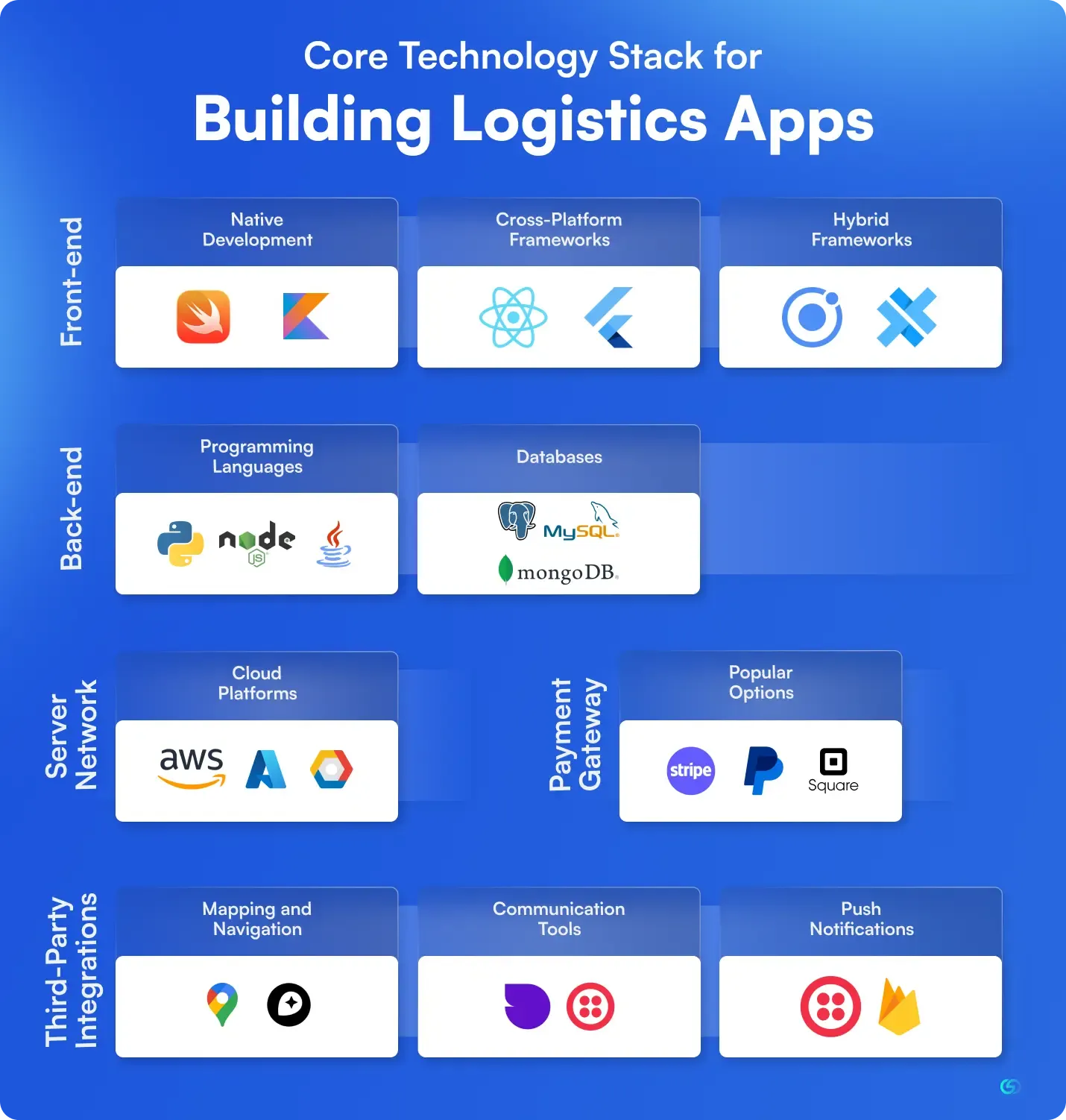
In order to create future-proof logistics apps, selecting the right advanced tech stack is a smart choice, which can manage extensive operations efficiently.
Step-by-Step Logistics App Development Process
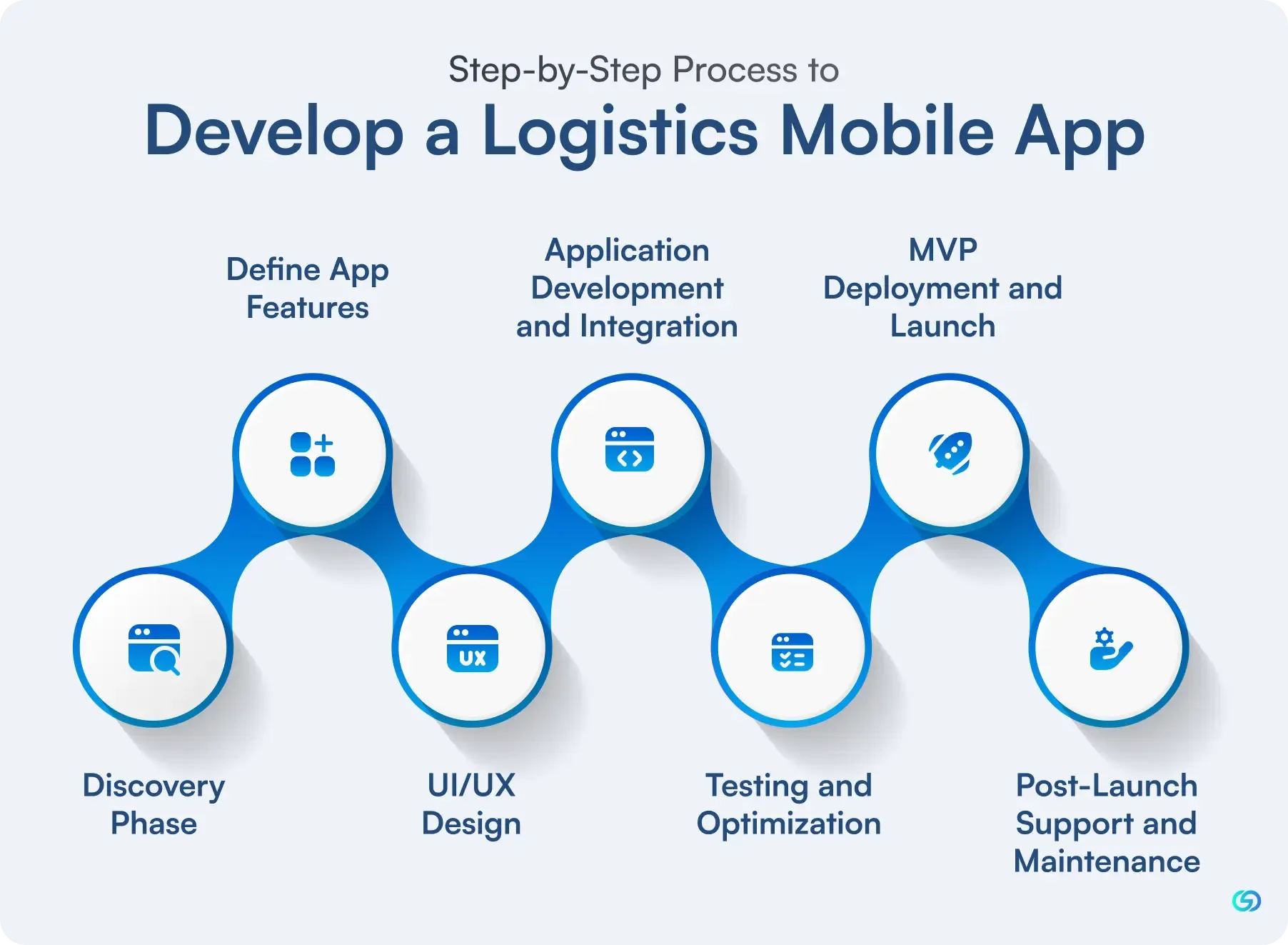
Top logistics app development companies help businesses of all sizes build a feature-rich and highly responsive mobile app for logistics. Here’s a step-by-step breakdown of how logistics apps come to life.
1. Discovery Phase
Logistics mobile app developers assess your existing logistics infrastructure, like warehouse management, supply chain, and transportation systems. After gaining a clear understanding of the business objectives and bottlenecks, the professionals design a tailored strategy. This phase involves thorough system analysis and technical audits, culminating in a comprehensive roadmap designed to align perfectly with your company’s needs.
2. Define App Features
After conducting comprehensive market research and discussion sessions, the mobile app development for the logistics team outlines both the functional and non-functional needs of your logistics app. These experts prioritize app features based on the type of logistics app, their importance, and feasibility for early release.
3. UI/UX Design
Logistics app development professionals create intuitive and user-friendly interfaces that enhance user experience by ensuring simple navigation. Ensure that the app design incorporates easy booking, real-time tracking, and a seamless, simple dashboard for managing logistics operations.
4. Application Development and Integration
Expert engineers build the core features and ensure that the application integrates with IoT devices, GPS, and external APIs for data synchronization. The development process focuses on performance optimization for smooth interaction between drivers, customers, and admins.
5. Testing and Optimization
The dedicated team of developers will conduct extensive tests, including performance, functionality, and security. The experts check for bugs and optimize app speed across platforms. Strict testing prevents the system from failure and ensures the app's success.
6. MVP Deployment and Launch
Now that you have a comprehensively tested logistics app, it’s time for deployment and launch. Developers prepare your app by ensuring the code quality and optimizing performance. They publish the app on iOS, Android, and web platforms, following the guidelines.
7. Post-Launch Support and Maintenance
Once the potential users have the MVP, experts monitor its ongoing maintenance, providing bug fixes, performance optimization, and feature updates. They even gather user feedback to recognize the areas for improvement. By staying updated on industry trends and technologies, the team of developers keeps your app competitive and relevant.
Integration of Advanced Technologies in Logistics Mobile App Development
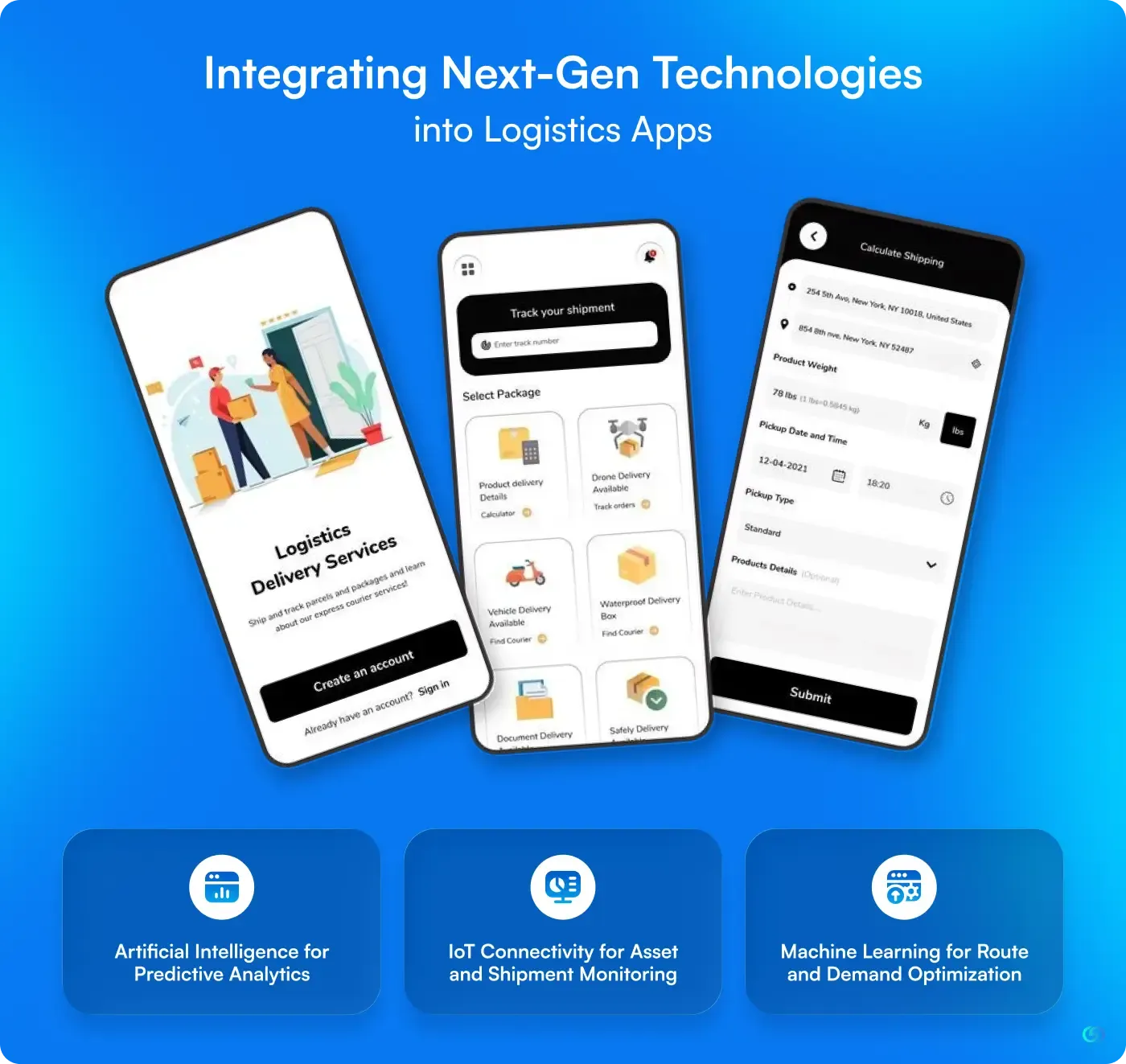
Going forward, logistics businesses will implement cutting-edge technologies to provide customers with more functionality. Incorporate the latest technologies to thrive in a cutthroat market.
🔵 Artificial Intelligence for Predictive Analytics
Integrating AI for predictive analytics in logistics mobile app development helps in forecasting demand, improving resource allocations, and optimizing routes. It analyzes large datasets, including sales, social media, weather, and more, and predicts future trends. The entire cycle allows for more efficient inventory management, enhanced customer satisfaction, and lower costs.
🔵 IoT Connectivity for Asset and Shipment Monitoring
Internet of Things connectivity is revolutionizing application development for logistics by offering real-time data for asset and shipment tracking. This enables automating processes, reducing costs, and increasing visibility across the supply chain.
🔵 Machine Learning for Route and Demand Optimization
ML helps logistics apps learn historical data, delivery trends, and traffic patterns to optimize routes and predict demands. By learning from past histories and real-time inputs, ML leads to smart route planning, minimizes delivery delays, and reduces fuel costs as well.
Security, Compliance, and Data Protection in Logistics Mobile App Development
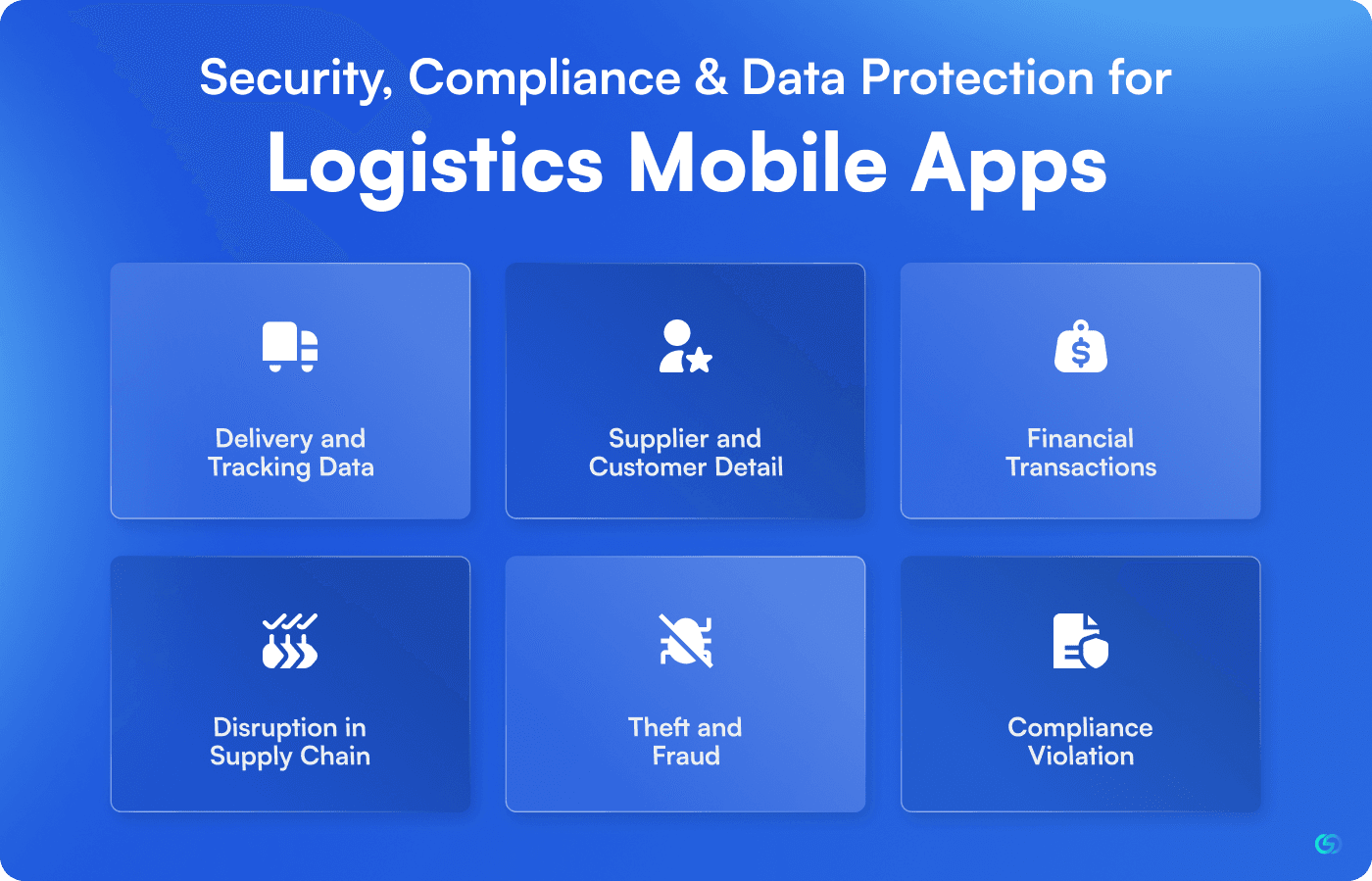
Logistics companies manage a large amount of sensitive data, such as:
- Delivery and Tracking Data: If real-time information is compromised, it could lead to cargo disruption or theft.
- Supplier and Customer Detail: Manufacturer, retailer, and customer’s confidential data needs to be safeguarded.
- Financial Transactions: Payment details and contractual agreements require secure handling and encryption.
Infringement in logistics data can lead to:
- Disruption in Supply Chain: The logistics system can halt shipments in case of a cyberattack, resulting in significant economic losses.
- Theft and Fraud: Cybercriminals can interfere with cargo tracking systems to reroute shipments or steal goods.
- Compliance Violation: If logistics data remains unsecure, it can result in non-compliance, leading to penalties.
Now you know that in logistics mobile applications, safeguarding sensitive data is critical. A robust app ensures encryption, secure authentication, and role-based access control to maintain operational integrity.
Custom vs. Off-the-Shelf Solutions
For many manufacturing companies, the lure to go with off-the-shelf logistics mobile app development is strong because it's cheaper and faster. However, it does come with limitations, making your unique business process seem generic. As your business scales, the limitations can hinder growth, leading to serious bottlenecks.
Custom logistics mobile app development, on the other hand, is engineered uniquely for your business. To go into the details of custom vs. off-the-shelf solution, we will break down the differences:
| Aspect | Custom Logistics App | Off-the-Shelf Software |
|---|---|---|
| Workflow & Feature | Designed to replicate your business and optimize your operations. Experts integrate every feature you need and leave out what’s not required. | Compels you to adapt a one-size-fits-all structure. Such software usually includes several extra features that your business doesn’t use, yet you still end up paying for them. |
| Integration Capabilities | These apps are built for seamless integration with the current WMS, ERP, CRM, and accounting software. | Logistics app based on off-the-shelf software generally has clumsy API connections that result in data silos, incomplete visibility, and manual workarounds. |
| Scalability and Performance | Made to grow your company, efficient in handling increasing fleet, user load, size, and data volume without performance decline. | Struggles when under tremendous load or while expanding to new areas, needing expensive upgrades or switching the platform entirely. |
| Competitive Advantage | Enables you to develop unique features that delight your user base and outmaneuver your competitors. | You find yourself in the same technological footing as your competitors, which makes it hard to differentiate on service technology. |
| Data Ownership & AI | In a custom app, you completely own your data and use it for your AI models, forecasts, and business insights. | The data is not your own; it resides on the vendor platform, restricting you from accessing the usage and limit the ability to innovate. |
| Total Cost of Ownership | Slightly higher initial cost but comparatively lower long-term TCO due to no recurring license fees, leading to a longer software lifespan. | Initial cost is lower, but high customization costs, subscription fees, and the cost of migrating once you outgrow it. |
Common Logistics Mobile App Development Challenges and Solutions
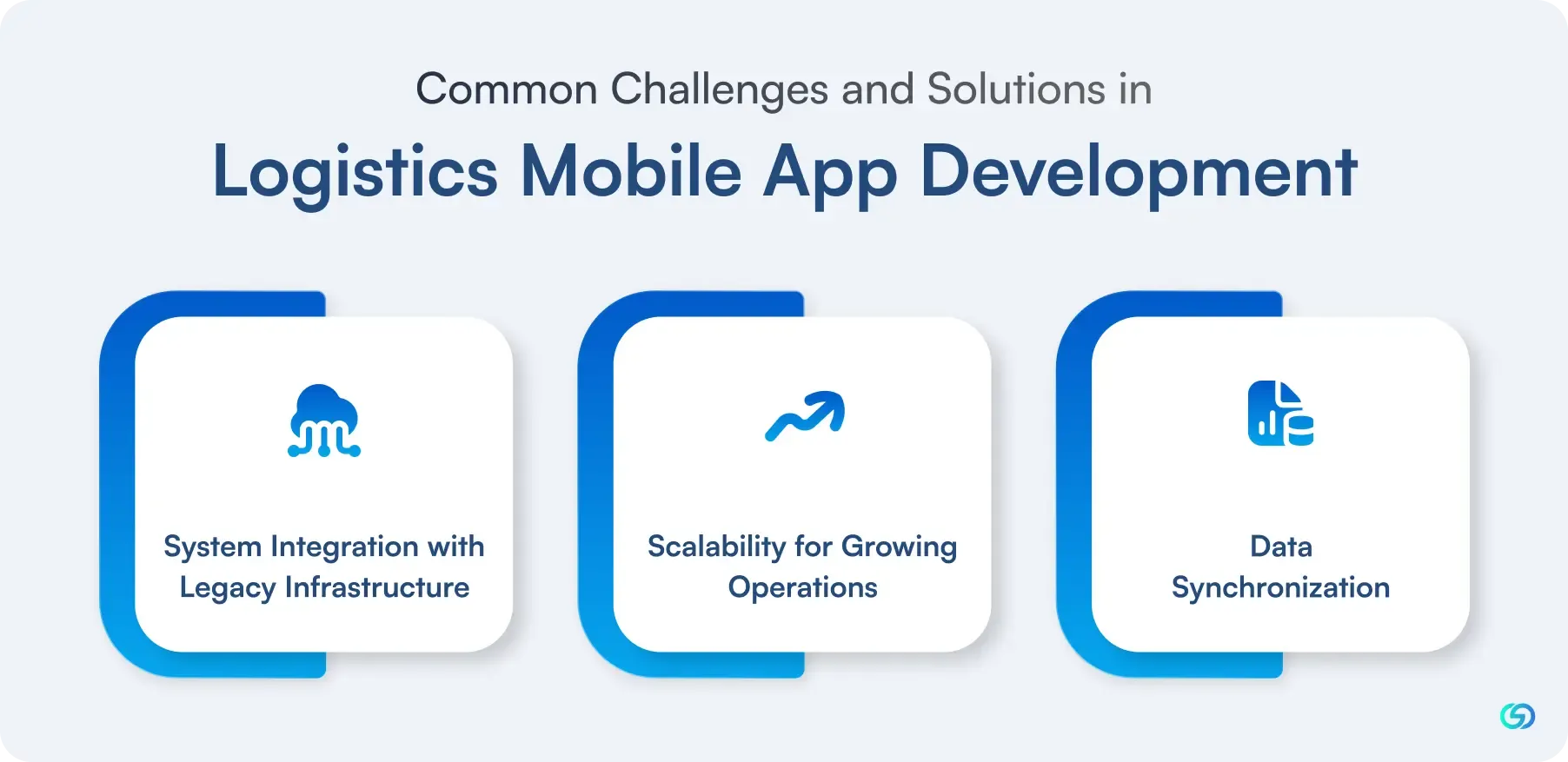
Multiple challenges arise in developing a logistics app due to the complexity of the industry. To meet these challenges, app developers come with thorough planning and deep expertise. They balance user experience, compliance, and technical capabilities for successful logistics app development.
System Integration with Legacy Infrastructure
Integrating the legacy system with logistics operations often poses a big challenge, which can be accomplished by a team of professionals.
Scalability for Growing Operations
As the operations grow, the logistics app must be able to scale. The app must handle exponential increases in users, including drivers, managers, and customers, delivery requests, and real-time data tracking.
Data Synchronization
For features like route optimization and live tracking, the app must process and sync large amounts of data from different resources in real-time. Connectivity issues halt or degrade performance.
Choosing the Right Logistics App Development Partner
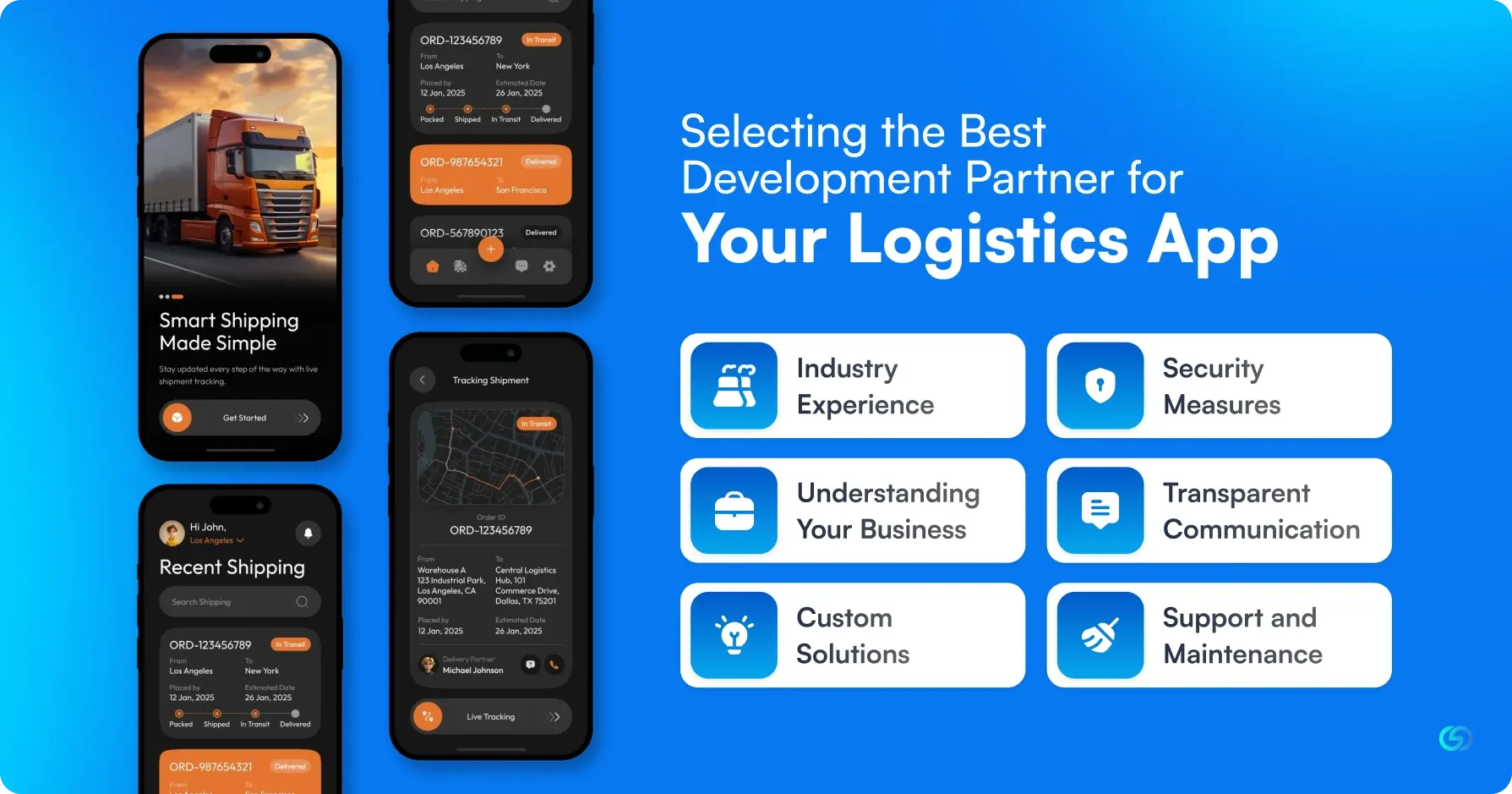
Selecting the right development partner can make or break your logistics app. You need to look beyond technical skill—a team of experts who understand your business operations, challenges, and translate business requirements into smart features. The right partner will enhance your logistics application.
◼ Industry Experience
Search for mobile app development partners with proven expertise in logistics, transportation, or the supply chain industry. Experts with proven work experience in a similar industry can help overcome logistics-specific challenges like customs compliance, route optimization, or inventory management.
◼ Understanding Your Business
The logistics app development partner you collaborate with should be efficient enough to grasp your business objective, daily workflow, pain points, and long-term goals. This ensures that they can build a customized solution that addresses your business bottlenecks and smoothly integrates with your legacy system.
◼ Custom Solutions
The engineers must provide custom solutions based on your specific business requirements and seamlessly integrate with your operations. This tailored strategy offers better data management and efficient decision-making.
◼ Security Measures
Ensure that the logistics company you choose strictly follows industry standards and ensures compliance with regard to protecting data. Evaluate their internal security protocols to ensure that they maintain a strong and proactive approach.
◼ Transparent Communication
One of the most crucial aspects when partnering with a logistics mobile app development company is clear timelines, regular progress updates, efficient collaboration, and on-time delivery. All of this is possible with the help of transparent communication, which helps both clients and developers stay on the same page.
◼ Support and Maintenance
Choose a partner that provides comprehensive support and maintenance, including bug fixes, regular updates, and performance optimization to stay competitive. This way, you will protect your investment in the long run.
The Future of Logistics Mobile Apps
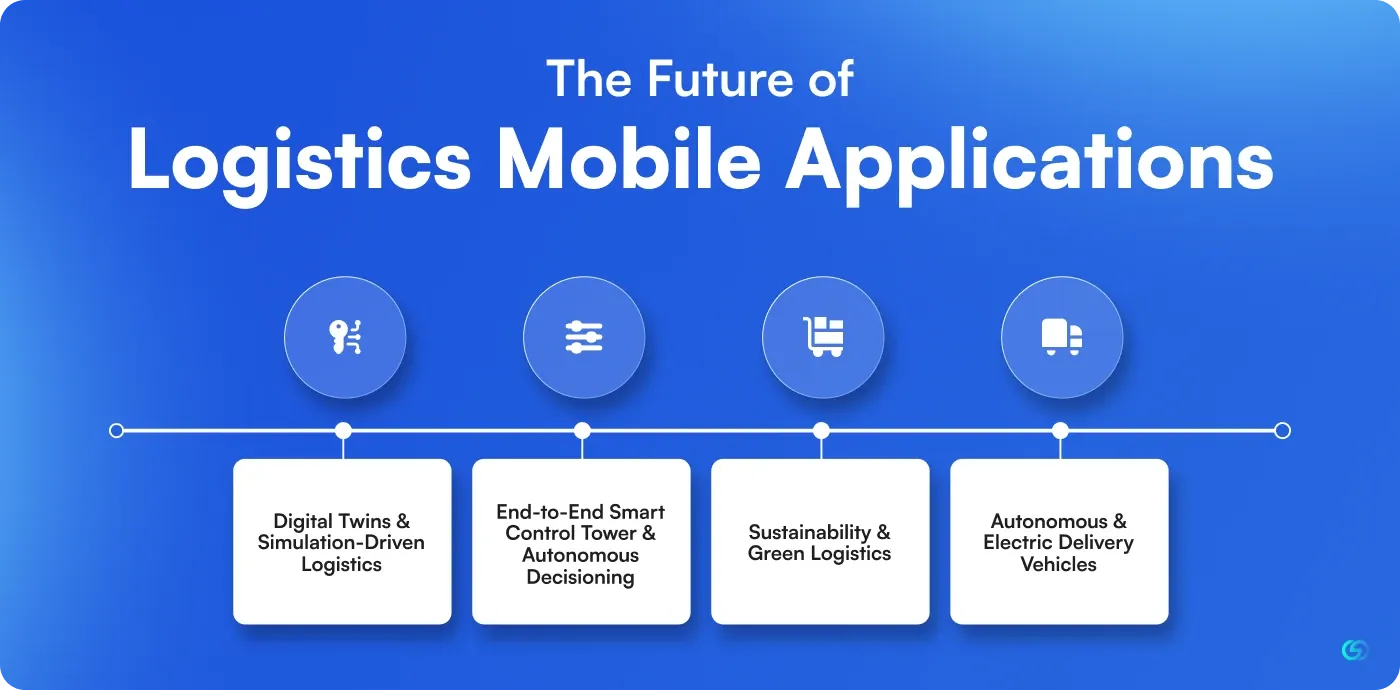
Now you know that the logistics industry is rapidly evolving, driven by technological advancements and changing customer expectations. However, staying ahead of these changes will transform the way supply chains operate.
Digital Twins & Simulation-Driven Logistics
The future of the logistics app will leverage digital twin technology to simulate warehouses, transport networks, and delivery corridors. This allows you to test different scenarios, like route disruptions, peak demand, and infrastructure failures, and optimize proactively.
End-to-End Smart Control Tower & Autonomous Decisioning
In 2025, the concept of a centralized control tower isn’t new. However, we are seeing it become multi-tiered, real-time, and AI-powered. Businesses are seeking visibility across suppliers, be it Tier 1, Tier 2, or Tier 3. In 2026, control towers will integrate risk mapping, predictive analytics, and even ESG (Environmental, Social, and Governance) metrics, enabling businesses to adapt in real-time and stay ahead of disruptions.
Sustainability & Green Logistics
With growing demand for eco-friendly practices and stricter environmental regulations, the future will see sustainability dominating logistics strategies. Businesses will come up with carbon-neutral transportation and energy-efficient warehouses with solar power and green packaging solutions, resulting in less waste. Sustainability is becoming a brand differentiator and a necessity for success.
Autonomous & Electric Delivery Vehicles
Logistics app development companies will focus on autonomous and electric delivery vehicles due to rising fuel costs and driving shortages. The reason has already started accelerating the use of electric delivery vans, drones, and trucks. In the near future, you can expect self-driving trucks, drones performing last-mile deliveries, and electric vehicles cutting fuel costs and emissions.
Conclusion
The logistics software market size is estimated to grow $22.3 billion by 2032, projecting a booming market. Developing a custom logistics application can modernize your enterprise, offer customers reliability and transparency, and ensure a sustainable competitive advantage. To make it happen, collaborate with experienced app developers who understand logistics inside out and can turn your operational goals into a powerful digital solution.
Frequently Asked Questions
How are mobile apps beneficial for a logistics business?
The logistics industry has progressed drastically, and now is the time to opt for app development, which offers multiple benefits, like real-time tracking and visibility, data analytics and insights, supply chain optimization, automation across operations, reducing cost, efficient fleet management, warehouse management, maintaining compliance, and boosting productivity.
Can logistics app be integrated with our existing system?
Absolutely. Experienced developers can seamlessly integrate logistics apps with your existing system. These experts specialize in creating reliable API connections to integrate your new app with the existing system, creating a unified data ecosystem, eliminating manual tasks, and boosting productivity across your operations.
How do you ensure the security of sensitive logistics data?
In the logistics industry, security is paramount. Experts can help secure sensitive logistics data with data encryption, secure authentication, security audits, and maintain compliance with regulations. This protects customer information and ensures secure operations across the supply chain.
What is the cost of developing a logistic app?
The cost of developing a logistics app typically depends on several factors, such as the complexity of features, including automated scheduling, real-time tracking, or multi-vehicle support. Apart from this, platform choice, whether iOS, Android, or both, also plays a key role in the cost of app development. More advanced functionalities like predictive analytics and AI optimization can drive up the expenses, but add great value to the app’s performance and enhance user experience.