- Manufacturing Mobile App Development
- 2025-12-17
Modern Manufacturing Mobile App Development: Use Cases, Features, & Trends
Audio Track
Table of Contents
Key Takeaways:
- Mobile app development for manufacturing companies means building workflows, streamlining team operations, and machinery.
- Apps solve common challenges like production bottlenecks, quality control issues, and inventory mismanagement, ensuring smoother operations.
- Production, quality, maintenance, HR, and EHS teams benefit from tailored apps.
- Features like ERP/IoT integration, offline functionality, real-time data access, workflow automation, and role-based security empower manufacturers to make smarter decisions.
What is Manufacturing App Development?
Manufacturers that want to stand out in today's market scenario are putting their resources into mobile applications. With more than six billion smartphones globally and 200+ billion app downloads each year, it shouldn’t come as a surprise that there’s a huge and growing appetite for mobile app solutions among consumers.
Coming to manufacturing app development, the industry has undergone persistent challenges—paperwork, complex resource management, thorough data entry, and financial oversight, leading to delays and disruptions.
Custom mobile app development companies can address these business issues by efficiently managing inventory, monitoring production, equipment maintenance, and quality control with a highly functioning and secure manufacturing app.
The impact of these apps isn’t just theoretical; the numbers show how much they have had an impact on manufacturing operations.
- According to a recent study, about 67% of manufacturing businesses utilize mobile applications to increase efficiency.
- Those businesses that leverage mobile apps witness a 30% reduction in operations.
- In the manufacturing sector, mobile apps have exponentially improved communication by 50%.
These statistics are not just nice-to-haves, but highlight the impact of mobile technology, which is not merely an option but a necessity for business transformation. This will make sure you do not lag in these technological advancements.
Types of Manufacturing Mobile Apps
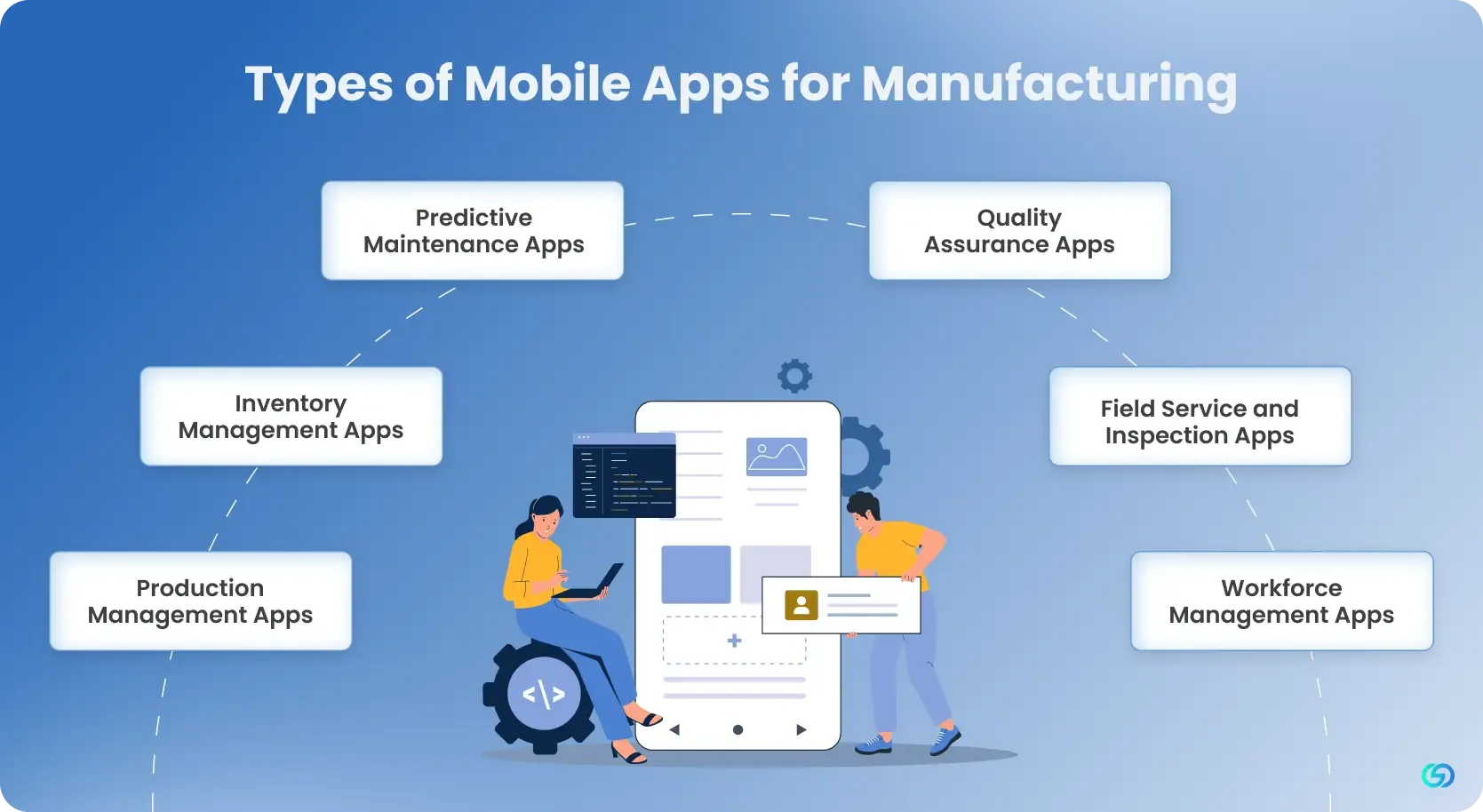
Custom mobile app development for manufacturing businesses focuses on building workflows, streamlining team operations, and machinery. These apps help overcome many challenges that come with the manufacturing industry.
🔷 Production Management Apps
Production planning and management are important in meeting deadlines and maintaining efficiency in manufacturing. Admins can easily monitor the status of production, workflows, and distribute resources efficiently. Production management applications identify bottlenecks, track production metrics, and optimize schedules. This level of control and supervision results in a productivity boost and a reduction in operational costs.
🔷 Inventory Management Apps
Inventory management is critical for manufacturers, allowing businesses to manage and track ongoing processes, raw materials, and finished products. Inventory management apps offer manufacturers real-time inventory level insights, helping them save time by avoiding overstocking and stockouts. Integrating inventory management apps optimizes supply chains and reduces storage costs.
🔷 Predictive Maintenance Apps
Predictive maintenance apps help manufacturers identify equipment issues before breakdown. These apps alert the admin when machine logs or IoT sensors show servicing is due. This helps in reducing unplanned downtime, maintenance costs, and increasing the lifespan of crucial equipment.
🔷 Quality Assurance Apps
One of the most important aspects of manufacturing is product quality. Quality assurance apps play an important role in meeting strict guidelines and industry standards. These apps inspect and monitor products in real-time, letting manufacturers catch inconsistencies and defects early on.
🔷 Field Service and Inspection Apps
Manufacturing apps smooth out machinery tests and audits performed by field engineers and technicians. They are provided with checklists, allow photo uploads, and form completion with offline entries synced later. This enhances reporting accuracy and ensures consistent data recording during inspection, even in remote locations.
🔷 Workforce Management Apps
Workforce management apps help in governing the factory with mobile apps that monitor tasks, shifts, and attendance. With such mobile apps, employees can easily report back to the shop to log or update their work progress. On the other hand, managers can track productivity.
Real-Life Manufacturing Challenges and How Mobile Apps Solve Them
Manufacturing applications are customized to meet modern business needs. These apps are developed with innovative features to address pain points and secure market leadership to enhance efficiency and improve accuracy in everyday operations.
Here are some remarkable ways manufacturing app development is powering transformation:
🔶Inventory Management
Challenges:
Inventory management remains one of the biggest pain points in the manufacturing industry. Relying on manual stock tracking can lead to delayed updates or misplaced items, affecting the production schedules between the production team and the warehouse. In most cases, operators may not even be aware if raw materials are available until it’s too late.
Use Case:
Manufacturing mobile app development simplifies inventory management by offering real-time visibility into stock levels, automated notification of low inventory, and QR code scanning. Warehouse teams can quickly update the quantities, and production managers can easily check the stocks on the go.
Benefits:
When you digitize inventory management, you can minimize errors and make sure the materials are always available on time. Real-time updates lead to faster restocking, smoother overall production flow, and optimized storage. Additionally, it also leads to cost savings and more streamlined operations.
🔶Quality Control
Challenge:
Maintaining product quality is quite challenging in the manufacturing industry. On the factory floor, some quality control teams still rely on paper-based inspection sheets. This slows down the process and increases errors or missing data. Sometimes, reports are submitted hours after inspection, leading to production delays or defective products reaching customers. All of this can lead to compliance issues.
Use Case:
Mobile apps for manufacturing allow logging inspection data quickly from smartphones. They can upload defects and record remarks right in the app. The data syncs automatically with central systems, so managers can view real-time inspection updates and act immediately if an issue is detected.
Benefits:
With mobile app development for manufacturing businesses, everything remains connected and digital, meaning quality issues are detected and resolved faster. Manufacturers gain full visibility, making it easier to maintain industry standards. This leads to less defective units and reduced waste, ultimately strengthening brand trust.
🔶Production Monitoring
Challenges:
Sometimes production managers struggle to get real-time updates from the factory floor. Data on machine performance or production output is usually collected manually at the end of shifts, which delays decision-making. As a result, minor slowdowns or equipment issues go unnoticed until they cause major production losses.
Use Case:
Manufacturing mobile app development gives teams real-time visibility into production performance. Operators can input data directly from the line, and the app displays metrics such as downtime, open rate, and machine utilization. Managers can remotely monitor progress and receive real-time alerts if production slows down or equipment fails.
Benefit:
Real-time monitoring authorizes teams to take quick action. This reduces downtime, bottlenecks, and ensures every shift meets its production goals. With time, it leads to consistency and better resource utilization.
🔶Maintenance Management
Challenges:
Many factories operate on a reactive maintenance approach instead of implementing preventive measures. Teams rely on paper logs to track schedules, which can lead to missed maintenance tasks. In case a machine breaks down unexpectedly, it stalls production and leads to high repaid costs and wasted time.
Use Case:
Opting for mobile app development, maintenance teams can get automated reminders for scheduled and completed tasks. Individuals can log repair details and attach images on the go. The app stores maintenance history for each equipment.
Benefits:
Preventive maintenance decreases the rate of unexpected breakdowns and expensive downtime. This way, the machines and equipment run longer. This leads to a more proactive team and machine reliability.
🔶Workforce and Task Management
Challenges:
Even today, there are many manufacturing businesses where the team often relies on verbal or paper-based instructions. This can lead to delays in deliveries and a lack of accountability. Additionally, shift handovers are also confusing because important updates can get lost, leading to miscommunication between the teams.
Use Case:
Centralize your workforce coordination with mobile app development by allowing managers to track and update tasks digitally. Technicians can mark tasks that are requesting approvals, complete, or report issues from their devices. Supervisors can view task progress in real-time.
Benefits:
Real-time visibility eliminates confusion. Teams become more organized, accountability improves across departments, and tasks are completed faster.
🔶Safety and Compliance
Challenges:
Many facilities rely on paper-based safety checklists, which are easy to lose or overlook. Missed safety checks lead to compliance penalties and workplace accidents.
Use Case:
With the help of manufacturing mobile app development, workers can finish safety inspections directly from their phones and attach photos for proof. The system can also send reminders automatically for scheduled checks.
Benefits:
Consistent safety checks reduce the accidents of non-compliance. Supervisors can access records anytime, which makes auditing smoother and transparent. This helps in building a safer workplace culture and ensures regulatory standards.
🔶Supply Chain Visibility
Challenges:
Supply chain disruptions are common because of poor visibility and delayed updates. Most manufacturers are still dependent on spreadsheets or calls to track shipment. This results in miscommunication and production slowdowns.
Use Case:
Manufacturing mobile apps offer real-time tracking of inventory, shipments, and supplier data. Teams can easily track delivery timelines, receive notifications on the status, and communicate with the vendors directly, using a single platform. Integrating with a logistics system or ERP provides comprehensive visibility.
Benefits:
With mobile apps, manufacturers can schedule productions to avoid expensive delays. Improved transparency strengthens relationships with the supplier, while clear communication helps resolve issues before they escalate.
🔶Tracking ROI and Progress KPIs
Challenges:
Many manufacturers struggle to measure their business’s true impact. Without centralized data, tracking ROI or KPIs becomes fragmented. Teams still rely on manual reports or outdated spreadsheets, which don’t show real-time performance. This makes it tough to spot areas for improvement.
Use Case:
Performance tracking can be simplified by collecting and visualizing data in real-time with manufacturing mobile app development. Manufacturers can access dashboards and get a look at the workforce's productivity—all at once. Automated reporting features give leaders a clear view of ROI.
Benefits:
Real-time insights and KPIs help decision-makers quickly detect inefficiencies and demonstrate returns from mobile app adoption. The data-driven visibility results in smarter investments, improvements, and sustainable growth across the manufacturing lifecycle.
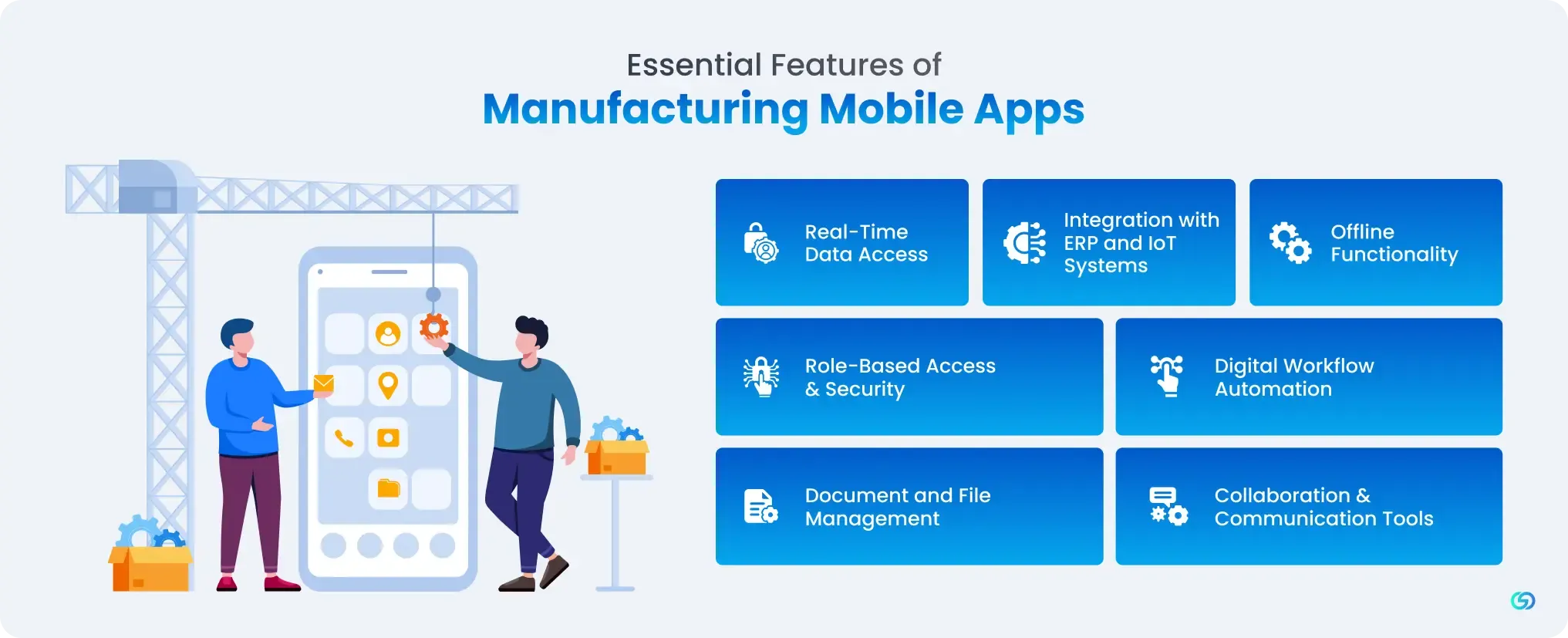
Key Features of Manufacturing Mobile Apps
The global manufacturing mobile application market is projected at $0.44 trillion in 2025 and is estimated to reach $1.07 trillion by 2030. With the manufacturing sector realizing the impact of mobile apps, businesses are quickly adopting digital tools to streamline production and operations. These apps have become a central component of the modern factory ecosystem today.
Let’s explore the key features to understand why manufacturers are investing so heavily in mobile app development.
➡️Real-Time Data Access
One of the key features of mobile app development in manufacturing is real-time data access. This gives supply chain information, real-time analytics, and so much more. Manufacturers can monitor inventory levels, production metrics, and quality control benchmarks on the go, resulting in smarter decision-making and issue resolution.
➡️Integration with ERP and IoT Systems
Expert mobile app developers will connect your application with ERP and IoT devices for seamless data flow across various manufacturing operations (from procurement to logistics and production). This ensures a unified view of all processes.
➡️Offline Functionality
Most plants operate in places where connectivity is poor. Mobile apps allow customers to leverage crucial functionalities even without an internet connection. Every information would automatically sync once the connection is available.
➡️Role-Based Access & Security
Another stand out feature of manufacturing mobile apps is that it controls who can view or approve particular data. Manufacturers can enjoy secure access while ensuring data integrity, compliance, and protection from prohibited use.
➡️Digital Workflow Automation
Manufacturing mobile app development streamlines manual and repetitive workflows inside an organization and processes such as reporting, approvals, and documentation. Automating these workflows reduces administrative burdens and accelerates production cycles without the need for constant human intervention.
➡️Document and File Management
Manufacturing businesses manage endless blueprints, manuals, and SOPs. A centralized library within the manufacturing mobile app ensures that every employee has secure access to the latest versions at all times. This reduces errors on the production floor.
➡️Collaboration & Communication Tools
Efficient collaboration and communication features in manufacturing mobile app development establish seamless interaction among team members. Facilitating quick communication and overcoming challenges leads to continuous improvements in the workflow.
What Manufacturing Departments Benefit the Most from Mobile App Development?
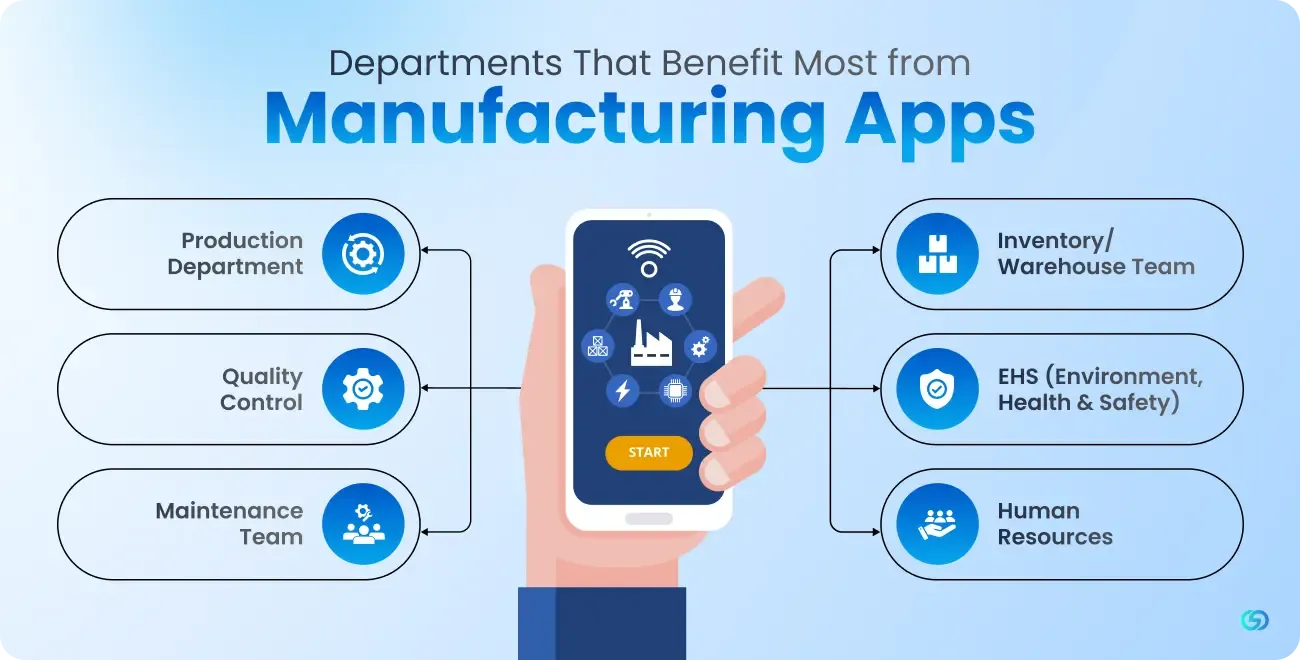
The market today is in a state of flux, and every strategic move that a business takes can make or break the outcome. Manufacturers who study and understand this market shift end up making smart decisions that help the company navigate through the market easily and emerge stronger than before. Custom manufacturing mobile app development can meet your unique needs to give you the edge in order to outpace competitors.
Here’s how different manufacturing departments can reap the benefits of a mobile app:
1️⃣Production Department
Mobile apps for the production team help track machine performance, track real-time output, and resolve bottlenecks. No more waiting for the end of the shift for updates because managers can check the workings of the floor and make faster decisions.
2️⃣Quality Control
The department relies on mobile applications to log all inspection data, attach images of defects or issues, and produce reports on the go. Mobile apps ensure that no details slip through the cracks. It also helps maintain consistency and quality standards across every batch.
3️⃣Maintenance Team
Applications are real game changers for maintenance engineers. Mobile apps help raise tickets to log issues right on the spot. Additionally, it helps track MTTR (Mean Time to Repair) and sends real-time notifications in case of urgent breakdowns. This almost eliminates the need for paperwork, reduces downtime, and prevents small issues from becoming big.
4️⃣Inventory/Warehouse Team
The inventory and warehouse department in the manufacturing company can streamline work processes with mobile app development. Expert developers can integrate Barcode or QR code scanning for stock movement. Supervisors receive real-time updates on the stock. Owing to instant visibility, companies can avoid overstocking and keep an eye on understocked goods.
5️⃣EHS (Environment, Health & Safety)
The EHS department can greatly benefit by leveraging manufacturing mobile app development, which provides thorough safety inspections and incident reporting. In addition to this, mobile apps offer emergency reporting and checklist verification. Managers get access to audit trails at any time, which results in workplace safety and compliance control.
6️⃣Human Resources
The HR team benefits tremendously from a mobile app for the manufacturing industry. They can manage attendance, shifts, and track employee performance. Working this way gives clarity, maintains transparency, and reduces administrative overhead.
Step-by-Step Guide to Develop a Manufacturing App
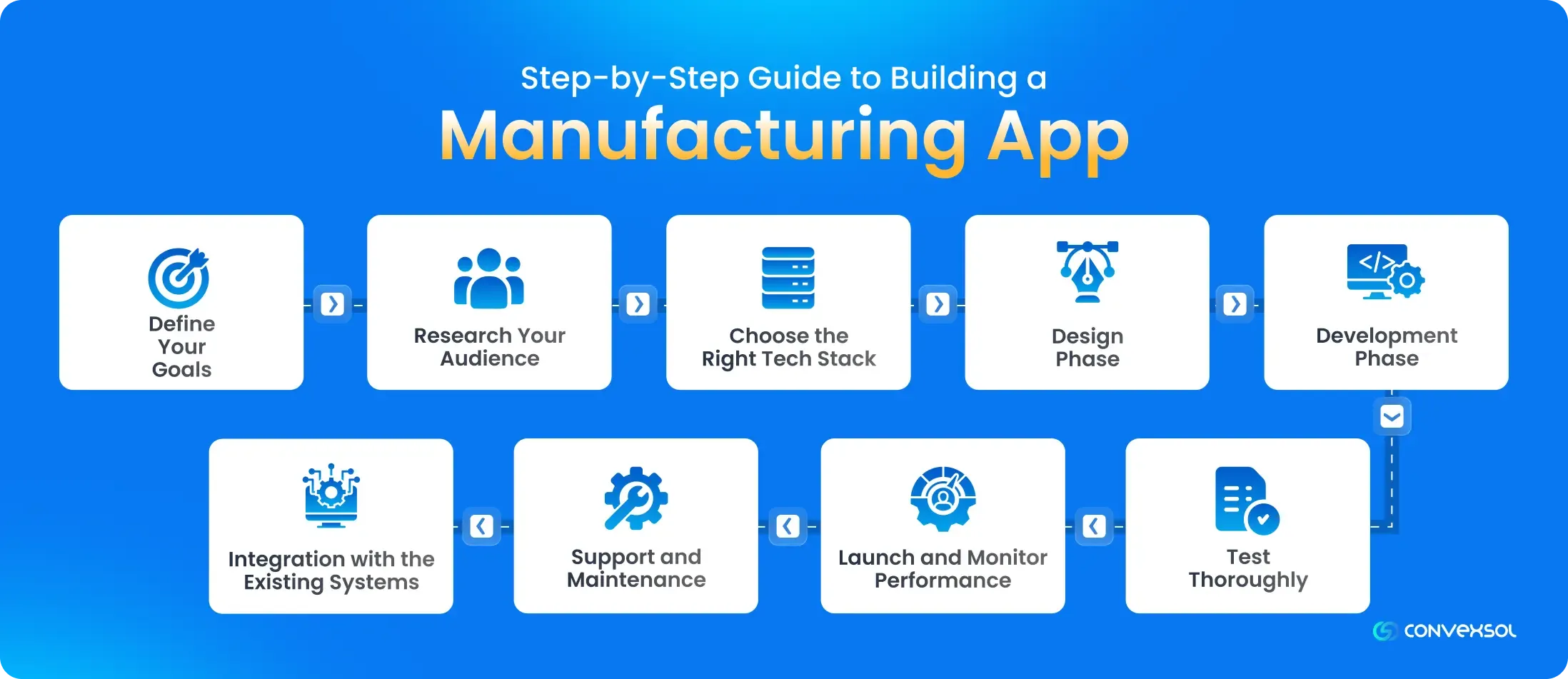
Companies in the manufacturing industry need to make quick and smart decisions because consumer demand is changing at an enormous rate. And to do so, compromising quality is out of the question. As one of the industries with the largest client base, mobile apps can completely change the game for manufacturing businesses.
So, whether you need an app for inventory management or real-time monitoring, here’s a complete guide to help you develop an app.
💠Define Your Goals
What is your goal? Before diving into the details, it’s important to understand the basics. Do you want to monitor equipment performance or manage inventory? Whatever your objective is, clarity and purpose can help you create an app that serves the purpose and addresses pain points in the process. This will help mobile app developers move to the next step.
💠Research Your Audience
A successful mobile app must understand the workflow, pain points, and challenges that end users face. Conduct comprehensive research by interacting with the floor employees, managers, and admins. Find out the areas that need improvement. By understanding the exact needs of the audience as well as the business, seasoned app developers will be able to design an app that truly stands out.
💠Choose the Right Tech Stack
The next step is to select the right tech stack, and a mobile app development company can help you with it. You need to consider factors such as scalability, integration, ease of use, and security when coming to a decision. Technologies like Flutter, React Native, and more can build a robust manufacturing mobile app.
💠Design Phase
UX is highly essential when developing a manufacturing mobile application. Skilled designers can create a clean and easily navigable design that not only improves but also boosts the adoption rate.
Certified and experienced designers understand the importance of a simple and smooth UI that is easily accessible to every person on the floor. Consistency, responsiveness, and clear navigation elements will ensure a streamlined user experience.
💠Development Phase
Once the design is complete, it’s time to build the core features. Real-time monitoring, inventory management, predictive maintenance, worker training and safety, and data analytics are some of the key features to consider. Each of these features depends on particular requirements. So, ensure that the app is designed in a way that’s easy to interpret.
💠Integration with the Existing Systems
Often, manufacturing mobile apps need to integrate with the existing system, such as inventory management systems, ERP software, and machine sensors. Professional developers ensure that your application is compatible with your current system by seamlessly integrating, ensuring that the app doesn’t disrupt the workflow and that data easily syncs.
💠Test Thoroughly
Before the app launches, quality assurance experts conduct thorough testing of the app. These experts test every feature and ensure functionality. Apart from that, they even test in different environments to ensure it performs well in the real-world.
💠Launch and Monitor Performance
After the mobile app undergoes strict testing, it’s time to launch. Offer proper training to your employees on how to use it and determine that support is possible for troubleshooting. A dedicated development team will monitor the performance of your app closely after launch.
💠Support and Maintenance
The dedicated development team you choose doesn’t just stop after app launch but works continuously to meet your business goals by closely analyzing the app’s performance. Improve functionality, make updates, and fix bugs.
Custom Build vs. Off-the-Shelf Manufacturing Apps
Manufacturing mobile app development is making a huge difference by helping companies work better and making smarter decisions. Understand the difference between custom-built and off-the-shelf apps to get started.
| Aspect | Custom-Built | Off-the-Shelf |
|---|---|---|
| Definition | Tailored solution, specifically built for your manufacturing operations and business goals. | Pre-made app designed to serve general manufacturing needs with standard features. |
| Customization | Completely customizable to match your brand and user roles. | Less customization; users need to adapt workflows to fit the app's existing structure. |
| Integration | Integrates seamlessly with CRM, ERP, and legacy systems. | Basic integration; may require third-party tools for compatibility. |
| Development Time | Requires design, development, and testing. | Ready to use; can be deployed quickly. |
| Cost | Higher upfront investment but long-term ROI. | Lower initial cost but licensing fees and subscription may add up. |
| Maintenance & Support | Dedicated technical support and regular updates as per your needs. | Support is vendor-dependent; updates and fixes are handled on schedule. |
| Data Security | High; you control data hosting and security protocols. | Moderate; data storage and security depend on the provider. |
| Best For | Manufacturers with complex processes, specific compliance needs, or several facilities. | Small manufacturers seeking quick and affordable solutions. |
Choosing the Right Partner for Manufacturing Mobile App Development
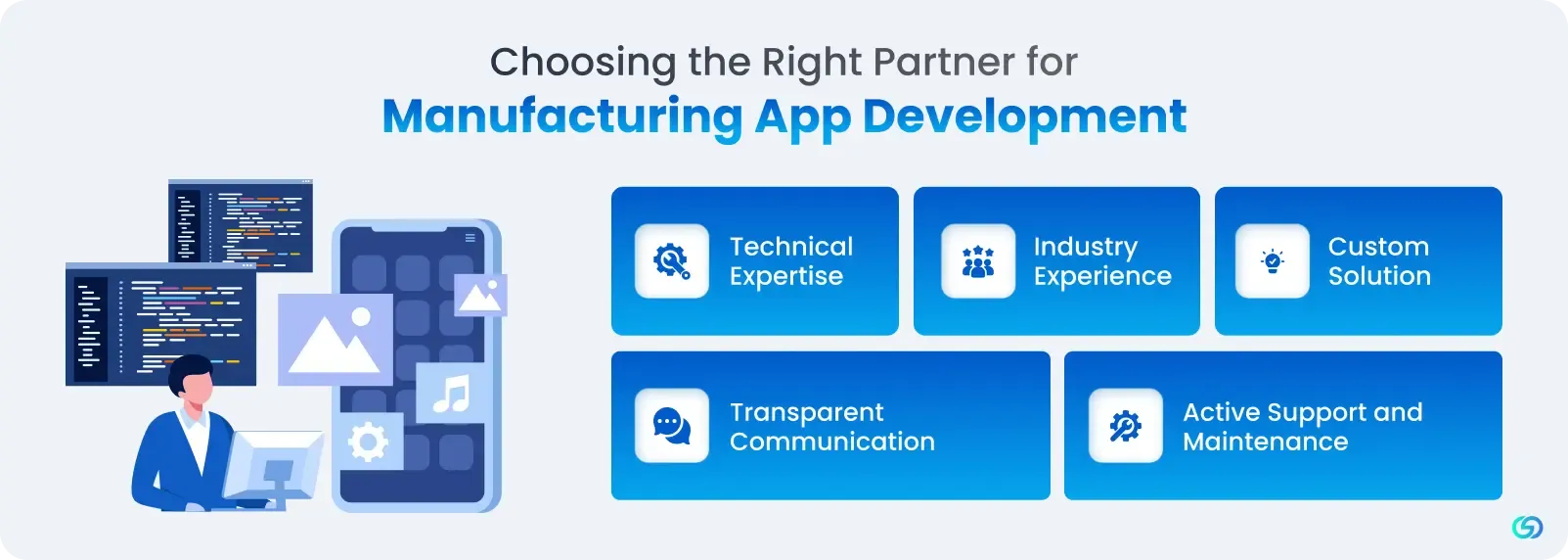
Once you have an idea of what a manufacturing app does and the numerous ways it can benefit your business, it’s time to find the right manufacturing mobile app development partner. These are the capabilities to look for when selecting one:
-
Technical Expertise: To collaborate with the right expert, analyze the company’s experience with particular technologies necessary for your app. This could be programming languages, development platforms, frameworks, and cloud technologies.
-
Industry Experience: The mobile app development company must come with proven expertise in the manufacturing industry. Expert engineers with previous experience can help solve industry-based challenges and provide stand out strategies.
-
Custom Solution: The dedicated developer must provide customized solutions based on your business’s specific needs. A reliable team offers tailored strategies to better manage operations and make sound decisions.
-
Transparent Communication: When partnering with a mobile app development company, transparent communication is one of the most crucial aspects to remain on the same page. The dedicated team must maintain clear timelines and offer regular progress updates while ensuring on-time delivery.
-
Active Support and Maintenance: Comprehensive support throughout the development journey and beyond is a necessity as marketing is changing at the blink of an eye. Experts should provide bug fixes, performance optimization, and regular updates to stay competitive.
Future Trends of Mobile Apps in the Manufacturing Industry
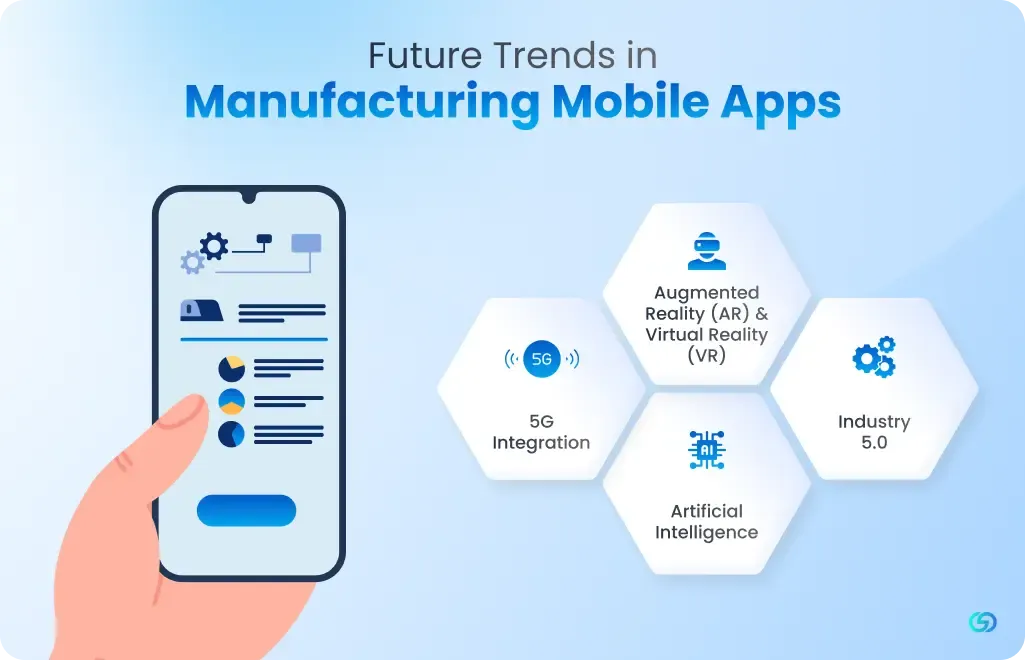
There are many technological advancements shaping the future of the manufacturing industry. Following are some cutting-edge trends that are redefining the workings.
⏺️Artificial Intelligence
AI is a notable trend, but its impact is already visible in the manufacturing industry. The powerful capabilities of predictive analytics, intelligent automation, demand forecasting, and more make AI an integral technology for mobile apps to enhance workflow. An AI-powered mobile app in manufacturing can optimize workflows, enhance product quality, and handle complex tasks with precision, driving greater efficiency and productivity across operations.
⏺️5G Integration
The 5G technology integration in mobile apps is powering transformation in the manufacturing industry by allowing quick and faster communication. This advanced system provides remote monitoring and instant data sharing, resulting in workflow efficiency and minimizing downtime.
⏺️Augmented Reality (AR) and Virtual Reality (VR)
Both AR and VR are emerging technologies changing the manufacturing sector. These technologies are redefining the maintenance and training processes, offering immersive training experiences and real-time guidance for challenging tasks, reducing errors.
⏺️Industry 5.0
This is the next phase of industrial revolution—Industry 5.0, highlighting the collaboration between cutting-edge technologies and humans in the manufacturing sector. Mobile apps are at the center of this transformation, allowing sustainable practices, personalized production, and human-centric approaches that blend human intelligence and the power of automation.
Concluding Note
With a growing interest in AI and other modern technologies, many manufacturers are adopting advanced digital strategies to stay competitive. Mobile apps play a crucial role in supporting compliance, boosting productivity, and enhancing user experience. On the other hand, in today’s highly competitive market, mobile apps have a larger space to reach targeted audiences.
Frequently Asked Questions
How much does it cost to make a manufacturing mobile app?
The cost of developing a manufacturing mobile app depends on several factors, such as the complexity of the app, design requirements, customization needed, and tech stack. Integrations with other platforms and systems can also influence overall investment.
How can manufacturers ensure the security of sensitive data within their mobile apps?
Manufacturers can ensure data security by implementing role-based access controls, encryption, and secure authentication methods. With the help of regular audits and compliance with industry standards, sensitive information is protected from unauthorized access.
How do manufacturing mobile apps integrate with existing systems?
Manufacturing mobile apps integrate with the existing system seamlessly, such as MES, CRM, ERP, and supply chain platforms. This allows real-time data exchanges between inventory, production, and management systems.
What kind of post-launch support and maintenance does a dedicated development team provide?
Dedicated engineers provide active post-launch support and maintenance by offering monitoring, bug fixes, and regular updates to ensure compatibility with various devices. Your development partners provide feature enhancements and ongoing technical support to keep the app updated.
Dedicated engineers provide active post-launch support and maintenance by offering monitoring, bug fixes, and regular updates to ensure compatibility with various devices. Your development partners provide feature enhancements and ongoing technical support to keep the app updated.