- Mobile App Development
- 2025-07-01
Our Detailed Mobile App Development Process: Step-by-Step Mobile App Development Guide
Audio Track
Table of Contents
Key Takeaways:
- ConvexSol has a refined a systematic mobile app development process that transforms visionary ideas into robust, mobile applications.
- The ideation phase involves structured brainstorming, stakeholder inputs, and market validation.
- The next phase is the planning phase which transforms abstract ideas into a concrete roadmap.
- The design phase brings your app to life. Here, our aim is to create a seamless and delightful user experience.
- The development and coding phase where your app takes shape through lines of code.
- The testing phase is not a one-time task but a continuous process integrated throughout development.
- Lastly, there is hassle-free deployment and ongoing maintenance services for regular updates.
An Overview of Mobile App Development with ConvexSol
In today’s digital-first era, mobile applications are no longer optional; they are a business imperative. Whether you're a startup disrupting an industry or an enterprise optimizing internal operations, a mobile app can serve as a strategic asset that enhances user engagement, operational efficiency, and revenue generation. But how does a mobile app go from a mere idea to a successful product on the app store?
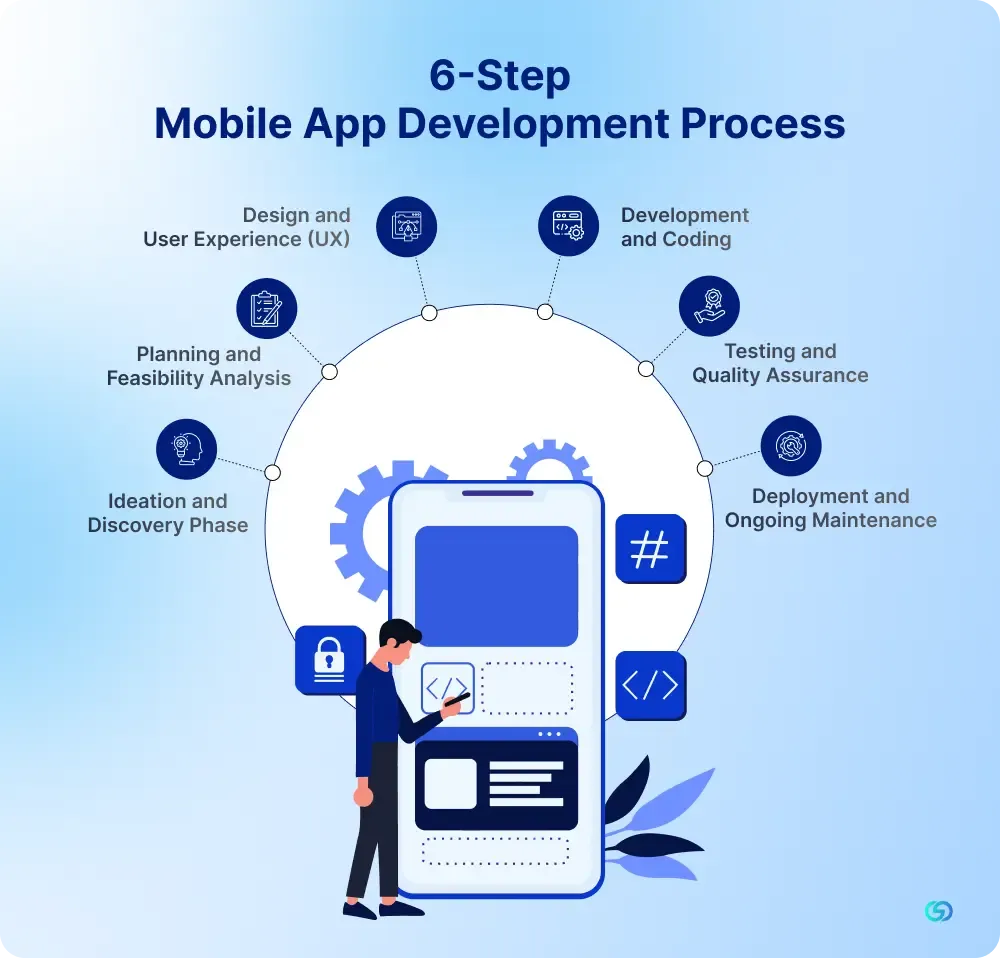
At ConvexSol, we have refined a systematic 6-step mobile app development process that transforms visionary ideas into robust, scalable, and user-centric mobile applications. Drawing from industry best practices and insights from leading app development frameworks, here is a comprehensive breakdown of our application development lifecycle.
Step 1: Ideation and Discovery Phase
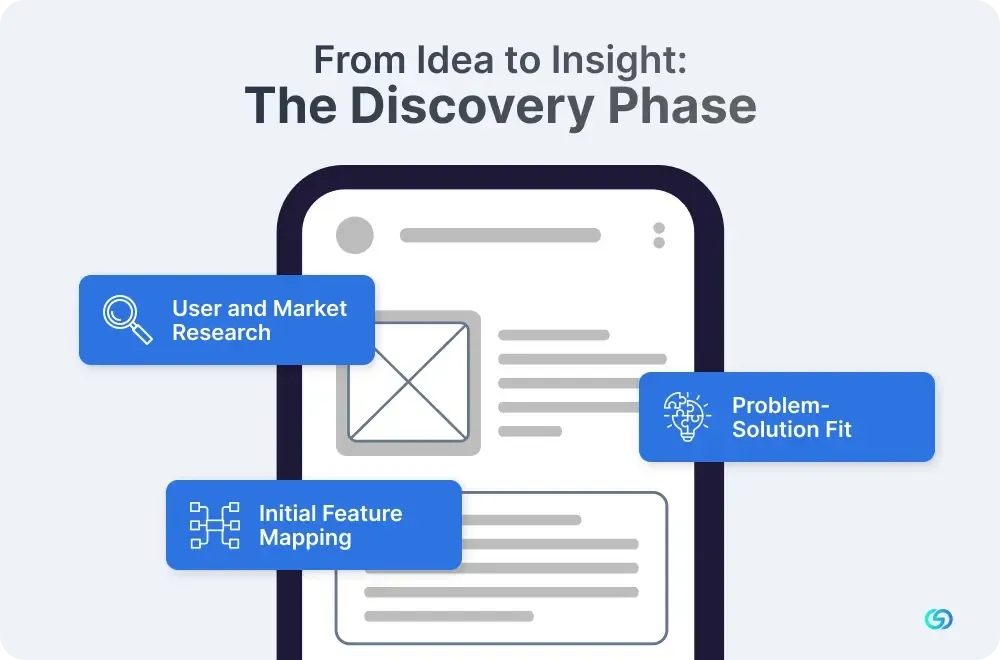
Every great app begins with a compelling idea. However, ideation isn’t just about having a lightbulb moment; it involves structured brainstorming, stakeholder inputs, and market validation.
🔹User and Market Research: We begin by understanding your target audience, analyzing competitors, and identifying industry trends. This research helps us pinpoint market gaps and user pain points your app could solve.
🔹Problem-Solution Fit: Through discovery workshops with stakeholders—including business leaders, developers, and end-users—we define the app’s core purpose. This involves identifying the user journey, understanding customer expectations, and aligning the product vision with business goals.
🔹Initial Feature Mapping: Once the vision is clear, we draft a preliminary list of must-have features and functionality. This helps in future planning, budgeting, and technical feasibility assessment.
By the end of the ideation phase, we have a clear understanding of what to build, why to build it, and who the app will serve.
Step 2: Planning and Feasibility Analysis
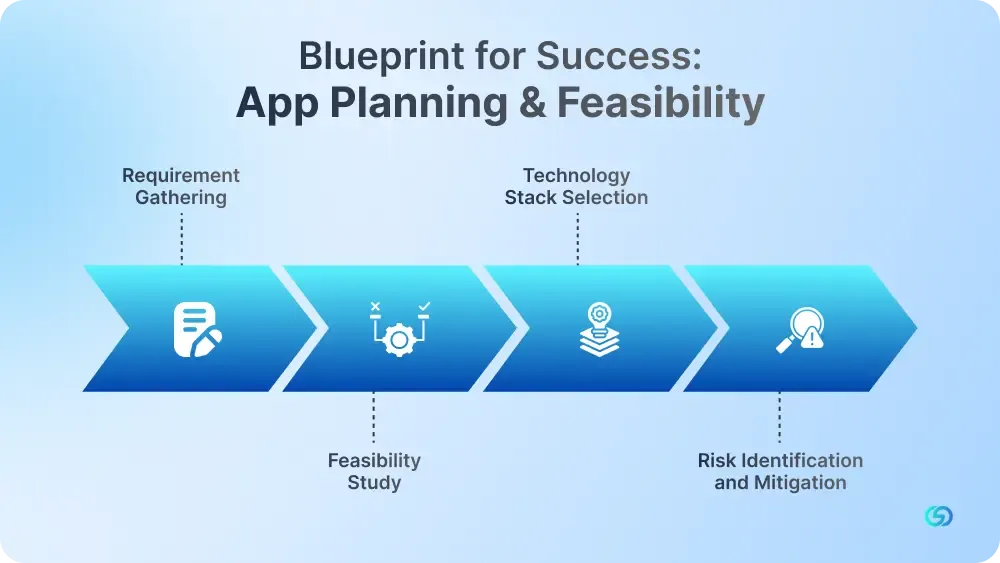
The next phase in mobile app development is the planning phase which transforms abstract ideas into a concrete roadmap. It’s where we align timelines, resources, and budget with the project scope.
🔹Requirement Gathering: We capture user stories, business requirements, and system requirements. These are classified from high-level goals to granular technical needs—such as performance benchmarks, accessibility standards, and data backup protocols.
🔹Feasibility Study: We evaluate whether the app can be built within your desired timeline, budget, and technology stack. This includes:
- Technical feasibility
- Operational feasibility
- Legal and compliance considerations
🔹Technology Stack Selection: Based on the app type (native, hybrid, or cross-platform), we select the most appropriate frameworks, libraries, and tools—be it Flutter, React Native, Swift, Kotlin, or backend stacks like Node.js and Firebase.
🔹Risk Identification and Mitigation: We forecast potential bottlenecks, including integration challenges, security vulnerabilities, or infrastructure constraints, and build contingency plans.
This phase ensures that development starts on a firm footing, reducing the risk of project derailment.
Step 3: Design and User Experience (UX)
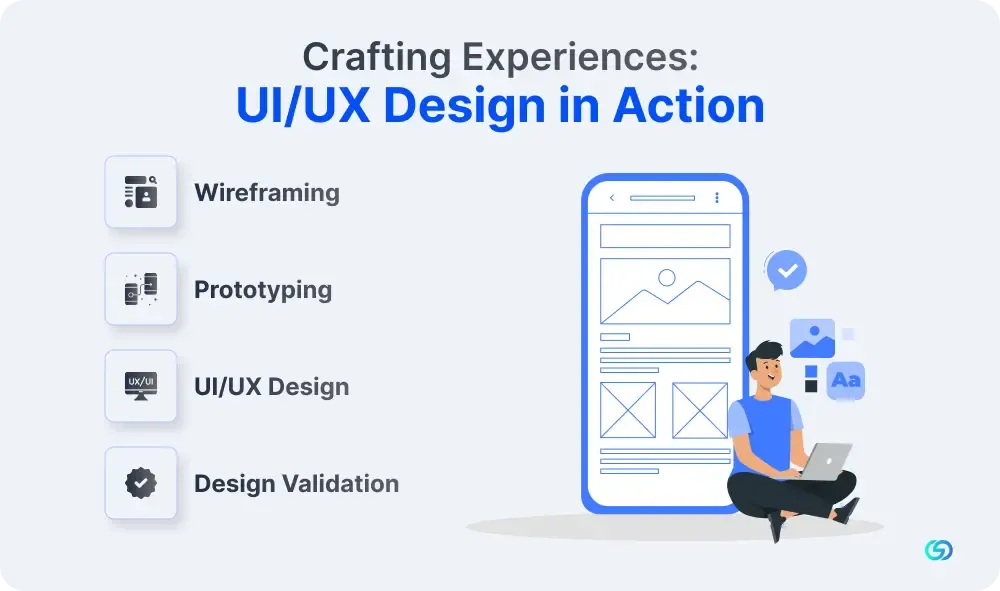
With the plan in place, the design phase brings the app to life visually. Here, our goal is to create a seamless and delightful user experience.
🔹Wireframing: We begin with low-fidelity wireframes to sketch the app’s basic layout, including screen flow and information architecture.
🔹Prototyping: Interactive prototypes simulate the end-user journey, allowing stakeholders to visualize the app in action and provide early feedback.
🔹UI/UX Design: Our design team crafts high-fidelity mockups that reflect your brand identity. Design elements such as color schemes, typography, icons, and animations are finalized.
🔹Design Validation: We collect feedback from potential users, refine the design, and ensure accessibility and usability standards are met.
By the end of this phase, we have a polished visual blueprint that guides development.
Step 4: Development and Coding
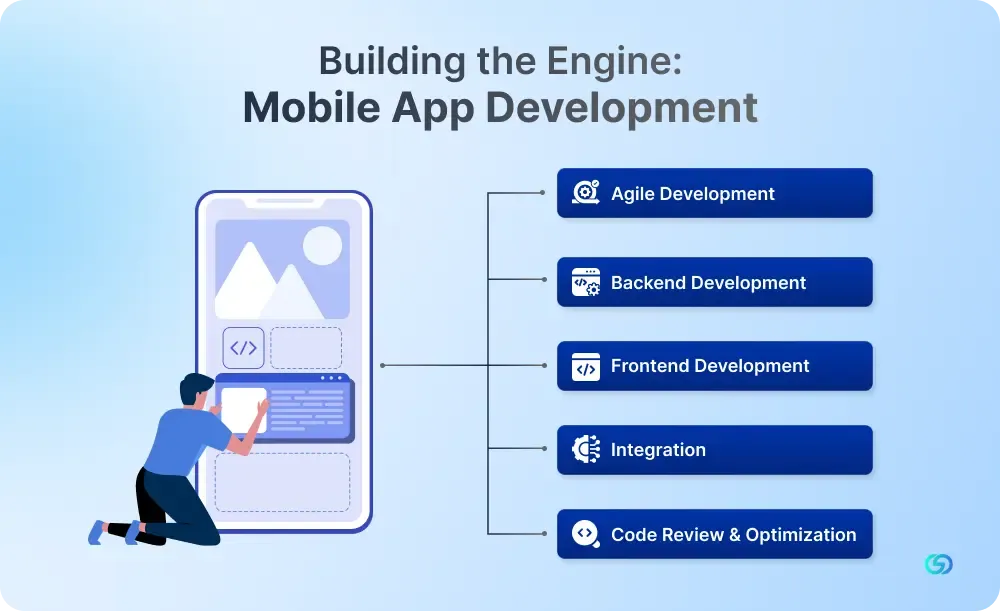
This is the execution phase where your app takes shape through lines of code. Depending on the complexity, the development app development lifecycle may be iterative or modular.
🔹Agile Development: We adopt Agile methodologies, breaking down the project into manageable sprints. Each sprint focuses on developing specific modules or features.
🔹Backend Development: Our developers build the server side, databases, and APIs that power the app’s core functionality. This includes setting up user authentication, payment systems, data storage, and business logic.
🔹Frontend Development: Concurrently, we develop the client side of the application. For native apps, we use platform-specific languages like Swift (iOS) and Kotlin (Android). For cross-platform apps, we rely on frameworks like Flutter and React Native.
🔹Integration: We integrate third-party APIs, cloud services, CRM/ERP systems, analytics tools, and other necessary platforms to ensure the app ecosystem functions holistically.
🔹Code Review & Optimization: Regular code reviews and refactoring ensure the codebase is clean, scalable, and maintainable.
Step 5: Testing and Quality Assurance
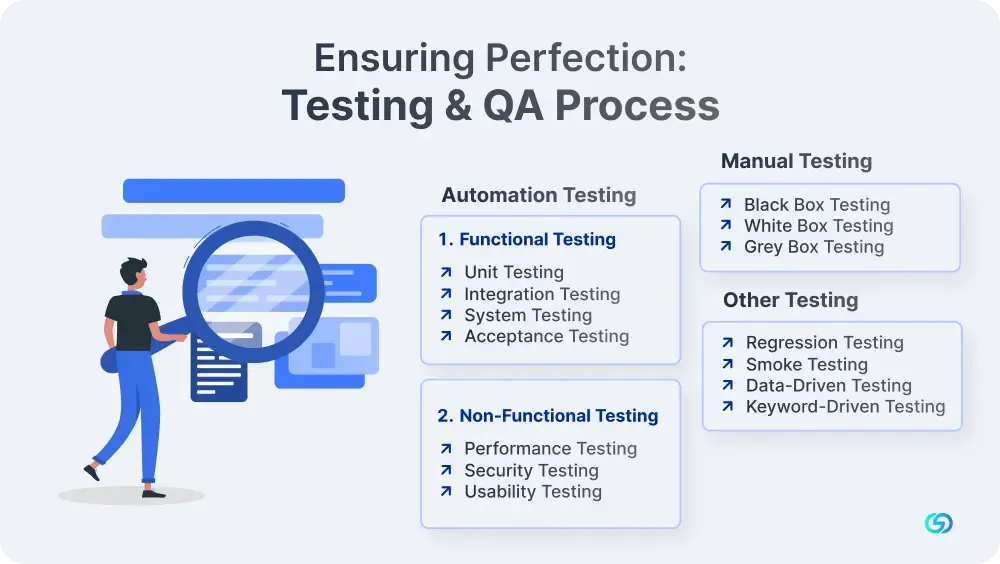
The testing phase of mobile app development is not a one-time task, but a continuous process integrated throughout development. Our QA team performs exhaustive testing to ensure a bug-free, high-performing product.
Automation Testing
Automation testing enables us to improve coverage, decrease human error and speed up time-to-market without compromising on reliability. Our automated testing workflow involves both functional as well as non-functional testing types.
Functional Testing
We verify all the features of the application behave as expected, utilizing automated scripts for repeated accuracy.
🔹Unit Testing: Individual components and functions are solely tested to make sure they function correctly.
🔹Integration Testing: We validate how multiple modules interact. This ensures consistent flow of data and behaviour across units.
🔹System Testing: The entire application is tested as the overall system for verifying the complete functionality and compliance with needs.
🔹Acceptance Testing: Testing is conducted with real-world scenarios for confirming the application meets user expectations and business objectives.
Non-Functional Testing
🔹Beyond functionality- We assess performance and reliability for guaranteeing strong user experience.
🔹Performance Testing: Evaluate the speed of the app, the responsiveness and stability under normal and peak usage conditions.
🔹Security Testing: Check for vulnerabilities like data unauthorized access, data breaches and encryption flaws.
🔹Usability Testing: Assess the usability of the app, its user-friendliness and accessibility across various devices.
Manual Testing
Some aspects of app testing need the human eye, especially for changing user interactions and unpredictable inputs. Our manual testing approach involves:
🔹Black Box Testing: Tests the behaviour of the app without internal coding knowledge.
🔹White Box Testing: Involves examining the integral logic and structure of the code, performed by the developers.
🔹Grey Box Testing: Combining both the above techniques for accessing both internal operations as well as user flows.
Other Testing Types
To make sure that the app remains stable and scalable, we include specialized testing methodologies.
🔹Regression Testing: Make sure that the new features and updates do not break existing functionality.
🔹Smoke Testing: A fast round of tests for checking whether the critical functions work after a new development and deployment
🔹Data-Driven Testing: Validate the behaviour of the app under multiple data inputs for confirming consistent accuracy and performance.
🔹Keyword-Driven Testing: Utilizes pre-defined keywords and actions for automating test scripts across various scenarios and functions.
Step 6: Deployment and Ongoing Maintenance
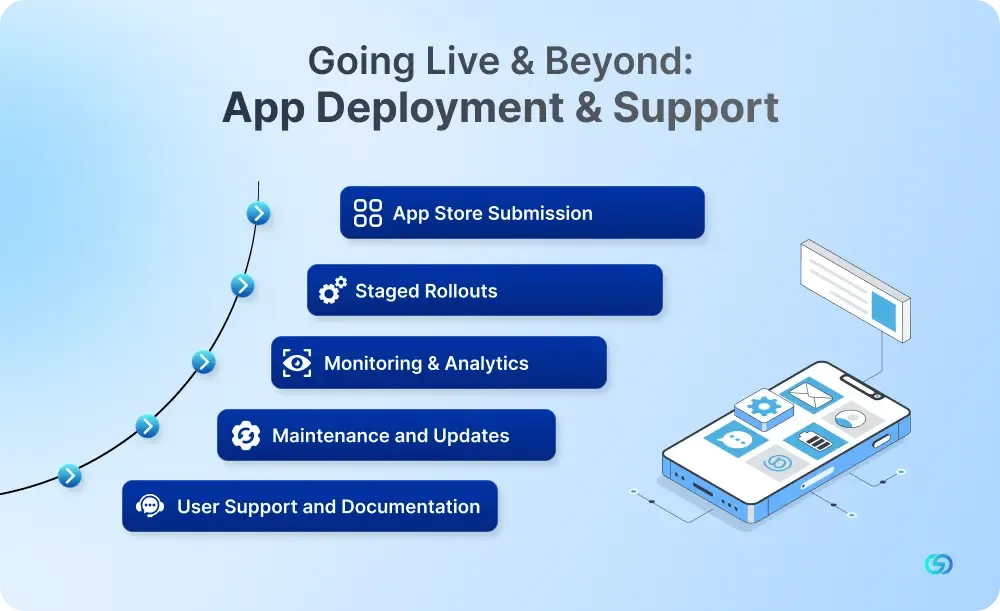
With a stable build in hand, it’s time to go live. However a successful launch in the application development lifecycle involves more than just hitting the publish button.
🔹App Store Submission: We prepare your app for distribution on Apple App Store and Google Play Store. This includes app listing, screenshots, metadata, privacy policies, and compliance with store guidelines.
🔹Staged Rollouts: Depending on the strategy, we may perform a soft launch to a limited user base for additional feedback before a full-scale release.
🔹Monitoring & Analytics: We set up dashboards to monitor user behaviour, performance metrics, crash reports, and usage patterns. Tools like Firebase, Google Analytics, or Mixpanel help fine-tune the app post-launch.
🔹Maintenance and Updates:
- Regular bug fixes
- OS version compatibility updates
- Feature enhancements
- UI/UX refresh based on user feedback
🔹User Support and Documentation: We ensure there is adequate support and documentation to address user issues and facilitate smooth onboarding.
The deployment phase marks the beginning of the app’s lifecycle in the hands of users, requiring ongoing nurturing to ensure it evolves with changing market needs.
Final Thoughts
Mobile app development is not just about coding; it's about creating a digital experience that users love and businesses benefit from. At ConvexSol, our six-step mobile app development process is designed to ensure structure, scalability, and success at every stage—from ideation to launch and beyond.
By focusing on clarity, collaboration, and continuous improvement, we help you navigate the mobile development lifecycle with confidence. Whether you're building a B2C app, an enterprise tool, or a startup MVP, our process ensures that your idea is not just built but built to last.
Looking to bring your app idea to life? Get in touch with ConvexSol’s expert development team today and start your journey from concept to market-ready app.