- MVP App Development
- 2026-02-05
Why Starting Small with MVP App Development Leads to Big Success?
Audio Track
Table of Contents
Key Takeaways:
- MVP app development lets you start small by validating your idea, revealing your user's interest in the platform.
- Launching an MVP means focusing on faster growth, fewer risks, and better insights.
- Airbnb and Dropbox started with MVPs and have now turned into billion-dollar companies.
- AI is revolutionizing businesses of all sizes. From real-time user feedback to automated decisions, AI is changing everything.
What is a Minimum Viable Product (MVP)?
Bringing a new application idea to life is quite exciting for any business. Several startups put months and huge budgets into building a complete product, only to find out that users' ideas do not solve real issues. This is exactly where Minimum Viable Product (MVP) comes in.
MVP in mobile app development is an effective approach to developing and delivering startup projects, which maximizes the chance of app success. Creating an MVP makes your app steadier and more gradual so that you go from one stage of development to the other with confidence.
An MVP app allows you to test your ideas with minimal resources, focusing on primary functions. It helps minimize the risk of failures, allowing you to learn, adapt, and quickly improve your app based on real user feedback.
Planning to opt for an MVP means you’re building a smarter path towards success. However, the actual power of an MVP goes far beyond just testing. Let’s explore how MVP app development can boost your startup growth in ways you might not expect.
What Are the Main Benefits of Starting Small with MVP App Development?
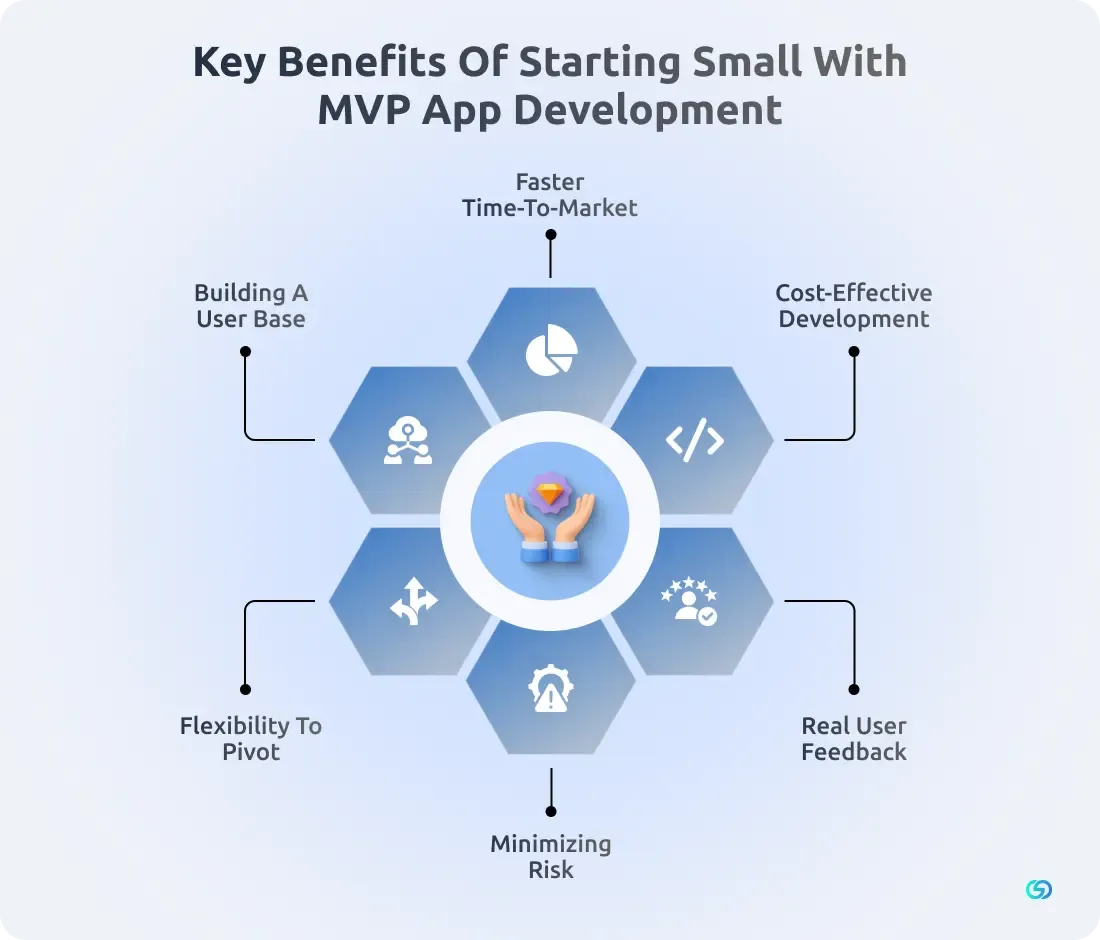
Want to know why your startup should opt for MVP app development? It’s really about minimizing risk. Think of MVP as the foundation of your application that only has must-have features to solve what users need. This version of app development gives you a chance to try out pricing ideas, concepts, and understand what early users think.
According to research, about 62.7% of small business owners believe that MVPs manage risk effectively, which makes it clear why exploring their key benefits is so important.
🔷 Faster Time-to-Market
One of the standout benefits of MVP app development is that it allows small businesses to launch their application into the market much more rapidly than a full-fledged version. Those working on tight deadlines and limited budgets can find this type of app development highly beneficial. MVP app allows faster market testing and faster generation of revenue.
🔷 Cost-Effective Development
For small businesses, developing a Minimum Viable Product is an economical option for startups when compared to full-cycle development. With fewer resources and lower costs, small business owners can test the product without exhausting their budgets. With MVP, small businesses can directly comprehend their target audience, ensuring that the product evolves with customer demands and expectations. The continuous enhancement based on real user data results in a refined application.
🔷 Real User Feedback
To be able to gather customer feedback is one of the most important benefits. Instead of wasting your budget on unnecessary features, an MVP helps in reaching early adopters who weigh in and give their feedback on what they want from your MVP app development. This is an excellent way to validate a business idea without having to spend too much time. This way, you can pivot or scrap the project.
🔷 Minimizing Risk
MVP app development helps in mitigating risks that could impact the project’s success. The risk associated with developing complicated features, something that the market won’t accept, is reduced. The MVP approach offers the most potential with less risk. About 70% of startups opting for MVP report a higher rate of success compared to fully developed products.
🔷 Flexibility to Pivot
One of the main benefits of MVP app development is the ability to pivot. In case your initial idea didn’t quite resonate with your audience, you can always change the feature, adjust the app’s direction, and altogether pivot to a different solution without committing to a full-scale app.
🔷 Building a User Base
MVP app development helps businesses build a user base way before the final launch. Small businesses can achieve this by gaining reviews from the beta testers and establishing a community among early adopters. Compared to full-cycle development, which takes a lot of time, MVP app is an exceptional solution to maintain audience’s interest because it takes less time to develop, reaches the market faster, and maintains interest in updating it with what the end user wants.
Core Characteristics of MVP App Development
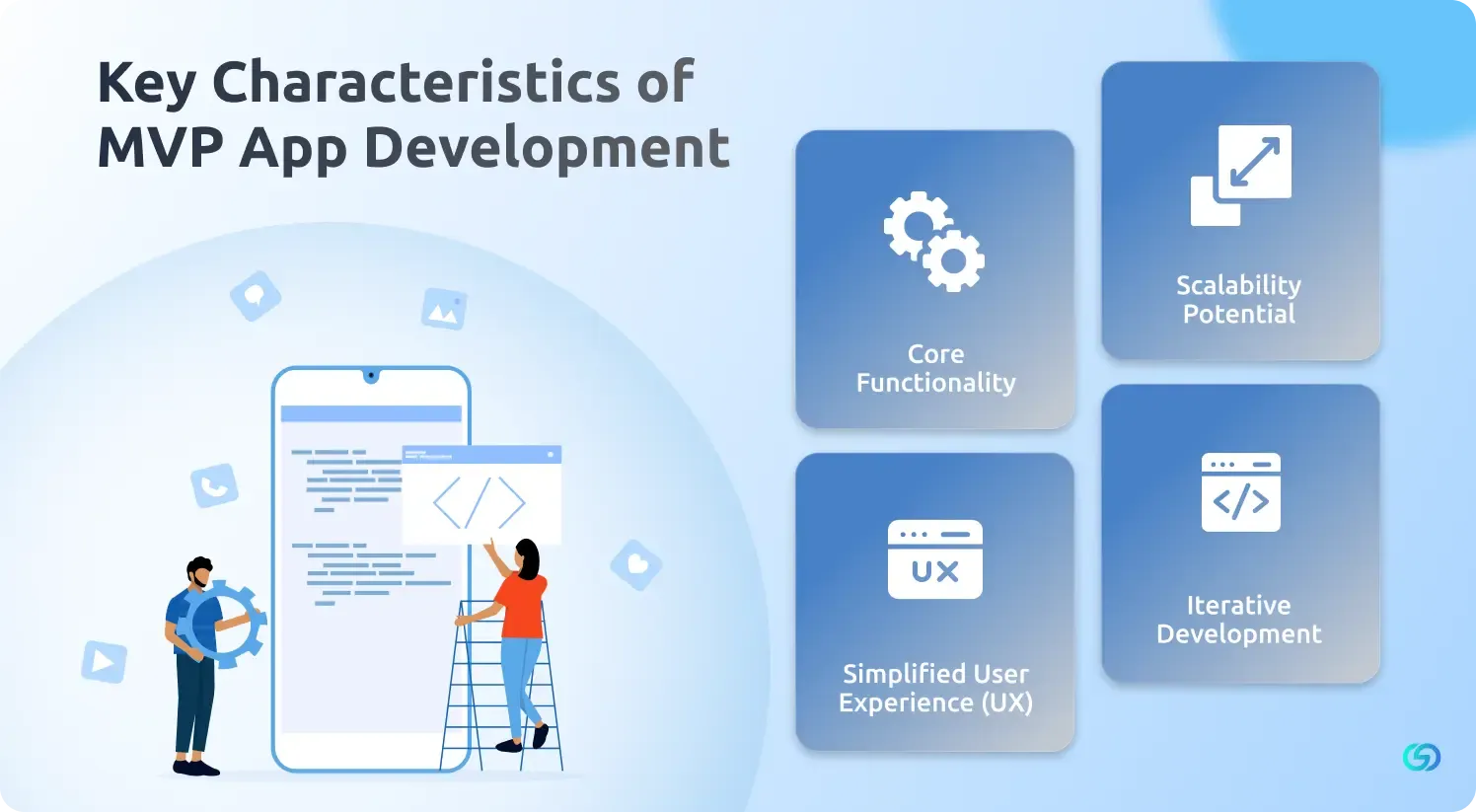
The core characteristics of MVP app development are designed to focus on delivering the basic but functional version of the product that can quickly be tested with users. Here are the key features:
🔶 Core Functionality
The MVP app is focused on delivering a core value proposition, essential to solve the primary problem for users. Unnecessary or complex features are eliminated to keep the development process streamlined.
🔶 Scalability Potential
One may think that the MVP version is basic, but it's actually built with future scalability in mind. The architecture is such that it allows for easy addition of new features. Additionally, it ensures that the foundational structure can support new updates as the app grows.
🔶 Simplified User Experience (UX)
Usually, the UI/UX design is simple and easy to navigate, focusing on the core features that solve the issues at hand. Unnecessary designs are typically avoided to maintain clarity.
🔶 Iterative Development
The application undergoes refinement and iteration based on the feedback received. Features are improved, added, or removed based on the real user's input. This process is continuous until the application is ready to meet a wider audience and scale.
The MVP Success Stories
The following are real-life MVP examples to find out how successful startups began small and reached new heights.
1️⃣ Airbnb
The company began when its founders rented out an apartment in San Francisco to conference attendees. What they did was simply create a website with just apartment pictures to assess if travelers would pay to stay in a stranger’s apartment. The outcome was that a simple test sparked a billion-dollar idea. The MVP websites allowed users to reserve sleeping accommodations. The website was plain and only had a few basic features that people were ready to pay for Airbnb.
2️⃣ Dropbox
Rather than building a complete file-syncing product, the founder of Dropbox released a demo video of 3 minutes, highlighting the way the service works. Surprisingly, the video went viral and ended up generating thousands of signups even before the app actually existed. The demo version of the MVP, which was put forward before the public, failed to function, yet reassured the users about the basic value proposition.
3️⃣ Uber
Started as UberCab, Uber was a simple app that helped connect riders with black cars in San Francisco. There weren’t any price estimates, no driver’s rating, and no GPS tracking. Sure, the founders were uncertain about how users would react to something so basic because the idea seemed new to users. The initial MVP phase of Uber helped collect user feedback and perform quick product adjustments. What started as a usual transportation service soon became the top company in the transportation sector.
4️⃣ Buffer
The founder of Buffer made a simple landing page where they just explained the concept around it, and the pricing plan. The page included a CTA for users to sign up, which measured their interest without building a complete product. By interacting with the interested users, the team gained clarity into which features were necessary for potential customers. Over time, Buffer added more features and attracted a larger user base.
Common MVP App Development Mistakes to Avoid
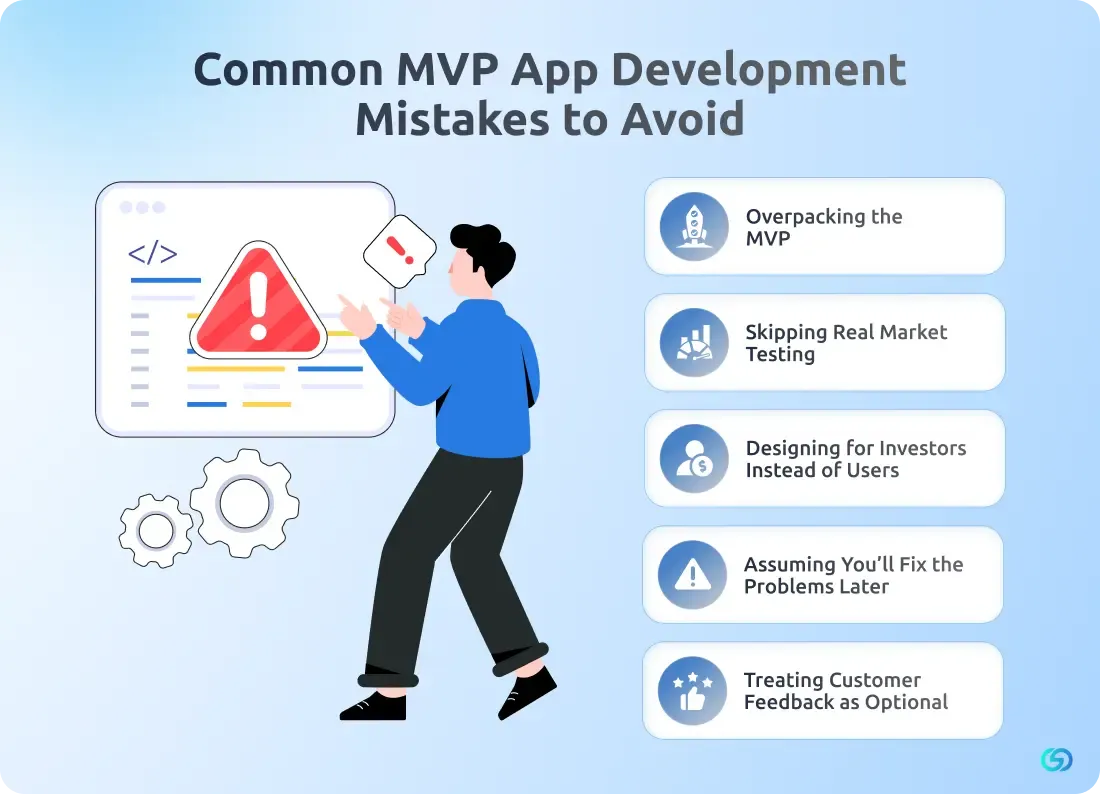
A business doesn’t fail because the vision is wrong, it may fail because the MVP was executed without real user insight. Avoid these costly pitfalls that slow down validation and drain resources.
▶️ Overpacking the MVP
Many mistakenly treat MVP as a lite version of a complete product and end up integrating a lot of features in the hope of impressing users. In reality, an MVP is focused on proving just one thing: can your product solve the primary problem? Anything more will only delay learning.
▶️ Skipping Real Market Testing
Instead of exposing the MVP to genuine users, many founders directly rush into launching the application, relying on internal feedback, assumptions, and guesswork. This is one of the most expensive mistakes. Real user’s feedback decides the product’s direction, skipping testing leads to building needless features and missing the ones users would actually pay for.
▶️ Designing for Investors Instead of Users
Some small businesses design an MVP to look perfect for investors. The MVP could have a polished user interface, a long feature list, and a modern tech stack. But the point remains that investors aren’t the ones who will adopt the product, but it's the early users. When MVP prioritizes design instead of outcomes, the business ends up validating the wrong audience. It’s important to build users first, and investor interest will follow.
▶️ Assuming You’ll Fix the Problems Later
“We’ll solve this in the next version,” is secretly a silent killer. Such a mindset piles up bugs, ignores feedback, and delays that make the product harder to maintain. These issues can lead to technical debt that demands time, money, and full rework. Addressing these flaws improves audience trust and strengthens future scaling probability.
▶️ Treating Customer Feedback as Optional
Some teams collect user feedback but do not act upon it. An MVP exists to learn and iterate. If customer insights aren’t shaping the product’s roadmap, you’re actually building blind. Ignoring feedback leads to missed opportunities and misaligned features, and a product that evolves away from user expectations.
A Step-by-Step Guide to Building a Successful MVP
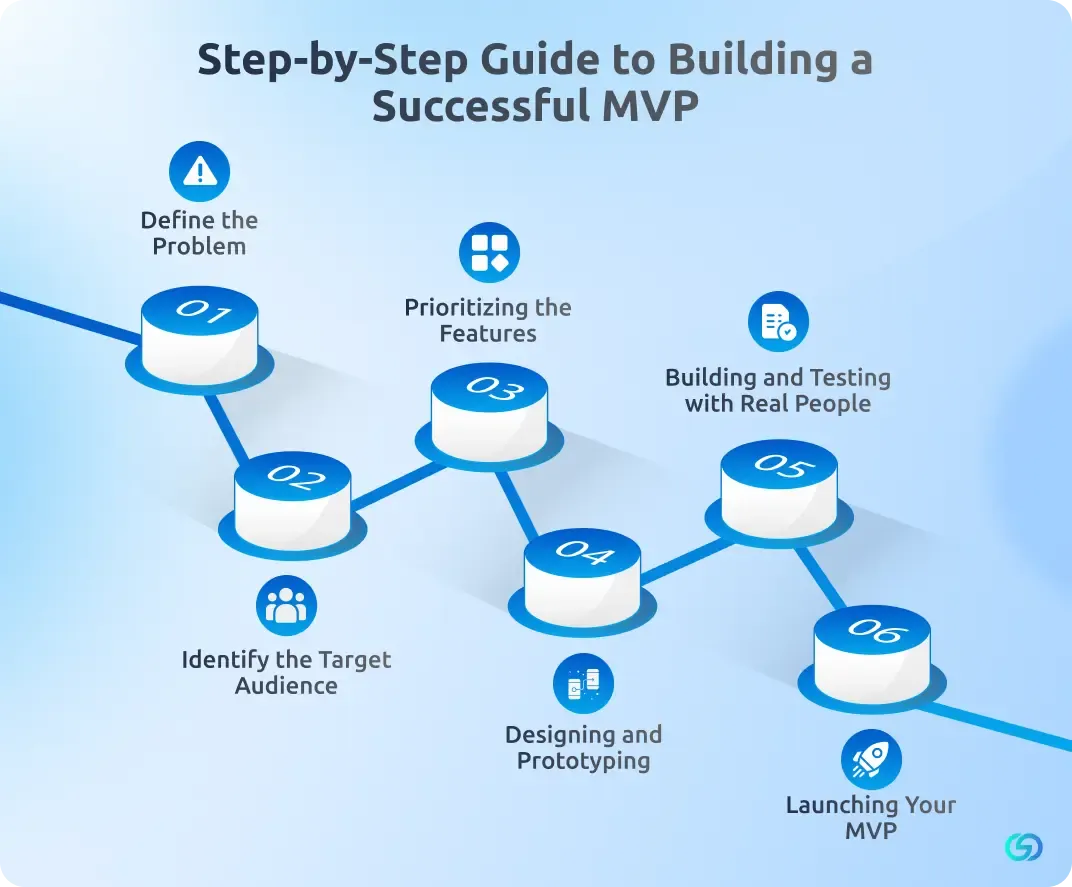
The MVP app development process includes six major steps. A dedicated MVP app developer can bring your idea to life and establish a foundation for scaling successfully.
💠Define the Problem
The main pillar for developing an MVP is finding the issue you want to solve. The projects fail because businesses lack clarity about the ultimate goal. With MVP app development, you can validate the app idea without developing the entire platform.
Conduct comprehensive market research to spot the pain points and needs of the customers. Get an idea of who your competitors are and how they are providing solutions to their audience base. Once done, find out your business’s specific problems and gain insights. Before launching the MVP, you must ensure the problems you’re trying to solve.
💠Identify the Target Audience
Once the problem is defined, you move to the second step, that is—identifying the target audience and their expectations. Businesses that understand the target audience are likely to grow twice. Make sure you know in and out who your application is for.
Align your MVP by identifying your target audience, for which you can conduct market research using surveys, generate buyer personas to define demographics and pain points, and analyze competitors to find gaps that your MVP can address.
💠Prioritizing the Features
The next phase in MVP app development is shortlisting the core features of the product. Start with the basic ones that resolve your target customer’s issues and add value. Prioritize making the product simple because too many features would increase the cost of development. The main motto is to have an MVP that reduces development cost and time.
For instance, if yours is a startup and you’re trying to build a social media platform, you need to build a small set of functionalities and features that could solve the issue of ideal users. The main features include setting up a profile, posting, and communicating with friends. On the other hand, an additional feature could be live streaming, which can be added later.
💠Designing and Prototyping
When you’re planning on building an MVP, put more emphasis on it from the user’s perspective. Provide an interactive user interface for the app to hook the customers, right from opening to the final transaction. After conducting market research, you can proceed with making a prototype of the app that represents the actual product.
This prototype should give users a realistic feel of the core features. It should reflect the main value proposition without overcomplicating the flow to create interactive wireframes and bring your concept to life visually.
💠Building and Testing with Real People
Once you’ve designed an interactive user interface, start using flexible ways that let you adjust as needed. Our MVP app development focuses on adaptability and speed, ensuring you launch quickly without building too much. Once done, focus on how easy it is to use, grow, and run smoothly while keeping the design minimal.
After developing it, your dedicated team will validate the functionality to ensure it meets the customer's requirements. To do this, you need to analyze the way users are behaving, tracking engagement, and getting feedback. Testing shows what users want the most, proves your assumptions right or wrong, and answers what needs fixing. All of this will ensure where your product is headed.
💠Launching Your MVP
Now comes the final part—the moment of truth: the app launch. Ensure your MVP app is available through the chosen platform. The dedicated developer will analyze errors, implement strategies to boost user engagement, and encourage them to try your app. With the help of analytics, track user behavior and review feedback to identify pain points and areas for improvement.
MVP vs. Full Product: Understanding the Difference
If you’re stuck at crossroads between launching an MVP or going all in with full product development, the following difference will help you clarify.
| Aspect | Full-Product Development | MVP |
|---|---|---|
| Purpose | Delivers a complete solution to the market. | For idea validation and gathering feedback. |
| Features | Planned features with extensive enhancements. | Core features and functionalities only. |
| Development Time | Several months to years. | A few weeks to months. |
| Budget | Larger teams, higher costs, and more resources. | Minimal resources required, low cost. |
| Risk | Higher risk needs large upfront investment. | Low risk, market testing prior to committing resources. |
| Target Audience | Extensive audience base. | Early testers and adopters. |
| Investment | High development and marketing costs. | Lower initial costs. |
| Release Frequency | Less frequent, more structured releases. | Frequent, iterative updates based on user feedback. |
| When to Scale | Scalability is the main need from day one. | Scaling is a strategic decision made after achieving product-market fit and based on strong metrics. |
How is Artificial Intelligence Helping SMBs with MVP?
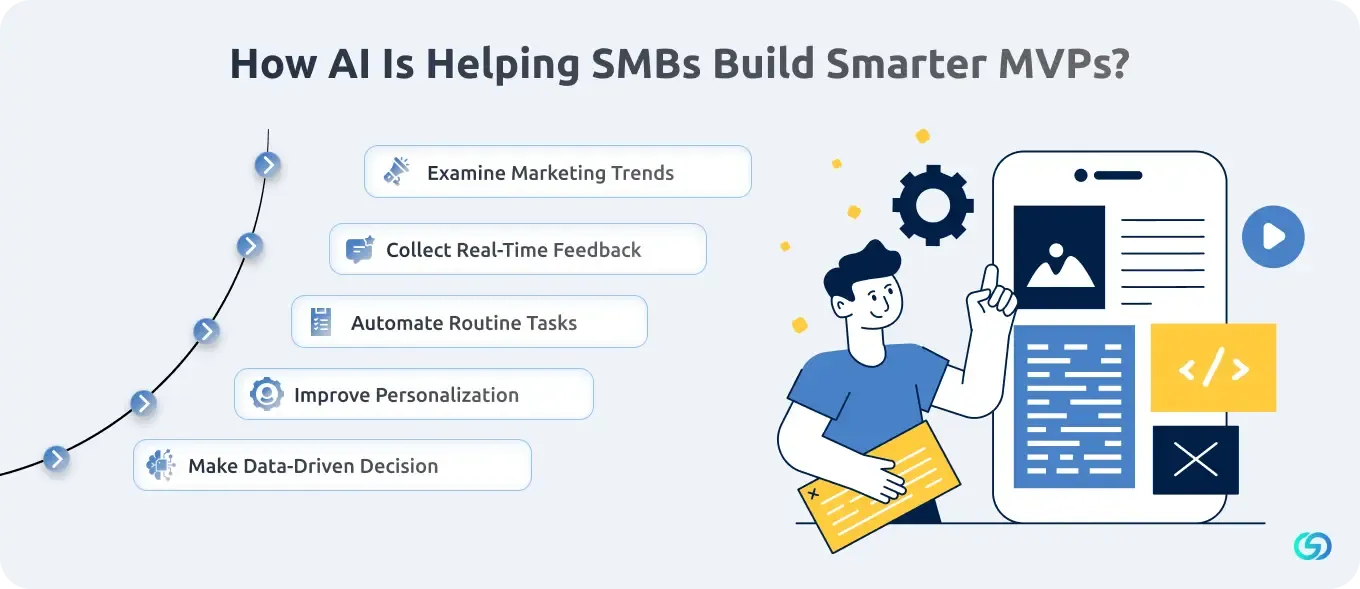
AI plays a significant role in helping businesses launch MVPs securely and effectively. These are a few ways AI in MVP app development can help you:
⏯️Examine Marketing Trends
AI tools are efficient enough to analyze massive datasets to analyze market trends, competitor activities, and customer preferences. This helps in understanding market needs and eventually making informed decisions.
⏯️Collect Real-Time Feedback
AI chatbots and survey tools can collect details about your application, analyze customer feedback in real-time, and provide benefits. Make informed decisions regarding your MVP and meet market demand.
⏯️Automate Routine Tasks
Automate routine tasks such as customer service, data entry, and other marketing aspects with the help of AI. This helps you get more time to focus on product innovation.
⏯️Improve Personalization
Make intuitive design and personalized interfaces by monitoring customer interactions. It provides insights into improving user satisfaction by making the MVP easier to use and appealing.
⏯️Make Data-Driven Decision
AI offers in-depth insight from data, allowing businesses to make smart decisions. This leads to enhanced product features, improved marketing strategies, and a successful launch.
Cost of MVP App Development
The cost of building MVP apps varies based on the chosen platform, complexity, and desired features. For small businesses, knowing the costs helps with better planning and keeping a record of your money.
Basic MVPs, like no-code versions and basic prototypes, are cost-effective, where you can test main ideas and collect user feedback without repetitive significant expenses. Modern MVPs with custom designs and complicated integrations cost more, but you have room to work better.
Expenses like backend services, early marketing, cloud hosting, or user testing can really add up. That’s why you need to spend smartly to make sure the MVP works and is a success.
- Low-code Prototype: $15,000 and above
- Native MVP: $30,000 and above
- Cross-platform MVP: $80,000 and above
These costs vary depending on the business requirements.
Concluding Note
Using MVP app development acts like a roadmap, helping businesses start small and find their way. With the main focus on the feature, you can save resources, minimize risks, and expect faster time-to-market. MVP encourages constant improvement, enabling businesses to adapt to market trends and user feedback.
ConvexSol is a leading app development company. Our team of experts is dedicated to developing a basic version of your product. We have helped many businesses go about MVP process, changing ideas into market-ready solutions while minimizing cost and time. We focus on ensuring that every MVP aligns with your objectives.
Frequently Asked Questions
Why is building an MVP important?
An MVP helps in validating your ideas in the real market. Building an MVP is one of the most practical ways to validate your idea early without committing to full-blown development. Instead of wasting money on an untested concept, MVP helps identify whether the market is interested, which features matter most, and how users actually behave. It ensures you make smart data-powered decisions from the start.
Why is it so important for MVP development to meet the needs of the core audience?
Your MVP succeeds only if it delivers value to the users who need your product the most. Focusing on your core audience helps you build relevant features that resolve issues. When you understand what your target audience cares about, you can gather meaningful feedback, make crucial improvements, and develop an app with real market fit.
Is an MVP only for tech startups?
No. MVPs apply to businesses testing a new idea, whether it’s a service, business model, or product; this approach allows you to test a small investment. The non-tech sector can use MVPs to validate what works before scaling.