- Micro-Frontends in Modern Web Applications
- 2026-01-16
The Rise of Micro-Frontends: Transforming Modern Web Applications

Audio Track
Table of Contents
Key Takeaways:
- Micro-frontends accelerate development, enabling parallel workstreams, reducing dependencies, and facilitating faster releases, making them ideal for large enterprises seeking rapid innovation.
- Tech agnosticism enables the flexibility of businesses. Allowing the team to utilize distinct frameworks such as Angular, React, Vue, or Web Components within the same app without being locked into one tech stack.
- Scalability and modularity are core strengths, enabling global businesses such as Walmart, IKEA, and others to localize, customize, and expand their platforms without being limited by monolithic codebases.
- Challenges remain, mainly around integration, SEO, UX consistency, and testing; however, with strong DevOps and proper communication standards, these problems can be handled effectively.
- The future of frontend architecture is distributed, modular, and edge-driven, with trends such as edge rendering, module federation, and standardized component contracts shaping how business apps will be developed and scaled.
Overview- Rise of Micro-Frontends
By 2025, more than 20% of businesses are anticipated to adopt micro frontends for speeding up the development cycles and improving scalability. Micro frontends have become an integral part of custom website development services.
A lot of times, traditional monolith frontend architecture creates obstacles to agile development and modular approaches. These technologies can impede scalability, hamper innovation, and creating bottlenecks on existing teams operating on the same database.
This blog explores the extended adoption of micro frontends in the year 2025- breaking down the advantages, best practices, challenges, when to use, and more.
Advantages of Micro Frontends in Web Applications

A frontend app can be categorized into independently deployable, smaller modules. Each of these modules is owned by a different team utilizing a technique known as micro frontend architecture. The various benefits of why businesses are choosing this architecture are as follows-
- Faster Development Cycles: Speed to Market is crucial in 2025. With the help of micro frontends, teams are capable of working in parallel on distinct modules. For instance, Spotify reported a 40% decrease in rolling out features by adopting a modular frontend approach. Each team can develop, test, and deploy its module independently without impacting other sections of the app. This kind of parallelism is vital for companies looking to meet aggressive product roadmaps and remain ahead of competitors.
- Tech Agnosticism: Utilizing multiple frameworks in the same app is one of the crucial benefits of micro frontends. Teams can utilize Vue, React, Angular, or even Web Components- anything that fits the module the best- without compromising the complete sentence. This kind of freedom helps businesses not be tied to one tech-stack. It allows better hiring flexibility, decreased technical debt, and a seamless transition when newer technologies come up.
- Scalable Development for Businesses: Companies such as IKEA have utilized micro frontends for scaling their e-commerce platforms worldwide. Micro frontends foster faster localization and customization while eliminating the coordination lags caused by several teams operating separately. Micro frontends enable businesses to scale the development work horizontally. This way, the teams can grow without getting constrained by a monolithic front-end codebase.
Micro Frontends Vs Monolithic Frontends
To realize the actual power of scalable frontend development models, it is important to compare both the frontends-
| Monolithic Frontends | Micro Frontends |
|---|---|
| Centralized architecture. | Decentralized modularization |
| Tight coupling between features. | Multiple technology stacks coexist |
| A single technology stack. | Agile and continuous delivery |
| Longer release cycles. | Independent releases per module |
Micro Frontends in Practice: How Does It Work?
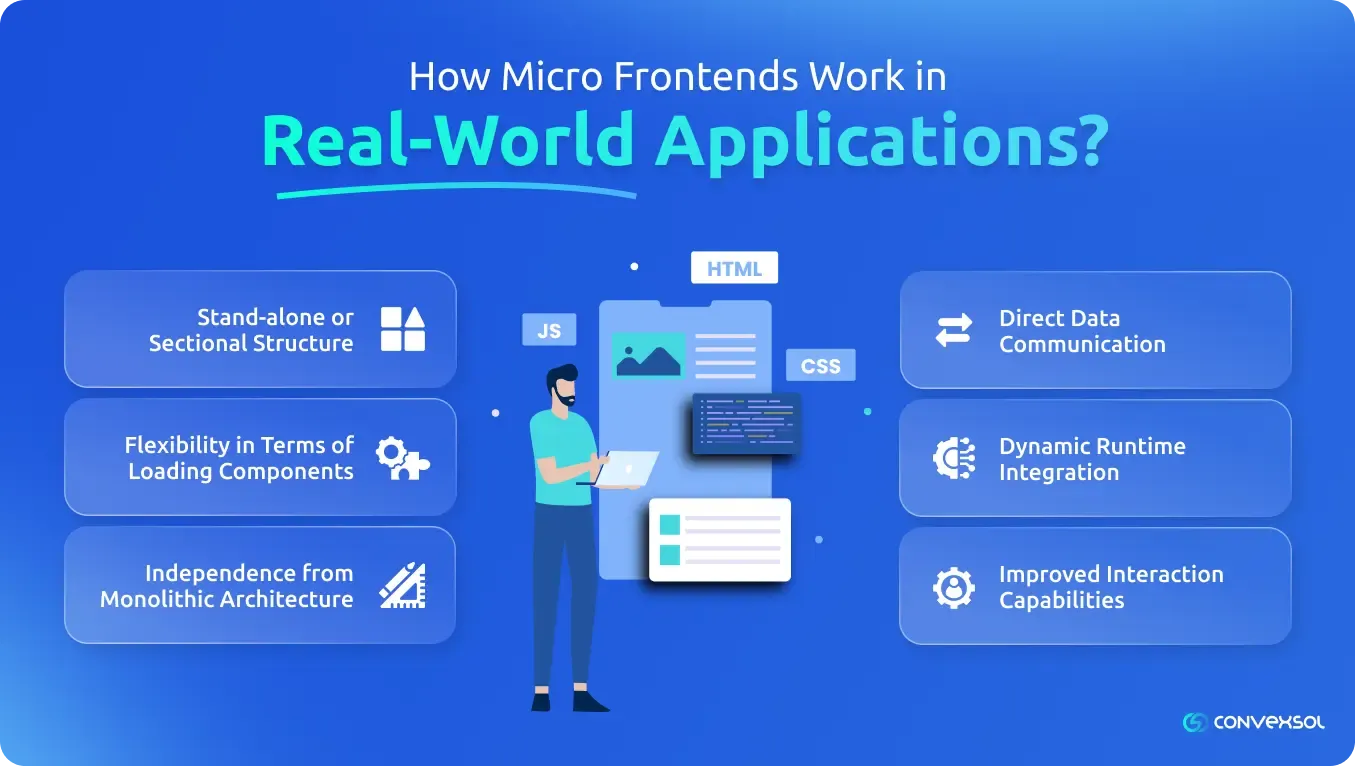
There are multiple approaches to implementing micro frontends. Let’s have a look at the most popular ones-
-
Stand-alone or Sectional Structure: A micro frontend is all-in-one, a standalone page, or a section of the page, developed for integrating well with the surrounding workflows.
-
Independence from Monolithic Architecture: Micro frontends enable the development, testing, launching, maintenance, and re-engineering of the front-end independently from what has previously been a monolithic architecture, without a slowdown.
-
Flexibility in Terms of Loading Components: Micro frontends only present the needed components for a page, so improving performance can be realized without overloading it with unnecessary components.
-
Direct Data Communication: Micro frontends generate their own information and data routing, and they can communicate directly with the information entity so that routing does not occur on a centralized server.
-
Dynamic Runtime Integration: Every front-end is developed independently as well as integrates vigorously at runtime, thus it can be updated more quickly, resulting in more enhanced scalability.
-
Improved Interaction Capabilities: In addition to displaying content, developers make user interface components as well as utility functions that enable user interactions to happen seamlessly in the application environment.
Challenges in Micro Frontends
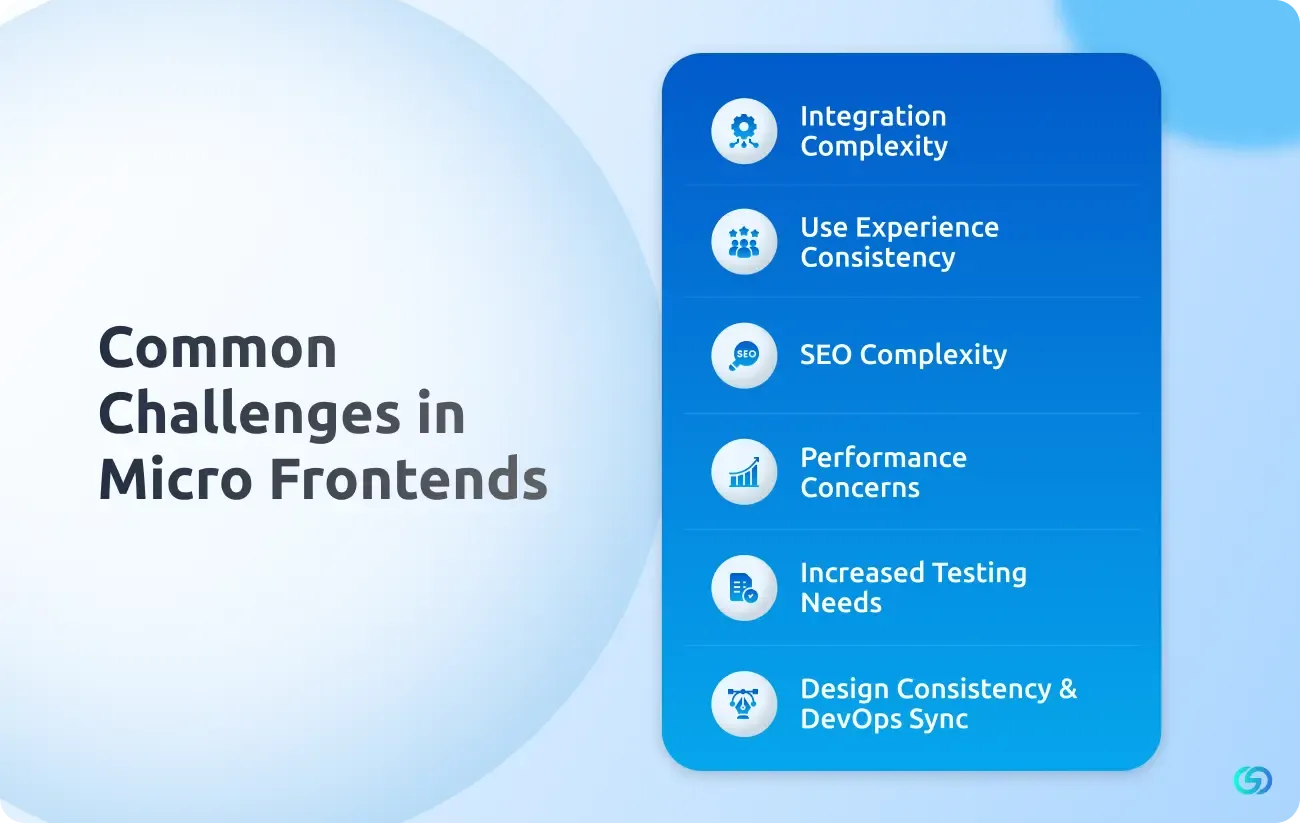
Inspite of the micro frontend advantages, there are several challenges of micro frontend that businesses should address to ensure success. Given below are some of the Micro frontend web development challenges that you should know:
-
Integration Complexity: Combining several modules created with distinct web application frameworks can be complicated. Ensuring easy communication and consistency of performance is crucial.
-
Use Experience Consistency: Since several teams handle distinct modules, maintaining the identity of the brand and UX standards across the app can be tricky.
-
SEO Complexity: Micro frontends are capable of introducing duplicate meta tags as well as inconsistencies in SSR or sever-side rendering. This can affect the organic visibility negatively unless it is carefully handled.
-
Performance Concerns: Loading several modules all at once may impact the speed of the page. Careful optimization is necessary for avoiding negative effects.
-
Increased Testing Needs: Each independent module should be tested comprehensively. Ensuring incorporation testing across varied components increases the overhead cost.
-
Design Consistency & DevOps Sync: Ensuring a centralized design language across various modules is challenging. Without having a shared design system and rigid DevOps coordination, user experience gets fragmented.
Best Practices for Implementing Micro Frontends
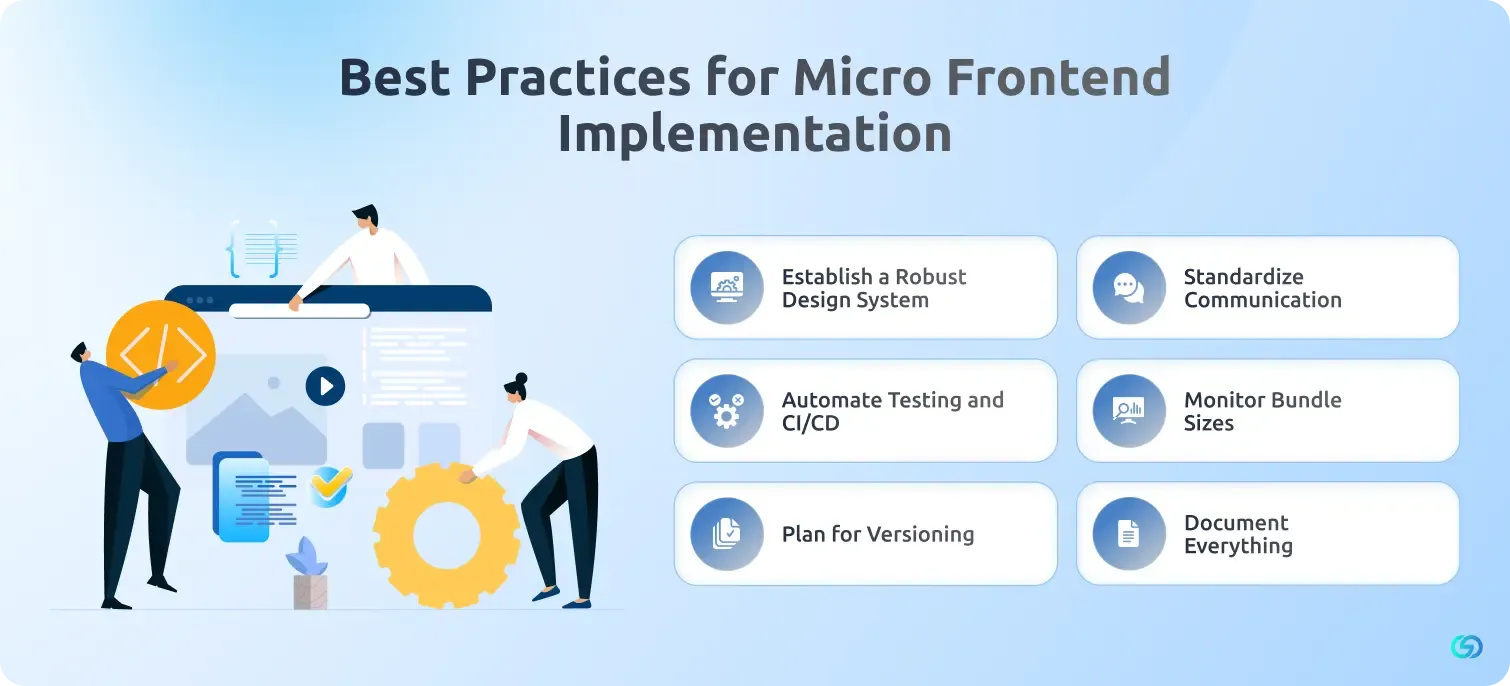
In case you are going for a micro frontend approach, given below are the best practices to keep in mind-
- Establish a Robust Design System: Develop a shared set of UI style and components guide for ensuring visual consistency.
- Standardize Communication: Utilize events or a shared state solution for inter-application communication.
- Automate Testing and CI/CD: Every micro frontend should have a pipeline of its own but also participate in end-to-end integration tests.
- Monitor Bundle Sizes: Utilize tools and set limits, such as Webpack Bundle Analyzer.
- Plan for Versioning: When sharing utilities or components, powerful versioning strategies prevent dependency hell.
- Document Everything: APIs, architecture, and communication protocols must be clearly documented for all the teams.
Best Real-world Use Cases of Micro Frontends
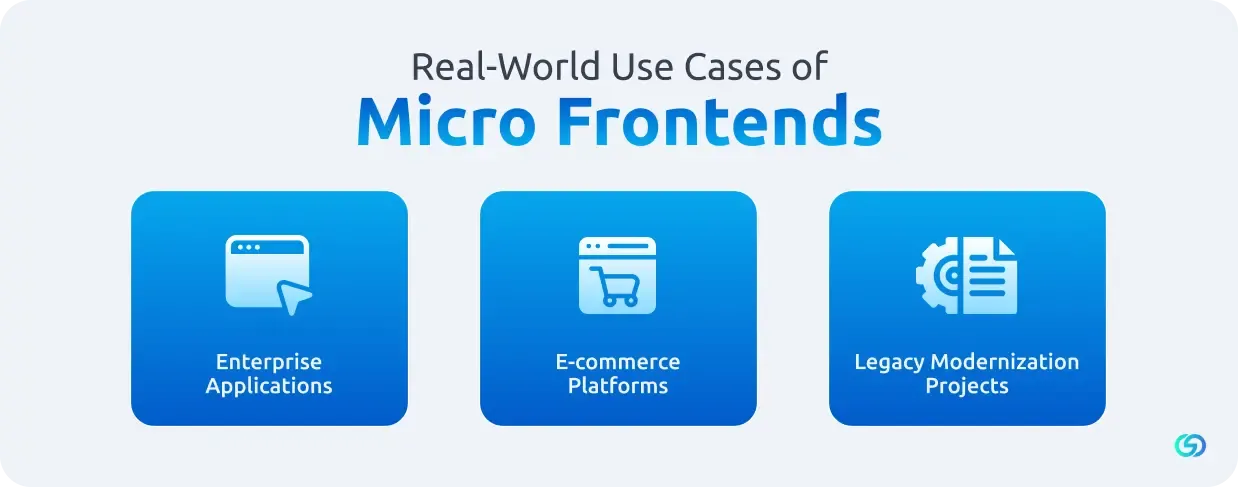
Here are some of the practical use cases of micro frontends:
- Enterprise Applications: For SaaS platforms with more than 50 developers, micro frontends are groundbreaking. They allow individual teams to innovate as well as launch independently.
- Examples involve CRM platforms, analytics dashboards, and HR systems, where several modules can be developed by specialized teams.
- E-commerce Platforms: Retail giants such as Walmart have adopted micro frontends for creating modular checkout systems, resulting in improved conversion rates and decreased cart abandonment rates.
- Legacy Modernization Projects: With micro frontends, you can develop small changes without the need to completely redo the frontend. This is perfect for businesses modernizing legacy systems gradually.
When Should You Use Micro Frontends?
Micro frontends are not a magical solution. They make the most sense in the following scenarios:
- You have several teams working on different features.
- Your app is large and difficult to maintain as a monolith.
- You need to migrate the info to a new framework.
- Independent fast releases and deployments are a priority.
For simple apps or smaller projects, the overhead might outweigh the advantages.
The Future of Front-End Architecture
The micro frontend trend is a segment of a broader movement toward distributed, modular architecture on the web. As the tooling matures, especially with technologies such as Module Federation and native browser support for Web Components. Progressive businesses are already reaping the benefits of this approach. You can expect three tightly coupled forces for shaping the next phase of the front-end architecture.
Firstly, hybrid patterns of rendering (SSR + client hydration) and server-driven user interface- led by React Server Components as well as similar server-centric approaches are transforming where data fetching and UI logic live, decreasing client bundle size and enhancing perceived performance. This forces the teams to rethink the boundaries between “backend” and “frontend”.
Secondly, near-edge and edge delivery are becoming mainstream for user interface composition. Personalization and rendering at edge nodes cut latency for worldwide users and allow real-time experiences that were traditionally impossible with a completely centralized CDN. Enterprises will largely pair micro frontends with edge composition for scaling both development autonomy and performance.
Thirdly, component interoperability as well as framework-agnostic developing blocks are resurging. Web components, as well as standardized component contracts, make it feasible for polyglot teams to independently ship while preserving the consistency of user experience- an interesting pattern for huge businesses adopting micro frontends. At the same time, rising tools such as module federation, edge composition patterns, and Vite/Werkzeug-style bundling are smoothing integration pain points.
Other than these, AI-powered developer tooling, TypeScript-first codebases, and a powerful emphasis on observability and accessibility will be built into front-end platform options and not optional extras. For businesses, the practical takeaway is vivid: front-end architecture in 2025 will be polycentric.
Final Thoughts
Micro frontends are not a niche architectural approach but are becoming a primary strategy for businesses aiming to speed up delivery, stay technologically flexible, and scale efficiently in 2025 and beyond. As companies demand modular development, faster releases, and greater autonomy for expert teams, micro frontends offer the structure required to come out of the cage of monolithic limitations. While challenges such as design consistency, integration complexity, and performance streamlining require careful planning, the long-term payoff is vital. With robust governance, disciplined DevOps practices, and a shared design, businesses are capable of unlocking a scalable architecture that supports future-ready innovation. For growing businesses, micro frontends are not simply an option- they are a competitive benefit.
Frequently Asked Questions
Which frameworks are commonly used for micro frontends?
Micro frontends can leverage the full spectrum of frameworks, including React, Angular, Vue.js, and Svelte. Most enterprises have also started adopting Web Components to create framework-agnostic modules. Also, the integration of various frameworks is orchestrated by tools such as Webpack Module Federation, Single-SPA, and Bit.
Are micro frontends ideal for enterprise-scale apps?
Yes, micro frontends are effective when dealing with enterprise-scale applications where multiple teams work independently. They allow for quicker releases, avoid bottlenecks in team dependencies, support diversity in tech stacks, and make large applications easier to scale and maintain.
What are microservices in web apps?
Microservices are a back-end architectural approach wherein an application is split into small, autonomous services, each of which handles a particular business function. While micro frontends modularize the UI, microservices modularize backend logic, making both ideal for scalable, distributed systems.
What are the different types of micro frontends?
The main types include:
- Route-based micro frontends - each module controls a unique route
- Micro frontends based on components: different UI components shared across applications
- Widget-style micro frontends - self-contained UI blocks loaded on a page
- Micro frontends integrated into edge/runtime using Module Federation or server-side composition
What kind of problems do micro frontends solve?
Micro frontend architecture solves slow-release cycles, tight coupling, scalability limitations, difficult maintenance, and bottlenecks in team coordination issues in monolithic frontends. They enable independent deployments, reducing tech debt, which allows for parallel development.
How do micro frontends modularize large web apps?
Micro frontends split a complex UI into independently buildable and deployable units. Each unit is responsible for its own code, UI logic, and data, integrating smoothly at runtime. This module-based approach makes scaling, updating, and evolution much easier for the application, without affecting other parts.