- RPA Use Cases in Hospitality
- 2025-11-10
Top Use Cases of RPA in Hospitality to Enhance Guest Experience

Audio Track
Table of Contents
Key Takeaways:
- Robotic Process Automation offers hospitality businesses with a unique solution for streamlining operations and enhance guest experiences.
- RPA, is utilized in back-office operations, is now being implemented all over multiple hotel departments, transforming the way hotel's function and provide guest services.
- The various benefits of RPA in hospitality operations include- enhanced operational efficiency, better guest experiences, streamlined inventory and supplies and more.
- RPA bots handle bookings automatically by extracting information, entering it correctly, and synchronizing with booking systems.
- Robots can track inventory across systems (purchase systems, PMS) as well as initiate automatic replenishment or order placement.
- RPA is not replacing employees, but it assists them with technology that improves their efficiency.
Overview- The Impact of RPA in Hotel Operations
Robotic Process Automation (RPA) is transforming hotel operations by taking time-consuming, manual tasks out of employees' hands—simplifying them to focus on delivering customized experiences. From applying automation to check in guests, modify reservations, and process invoices, to speeding up billing and compliance procedures, RPA operates 24/7 with near-zero mistakes and lightning speed. This shift remakes the landscape of RPA applications within hospitality, with returns of cost savings, faster guest turnover, greater accuracy of data, and enhanced regulatory compliance. Efficiency is the bottom line in an industry where it matters most, and RPA is a formidable force—a productivity driver that lifts the guest experience, as well, without demanding costly system overhauls.
The Rise of RPA Integration in Hotels
Over the past few years, RPA in hospitality has graduated from an innovative technology to a mainstream solution that has transformed the way hotels operate. First taken up to solve inefficiencies in repetitive, rule-based activities, RPA is now deeply embedded in core hotel operations like reservations, billing, housekeeping coordination, and revenue management. Through automation, hotels save on time and money as well as eliminate human mistakes and enhance consistency in service.
Top hotel brands have adopted RPA to help speed up their digital transformation initiatives, allowing employees to move their focus away from back-office tasks to improving guest satisfaction. The ease with which the technology integrates with existing legacy systems has facilitated quicker adoption and less disruption than typical IT overhauls.
What makes this rise even more significant is RPA's increasing contribution to strategic activities such as dynamic price adjustments, predictive analytics, and compliance tracking. With guest expectations for speed, customization, and impeccable service increasingly on the up, hotels are looking to RPA as a trustworthy catalyst for innovation and efficiency. This development is an unmistakable move towards wiser, data-driven hospitality operations fuelled by automation.
Top Hospitality Challenges Promoting RPA Adoption
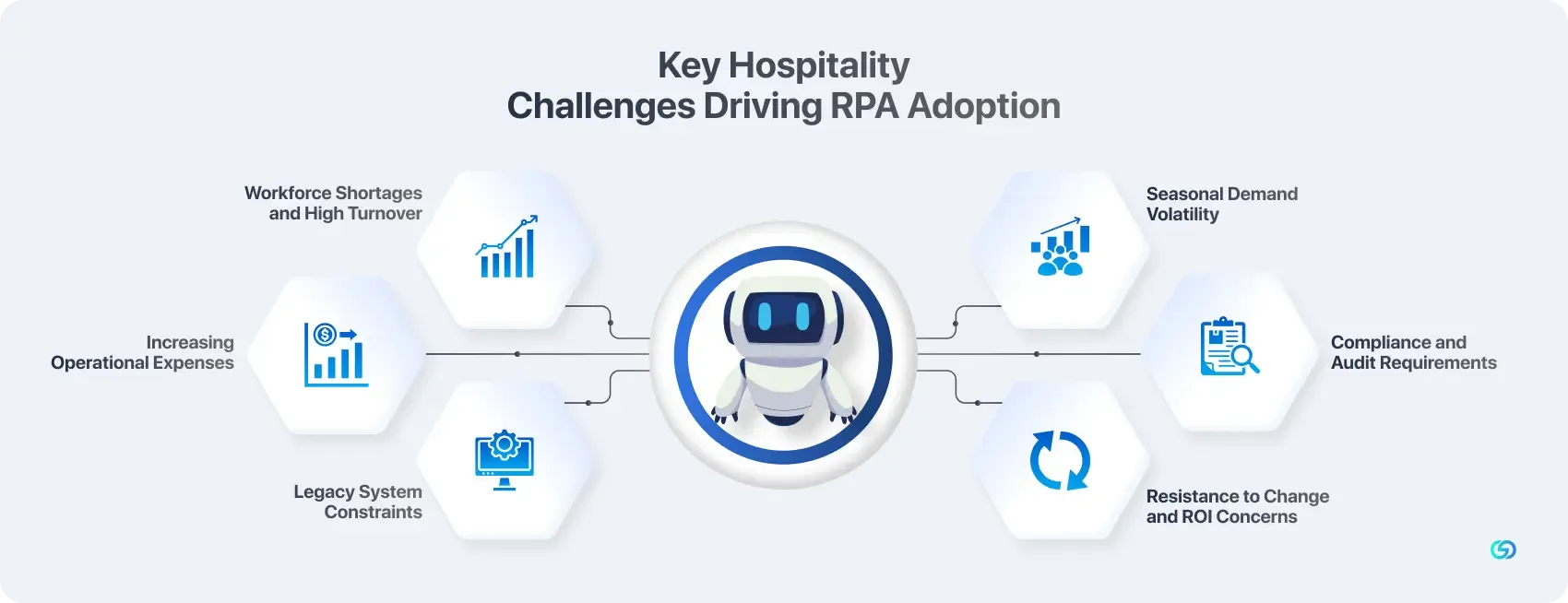
Hospitality is a highly competitive, customer-focused, and cost-conscious industry. Yet, it has chronic challenges that affect efficiency, profitability, and guest satisfaction. Those challenges have hastened the need for automation, and therefore, RPA use cases in hospitality are more important than ever before. The top challenges driving this adoption are listed below:
1. Workforce Shortages and High Turnover
Hotels tend to suffer from high staff turnover and seasonal workforce shortages. Constant training of new staff not only adds expense but also impacts service quality. RPA assists by eliminating the drudgery of repetitive tasks, decreasing reliance on extensive workforces, and enabling staff to attend to guest interaction.
2. Increasing Operational Expenses
Increasing labor, utility, and supply chain expenses are tightening profit margins. RPA automates procurements, payroll, billing, and reporting, reducing operational costs while enhancing precision and velocity.
3. Legacy System Constraints
Most hotels make use of antiquated property management and financial systems that don't interface well. RPA fills the gaps by linking divergent systems without necessitating a full IT overhaul, simplifying data transfers and reporting.
4. Seasonal Demand Volatility
During peak booking periods, intensive pressure is imposed on manual procedures such as reservation confirmations, renewals, and cancellations. RPA allows hotels to scale quickly, maintain accuracy, and provide quicker response times during peak demand.
5. Compliance and Audit Requirements
Hospitality companies handle sensitive financial and personal information; compliance is therefore paramount. RPA supports rigorous compliance with regulations by standardizing procedures, creating audit trails, and reducing documentation errors.
6. Resistance to Change and ROI Concerns
The implementation of automation is often met with cultural opposition and scepticism regarding return on investment. Phased rollout of RPA with ROI demonstration generates confidence among stakeholders and overcomes these issues.
Important Benefits of Robotic Process Automation in Hospitality Sector
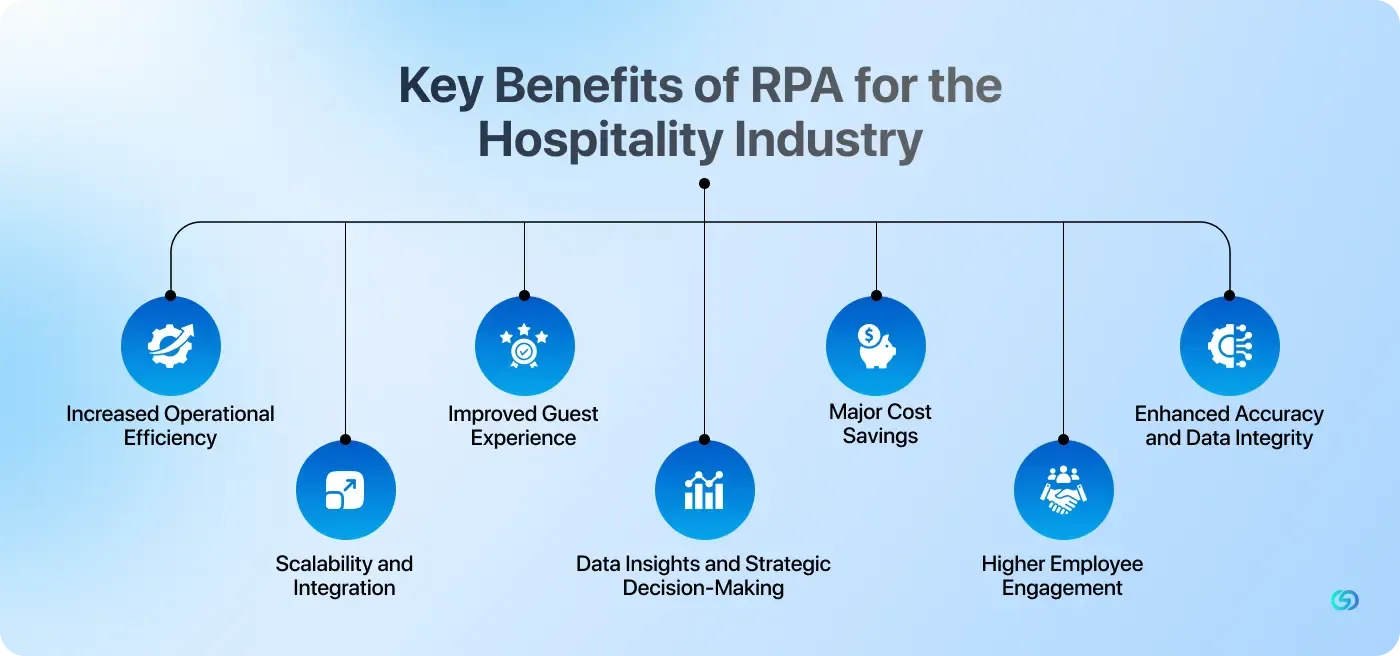
The hospitality industry requires high operational responsiveness, outstanding customer experience, and accurate execution at every touchpoint. RPA provides an intrinsic solution that enhances performance across the board. The following are the key advantages based on why Use cases RPA in hospitality are quickly becoming the building blocks of hotel operations:
▶ Increased Operational Efficiency
RPA automates repetitive manual tasks—such as inventory refreshes, report runs, and housekeeping scheduling—quickly and reliably. This liberates staff to focus on personalized guest service and strategic initiatives. Automation far surpasses task turnaround time while guaranteeing accuracy in all workflows.
▶ Improved Guest Experience
By standardizing guest interactions like check-in/out, booking confirmations, and personalized recommendations, RPA guarantees guests have quicker, fewer error-prone interactions. Automation improves the guest experience through 24/7 responsiveness and service delivery simplicity.
▶ Major Cost Savings
Processing and labor costs diminish since RPA executes tasks such as billing, invoicing, payroll, and reservations with minimal human involvement. This results in lower overheads, lower errors, and increased profitability.
▶ Enhanced Accuracy and Data Integrity
RPA standardizes processes like data entry, financial reconciliations, and compliance reporting to reduce errors and impose consistency. It also makes strong audit trails possible, providing visibility and confidence in processes.
▶ Scalability and Integration
RPA can expand at the same rate as hotel requirements—peak seasons or growth phases—without necessitating corresponding increases in staffing. It harmonizes seamlessly across PMS, billing systems, CRM, and HR platforms, facilitating single-channel data flows and multi-functional coordination.
▶ Data Insights and Strategic Decision-Making
Automation produces enriched data outputs—from reservation trends to guest preference and operational bottlenecks—that enable analytical insights. This powers dynamic pricing, resource planning, and anticipatory service improvements.
▶ Higher Employee Engagement
RPA frees employees from routine administrative tasks, allowing them to connect more purposefully with customers. This boosts morale and maximizes human ability for high-impact hospitality services.
Top Use Cases of RPA in Hospitality
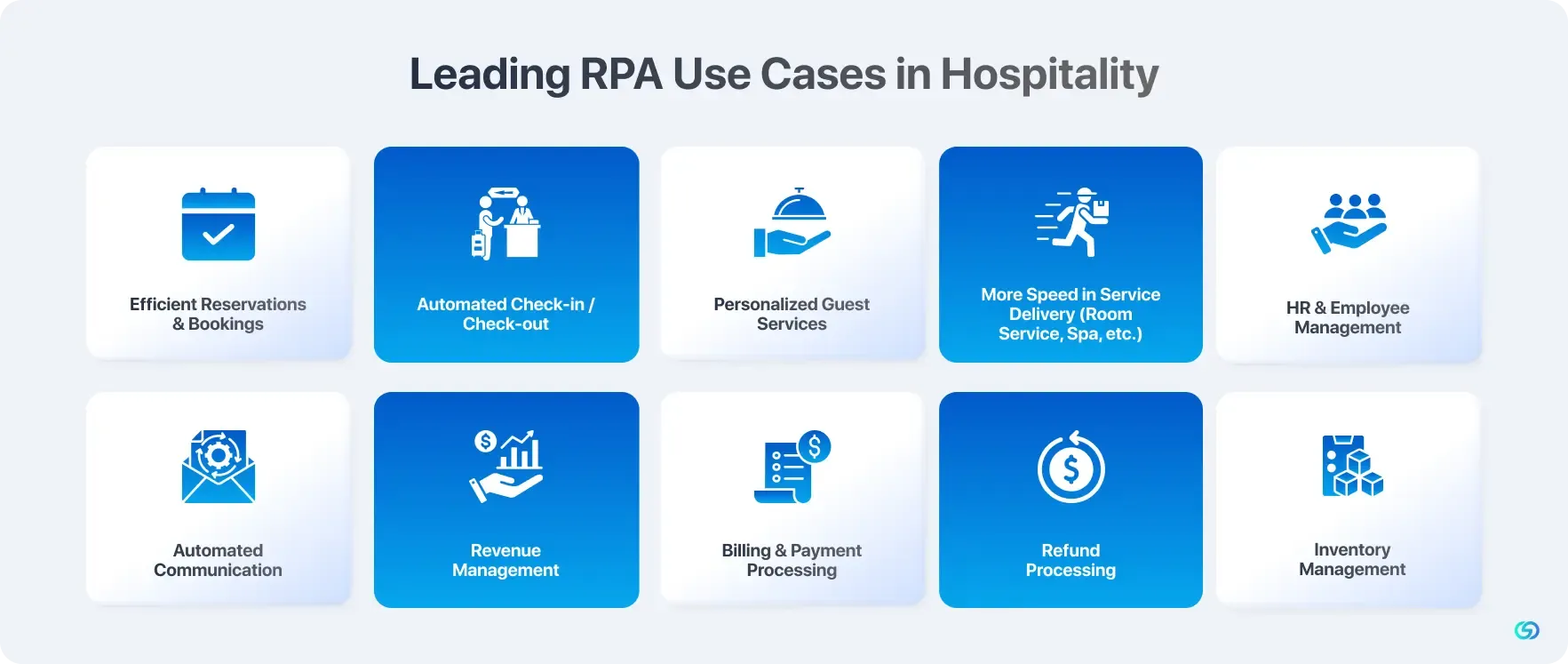
1️⃣ Efficient Reservations & Bookings
Without RPA – Pain Points:
- Manual handling of reservations tends to introduce human errors—duplicated bookings, entry errors, and disparate data.
- Staff waste hours answering repeat booking inquiries, taking away from guest interaction or upselling.
With RPA – How It Assists:
- Bots handle bookings automatically by extracting data, entering data correctly, and synchronizing with booking systems.
- RPA is able to scan guest preferences in real-time and recommend upselling, enhancing efficiency and revenue.
2️⃣ Automated Check-in / Check-out
Without RPA – Pain Points:
- Long queues and waits at reception annoyance guests, especially during high occupancy.
- Manual verification of ID and payment processing is time-consuming and prone to errors.
With RPA – How It Helps:
- RPA supports contactless, automated processing—ID scanning, PMS updating, and payment completion smoothly.
- Enhances front desk flow and guest satisfaction with faster, more efficient service.
3️⃣ Personalized Guest Services
Without RPA – Pain Points:
- Manually tracking guest preferences across stays, loyalty levels, or services is time-consuming and usually inaccurate.
- Personalized recommendations and offers are inadequate, particularly during peak times.
With RPA – How It Helps:
- Bots pull and analyze guest information—from historical behaviour, booking history, and preferences.
- Enable targeted promotions, upselling of amenities (such as spa or dining), and personalized suggestions pushed proactively.
- Automation drives personalization past human capability, creating even more guest satisfaction and loyalty.
4️⃣ More Speed in Service Delivery (Room Service, Spa, etc.)
Without RPA – Pain Points:
- Room service orders, spa reservations, or amenity arrangements tend to get held up due to miscommunication or hectic staff.
- Service quality is compromised when staff is bogged down.
With RPA – How It Helps:
- Bots robotize service requests by sending them immediately to the concerned departments (e.g., housekeeping, F&B, spa).
- Guarantees quicker fulfilment and correct processing, thus improving guest experience.
5️⃣ Automated Communication
Without RPA – Pain Points:
- Sending manual booking confirmations, reminders, follow-ups, and promotions is time-consuming and may be inconsistent.
- Guests might miss critical updates owing to slow or impersonalized messaging.
With RPA – How It Helps:
- RPA processes bulk email or SMS communications automatically addressed by guest name, stay information, or special promotion.
- Reminds guests and keeps them engaged, with minimal manual handling.
6️⃣ Revenue Management
Without RPA – Pain Points:
- Manual effort is needed for updates of prices and inventory syncing among channels.
- Lost revenues or discrepancies can occur due to delayed rate changes (e.g., OTA problems, rate differences).
With RPA – How It Helps:
- Use cases of RPA in hospitality include bots executing dynamic pricing, rate comparisons among platforms, and instant inventory updating.
- Maintains price parity, enhanced yield management, and enhanced revenue control.
7️⃣ Billing & Payment Processing
Without RPA – Pain Points:
- Using discounts, creating bills, and handling payments manually is prone to human mistakes.
- Reconciliation of payments consumes time.
With RPA – How It Helps:
- Automates discount application, billing, and payment verifications.
- Guarantees speed, reduced billing mistakes, and more efficient guest and accounting processes.
8️⃣ Refund Processing
Without RPA – Pain Points:
- Refunds are done manually—volunteers required for data consolidation, verification, approval, and notification.
- Processing time is lengthy, and mistakes are probable.
With RPA – How It Helps:
- RPA use cases in hospitality includes robots aggregate information from PMS, reservation systems, and payment gateways to create and process refunds.
- Facilitates quicker resolution and reliable communication with guests.
9️⃣ HR & Employee Management
Without RPA – Pain Points:
- Onboarding and offboarding require paperwork and numerous system entries (e.g., employee records, payroll).
- Risk of delays or inconsistencies during transitions.
With RPA – How It Helps:
- Automates the configuration or disabling of accounts (e.g., email, payroll, access credentials).
- Removes administrative burden and accelerates HR processing.
🔟 Inventory Management
Without RPA – Pain Points:
- F&B, housekeeping, and amenity stock levels typically manually monitored, with inaccuracies.
- Leads to stockouts or overstocking.
With RPA – How It Helps:
- Robots track inventory across systems (purchase systems, PMS) and initiate replenishment or order placement automatically.
- Enhances inventory accuracy, prevents shortages, and automates back-of-house procedures.
Real-world Examples of RPA in Hospitality
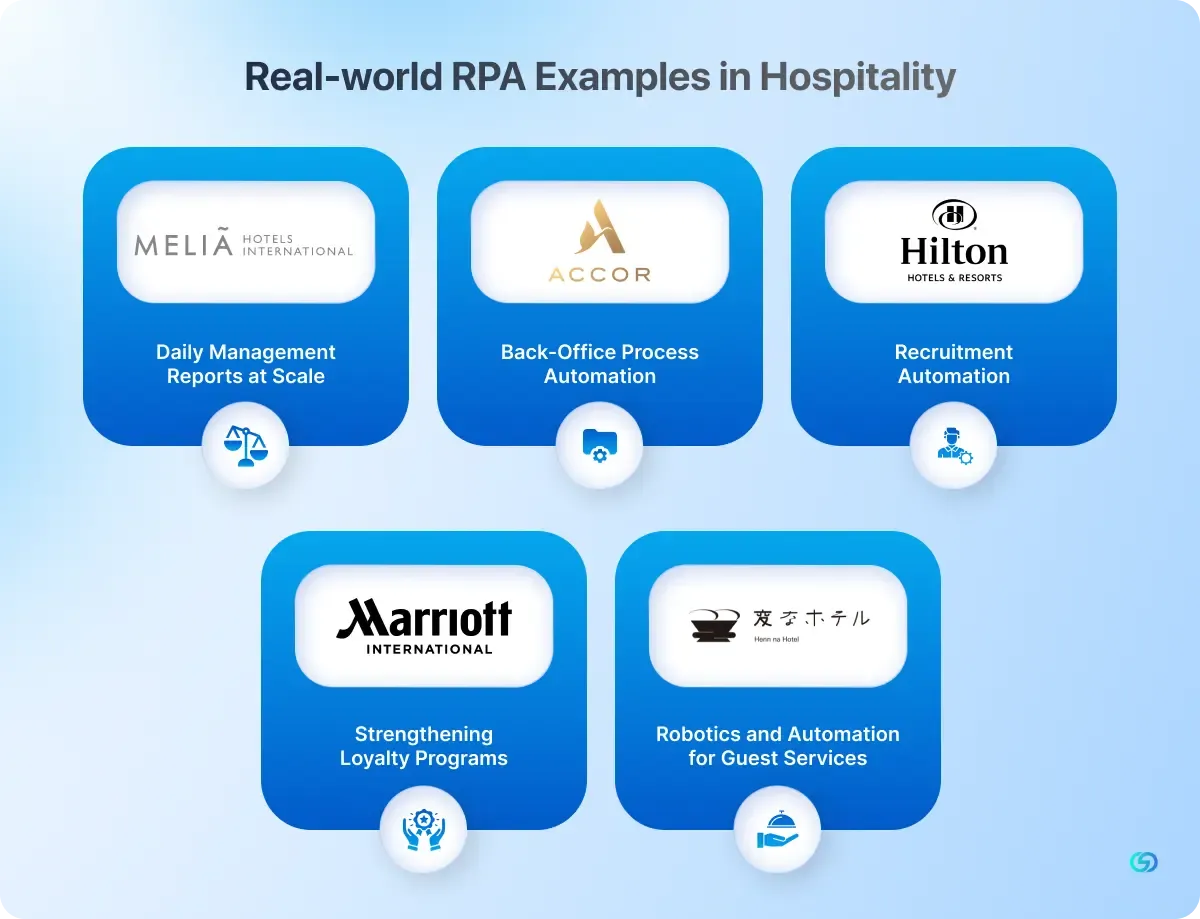
The practical or real-world examples of Robotic Process Automation in hospitality are as follows-
🔹 Meliá Hotels International — Daily Management Reports at Scale
Challenge: Finance and hotel operations teams required timely property-level snapshots of performance on revenue, occupancy, and key indicators. Manually extracting and compiling across systems was time-consuming, prone to errors, and not scalable as the group grew.
RPA Solution: In collaboration with Auxis, Meliá implemented bots to extract data from each hotel, normalize it, and supply a business intelligence system that automatically generates daily management reports.
Outcomes: The outcome was an extraordinary increase in operational insight for hotel managers, major efficiency improvements, and an extremely high return on investment.
Takeaway: Beginning with high-impact back-office reporting processes sets the foundation for scaling automation through other finance and operations processes.
🔹 Accor — Back-Office Process Automation
Challenge: Its extensive multi-brand footprint resulted in high volumes of repetitive and time-consuming back-office activity including invoicing and accounts payable. Manual processing resulted in inefficiencies and increased operational expense.
RPA Solution: Accor introduced RPA as a part of its overall digital transformation, initially targeting finance and shared service operations. Bots were established to standardize and automate repetitive transactional procedures.
Outcomes: The program streamlined processes, lowered operational expenses, and enhanced process precision throughout the group's worldwide network.
Takeaway: Creating a Center of Excellence (CoE) for automation guarantees uniform, scalable outcomes and faster rollout across properties.
🔹 Hilton Hotels — Recruitment Automation
Challenge: High-volume hiring, especially in hotels and call centers, needed recruiters to spend too much time shortlisting and arranging interviews.
RPA Solution: Hilton incorporated automation within its recruitment process to manage applicant screening, scheduling, and interview arrangements.
Outcomes: The automation saved up to 15 minutes of manual effort per candidate, decreased time-to-hire, and lowered overall recruitment expenditure.
Takeaway: Even HR activities can gain from RPA, enabling employees to concentrate on developing improved candidate relationships instead of boring admin work.
🔹 Marriott International — Strengthening Loyalty Programs
Challenge: Operating an international loyalty program involving tens of millions of customers needed considerable manual effort to provide tailor-made offers and effective service.
RPA Solution: Marriott implemented RPA for management of its loyalty program, with the use of bots to automate handling of data, member service requests, and routine back-office tasks.
Outcomes: Guests benefited from quicker, more tailored interactions, while the business eliminated some of the operational burden and increased efficiency in its loyalty services.
Takeaway: RPA has the ability to fuel mass-scale personalization efforts, providing smooth service while alleviating the burden on employees.
🔹 Henn na Hotel, Japan — Robotics and Automation for Guest Services
Challenge: Labor shortages and rising service demands made it challenging for the hotel to provide round-the-clock guest support without increasing costs.
RPA Solution: The hotel introduced robotic front-desk agents and service robots to handle check-ins, information requests, and certain in-stay services.
Outcomes: The automation lowered staffing requirements, enabled touchless service, and provided the guests with a novel and future-like experience, although human monitoring was still necessary.
Takeaway: Marriage of RPA to physical robotics has the ability to revolutionize guest-facing service, but balance is required between automation and human touch.
Conclusion
The hospitality industry works at the pace where efficiency and customer satisfaction are the top priority. Manual operations, whether for reservations, billing, or reporting, tend to retard processes and leave opportunities for errors. RPA use cases in hospitality solve these problems by automating processes, increasing accuracy, and allowing employees to spend more time on customer interactions and not repetitive processes.
Case studies from real-world applications across international hotel chains demonstrate the quantifiable advantages of RPA, from quicker reporting and lower operational expenditures to enhanced loyalty program management and recruitment effectiveness. Customers experience more efficient, personalized services, with hotel operators achieving greater visibility, scalability, and lower costs.
Most importantly, RPA is not about replacing employees but assisting them with technology that enhances their efficiency. In an experience-driven industry where experiences are given paramount importance, embracing RPA has become a strategic imperative to stay ahead of the competition and provide seamless hospitality.
Frequently Asked Questions
How do I get started with RPA implementation in my hotel?
Start with finding out rule-based and repetitive tasks that take up the time of the employees, like reservations, reporting, or billing. Then, partner with a trustworthy RPA service provider like ConvexSol, who will be able to assess the workflows of your hotel, recommend processes for automation, and develop a roadmap for gradual adoption.
How can I ensure a successful RPA implementation?
Implementing RPA successfully needs clear objectives, the right automation process, as well as expert assistance. ConvexSol helps hospitality businesses identify high-impact workflows, develop tailored automation strategies, and incorporate RPA with the existing systems to disrupt operations. ConvexSol’s efficient team ensures seamless deployment, ongoing support, and staff training. This way, you can achieve faster ROI, scalability, and measurable enhancements in guest satisfaction and efficiency.
Can RPA help with housekeeping and maintenance?
Yes, RPA can help in automating housekeeping schedules, real-time tracking of room readiness, and sending automated alerts for maintenance requests. By incorporating with property management systems (PMS), bots ensure rooms are cleaned and inspected promptly, decreasing delays and enhancing guest satisfaction.
Can RPA be used to analyze customer feedback?
Absolutely, RPA can be used for analyzing customer feedback by collecting reviews, surveying responses, and feedback from several platforms, and then consolidating the information for analysis. Combined with analytical tools or AI, hotels can find out patterns in guest sentiment, enhance services, and make data-driven decisions to improve the experience of the guests.
Does RPA replace hotel staff?
No. RPA supports the employees of a hospitality business by handling time-consuming administrative and back-office tasks. This enables the hotel staff to focus on crucial guest-facing roles like event planning, concierge services, and personalized care instead of repetitive work.
Is RPA expensive to implement in hotels?
In comparison to traditional IT overhauls, RPA is affordable. Most of the hotels achieve an ROI within 6 to 9 months, as automation decreases operational costs and enhances efficiency faster.