- RPA Use Cases Across Industries
- 2025-11-06
The Best RPA Use Cases Across Industries and Why They Matter
Audio Track
Table of Contents
TL;DR:
- The market value of Robotic Process Automation (RPA) is estimated to reach $30.85 billion by 2030.
- RPA in business boosts operational excellence, strategic value, scalability, flexibility, and security.
- Best RPA use cases span across industries from healthcare, banking, and HR to education and real estate.
- Businesses leveraging RPA free up employees to focus on creative and more critical thinking tasks.
- RPA and AI, when combined, can personalize experiences, allow predictive insights, and make smarter decisions.
Automation that Accelerates Success
Businesses must evolve with technologies, understand their customers’ needs, and analyze the market demands to grow and maintain a strong position in today’s market.
Today, Robotic Process Automation (RPA) is absolutely changing business operations, having emerged as a critical technology in transforming businesses digitally.
With the tremendous potential of RPA, it's clear that forward-thinking businesses are driving a game-changing revolution. This powerful software is completely changing the way business is conducted by simplifying processes and paving the way for increased productivity.
RPA use cases aren’t just buzzwords; they are the real stories of how businesses cut through the noise to speed up the work and help focus on what truly matters, which is exactly what we will discover in this blog.
Why Is Robotic Process Automation a Necessity?
Robotic Process Automation uses virtual software robots to carry out manual, repetitive, and time-consuming tasks. These robots mimic human actions and perform defined tasks. By automating tasks faster, RPA boosts accuracy and efficiency, allowing employees to focus on higher-value tasks that need critical thinking and creativity to enhance business.
It’s no wonder that the landscape of small and mid-sized businesses is undergoing a massive shift. The technology, which was once leveraged by large corporations, is now being adopted by businesses of all sizes. This is because the amount of time spent performing repetitive tasks manually is overwhelming.
A recent survey shows that employees spend at least five hours each week on work that can easily be automated.
In 2024, the market value of RPA was $3.79 billion, which is projected to reach $30.85 billion by 2030. Companies leveraging RPA have reported a 92% improvement in compliance and a 59% boost in productivity.
Well, these numbers are impressive, but what do they actually look like in practice? That’s where RPA use cases examples come in. From healthcare to finance, businesses are finding new ways to eliminate repetitive tasks.
Benefits of RPA in Businesses
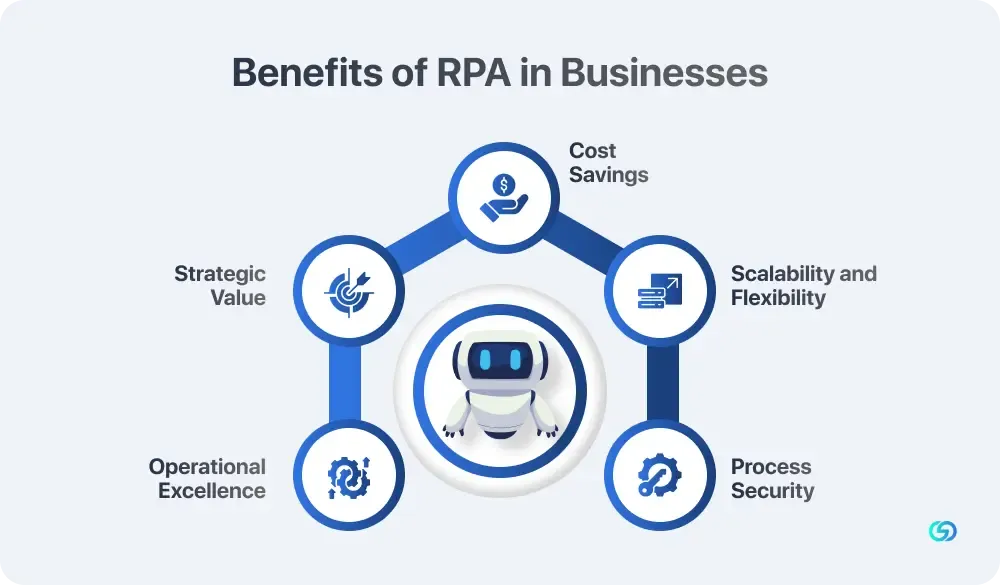
Now you have a clear picture of how automation can up the game. In processing repetitive tasks accurately and rapidly, RPA can contribute a lot to business process automation.
Here are some benefits of RPA:
🔹 Operational Excellence
- Eliminates entry errors
- Completes various tasks faster than manual efforts
- Offers consistent execution
- Can work 24/7
🔹 Strategic Value
- Maintains compliance standards
- Free up employees for bigger tasks
- Allows speedy digital transformation initiatives
- Provides faster response
🔹 Cost Savings
- Reduces expensive rework
- Lowers process costs
- Reduces the need for training on repetitive tasks
- Scales without the need for increasing headcount
🔹 Scalability and Flexibility
- Adds robots to meet peak demand
- Supports hybrid and remote operations
- Grows with business efficiently
- Adjusts faster to shifting market demands
🔹 Process Security
- Eradicates the possibility of data breaches
- Keeps sensitive data within controlled environments
- Eliminates human errors in confidential processes
- Strengthens audit trails for better transparency
12 Top RPA Use Cases
RPA has a range of potential applications. Let’s look at some RPA automation use cases.
1. RPA Use Cases in Healthcare
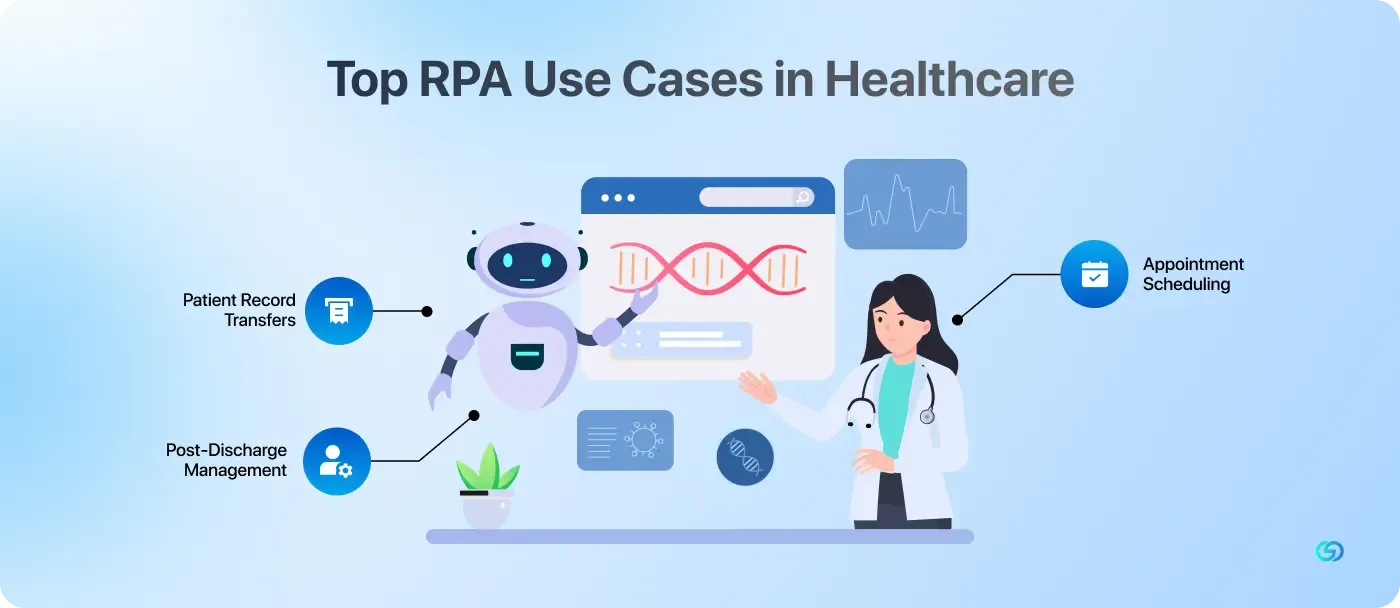
RPA bots interact with your hospital system just like a human does. It can handle both backend and front-end processes. Healthcare businesses need a reliable transfer of data throughout the department. The industry requires patient records to stay updated and synced between pharmacies, labs, and more.
Here are RPA use cases in healthcare:
- Patient Record Transfers: RPA bots ensure patient records are securely and automatically transferred. The bot can check directories for new information or files without having to enter patient information manually.
- Appointment Scheduling: Acting as a digital assistant, RPA eliminates manual data entry while scheduling an appointment. Additionally, it helps fetch patient data easily and speeds up call times, allowing staff to focus on patient care.
- Post-Discharge Management: During discharge, patients need to follow discharge instructions. This ensures that patients follow the guidelines. RPA sends notifications, reminding patients of the upcoming appointments and prescriptions/medicines to pick up. This ensures better care and boosts patient satisfaction.
2. RPA Use Cases in Banking and Finance
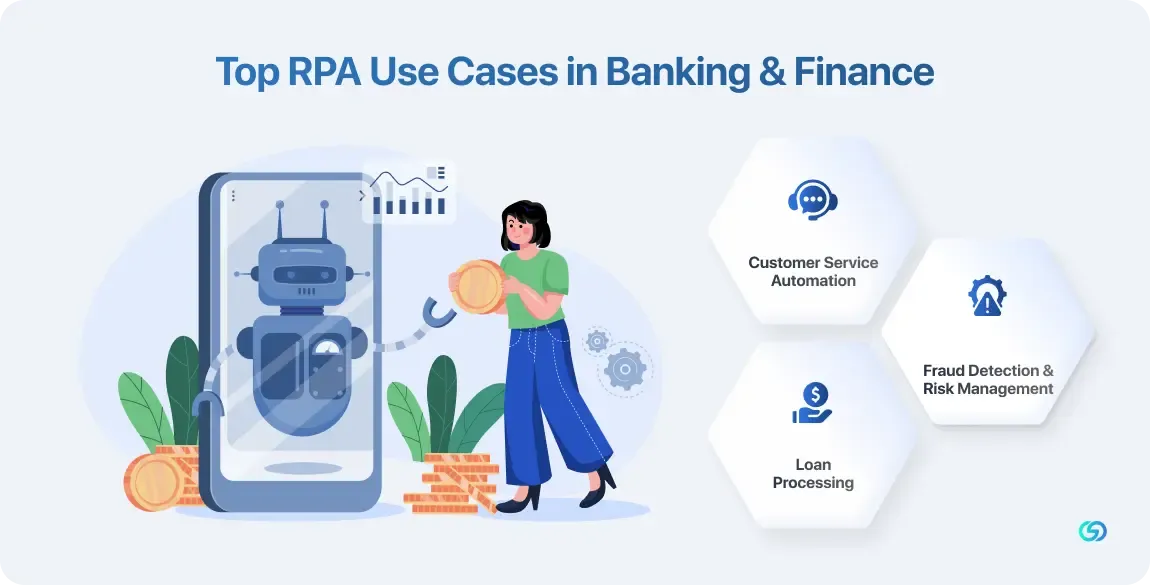
RPA is growing in the finance industry as it is effective in handling repetitive and mundane tasks. The finance and banking industry remains under tremendous pressure to reduce operational costs, deliver faster, and ensure compliance—areas where RPA can deliver value. Let’s find out how RPA use cases in banking and finance help:
- Loan Processing: RPA use cases in banking mean that the advanced software can help bankers through the entire process, including application processing, risk assessment, and disbursement.
- Fraud Detection & Risk Management: RPA monitors transactions across multiple systems. The bots are capable of flagging suspicious activities based on predefined rules to spot anomalies that indicate fraud. RPA freezes accounts, alerts parties, and begins recovery procedures, mitigating financial losses.
- Customer Service Automation: RPA bots can handle high volumes of common customer queries. Bots can respond to routine inquiries, provide status on transactions and applications, and update Customer Relationship Management (CRM) records after an interaction.
3. RPA Use Cases in Manufacturing
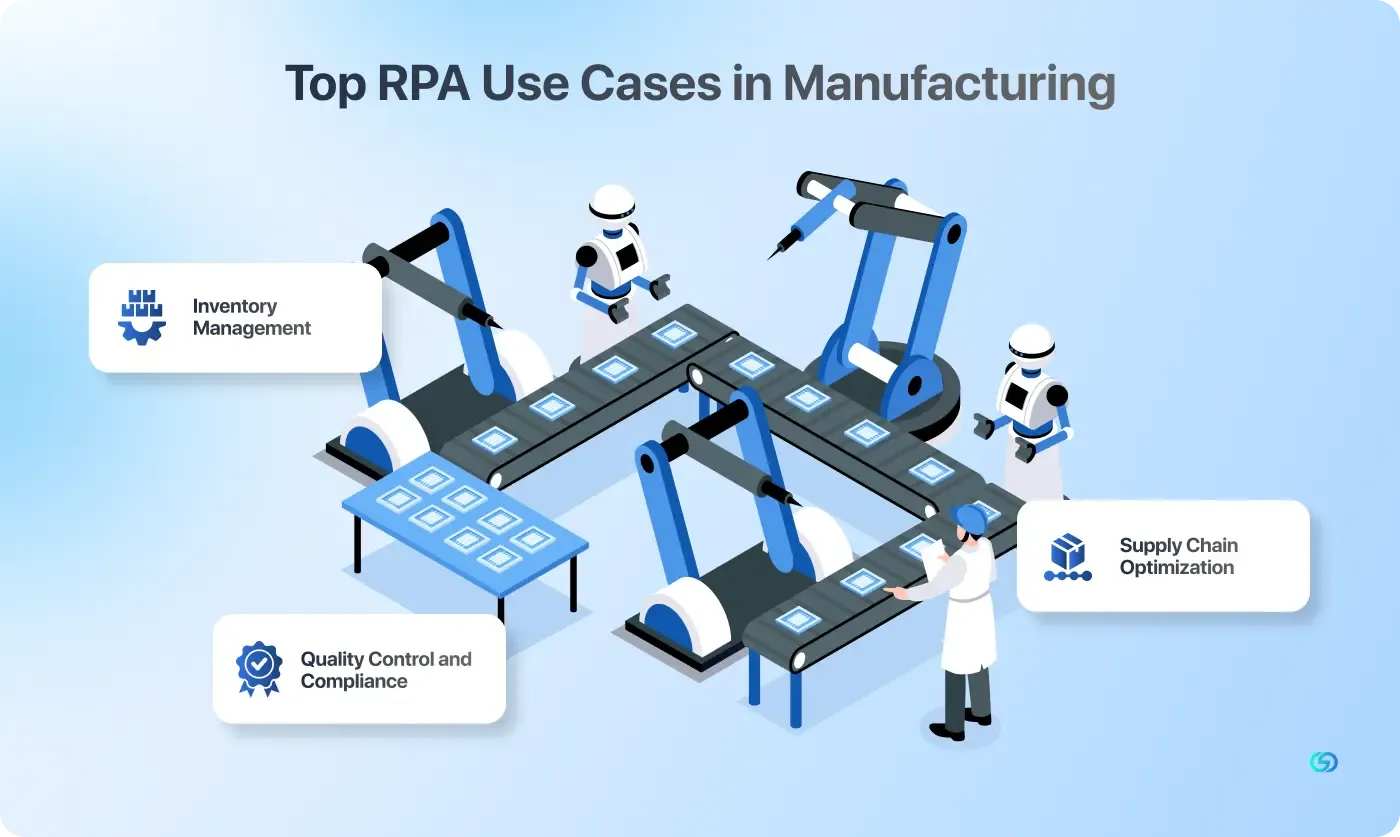
Several paperwork tasks in the manufacturing industry require communication with vendors and suppliers. This means there are several RPA use cases in manufacturing. RPA helps improve quality, streamline production, and reduce costs. Statistics show that about 43% of manufacturers leverage RPA in their operations.
- Inventory Management: Associates can track the stock levels in real-time, receive alerts for placing orders, monitor delivery status, and generate reports to access important data on inventory.
- Supply Chain Optimization: RPA enhances the supply chain optimization process by predicting customer demand, automating supplier onboarding, collecting data from vendors, and conducting reliability checks.
- Quality Control and Compliance: One of the impactful RPA automations use cases in manufacturing is quality control and compliance. The bots automate data collection and analysis for audits, adhere to quality standards, and generate consistent documentation.
4. RPA Use Cases in Retail
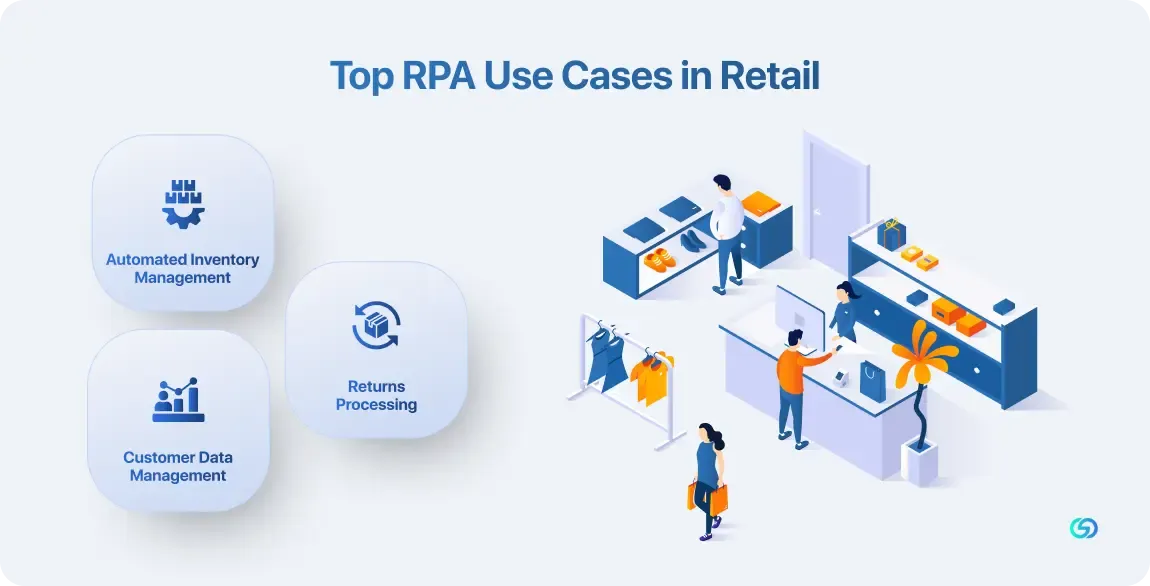
RPA in the context of the retail industry replicates steps that a human would take to complete routine tasks. The retail industry seeks innovative solutions to automate manual, repetitive tasks, ease the workload on employees, and deliver great shopping experiences.
- Automated Inventory Management: RPA handles challenges associated with manual purchase ordering with automation. Bots check orders, extract data, and verify bills and delivery information in seconds.
- Returns Processing: Managing returns takes time, and this is where RPA steps in. RPA efficiently handles returns and adjusts to customer billing and inventory data. Additionally, it reduces operational expenses by automating labor-intensive work.
- Customer Data Management: RPA transforms customer data management by integrating information across channels, allowing personalized promotions, automating customer feedback collection for service improvement, and ensuring data accuracy to enhance customer relationship management.
5. RPA HR Use Cases
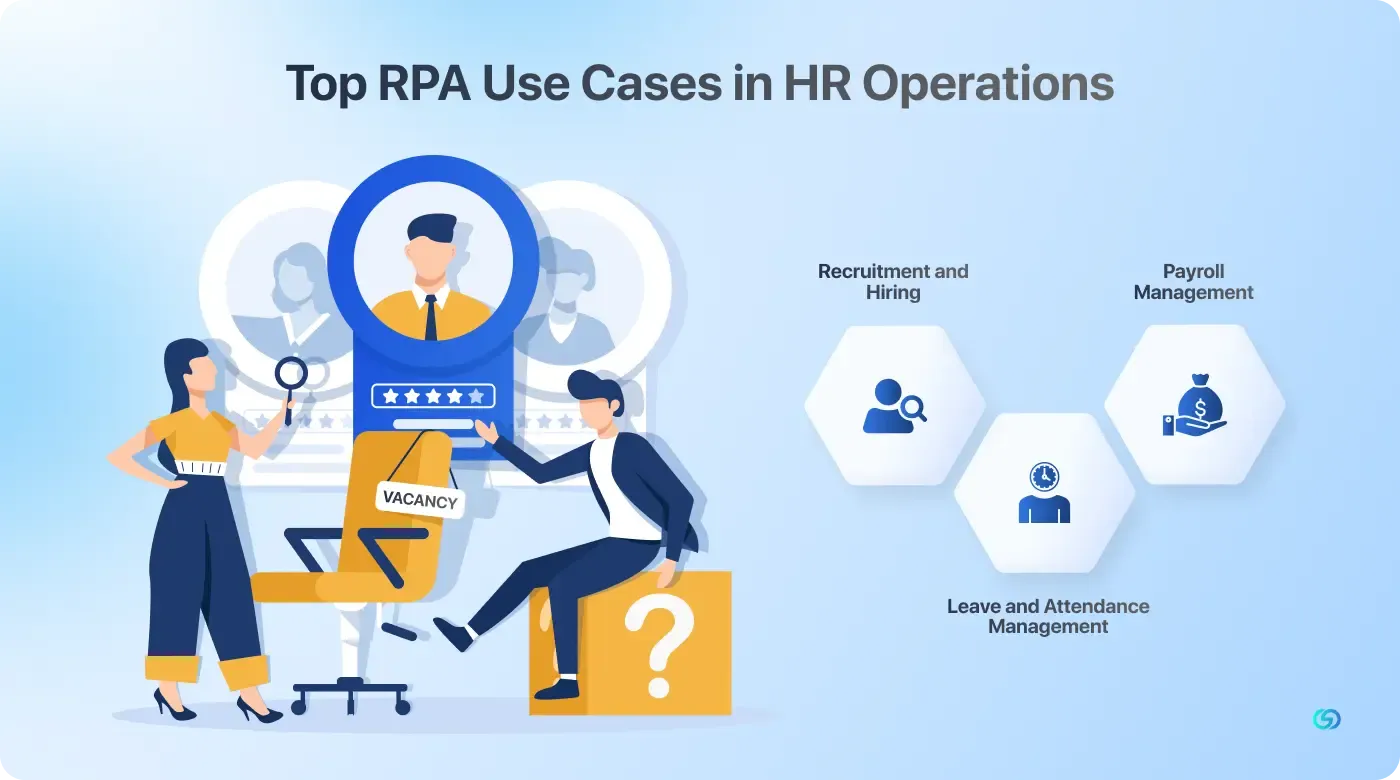
The HR department has a vital role to play in every industry, monitoring employees’ phases. However, due to the load of never-ending repetitive tasks, there’s hardly any time left for strategic decision-making, employee development, and building trust. Let’s go through RPA use cases in HR:
- Recruitment and Hiring: Filtering through volumes of resumes to find the right candidate is tough. RPA is used to evaluate resumes and shortlist candidates. Furthermore, the bot can help in interview scheduling, drafting emails to new onboards with automated templates. All of this help HRs remain focused on strategic tasks.
- Payroll Management: In HR management, payroll involves extracting large volumes of data, verifying working hours, and considering tax regulations. With RPA, you can automate payroll processing, ensuring accurate calculation of salaries, deductions, and taxes. RPA fetches data from the timesheet for error-free payrolls, reducing human errors.
- Leave and Attendance Management: Logging in and out and maintaining attendance is tough for employees, especially if it involves filling in forms. RPA manages leave requests by confirming leave balances, matching them with the company’s policy, scheduling events, and updating records.
6. RPA Use Cases in Government
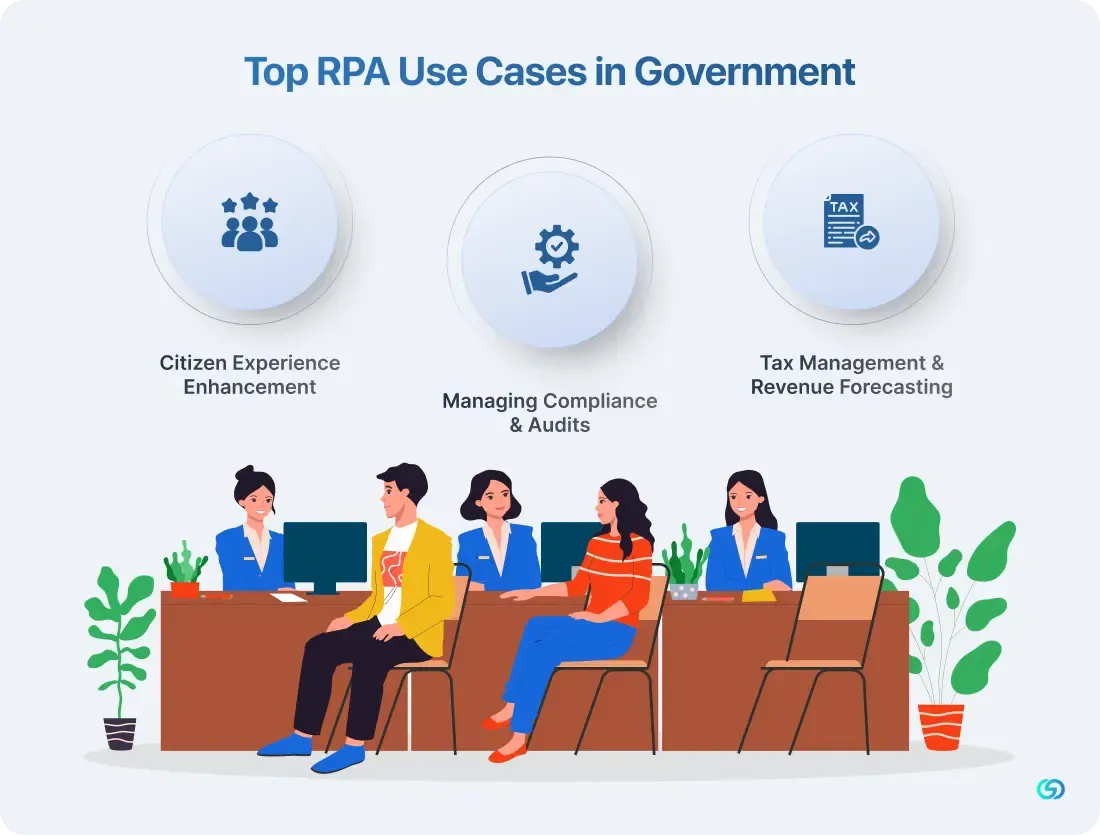
Today, the government has to deal with multiple operational challenges. From outdated technologies to slow manual tasks, and operational expenditure, the list just goes on. This is exactly where RPA can help.
- Citizen Experience Enhancement: RPA automation use case in the government sector allows for faster response times and quick service delivery. This satisfies the citizens, which builds trust in the government service.
- Managing Compliance and Audits: RPA improves compliance and audits by automating repetitive tasks like report generation, data gathering, and regulatory monitoring. RPA bots monitor processes and generate audit-ready reports, thereby enhancing transparency and accountability.
- Tax Management and Revenue Forecasting: RPA helps in automated tax collection and revenue forecasting, sending tax notices, analyzing large user data, and verifying invoices.
7. RPA Use Cases in Insurance
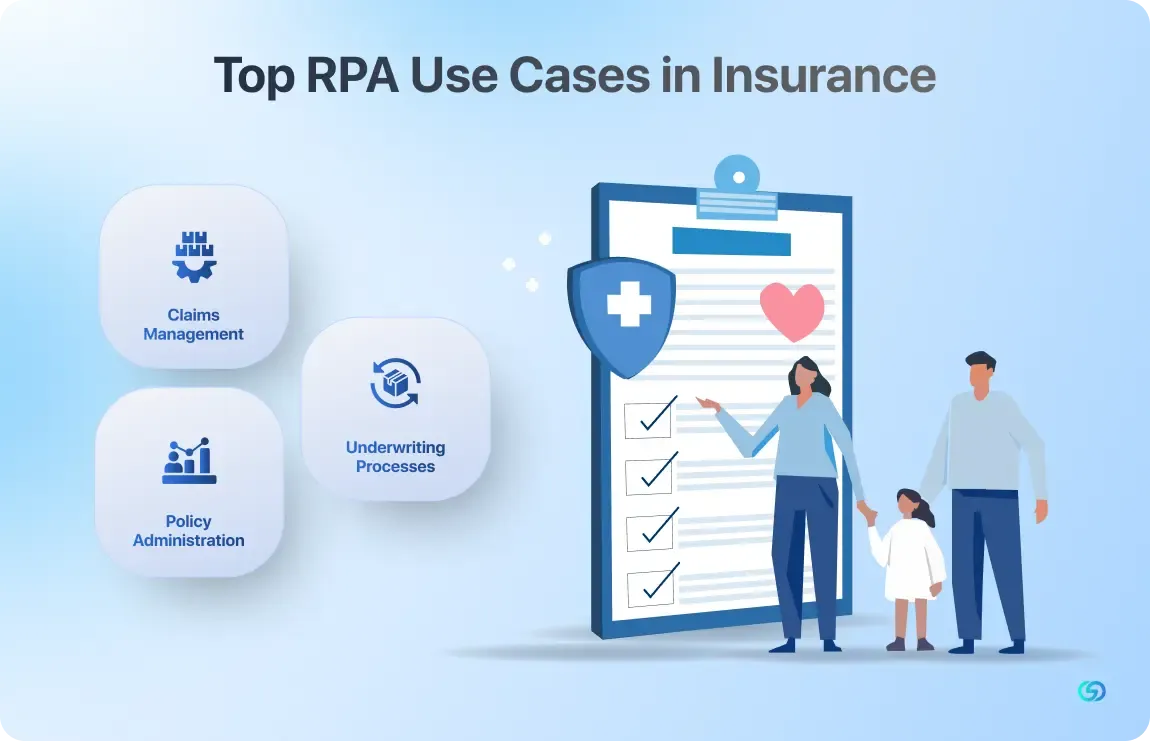
The insurance industry involves complex processes, tons of paperwork, and manual tasks. However, with RPA in the picture, insurers can now streamline their business workflow, reduce costs, and enhance customer satisfaction. Let’s check out RPA use cases in insurance industry:
- Claims Management: In a traditional workflow, claims management is a laborious task, it’s about collecting data from diverse sources and validating them. With RPA, the need for human input decreases. The advanced solution integrates with all apps and systems and takes over the burdensome task of claim verification, data extraction, and more from emails, bank statements, and forms.
- Underwriting Processes: RPA collects and processes data accurately from various sources at a rapid pace. The advanced software automates risk analysis coverage and pricing to provide greater visibility into reported issues. This leads to less paperwork, faster response times, and accuracy.
- Policy Administration: RPA automates repetitive tasks such as administrative and transactional duties, including regulatory compliance, credit control, tax calculations, and more. It also automates the entire insurance policy cycle from quoting to endorsing.
8. RPA Use Case in Customer Service
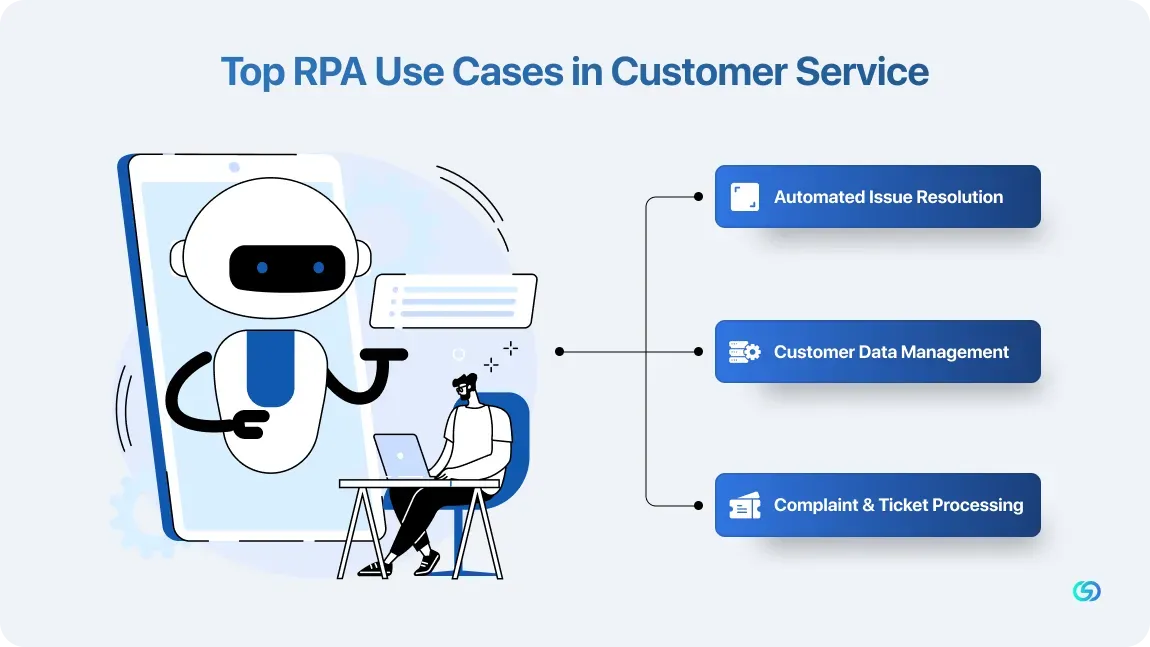
In the customer service industry, if rule-based bots could manage repetitive tasks that usually resulted in human mistakes, the entire workflow could become efficient. Today, customers demand a quick solution to their queries, which is now possible with RPA. This is why RPA use cases in customer service are growing rapidly — helping brands automate routine processes, reduce response time, and deliver faster, more accurate support at scale.
- Automated Issue Resolution: RPA handles routine inquiries such as billing details, order status, and password resets without the need for human intervention
- Customer Data Management: The cutting-edge software automatically updates, validates, and syncs customer details across systems to keep records consistent and accurate.
- Complaint and Ticket Processing: RPA sorts and categorizes customer complaints or support tickets to the appropriate department, speeding up response times.
9. RPA Use Cases in Transport and Logistics
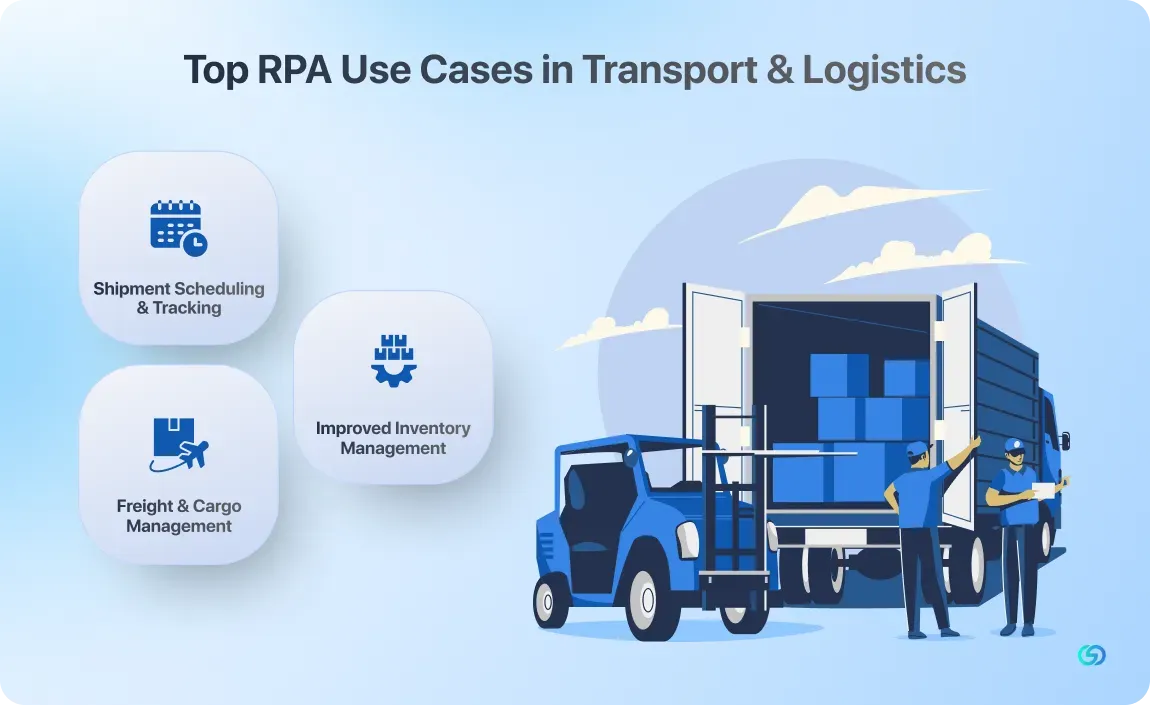
The transport and logistics industries face numerous challenges, from labor and fuel costs to real-time tracking, increasing customer demands, and transparency. RPA has emerged as a game-changer for this sector. Let's go through some of the top RPA use cases examples for transport and logistics.
- Shipment Scheduling and Tracking: One of the biggest parts of logistics is shipment scheduling and tracking, which needs to be carried out with much efficiency. RPA can take care of the shipment forms, choose the right transport, and update the tracking system with real-time data.
- Freight and Cargo Management: Freight and cargo are time-consuming tasks in the logistics and transport industry; however, it's the backbone of this sector. RPA efficiently handles the repetitive tasks related to freight management, such as processing invoices, tracking shipment, custom document processing, and more.
- Improved Inventory Management: RPA can help businesses gain a competitive edge with inventory upkeep and timely updates. It automates tasks like data entry, stock tracking, and reordering, which eventually leads to reduced costs and optimized stock levels.
10. RPA Use Cases in Education
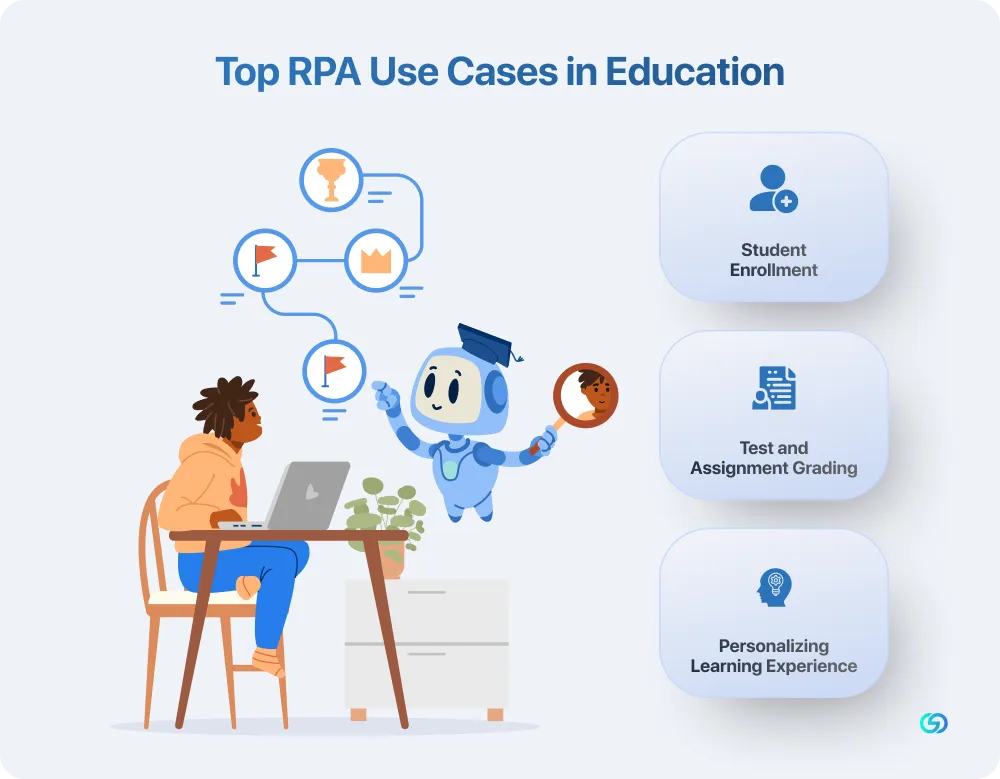
In the education industry, the teacher-to-student ratio is disproportionate, which leads to an overload of work. Time and again, educational institutions are looking for ways to reduce the cumbersome tasks and improve operations. RPA use cases in education can clear your doubts.
- Student Enrollment: The admission process is a huge task for educational institutions, which needs significant time. However, with RPA, facilities can automate the entire process by collecting and verifying student data in the systems. Stats show the RPA implementation witnessed a 40% improvement in application processing time.
- Test and Assignment Grading: RPA bots can be programmed for online grading of tests and assignments, especially for repetitive tasks. This frees up tutor’s time to focus on complex teaching activities and allows instant feedback for students.
- Personalizing Learning Experience: RPA creates a personalized learning atmosphere for each student by leveraging their hobbies, scores, and attendance information. The students can approach RPA bots for quick help on a certain topic.
11. RPA Use Cases in Hospitality
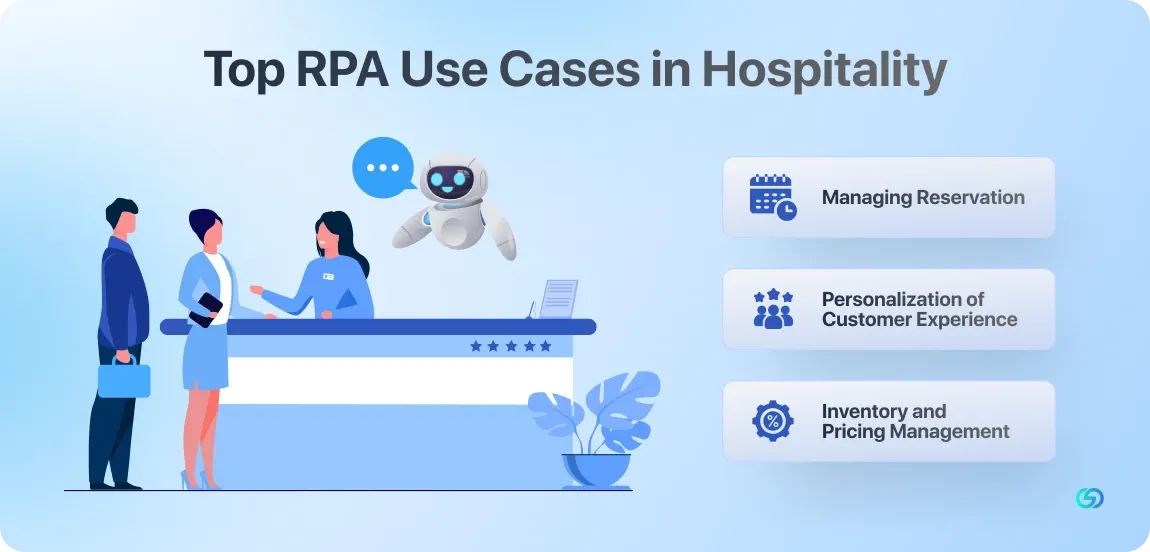
A survey revealed that in the next three years, more than 80% of hoteliers are planning on increasing their tech investments. The hospitality industry requires software that can manage their workflow in an end-to-end manner. Let’s look at RPA use cases in hospitality sector:
- Managing Reservation: Thanks to RPA bots that can automate the whole reservation process. Bots can access room availability in real-time, create guest profiles, and ensure online payments. It smoothens the booking process and eliminates the need for human intervention.
- Personalization of Customer Experience: With each passing day, consumers are looking for personalized experiences. RPA frees up employee time to help them take personalization measures that can be used to gain customer insights and tailor experiences that resonate with buyers.
- Inventory and Pricing Management: Inventory and pricing management are major focus areas for travel and hospitality businesses. RPA automates revenue management, analyzing competitor’s pricing, and other important areas to heighten experience. This eliminates guesswork and manual effort.
12. RPA Use Cases in Real Estate
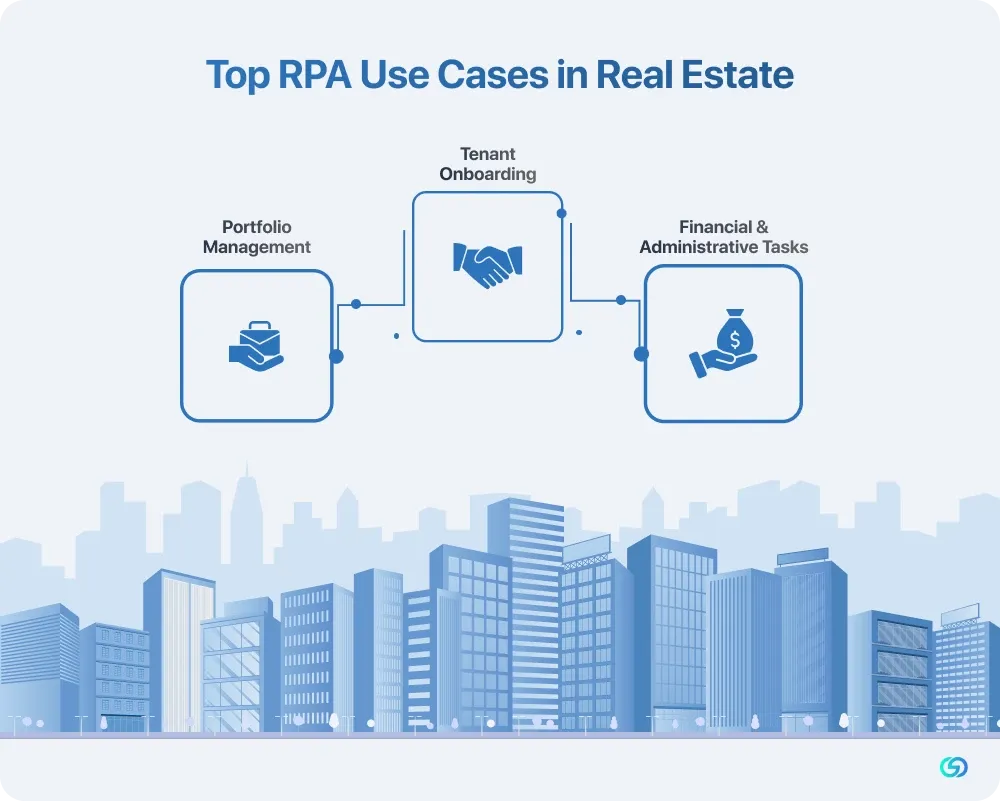
The real estate industry faces challenges, like difficulty in invoice processing, document management, and data extraction. These are important aspects of real estate businesses. The sector is always looking for ways to improve the workflow. Let’s look at the top RPA use cases:
-
Tenant Onboarding: The tenant onboarding process deals with several manual and time-consuming tasks, resulting in poor customer experience. With RPA bots, real estate businesses can fetch and process details to handle tenant onboarding.
-
Portfolio Management: Real estate organizations manage various assets, acquire, or sell individual components efficiently. RPA lets realtors list sold or rented properties and update data on different websites for property visibility.
-
Financial and Administrative Tasks: RPA bots help manage financial and administrative tasks in real estate, like invoice and payment processing, accounts payable and receivables, loan and mortgage processing, tax billing and reporting, and more.
Conclusion
At the end of the day, RPA technology has made automation more accessible to businesses of all sizes. From healthcare to estate, the best RPA use cases, listed above, highlight how organizations are eliminating repetitive work and achieving peak productivity. When you combine RPA with Artificial Intelligence, the possibilities grow even bigger, and together they pave the path for smarter operations and better decision-making.
Whether you are searching for everyday process automation or exploring the future of RPA and AI use cases, one thing is quite clear: automation is a necessity to stay ahead in the competitive market.
If you are still relying on manual processes, now is the time to rebuild your strategy.