- Modern Web Development
- 2026-06-11
The Ultimate Guide to Modern Web Development in 2026
Audio Track
Table of Contents
Key Takeaways:
- In 2026, websites evolve into AI-driven, high-performance digital hubs that impact growth, conversions, brand authority, and customer experience across all industries.
- Fast-loading pages, robust cybersecurity, mobile-first design, accessibility, and tailored user experiences drive engagement and business success.
- Headless CMS, microservices, PWAs, Jamstack, and cloud-native development deliver scalability, flexibility, and unmatched performance.
- From code generation and testing to chatbots, recommendations, and predictive UX, AI is reshaping how websites are built and used.
- Choosing the right tech stack, development process, and partners like custom web development companies. This ensures long-term scalability, stronger conversions, and sustained digital growth.
Introduction: Why Web Development Matters More Than Ever in 2026?
Web development is the most crucial thing in 2026 as websites are changing from static brochures to dynamic, AI-powered, user-centric platforms, important for the survival of business, driving sales, and developing credibility of brand in an extremely competitive digital world demanding personalization, seamless experiences, and speed across all devices with privacy, AI, and advanced interactivity turning into core expectations.
Custom website development services in essential as websites are serving as the core business assets, with the enterprises increasing their budget for strengthening their digital presence. Users want hyper-personalized, AI-driven experiences, while PWAs and mobile-first design are dominating because of the increasing mobile traffic. AI improves efficiency throughout the development, and privacy, security, and performance stay non-negotiable, with the users mostly avoiding slow-loading sites within seconds. Ethical design and accessibility broaden the reach and enhance the UX, while increasing ecommerce demands, secure, fast, and customized platforms.
What Is Modern Web Development?
Modern development can be defined as an end-to-end process for developing powerful, high-performing web experiences that utilize next-generation technologies and contemporary methodologies. The focus of modern web development is to create user-friendly, scalable, and secure websites or web applications.
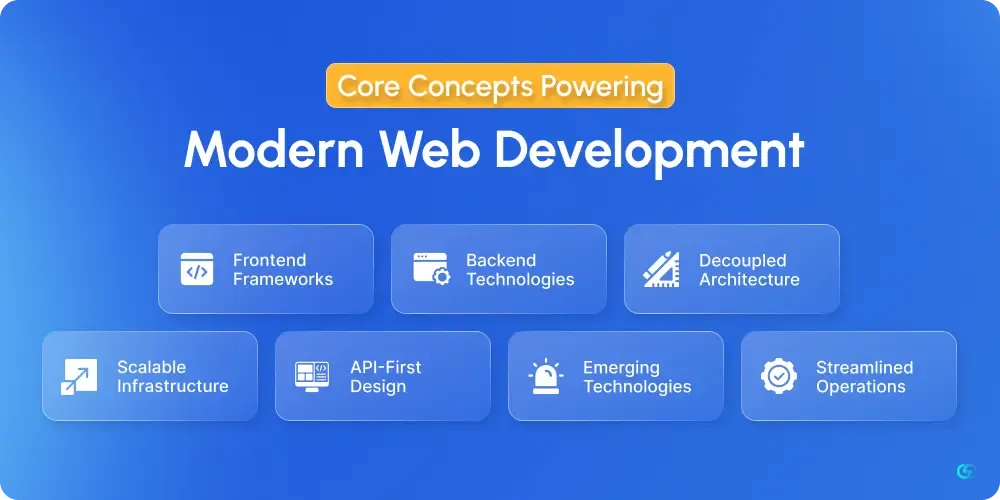
The main concepts and technologies defining modern web development include:
-
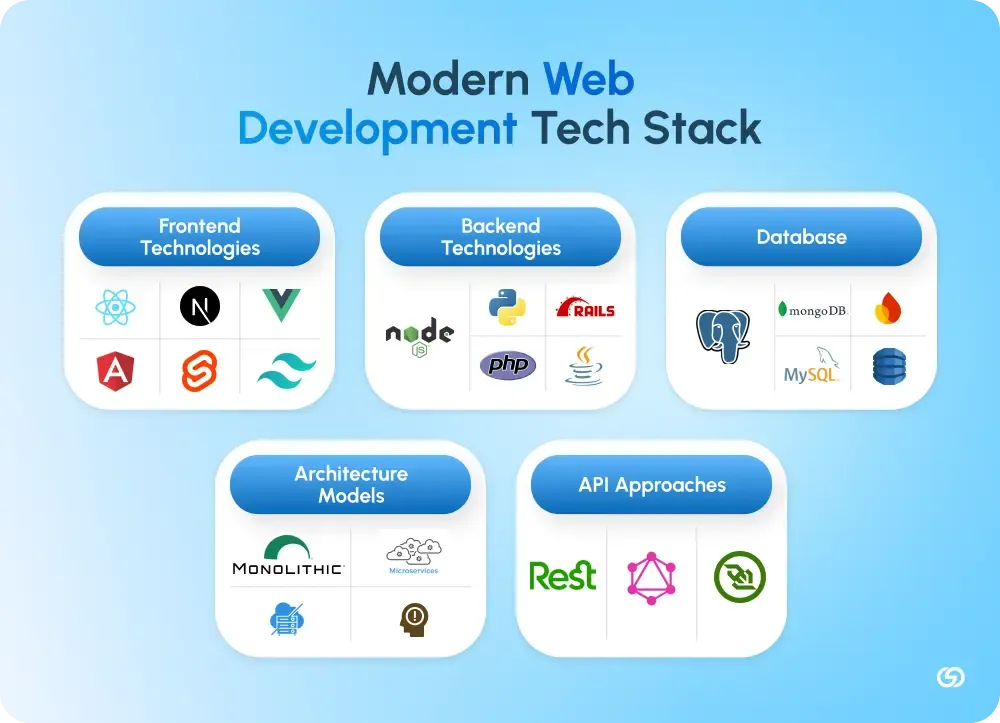
Frontend Frameworks: Leveraging component-based libraries such as React.js as well as opinionated frameworks such as Next.js, for effective and interactive UI.
-
Backend Technologies: Utilizing robust runtime environments like Node.js or versatile programming languages such as Python for managing server-side logic and databases.
-
Decoupled Architecture: Employing a “headless” approach where the content management system (CMS) is separate from the frontend delivery layer, mostly powered by Headless CMS.
-
Scalable Infrastructure: Deploying apps on resilient cloud and serverless platforms that automatically scale based on demand.
-
API-First Design: Building systems around powerful, well-defined APIs to ensure that several services and clients can easily communicate.
-
Emerging Technologies: Incorporating AI and ML capabilities for providing personalized user experiences and advanced functionalities.
-
Streamlined Operations: Utilizing automation and DevOps pipelines for ongoing integration and ongoing deployment (CI/CD), ensuring speedy and trustworthy.
Modern web development goes beyond simple design; it is about developing sophisticated systems and delightful user experiences that can adapt and grow with business requirements.
Types of Websites & Web Applications
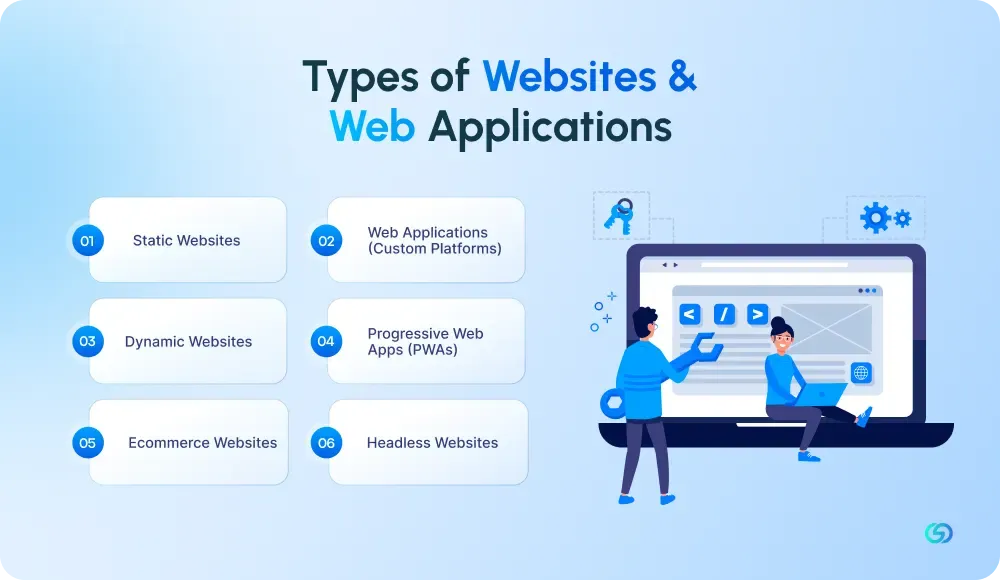
Modern businesses depend on several types of digital platforms as per their functionality needs, goals, and user expectations. Given below is a clear breakdown of the website and web app types used at present.
Static Websites
What they are:
Static websites are developed utilizing fixed HTML/CSS pages that reflect the same content to all visitors. They do not depend on databases or server-side processing.
Static Websites are Best For:
- Portfolios
- Basic business or brand presence
- Information and Brochure-style websites
Why They Matter?
Static sites are highly secure, fast, and cost-effective, making them perfect for businesses that require a simple digital presence without continuous content updates.
Dynamic Websites
Dynamic websites generate content based on real-time user actions, backed by logic or database queries or backend logic. They are more content-driven and interactive.
**Dynamic Websites are Best For:
- Portfolios
- Basic business or brand presence
- Information or brochure-style websites
Why They Matter?
Dynamic websites enable businesses to offer personalized experiences, update content in real-time, and handle complicated workflows that change with the needs of the user.
Ecommerce Websites
Ecommerce websites are online stores developed for selling products and services. They incorporate checkout systems, product catalogs, payment gateways, and inventory management.
Ecommerce Websites are Best For:
- Retail and online stores
- Multi-vendor marketplaces
- Digital products
- Subscription-based services
Why They Matter:
They support all online selling works, starting from browsing products to secure checkout, integrate with CRM analytics, and marketing tools from end-to-end commerce.
Web Applications (Custom Platforms)
Web applications are interactive software systems that can be accessed via a browser. They go beyond traditional backgrounds with specialized features, real-time data handling, and complex logic.
Web Applications are Best for:
- CRM & sales platforms
- Learning management systems
- HRMS and employee portals
- SaaS dashboards and custom enterprise tools
Why They Matter:
Web apps are developed for solving business-specific challenges and support automation, personalized workflows, and data processing on a secure, scalable architecture.
Progressive Web Apps (PWAs)
PWAs are advanced web apps that look and feel like native mobile applications. They provide offline access, push notifications, and app-like experiences right from the browser.
PWAs are Best For:
- Mobile-first audiences
- Business targeting users in environments with low connectivity
- Brands wanting application functionality without publishing it in app store
Why They Matter?
PWS brings a combination of the reach of the web with the capabilities of mobile apps, allowing smooth performance and improved engagement with a single codebase.
Headless Websites
Headless websites utilize a decoupled architecture where the design is separated from content management. Content is delivered through APIs into an interface.
Headless websites are best for:
- Omnichannel brands
- Businesses need flexible and fast frontends
- High-performance marketing websites
- Teams that want independent control for content and design
Why They Matter:
Headless architecture allows easier integrations, faster loading times, and greater flexibility in designing, making it perfect for modern, scalable digital ecosystems.
Why Web Development is Critical to Business Growth?
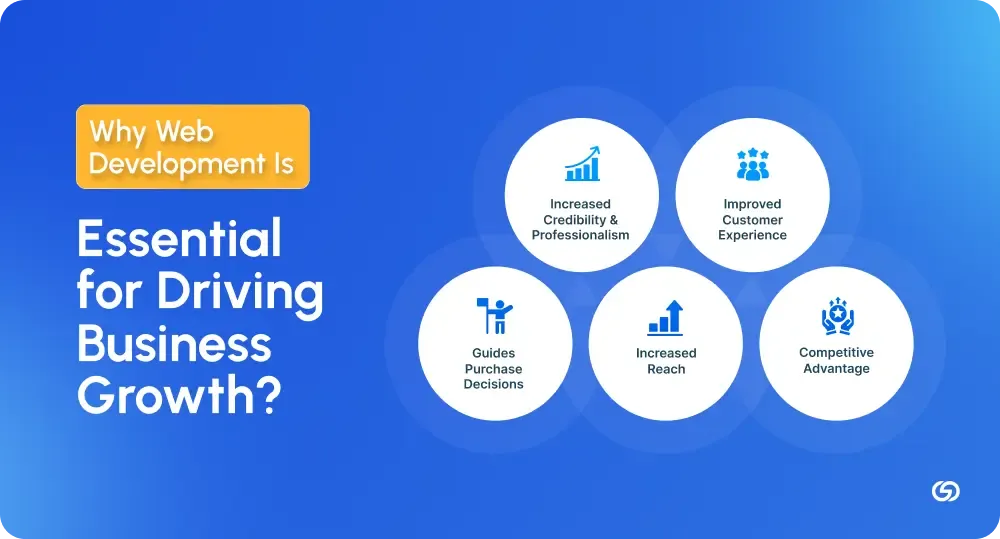
The business website is the main source of communication with clients. It is the premier source of information about your business and fosters customer interaction and purchase.
This is only the beginning; custom web development also has the following benefits:
🔷 Increased Credibility and Professionalism
A perfectly designed website is capable of inspiring confidence in the prospect of customers. Features such as easy navigation, payment gateways, and responsiveness to the user. All of these can be achieved via good web development, making a difference in how professional and reliable your business looks.
🔷 Improved Customer Experience
As per research, the conversion rate of ecommerce websites ranges between 1.84% to 3.71%. A well-designed website can improve the experiences of customers by making it easy to find out products, navigate through the website, and make transactions. This improved user experience can result in greater satisfaction with the service and increase the chance of returning customers.
🔷 Guides Purchase Decisions
Websites act as hubs of information about services, products, and businesses, enabling customers to browse information, advantages, and specifications and make informed buying decisions.
🔷 Increased Reach
As per Ahrefs, 68% of experiences start using an internet search engine. A well-optimized website enables companies to reach a broader audience by improving their visibility via efficient SEO. It expands the reach of the website beyond the local area. It enhances the cost-effectiveness of the business by attracting clients who are actively searching for relevant services and products.
🔷 Competitive Advantage
With website development, you can incorporate dynamic features such as contact forms, chatbots, and social media buttons on your website. These improvements enhance the way customers interact and offer personalized support, which results in greater engagement.
Key Features of a High-Performing Website
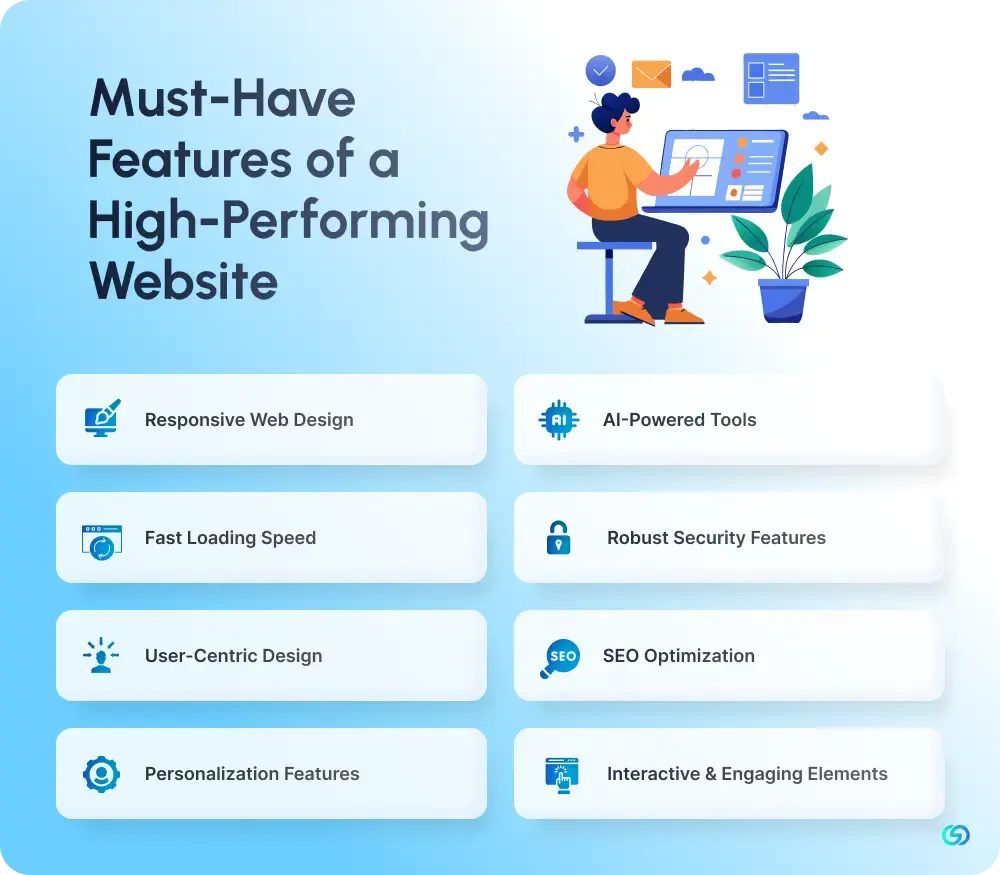
In 2026, simply having a website is no longer enough. Businesses need digital experiences that are fast, intuitive, secure, and tailored to each user. Modern custom web development ensures your website not only attracts visitors but converts them into loyal customers. Below are the key features every website must include to stay competitive.
🔶 Responsive Web Design
Responsive design is now mandatory, not optional. With users accessing websites across smartphones, tablets, laptops, and wide screens, your site must adapt seamlessly to every device.
A fully responsive layout automatically adjusts images, components, and content flow, resulting in faster load times and consistent experiences. Search engines also prioritize mobile-friendly websites, making responsiveness a key driver of both user engagement and SEO performance.
🔶 Fast Loading Speed
Speed directly impacts user satisfaction and conversion rates. Studies show that nearly half of users abandon a website that takes more than three seconds to load.
To keep users engaged in 2026, websites must use optimized code, compressed media, caching strategies, and global CDNs. Faster loading not only enhances user experience but also improves search visibility and reduces bounce rates.
🔶 User-Centric Design
User experience sits at the core of modern web development. A user-centric website ensures visitors can easily browse, find information, and complete actions such as purchases or form submissions.
Beyond usability, accessibility is crucial. Features like keyboard navigation, screen-reader compatibility, optimized contrast, and clear typography make your site inclusive for all users, including those with disabilities, aligning your brand with global accessibility standards.
🔶 Personalization Features
In 2026, personalized digital experiences will be the norm. Users expect content, product recommendations, and offers tailored to their behavior, location, and preferences.
With custom web development, businesses can integrate analytics, cookies, and dynamic content engines to deliver individualized journeys. Personalization boosts engagement, improves conversions, and helps brands build stronger customer relationships.
🔶 AI-Powered Tools
AI-powered web development has become an integral part of modern websites. From smart recommendations to predictive insights, AI enhances how users interact with your platform.
AI-powered chatbots provide instant customer support, guiding users, answering queries, and improving overall satisfaction. AI also helps automate routine tasks, detect user intent, and personalize content in real time, making your website more intelligent and efficient.
🔶 Robust Security Features
As cyber threats continue to evolve, strong security is non-negotiable. Users must feel confident when sharing personal or payment information on your site.
Modern websites need SSL certificates, multi-factor authentication, firewalls, and regular security patches to prevent breaches. With custom development, you also ensure compliance with global regulations like GDPR and CCPA, protecting user data and building long-term trust.
🔶 SEO Optimization
A visually appealing website won’t achieve results if it’s not discoverable. SEO remains critical for improving online visibility in 2026.
Technical SEO, optimized page structure, mobile performance, relevant keywords, schema markup, and clean URLs all help search engines understand your site. SEO-optimized websites earn higher rankings, attract organic traffic, and generate more qualified leads.
🔶 Interactive & Engaging Elements
Modern websites are becoming more dynamic, using interactive elements to capture user attention and improve engagement.
Animations, quizzes, sliders, videos, micro-interactions, and visual storytelling make browsing more exciting and increase retention. Custom development ensures these features align with your brand identity and provide meaningful value, not just aesthetics.
Modern Web Development Tech Stack
Given below is the tech stack needed for premier website development:
Web Development Process: From Idea to Deployment
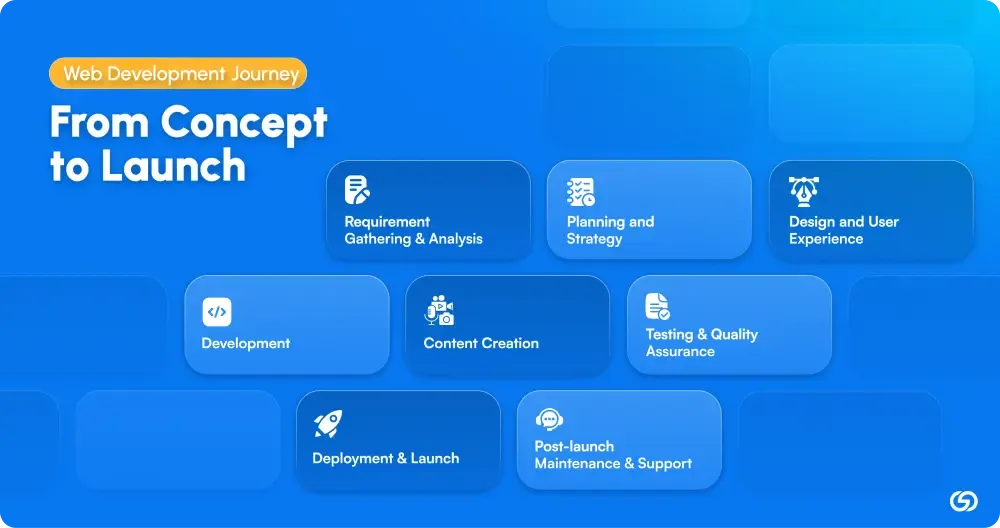
Business website development needs various important steps for ensuring that you have a single website customized to meet the needs and requirements of a company. The main steps involved in customized development are as follows.
Step 1: Requirement Gathering and Analysis
The first step is to gather specific requirements from the customer about the goals and objectives of the website, target audience, and desired functions and features. This also includes a detailed analysis of the industry of the business, market trends, and competition for guiding the process of development.
Step 2: Planning and Strategy
In the next step, an extensive plan and program for web development are developed. This involves defining the structure and navigation of the website, content architecture, and technology stack. Milestones, timelines, and allocation of resources are also formulated at this phase.
Step 3: Design and User Experience
The design phase concentrates on the visual component and the user interface (UI) of the website. Web designers work with the clients on mockups, wireframes, and prototypes to ensure that the aesthetics of the website and user experience align with the branding and mission of the client.
Step 4: Development
Once the design is accepted, the development process begins. Developers make the code and develop the functionality of the website as per the design needs and specifications. The frontend design involves CSS, HTML, and JavaScript for the UI and developing back-end functionality for processing data and dynamic functions.
Step 5: Content Creation
In this phase, content such as text, video, and multiple media items is produced and optimized to be used on the website. CMS can be integrated for content management to offer easy updates and management of content.
Step 6: Testing and Quality Assurance
A thorough test is conducted to find out and correcting bugs, errors, and compatibility issues. This involves performance testing, functional testing, cross-browser compatibility testing, and responsive design testing for ensuring that the websites work well throughout all browsers and devices.
Step 7: Deployment and Launch
Once the website is vividly tested for finding out and correcting bugs, errors, and issues related to compatibility. This involves performance testing, functional testing, cross-browser compatibility testing, and responsive design testing to ensure that the website works fine across all devices and browsers.
Step 8: Post-launch Maintenance and Support
Once the website has been created, ongoing support and maintenance are important for ensuring its safety and efficiency. This involves bug fixes, security patches, periodic updates, and technical support for resolving any problem that could occur.
Web Development Challenges & How Experts Solve Them?
The various web development challenges in 2026 are as follows:
💠 Slow Page Speed
Slow page is a common challenge and can be solved by optimizing images, utilizing browser caching, decreasing CSS and JavaScript, utilizing a Content Delivery Network (CDN), and implementing lazy loading for media.
💠 Poor Security Measures
Poor security measures hamper web development and can be fixed by utilizing HTTPS, updating software/libraries daily, implementing firewalls and strong authentication, input validation for preventing attacks, and continuous security audits.
💠 Broken UX & Navigation
UX and navigation makes or breaks a website and can be optimized by conducting user testing, making a clear data infrastructure, implementing responsive design for multiple devices, and ensuring user-friendly, consistent navigation patterns.
💠 Scaling Issues During Heavy Traffic
Issues related to scaling and heavy traffic can be fixed by employing cloud infrastructure, such as load balancing, utilizing scalable databases, distributing traffic, and designing stateless apps.
💠 High Maintenance Costs
The high maintenance cost of a website can be tackled by writing modular, clean code utilizing automated testing, detailed documentation, and utilizing DevOps practices for efficient monitoring and deployment.
💠 Inconsistent Branding
Inconsistent branding often becomes established by strictly following a comprehensive guide and design systems throughout all platforms.
💠 Integration complexity
Complexities related to integration can be solved by utilizing microservices architecture, well-documented APIs, and standardized protocols for facilitating seamless communications between several systems.
💠 SEO-unfriendly Structure
Not having a SEO-friendly structure can affect SEO performance, by ensuring clean URLS, streamlining meta tags and content, implementing semantics, enhancing site speed, and creating a clear XML sitemap.
Cost of Web Development in 2026
When it comes to customizing web development, knowing the price becomes important. The cost of custom web development can be very different based on several factors, including the complexity level and degree of customization, and the experience of the involved developer.
Cost Range
The price of custom web development ranges from a few thousand dollars to thousands of dollars. Basic custom web development can be priced as low as $5000, and in the case of more advanced websites with advanced features, it can be priced at more than $20000. The varied range of options enables companies to pick an option ideal for their budget and needs.
Pricing Factors
Several factors affect the price of web development:
- More Complex Features: Complex websites that can sell products, custom-made animations, or integration with other software may be expensive.
- Development and Design Time: The longer the designers require to invest in your project, the higher the price. This time is dedicated to design iterations, studies, and development.
- Agency vs. Freelancer: Agency businesses are typically more expensive because of their overhead expenses. However, they may provide more selection of services than freelancers.
Freelance Rates
Freelancers are a cheap alternative for customizing web design with rates in ranging from $50 and $150/ hr. However, also keep in account the compromises. While the freelancers may offer personalized services and low costs, they may not have the resources or experience that a full-service company can offer.
Industries Leveraging the Power of Website Development
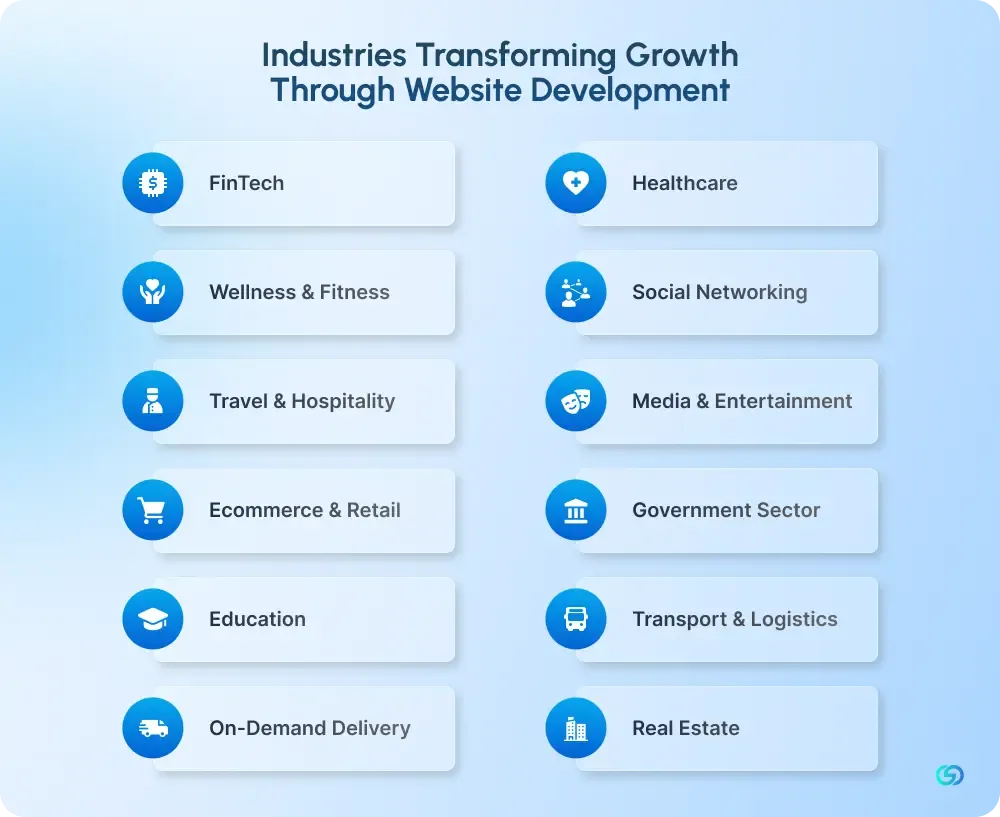
Modern website development empowers businesses across every industry to deliver seamless digital experiences, automate operations, and scale faster. From real-time interactions to secure transactions and personalized user journeys, companies are using advanced web technologies to improve engagement, strengthen brand presence, and meet evolving customer expectations.
➡️ FinTech
FinTech companies rely on robust websites and web applications to deliver secure transactions, digital banking, investment tools, and real-time financial insights. Modern FinTech web development ensures compliance, high performance, data encryption, and seamless user experiences that help financial institutions build trust and support millions of digital customers.
➡️ Wellness and Fitness
Web development enables fitness brands, gyms, and wellness platforms to offer online bookings, virtual training sessions, personalized workout dashboards, and subscription-based content. With user-friendly interfaces and integrated payment systems, wellness businesses can scale online engagement and deliver accessible health experiences anytime, anywhere.
➡️ Travel & Hospitality
Travel and hospitality companies use feature-rich websites to manage bookings, showcase destinations, enable virtual tours, and process payments. Scalable web platforms help brands personalize recommendations, streamline guest management, and enhance customer satisfaction through real-time updates, responsive design, and secure reservation systems.
[Other Useful Resource: Hospitality and Hotel Web Development]
➡️ Ecommerce and Retail
Ecommerce businesses depend on customized websites for product catalogs, secure checkout, inventory management, and personalized shopping experiences. Advanced web development supports faster load times, multi-vendor setups, omnichannel experiences, and analytics-driven features that boost conversions and customer loyalty across digital retail channels.
[Other Useful Resource: Ecommerce Web Development Complete Guide]
➡️ Education
Educational institutions and EdTech platforms leverage web development to deliver eLearning portals, video-based courses, real-time assessments, and student dashboards. These platforms improve accessibility, enhance engagement, and provide personalized learning paths, enabling institutions to offer hybrid, scalable, and future-ready education experiences.
➡️ Healthcare
Healthcare providers use secure websites and patient portals for online appointments, telemedicine, health records access, and remote monitoring. Modern healthcare web development ensures HIPAA/GDPR compliance, reliable performance, and seamless communication, improving patient experience and operational efficiency across digital healthcare ecosystems.
➡️ Social Networking
Social networking platforms depend on scalable web applications to support real-time messaging, content sharing, user profiles, and community engagement. High-performance architectures ensure fast interactions, secure data management, and personalized feeds that keep users active and connected across devices.
➡️ Media & Entertainment
Web development powers streaming platforms, digital publications, music portals, and content-sharing websites. With features like real-time updates, adaptive streaming, and personalized recommendations, media companies can deliver engaging, data-driven experiences that capture audience attention and support increased viewership.
➡️ Government Sector
Government agencies use web platforms to offer digital services, public portals, citizen support systems, and document access. Secure and scalable websites help streamline processes, improve transparency, and make essential services accessible to millions through user-friendly, compliant, and reliable digital interfaces.
➡️ Transport & Logistics
Transport and logistics companies leverage web solutions for shipment tracking, fleet management, booking systems, GPS integrations, and automated workflows. These platforms enhance operational visibility, reduce delays, and enable real-time communication across the supply chain, improving overall efficiency and customer satisfaction.
➡️ On-Demand Delivery
On-demand delivery services rely on responsive web applications for order placement, live tracking, driver management, and automated notifications. Scalable architectures help businesses handle high traffic, ensure fast updates, and deliver a smooth, reliable experience for customers and service partners.
➡️ Real Estate
Real estate businesses use modern websites to showcase listings, provide virtual tours, enable property searches, and simplify communication with buyers and renters. With advanced filters, CRM integrations, and high-performance design, agencies can improve visibility, generate qualified leads, and create seamless property discovery experiences.
Latest Web Development Trends to Watch in 2026
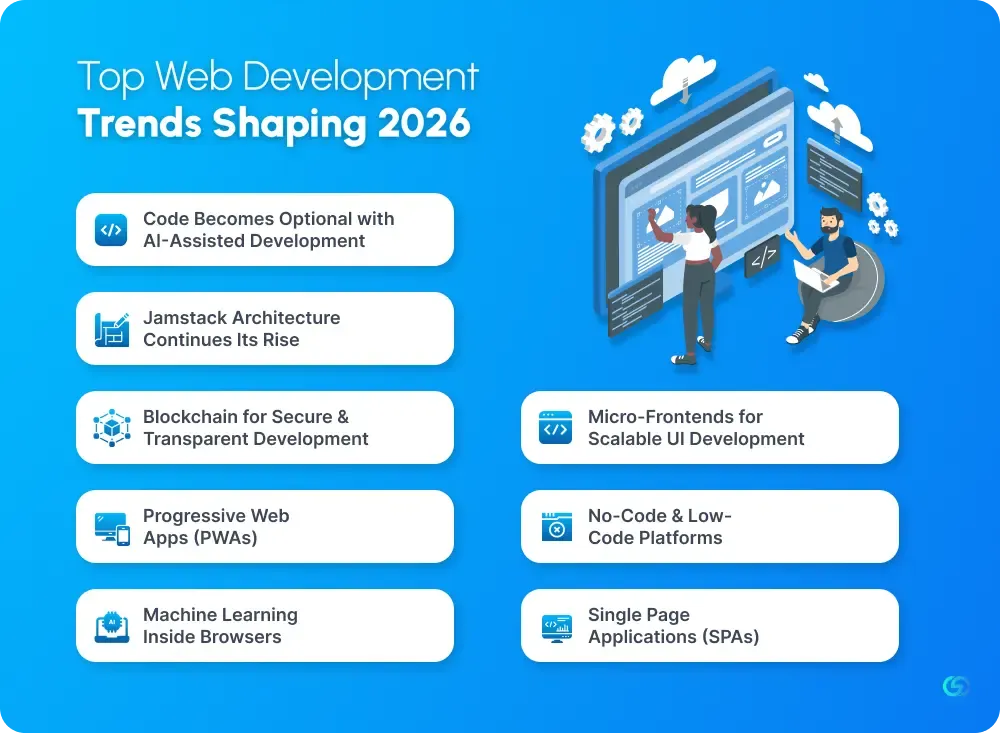
As we step further into 2026, the web development landscape is undergoing a significant transformation. New technologies, architectures, and development practices are redefining how websites and web applications are built, deployed, and optimized. These trends focus on scalability, automation, personalization, performance, and transparency, paving the way for smarter and more efficient digital experiences.
▶️ Code Becomes Optional with AI-Assisted Development
AI-driven development tools, such as GitHub Copilot, OpenAI Codex, and Tabnine, are transforming traditional software development workflows. Developers can now generate code, identify bugs, suggest UX improvements, and automate repetitive tasks within seconds.
Predictive analytics, intelligent chatbots, and AI-powered personalization are becoming standard in modern web projects, reducing development time and dramatically enhancing user engagement.
▶️ Jamstack Architecture Continues Its Rise
Jamstack (JavaScript, APIs, and Markup) is now one of the most preferred architectures for building fast, secure, and scalable websites.
By decoupling the frontend from the backend, Jamstack delivers lightning-fast performance, improved security, and easier scaling, making it ideal for eCommerce, content-heavy websites, and marketing pages.
▶️ Blockchain for Secure & Transparent Development
Blockchain technology enables tamper-proof data, secure transactions, and decentralized applications.
Developers are increasingly using blockchain to build high-performance apps with enhanced security, transparency, and trust, especially for industries like finance, supply chain, and healthcare.
▶️ Progressive Web Apps (PWAs)
Progressive Web Apps combine the best features of native apps and websites. They work offline, load quickly, and provide app-like interactions, all without requiring app store installations.
With the global PWA market projected to reach USD 9.7 billion by 2034, businesses are rapidly adopting PWAs to enhance accessibility and reduce development costs.
▶️ Machine Learning Inside Browsers
Technologies like TensorFlow.js and WebAssembly now allow machine learning models to run directly in browsers.
This enables real-time personalization, voice recognition, predictive interactions, and privacy-friendly data processing, resulting in faster, smarter user experiences.
▶️ Micro-Frontends for Scalable UI Development
Micro-frontends break large user interfaces into smaller, manageable components.
This modular approach supports parallel development, easier maintenance, and faster scaling, making it perfect for enterprise-level applications and large platforms.
[Other Useful Resource: The Rise of Micro-Frontends: Transforming Modern Web Applications]
▶️ No-Code & Low-Code Platforms
Platforms like Webflow, Bubble, and OutSystems empower non-technical users to build fully functional websites with minimal code.
These tools accelerate prototyping, reduce development costs, and make digital transformation more achievable for startups and small businesses.
▶️ Single Page Applications (SPAs)
SPAs load a single HTML page and dynamically update content without refreshing the browser.
This improves performance, reduces server load, and enhances user experience. Popular SPAs include Google Maps, Facebook, Airbnb, Twitter, and Netflix.
How ConvexSol Helps Businesses with Web Development?
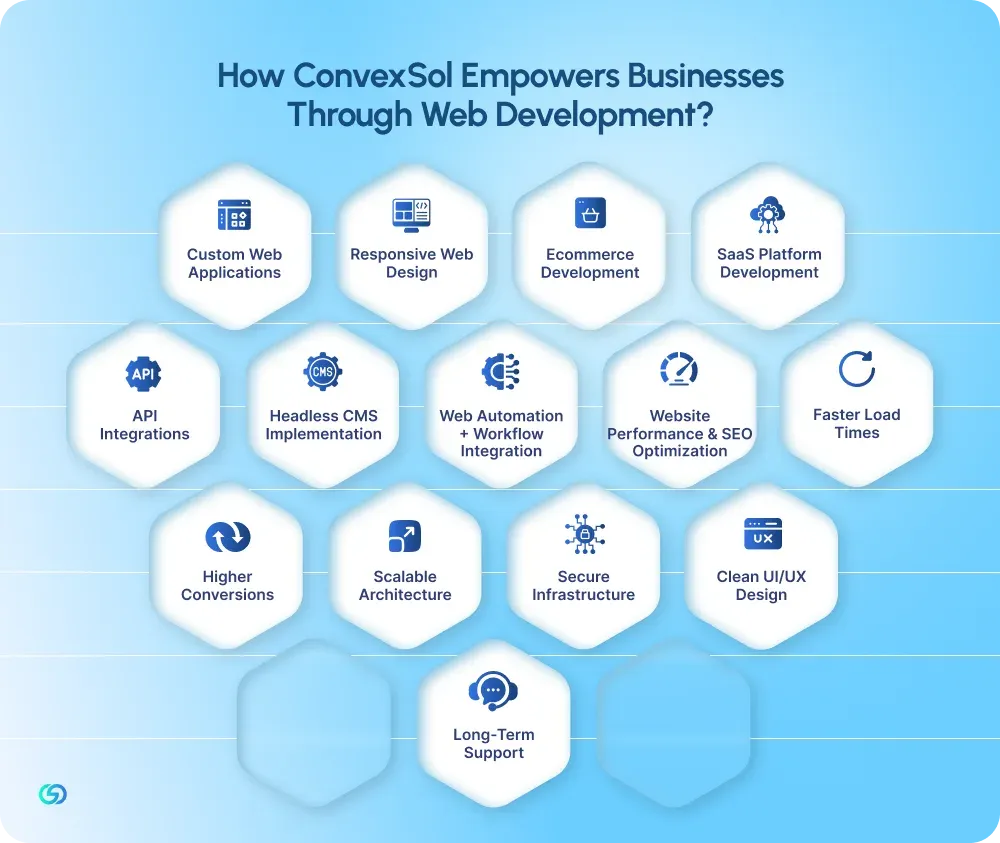
ConvexSol helps businesses to develop scalable, powerful, and future-ready digital experiences. Our complete web development services are developed for improving performance, supporting long-term business growth, and strengthening customer engagement. Whether you are a startup or an enterprise, our team ensures your digital presence aligns with modern standards, changing user expectations.
Our web development expertise includes:
-
Custom Web Applications: Customized platforms are developed from the ground up to match the workflows of your business, industry needs, and long-term growth goals.
-
Responsive Web Design: Mobile-first, device-adaptive interfaces that ensure easy user experiences across tablets, smartphones, desktops, and emerging screen formats.
-
Ecommerce Development: High-performing online stores with secure checkout flows, inventory control, product management systems, inventory control, multi-vendor capabilities, and conversion-driven design.
-
SaaS Platform Development: Subscription-based, cloud-ready SaaS apps with multi-tenancy, secure architecture, analytics, and intuitive dashboards.
-
API Integrations: Seamless integration of payment gateways, third-party tools, CRM systems, ERP solutions, analytics platforms, and more, ensuring unified operations.
-
Headless CMS Implementation: Decoupled content architecture for omnichannel delivery, faster performance, and effortless content management utilizing platforms such as WordPress, Strapi, and Drupal.
-
Web Automation + Workflow Integration: Back-office workflows, automated processes, and AI-driven triggers that help businesses save time and enhance operational efficiency.
-
Website Performance & SEO Optimization: Optimization of speed, clean code structure, improvements in mobile performance, and SEO improvements for boosting user engagement and visibility in search.
Businesses partner with ConvexSol to achieve:
-
Faster Load Times: Enhanced performance decreased bounce rates, and improved user experience.
-
Higher Conversions: Optimized UI, engaging digital journeys, and optimized UI.
-
Scalable Architecture: Future-proof systems are developed for growing with your business.
-
Secure Infrastructure: Robust authentication, encryption, and best-in-class security practices.
-
Clean UI/UX Design: Intuitive interfaces that improve engagement as well as user satisfaction.
-
Long-term Support: Ongoing maintenance, updates, performance checks, and technical guidance.
Conclusion
In 2026, custom web development is not simply a technical requirement but a strategic growth engine. As the users demand seamless personalization, faster performance, airtight security, and mobile-first experiences, businesses should invest in future ready websites that scale their goals. Whether it is SaaS, enterprise portals, ecommerce, or custom platforms, well-developed website improvements trust, enhances conversions, and strengthens digital presence. By utilizing emergency technologies-PWAs, AI, automation, headless architecture, scalable cloud systems businesses can remain competitive in a speedily evolving digital world. The businesses that prioritize modern web development now will lead their industries tomorrow.
FAQs About Web Development
What makes a website “modern” in 2026 compared to traditional websites?
A modern website goes beyond visuals. It integrates AI-driven personalization, fast-loading architecture, headless CMS, automation, advanced security, responsive layouts, and micro-interactions. It’s scalable, optimized for conversions, and capable of delivering seamless experiences across devices and touchpoints.
Is custom web development better than using website builders in 2026?
Yes, for long-term scalability and brand-specific needs, custom development is superior. Website builders work for basic sites, but custom development supports complex workflows, integrations, automation, multi-user systems, and high-traffic performance, critical for growing businesses.
How does AI impact modern web development in 2026?
AI accelerates development through automated coding, testing, debugging, and UX optimization. On websites, AI enables personalization, predictive search, chatbots, recommendations, and fraud detection, making web experiences smarter and more intuitive.
What are the biggest mistakes companies make in web development?
Common mistakes include:
- Ignoring mobile-first design
- Poor SEO structure
- Slow page speed
- Choosing cheap templates over scalable systems
- Not planning integrations early
- Overlooking security and accessibility
- Fixing these later becomes costly and time-consuming.
How often should a business update or redesign its website?
Most businesses should update UI, features, and technology every 2–3 years. In fast-moving industries like FinTech, ecommerce, SaaS, updates may be needed yearly to stay competitive with performance, security, and user expectations.